On November 24 Eastern Time, HP announced its fourth quarter and full year performance. Revenue and adjusted earnings per share both exceeded Wall Street expectations, but the company's guidance for the new fiscal year was cautious. During the conference call, when analysts pressed on how material costs and machine prices would change, HP's Chief Financial Officer Karen Parkhill referenced an estimate from earlier this year. At that time, memory and storage accounted for less than 20% of the bill of materials for a computer.
The quarterly revenue on the financial report reached $16 billion, a year-on-year increase of 9.3%, mainly driven by the personal systems business. This department sells personal computers, workstations, and related services. In the same quarter, the operating profit margin for the department fell to a fiscal year low.
How much has the bill of materials for a computer changed?
Parkhill stated that by the fourth fiscal quarter, memory and storage accounted for nearly 40% of the bill of materials. To understand this in terms of every $100 of material costs, less than $20 was spent on these two types of components at the beginning of the year, but by the fourth fiscal quarter, the spending on them was close to $40.
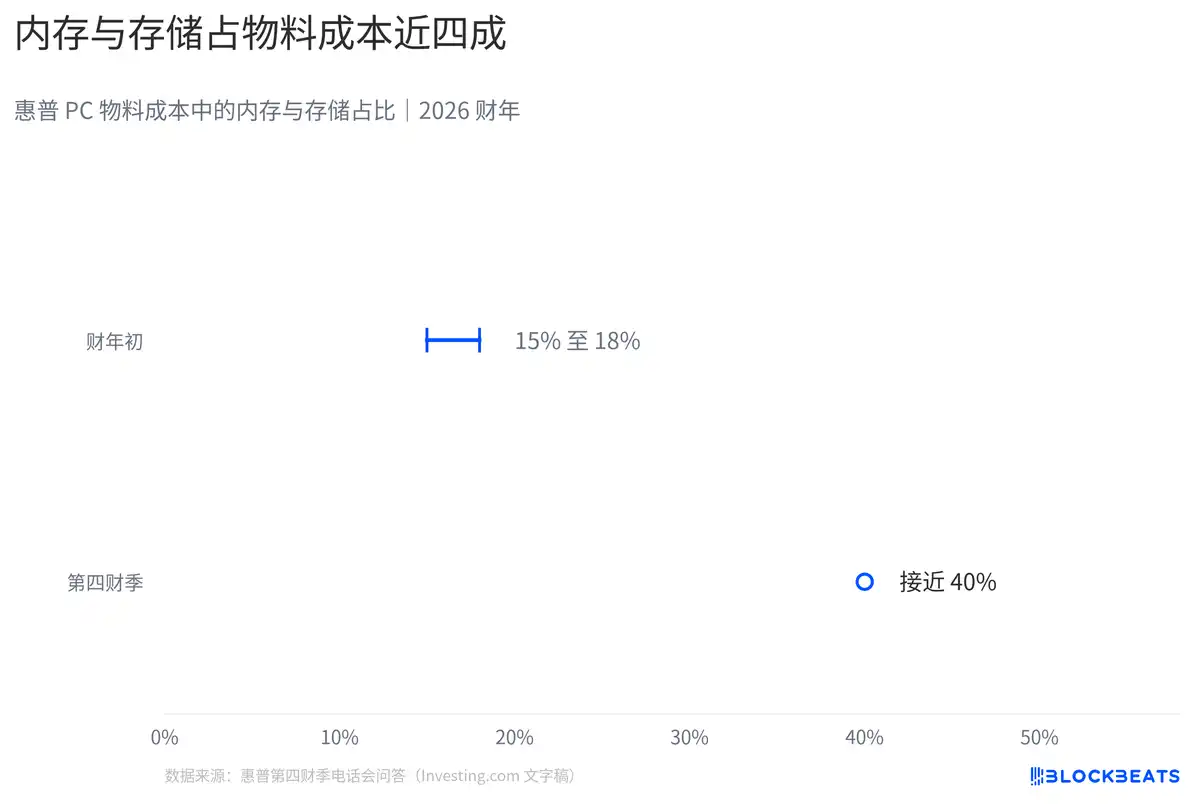
HP's memory and storage accounted for nearly 40% of material costs
The denominator of this figure is HP's material costs. The sales volume of machine models can vary, and changes in configurations within the same series will alter the final parts mix that the company procures. HP only provided percentages for two points in time, making it difficult to deduce how much the procurement price of a specific memory module or solid-state drive has increased. Parkhill also cited product and configuration changes as reasons for not updating the percentage forecast.
For the new fiscal year, HP still budgeted for price increases in memory and storage, although it expects the pace of increases to be milder than in the past year. Processor costs are also expected to rise. If the configuration and pricing of computers remain unchanged, for every additional dollar spent on procurement, the cost for the PC business to absorb will increase by one dollar. Changing configurations, renegotiating procurement terms, and adjusting prices will ultimately determine how much of this cost HP will bear.
During the Q&A session, someone pressed whether HP would continue to raise prices due to the rising cost of components. Parkhill placed price increases after other measures, reasoning that raising prices tends to dampen demand. The same manufacturer can sell more expensive configurations in commercial orders while offering promotions at the retail end to clear inventory held by distributors.
The computer business is still growing, where is the money being made?
HP's personal systems business achieved double-digit revenue growth for four consecutive quarters. The operating profit margin reached a fiscal year high in the second fiscal quarter, then fell for two consecutive quarters. By the fourth fiscal quarter, only about $3 of operating profit remained for every $100 in revenue from personal systems. HP’s segment disclosure also indicated that the operating profit margin for the fourth fiscal quarter was below the same period last year.
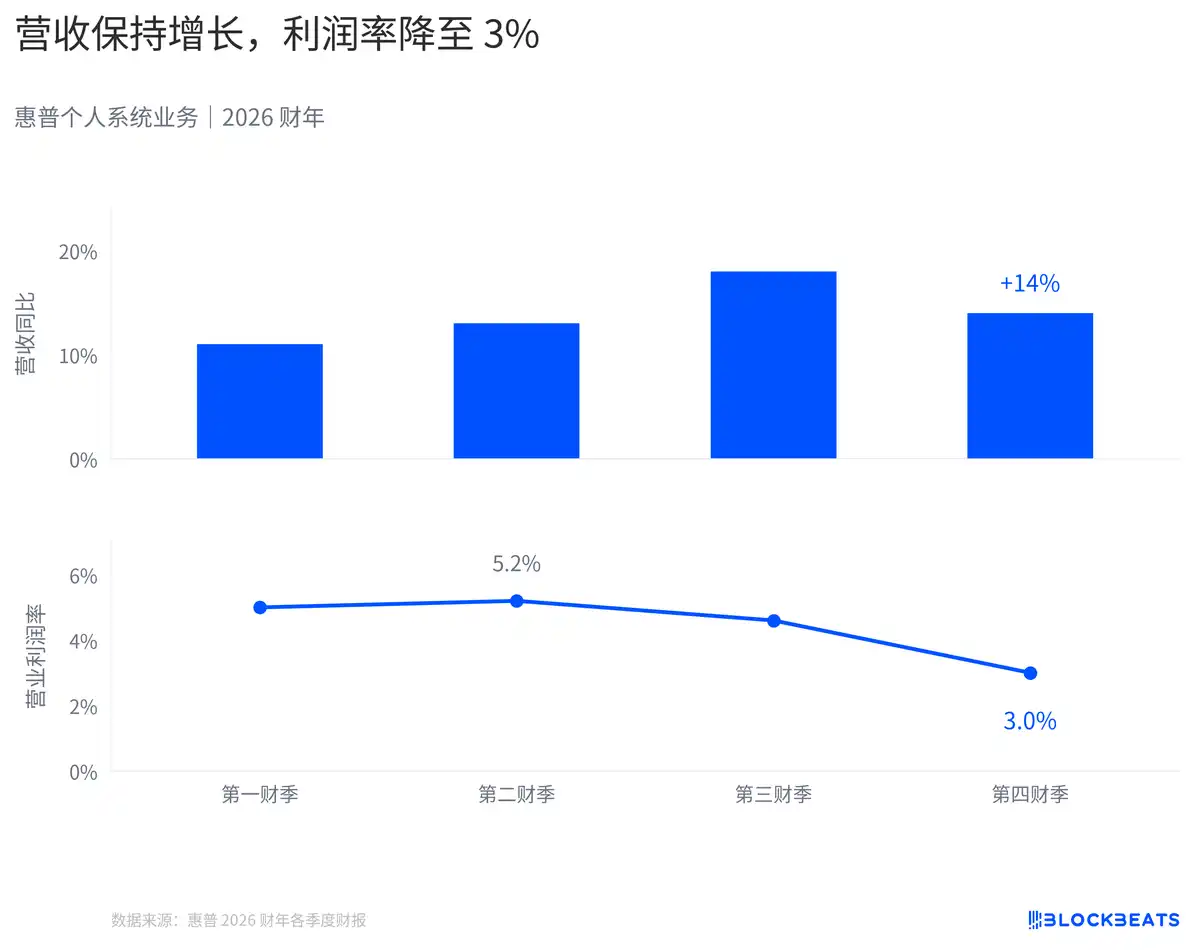
HP's personal systems revenue year-on-year and operating profit margin
This quarter saw commercial revenue grow by 23%, while consumer revenue declined by 7%. HP said during the conference call that pricing in commercial products, high-end models, and services sold with devices supported revenue growth. The consumer market weakened in the second half of the quarter, with distributors reporting slower sales and higher inventory. Adjusting prices for the retail channel helps inventory turnover, but the profit margin for the quarter was therefore lower than the company's previous expectations.
In the same financial report, total shipments of personal systems decreased by 29% year-on-year. If you take the segment revenue and divide it by shipment volume, it's easy to misinterpret the change in product mix as an increase in the price of regular computers. The revenue disclosed by HP also includes workstations, high-end models, and related services. More expensive equipment may account for a greater share of orders, or companies may have bought additional services provided with the equipment, which could elevate income even as shipments decline.
HP has two initiatives planned for the consumer segment. For computers that are already stockpiled by distributors, the company will accelerate promotions. For newly launched mainstream priced products, HP is trying to lower costs from the design and procurement stages. The head of personal systems business cited the OmniBook 5 as an example during the conference call. Promotions address the inventory already in the channel, while the costs of new models will only be reflected in future sales.
At an industry level, HP expects that PC shipments in the natural year 2027 will decline by high single digits to low double digits, while sales will roughly remain flat. This expectation relies on pricing and the share of high-end models offsetting a portion of the drop in volume. HP also anticipates its personal systems profit margin will gradually recover, returning to its long-term range before the end of the new fiscal year.
Performance exceeded expectations, how to interpret the guidance for the new fiscal year?
According to Investing.com, Wall Street originally expected HP's adjusted earnings per share for the fourth fiscal quarter to be $0.75, while the actual reported was $0.83. The adjusted earnings per share for the quarter was still below the same period last year.
In the same financial report, HP disclosed that the contribution of tariff refunds to earnings per share for the quarter was $0.15, higher than the $0.08 included in the original company guidance.
According to the numbers disclosed in the report, after deducting the portion of refunds that exceeded the company's estimates, the adjusted earnings per share for the quarter was approximately $0.76, which is still slightly above the midpoint of the company's original guidance.
The cash flow guidance provided another set of directly comparable numbers. The company's guidance for the new fiscal year is lower than the actual value for the recently concluded fiscal year, covering levels from the previous year. During the conference call, Parkhill stated that capital expenditure plans remained roughly flat, and the company hoped to reduce inventory within the year to improve working capital. She attributed the expected decline in free cash flow mainly to profitability and explained that the guidance did not include new tariff refunds.
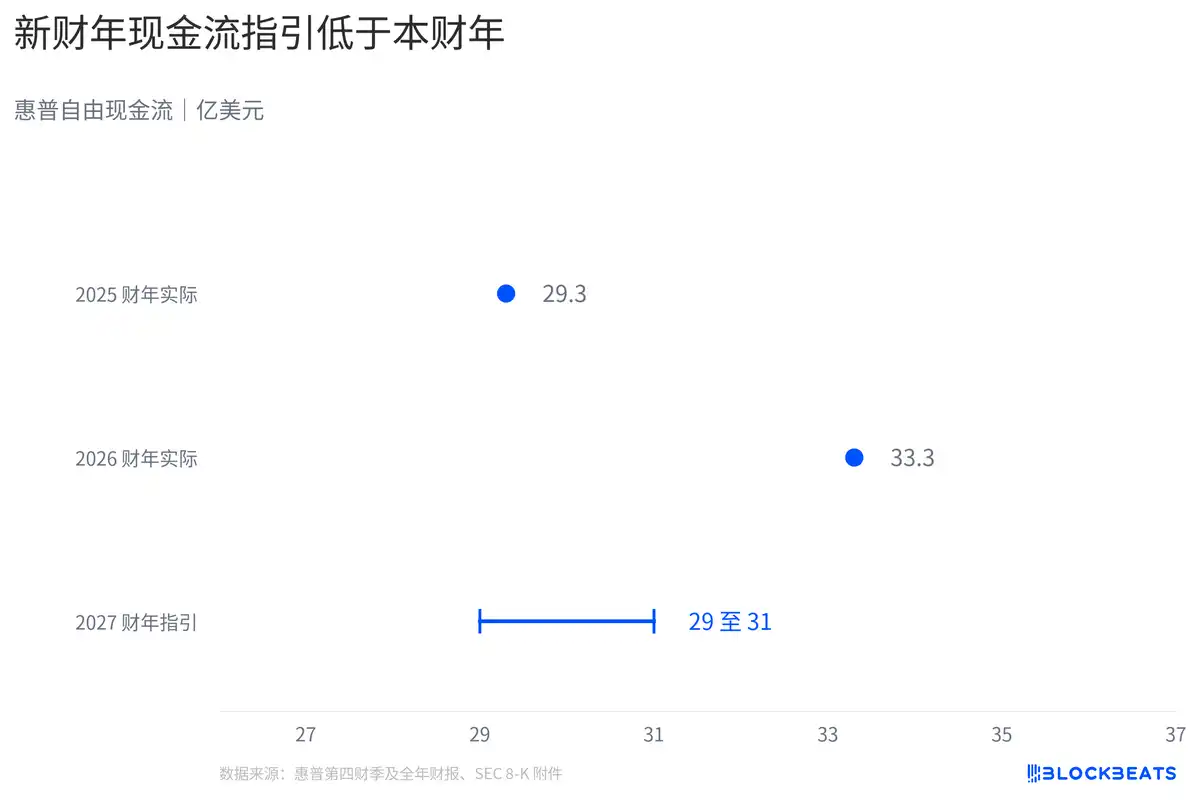
HP's actual free cash flow and guidance for the next fiscal year
The earnings per share guidance also involved two adjustments. HP disclosed that the adjusted earnings per share for the recently concluded fiscal year was $3.33, which included $0.26 from tariff refund gains.
The guidance for the new fiscal year assumes no additional refunds while excluding stock-based compensation expenses from the adjusted profits. Just from the stock-based compensation adjustment alone, the company disclosed that under the new standard, the earnings per share for the recently concluded fiscal year would increase by $0.38.
HP provided an adjusted earnings per share range for the new fiscal year of $3.15 to $3.45.
Using the adjusted earnings per share from the recently concluded fiscal year as the starting point, adding back the impact of stock compensation adjustments, and then deducting the tariff refund gains, results in a comparable benchmark of approximately $3.45. To reach the upper end of the guidance for the new fiscal year, it roughly aligns with this benchmark.
Click to learn about the job openings at BlockBeats
Welcome to join BlockBeats official community:
Telegram Subscription Group: https://t.me/theblockbeats
Telegram Discussion Group: https://t.me/BlockBeats_App
Official Twitter Account: https://twitter.com/BlockBeatsAsia
免责声明:本文章仅代表作者个人观点,不代表本平台的立场和观点。本文章仅供信息分享,不构成对任何人的任何投资建议。用户与作者之间的任何争议,与本平台无关。如网页中刊载的文章或图片涉及侵权,请提供相关的权利证明和身份证明发送邮件到[email protected],本平台相关工作人员将会进行核查。