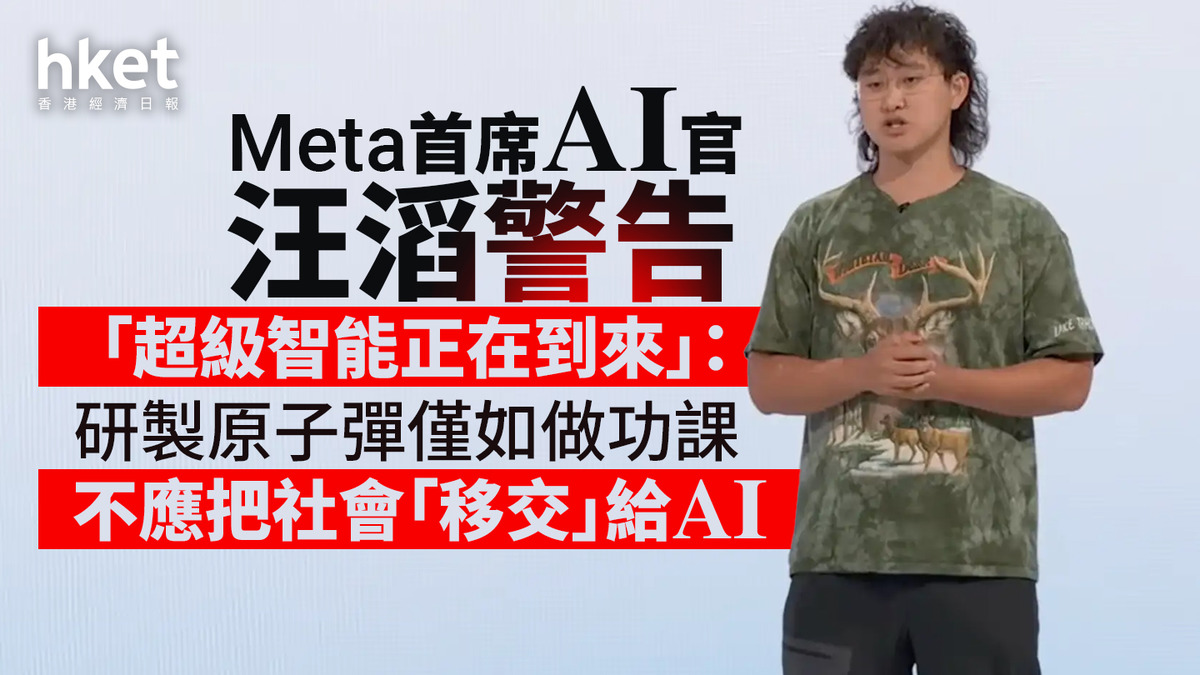
Meta (US: META) Chief AI Officer, head of Meta Superintelligence Lab and co-founder of Scale AI, Alexandr Wang, published a long article titled "Superintelligence is Arriving" on social platform X on Monday (23rd). In the article, he noted that with the assistance of artificial intelligence (AI) in tackling the famous mathematical problem "Riemann Hypothesis," superintelligent AI (ASI) is officially approaching, and human actions in the coming year will profoundly impact the future direction of the world.
With the Riemann Hypothesis as a watershed, he describes the development of the atomic bomb as merely "homework"
The impetus for Wang's statements stems from a recent major advancement in the mathematics community. According to foreign reports, Levent Alpöge, a mathematician at AI startup Anthropic, claimed last Friday (20th) that he completed the proof of the "Riemann Hypothesis," which has troubled mathematicians for over 150 years, using about 17 million lines of Lean code in collaboration with his AI model Claude. The nonprofit organizations Lean FRO and Mathlib Initiative certified the proposition and proof as correct the following day (21st); however, the Associated Press reported that the Clay Mathematics Institute, which posed the problem, still lists it as an unsolved problem. The Riemann Hypothesis was proposed in 1859 and involves the distribution of prime numbers; it is one of the seven "Millennium Prize Problems," each carrying a reward of 1 million dollars.
Wang believes that the proof of the Riemann Hypothesis clearly marks the beginning of a major transformation. For most mathematical researchers, in terms of pure intellectual prowess, humanity's past achievements are hard to compare. Growing up in New Mexico, the birthplace of the atomic bomb, Wang candidly stated, "Many physicists would agree that discovering the atomic bomb is just a homework problem compared to the Riemann Hypothesis." He emphasized that the far-reaching significance of this breakthrough is difficult to estimate and was accomplished with the assistance of "an alien mind that we do not yet understand."
Intellect is no longer a bottleneck, predicting AI will fully automate its own research and development
Wang compares this breakthrough to December 2024. At that time, OpenAI's o3 model began to achieve high scores in the American Mathematics Invitational Exam (AIME), making those who have participated in mathematics competitions strongly feel that "everything is about to change." He pointed out that the most profound problems in AIME are already far beyond the pure intellectual difficulties faced by top engineers and business professionals on a daily basis. The constraints on AI's cross-domain applications at that time were not raw intellect, but rather domain knowledge, contextual background, practical experience, and other operational limitations; after the industry gradually filled these gaps over the past two years, programming has "nearly been solved," and models have demonstrated strong capabilities in network attacks and general agent abilities.
Wang continued to state that AIME is merely an extracurricular competition for teenagers, while the Riemann Hypothesis could perhaps be the most intellectually challenging problem ever conceived by humanity. During his studies at the Massachusetts Institute of Technology (MIT), professors often remarked that nearly all major disciplines' most challenging intellectual problems are easier than the Riemann Hypothesis, merely involving other challenges such as experiments, data, and feedback loops. Therefore, he believes that for AI to significantly surpass humans in various fields, the remaining gap is no longer pure intellect itself, but rather the specialized knowledge, engineering plumbing, and experimental work of specific industries.
He specifically warned that this inference also applies to AI research itself, as most researchers would agree that the intellectual threshold for AI research is far lower than proving the Riemann Hypothesis. This means that models will be smart enough to fully automate all AI research and development work, significantly surpassing humans in self-improvement, while rapidly advancing research in fields such as biology, weaponry, and economics. He described that just as the mathematics community has not yet fully digested the proof of the Riemann Hypothesis, nearly all fields' development speeds may exceed human understanding and regulatory capabilities.
Critiques the industry's "lazy thinking," opposes handing over society to AI
Wang believes that since the scientific and technical challenges of enhancing AI capabilities have likely been resolved, the industry must not only expedite progress in crucial areas such as AI safety, value alignment, and cybersecurity, but also carefully consider the way forward. He stated in the article:
"It is hard to imagine that humanity can maintain control under completely unconstrained recursive self-improvement; it is similarly hard to imagine that humanity can control superintelligent beings that are 1,000 times smarter and stronger in all fields."
He explicitly criticized the AI industry for exhibiting a kind of "lazy thinking" that assumes the emergence of superintelligent AI is unavoidable, and the only thing to solve is how to achieve it safely. Wang pointed out that the stakes involved go far beyond this: "We should not accept handing over society to AI." He urged the industry to strive to create technologies that can bring a positive future for humanity, providing everyone with greater autonomy and capabilities, and believes that this goal can be achieved, provided the entire industry must take actions fundamentally different from the current "preset path."
The post has over 13 million views and is criticized for lacking concrete plans
As of Tuesday (24th), Wang's post has recorded over 21 million views. However, he did not specify in the original text what actions the industry should take, which led to many netizens criticizing him for "only giving warnings and not providing solutions." Wang later responded that Meta has prioritized safety in its development focus, with related measures including delaying the launch of Muse technology and signing a voluntary AI safety agreement promoted by the Trump administration in the United States.
It is worth noting that on the same day (November 23rd), OpenAI Chief Scientist Jakub Pachocki also published a lengthy article, proposing that AI companies agree on a common capability cap and should not cross lines before achieving corresponding milestones in human understanding and monitoring of AI.
This article is reproduced from the Hong Kong Economic Daily, with copyright owned by the original author and original media.
免责声明:本文章仅代表作者个人观点,不代表本平台的立场和观点。本文章仅供信息分享,不构成对任何人的任何投资建议。用户与作者之间的任何争议,与本平台无关。如网页中刊载的文章或图片涉及侵权,请提供相关的权利证明和身份证明发送邮件到[email protected],本平台相关工作人员将会进行核查。