After NVIDIA restored Jensen Huang's positions as president, CEO, and director, technology stocks and risk assets briefly rebounded, and Bitcoin also surged momentarily. However, this wave of sentiment recovery did not smoothly translate into sustained buying: as of the report on November 24 during the Asian session, BTC had nearly given back its nearly 6% increase from the previous night, falling back to around $60,600.
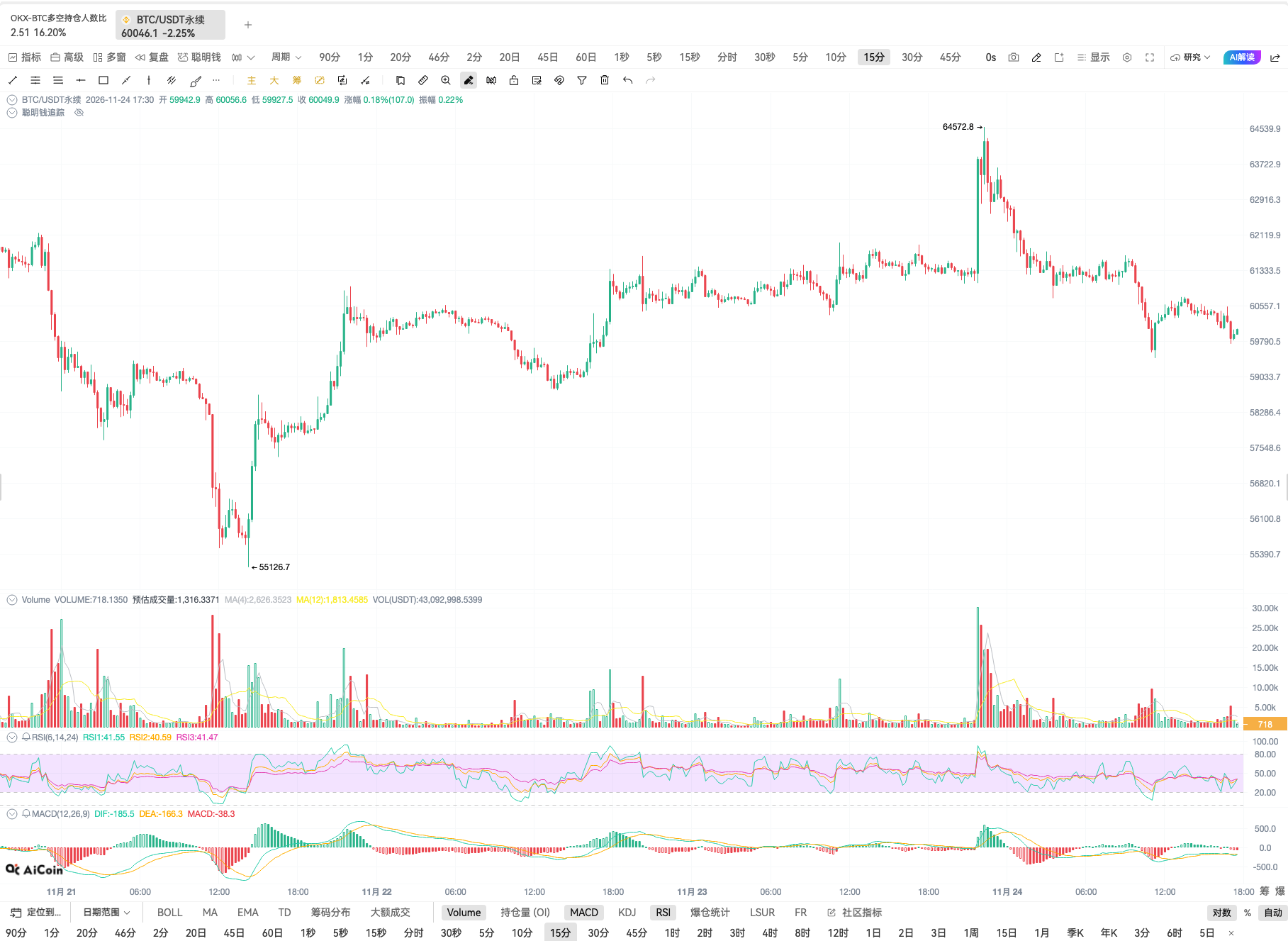
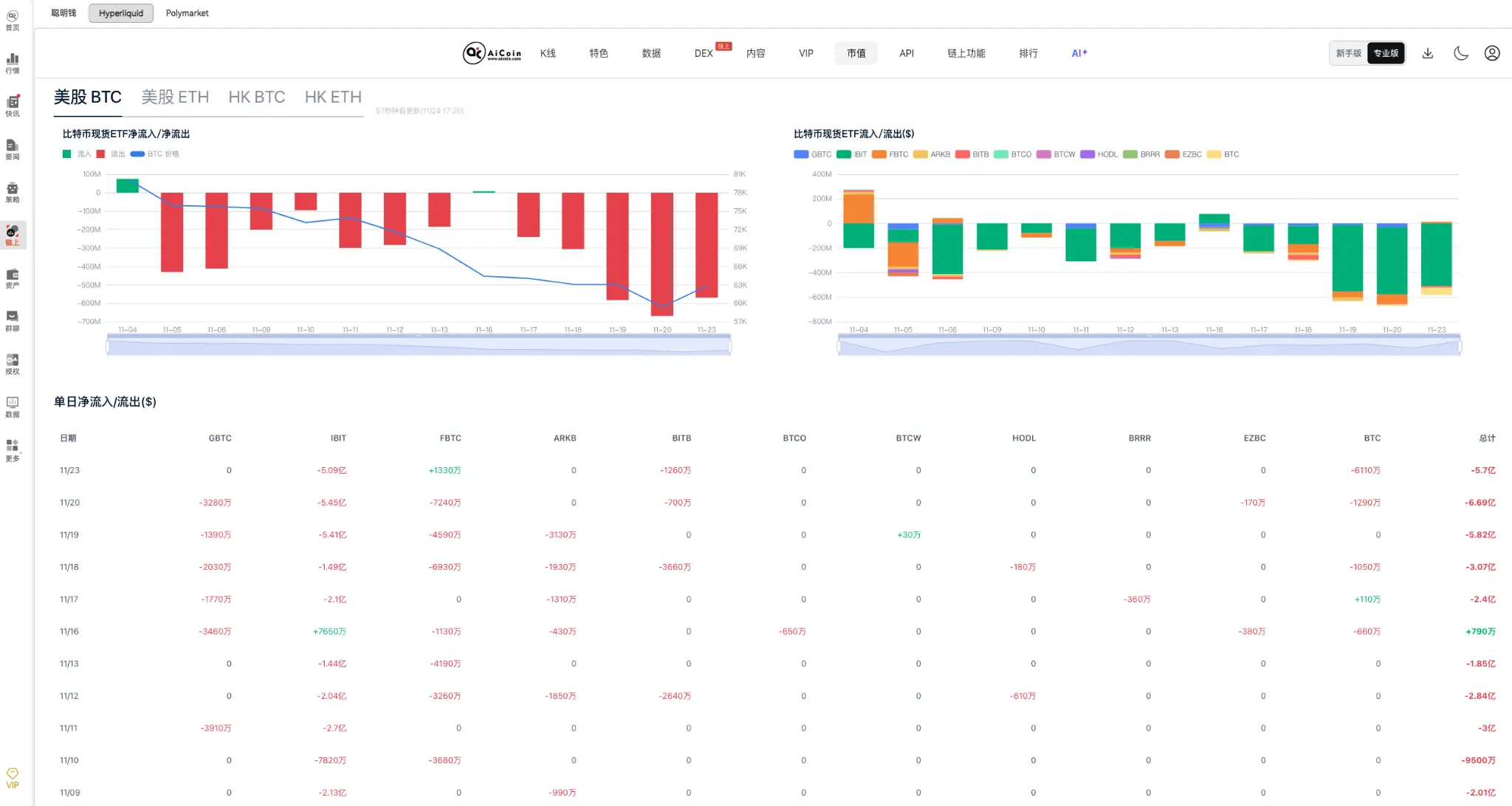
This set of reactions provides an important observation: macro gains can trigger a rapid bounce, but if spot funds are still exiting and derivative longs remain crowded, price rebounds may lack follow-through support. During most trading days in November, BTC spot ETF showed net outflows; as of November 23, it showed a single-day net outflow of about $570 million. The spot BTC ETF has seen net outflows for four consecutive weeks, totaling over $4 billion; the previous week saw a single-week net outflow of about $1.8 billion.
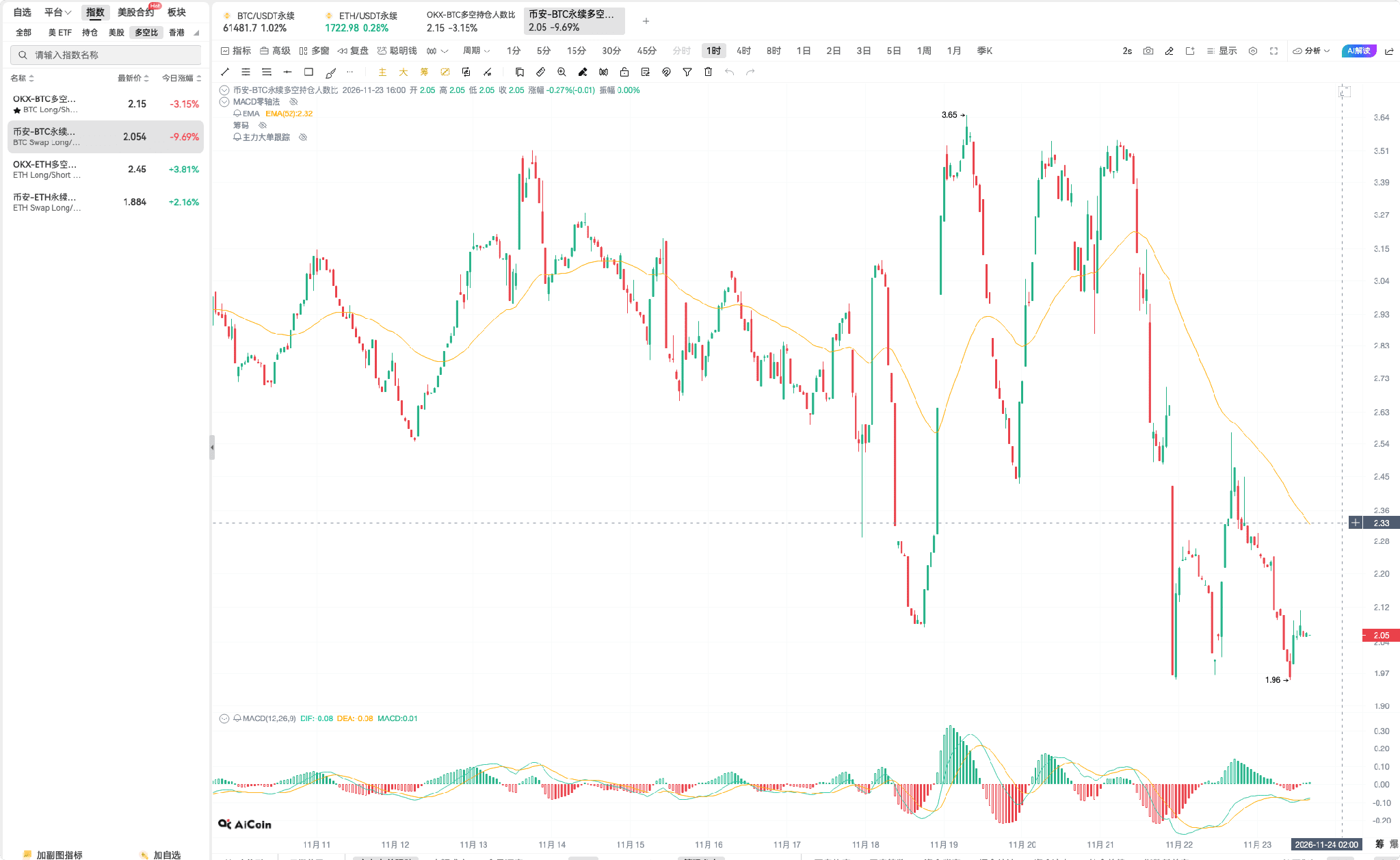
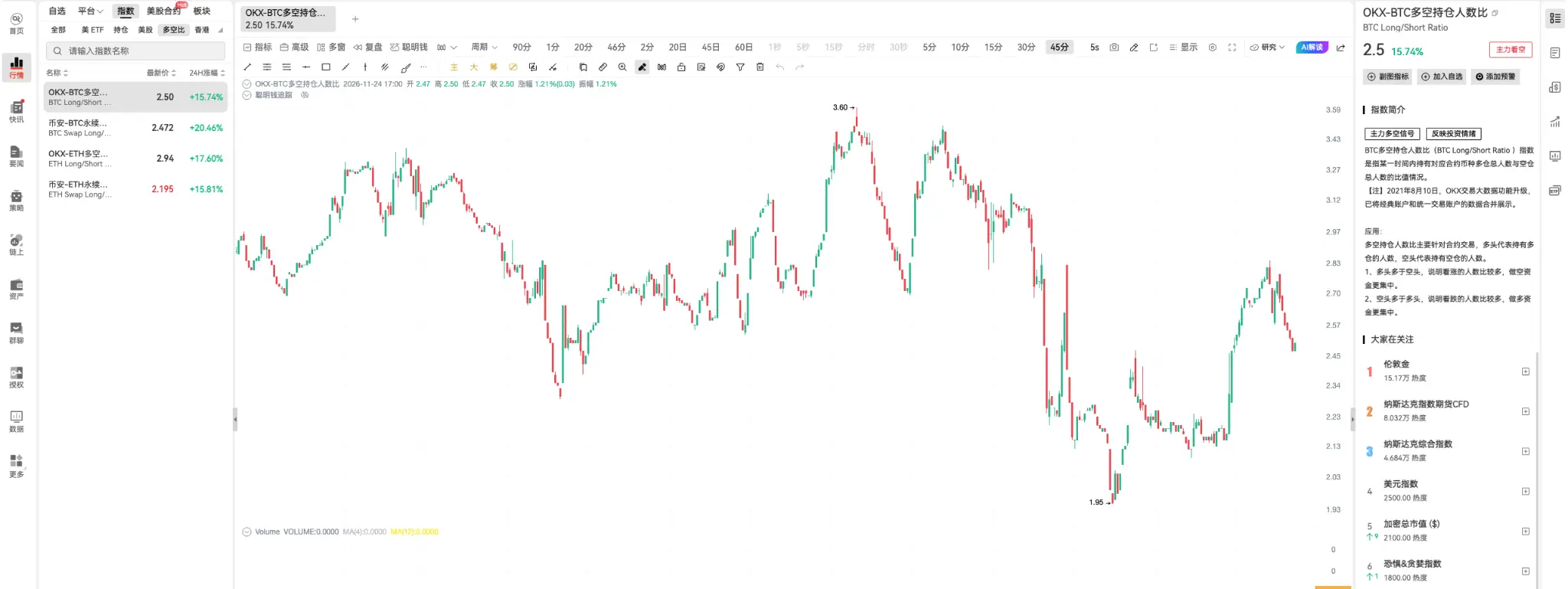
At the same time, the long-to-short ratio on two platforms is still significantly greater than 1: OKX BTC is about 2.50, Binance BTC perpetual is about 2.472, OKX ETH is about 2.94, and Binance ETH perpetual is about 2.195; these readings have increased by about 15.7% to 20.5% compared to the previous period. This indicates that on the shown platforms, the number of long accounts is relatively high, which does not equal the total long position amount in the entire market, nor is it a prediction that prices must fall.
Jensen Huang's reinstatement is a positive catalyst, but a catalyst does not equal a trend reversal
After NVIDIA's board announced the restoration of Jensen Huang's positions as president, CEO, and director, the market's concerns regarding uncertainty in technology stock leadership were temporarily alleviated, resulting in significant rebounds in NASDAQ futures and NVIDIA stock, with Bitcoin also surging alongside risk assets. Such news has a stimulative effect on short-term sentiment, but it does not directly create demand for Bitcoin spot.
What's more worth analyzing is the market's choice after the rebound. If a positive development can drive prices up sharply but fails to attract sustained ETF purchases and does not reverse the existing price weakness, then it resembles a short covering or a repair of short-term risk appetite rather than a new wave of trend-setting funds entering the market. BTC nearly gave back its previous night's gains during the Asian session; the same report also mentioned continued net outflows from ETFs and confidence pressures in other crypto markets.
This does not mean that Jensen Huang's reinstatement "caused" BTC to continue declining; rather, it indicates that the price feedback from the market is weak: good news has occurred, but buyers have not been able to maintain their gains. In analysis, the news is responsible for providing the catalyst, while capital flow and price behavior are responsible for validating the trend.
Continuous ETF outflows: marginal spot buying remains insufficient
ETF outflows do not mean all institutions are selling, nor can they alone determine price direction; however, during market downturns, continuous net outflows indicate that important channels for spot funding have not yet resumed net buying. If prices are to form a reliable reversal, capital flows need to at least shift from continuous outflow to stabilization, and preferably show sustained net inflows.
High long-to-short ratio: beware the vulnerability of positions during declines
The long-to-short ratio for BTC is approximately 2.50 on OKX and 2.472 on Binance; for ETH, it's about 2.94 and 2.195 respectively on OKX and Binance. These values are significantly above 1, and the page also shows a rise in the short-term ratio, indicating a large proportion of long accounts still exist within the selected platforms. If prices continue to weaken, some longs may actively reduce their positions; accounts using leverage may also trigger stop-loss or forced liquidation, further increasing short-term selling pressure.
This also explains why "high long-to-short ratios" may signal risks for bears: it does not represent that short positions have gained dominance but instead suggests that the long side may be more crowded. When prices lose key support, crowded longs may need to exit, potentially amplifying the original decline into a deleveraging scenario.
However, long-to-short ratios are not automatic buttons for contrarian trading. The account ratio does not display the position amount, leverage multiplier, and cost for each account, nor does it imply all participants across all platforms are taking the same direction. As long as prices continue to rise, the dominance of long accounts may persist; therefore, it is necessary to combine position data with price structure, capital flow, and trading behavior for judgment.
Comprehensive judgment: bearish trends have not been reversed by positive news; rebounds still need validation
The current bearish logic stems from three complementary clues. Firstly, BTC exhibited a short-lived rebound in response to Jensen Huang's reinstatement, but quickly gave back most of its gains, showing insufficient buying pressure. Secondly, the spot BTC ETF is still predominantly showing net outflows, with spot demand not yet showing sustained signs of recovery. Lastly, the long-to-short ratios for BTC and ETH are significantly above 1, and the crowded longs increase the pressure for potential liquidation if prices continue to decline.
These three clues do not prove that prices will necessarily continue to fall, nor do they constitute a definitive short signal; however, in terms of trend assessment, they imply that the bearish structure has not been effectively disrupted. If BTC's rebound continues to be obstructed, with lows repeatedly moving downward, and ETF outflows persist, while long positions have not been significantly cleared, then the risks of a continuing downward trend and revisiting lower levels remain a greater concern.
Conversely, if BTC can reclaim and hold crucial price areas, ETF flows shift from continuous net outflows to consistent net inflows, long-to-short ratios decrease with the release of risk, and the market forms higher lows, then the bearish assessment would need to downgrade. A true trend reversal should be confirmed by price, funding, and positions together, rather than relying solely on a piece of news.
Trading plan in the bearish direction: wait for confirmation, do not chase orders based on news
If traders are prepared to execute in the bearish direction, a more prudent approach is to clearly outline the triggering conditions in advance, such as when positive rebounds are obstructed, key support is breached, and pullbacks cannot recover; simultaneously, clarify conditions for invalidation, individual risk, and total account risk. Do not immediately short just because of ETF outflows or high long-to-short ratios, nor should one overlook the ongoing structural pressures due to a single piece of good news.
If trading conditions have been met and execution across multiple accounts is necessary, AiCoin multi-account ordering can reduce the steps of switching accounts, reselecting trading pairs, and entering quantities. The following mode is suitable for setting a base quantity first, then allowing other accounts to follow proportionally or by multiples; the distribution mode is suitable for first determining the total commission amount across accounts, then proportionally allocating it to each account.
Multi-account ordering: execute verified strategies with greater discipline
Market analysis answers the question of “Are the signals sufficient, and which conditions have not yet been met?”; multi-account ordering addresses “How to execute more efficiently with multiple accounts when the trader already has a clear plan.” If multiple accounts are taking the same strategy but have different planned commission sizes, switching accounts one by one and repeatedly entering quantities is time-consuming and prone to account or quantity errors.
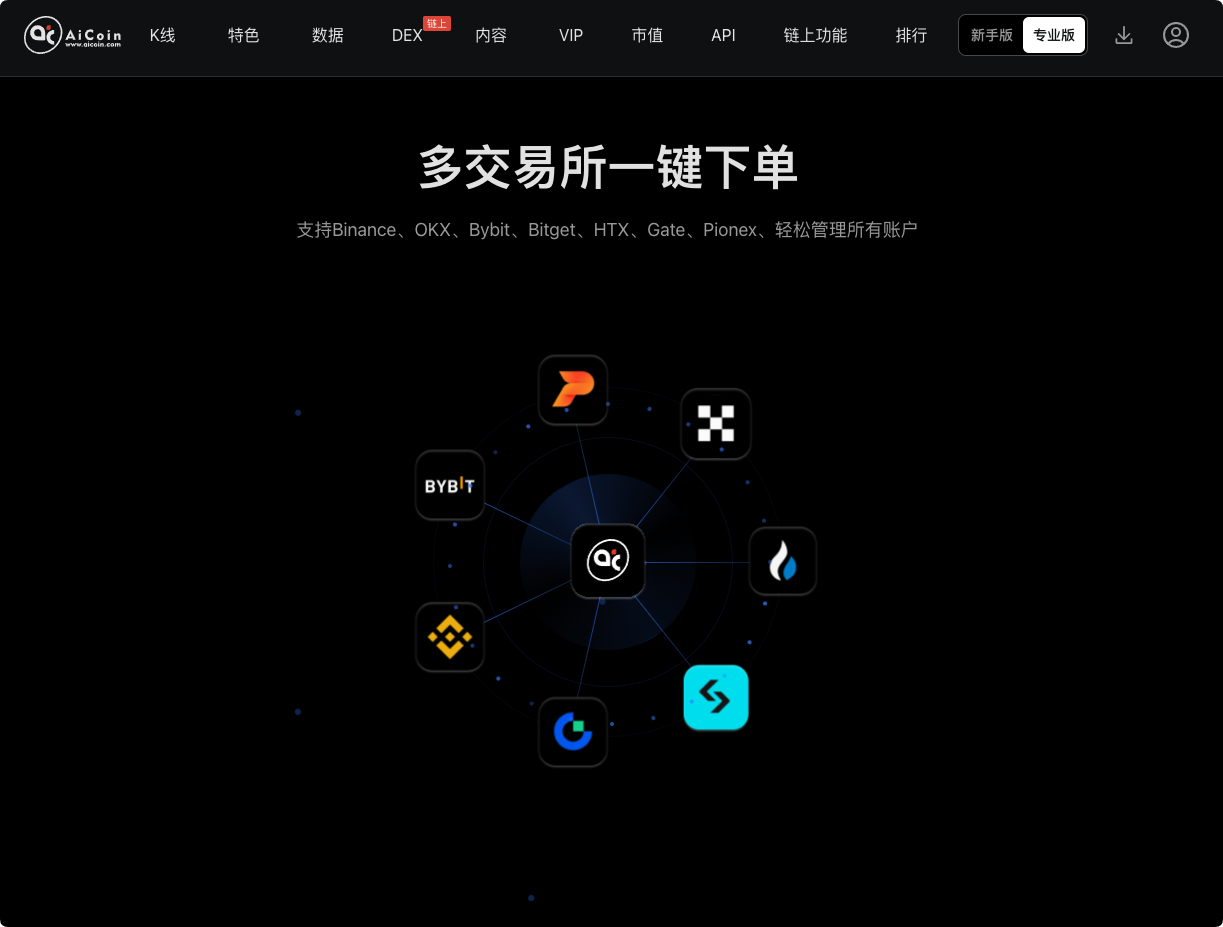
AiCoin's multi-account ordering allows the selection of multiple API accounts in a single ordering process and organizes orders according to pre-set account ratios. Its advantages lie in centralized management, reducing redundant switching and input, and assisting multiple accounts to operate collaboratively under the same plan.
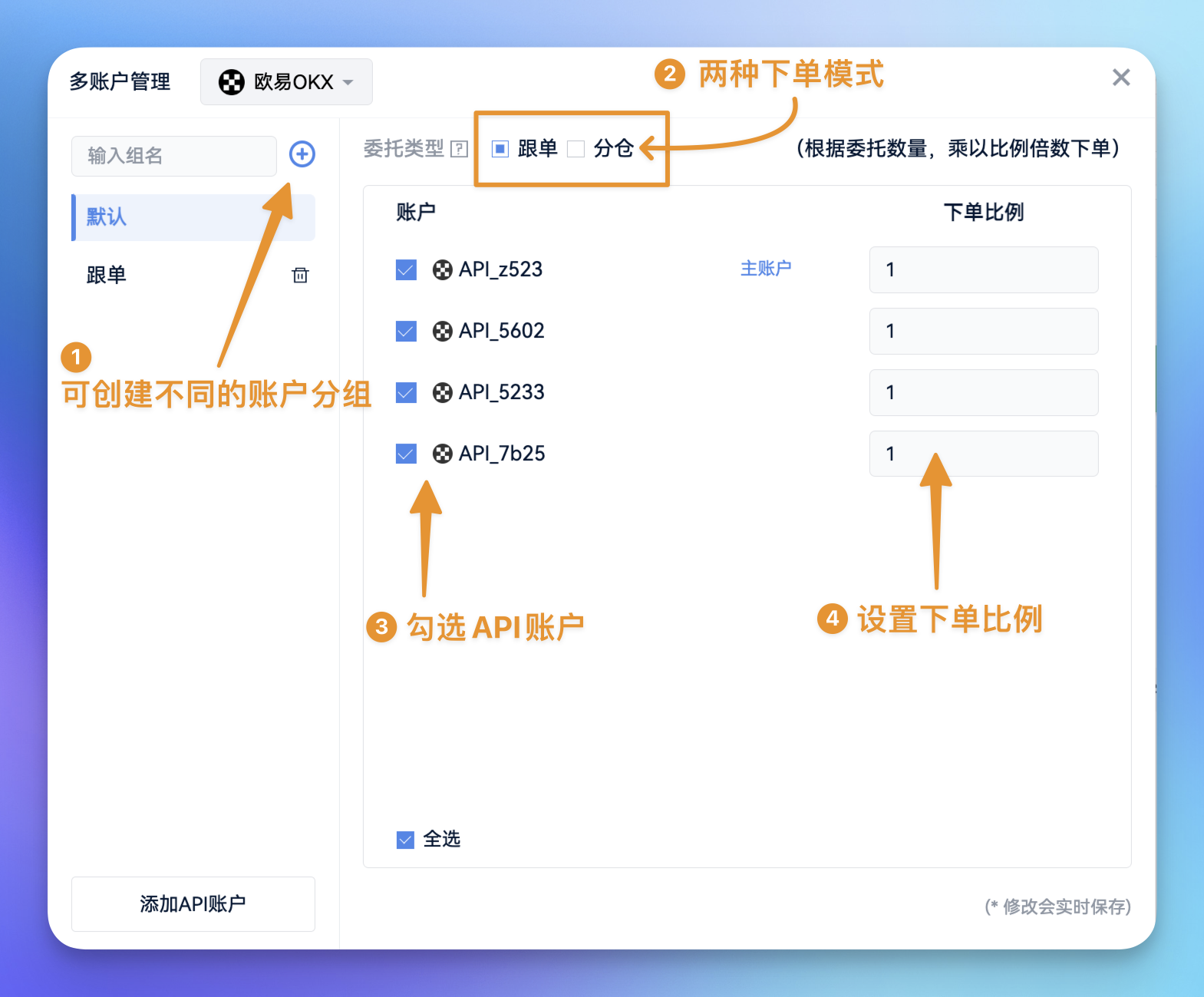
The following mode is suitable for first setting a base order amount, then having other accounts follow according to their respective proportions or multiples. If different accounts need to execute the same strategy but with differing planned sizes, ratios can be set in advance to reduce the need for recalculating for each account.
The distribution mode is suitable for first determining the total amount of orders across multiple accounts, and then proportionally allocating it to each account. It is applicable in scenarios where traders wish to first control the total amount and then plan shares for each account. In simple terms, the following mode emphasizes how accounts follow their input quantities, while the distribution mode emphasizes how the total amount is divided.
Operational steps: first set plans, then select accounts and modes
1. Open “multi-account ordering” on the AiCoin order panel.
2. Check the API accounts involved in this plan and verify the exchange, account identity, and authorization status.
3. Choose either following or distribution mode based on the strategy, setting the ratios or multiples for each account; the balance, existing positions, and risk limits of different accounts need to be verified separately.
4. Confirm trading pairs, directions, order types, and commission quantities. Only execute synchronized orders when your strategy conditions have been met; do not take a large bullish candlestick or an individual indicator as an automatic signal.
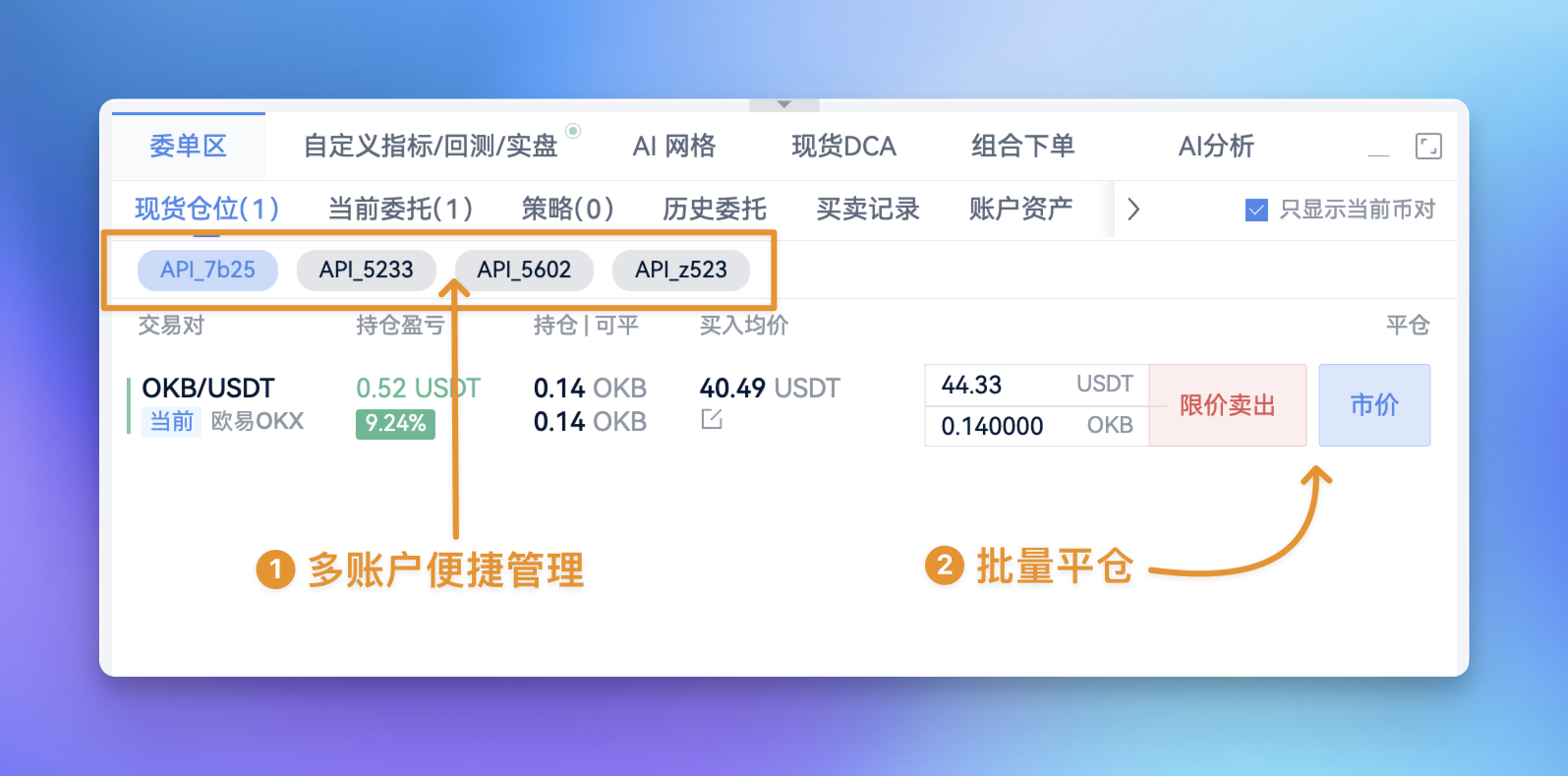
5. After submitting, check the order statuses, executed quantities, and position changes for each account. If needed, adjust orders, cancel orders, or manage positions based on actual executions.
If the trader's strategy is to participate in batches, with different accounts proportionally following the same set of conditions, the following mode can be used; if the total commission amount of multiple accounts has been determined beforehand, then the distribution mode can be employed. The multi-account tools enhance operational efficiency and execution consistency, but they do not judge whether ETH has reversed, nor do they eliminate the possibility of multiple accounts taking on the same directional risk simultaneously.
Conclusion: Positive news has appeared, but trend confirmation has not
Jensen Huang's reinstatement has led to a rebound in technology stocks and a temporary rise in BTC; however, ETF funds are still flowing out, the long-to-short ratio remains high, and BTC has nearly given back the gains driven by this news. Overall, the positive news has not changed the pressure structures of spot funds and derivative positions, and the bearish trend has not yet been effectively reversed.
For the bulls, the focus should be on guarding against the de-leveraging risks associated with crowded positions after failed rebounds; for the bears, the emphasis is on waiting for price confirmation and avoiding treating a single indicator as an opening order. Once conditions are met, use AiCoin's multi-account ordering to implement established plans faster and more consistently across multiple accounts.
AiCoin user's exclusive “multi-account ordering” super tool
One-click synchronous ordering across multiple accounts with AiCoin to achieve operations in seconds; also supports cross-exchange multi-account ordering:
https://www.aicoin.com/zh-Hans/tg/multi-account

免责声明:本文章仅代表作者个人观点,不代表本平台的立场和观点。本文章仅供信息分享,不构成对任何人的任何投资建议。用户与作者之间的任何争议,与本平台无关。如网页中刊载的文章或图片涉及侵权,请提供相关的权利证明和身份证明发送邮件到[email protected],本平台相关工作人员将会进行核查。