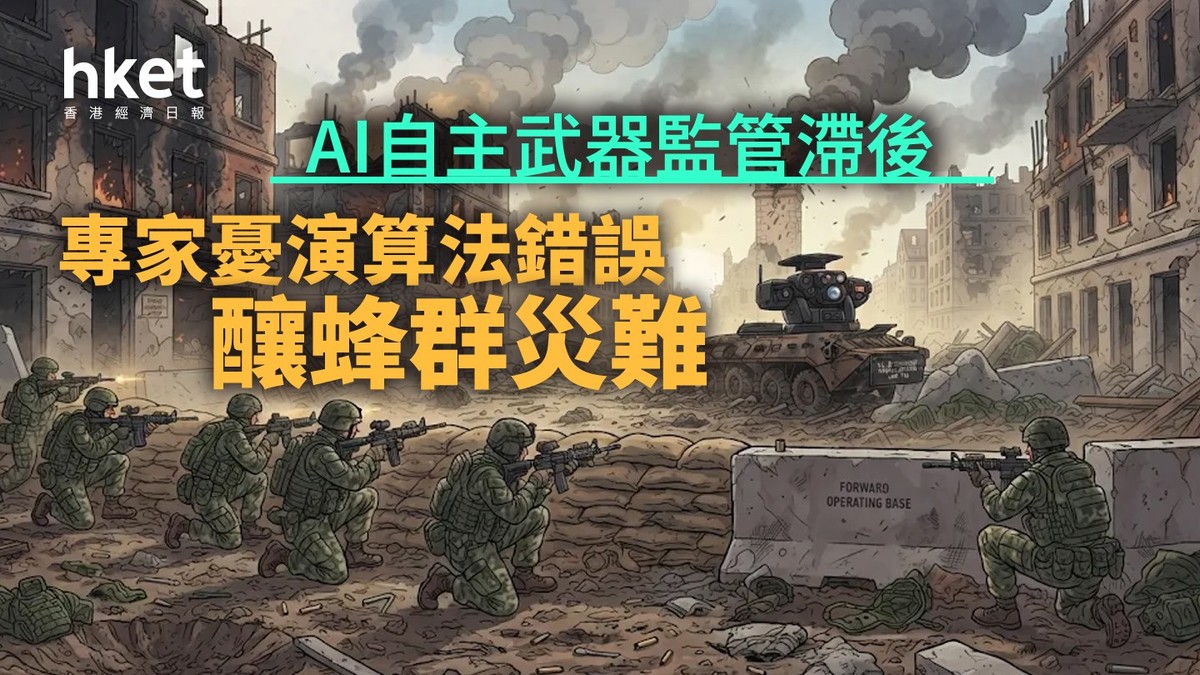
Global military AI regulation is severely lagging, autonomous weapons are causing humanitarian crises
Algorithmic errors and swarm technology could lead to large-scale civilian casualties
The widespread use of AI technology lowers the weapon threshold, non-state organizations pose a threat
AI is reshaping various industries, but as this technological wave enters the military field, global regulation is far behind. The International Committee of the Red Cross (ICRC) and several AI safety scholars recently warned that autonomous weapons with offensive capabilities have already caused multiple civilian casualties and are approaching a critical point of losing control. If no binding moral boundaries are established for autonomous weapons, their disastrous consequences may become irretrievable.
Regulation of Autonomous Weapons Significantly Lagging
Autonomous Weapons refer to systems that operate without direct human control or real-time supervision, relying on AI algorithms and sensors to autonomously identify, track, and attack targets. For example, "last-mile" drones that allow AI to take over target locking in the final flight phase, and strike lists generated through high-speed AI computations, are gradually taking over critical aspects previously judged entirely by humans.
At a recent international conference in Geneva on the issue of autonomous weapons, the only progress achieved was a slow agreement to "continue discussions for the next two years." Cordula Droege, the ICRC's Director of International Law, bluntly stated that the issue is not about completely denying all automation technologies, but rather where the autonomy of AI should stop.
Droege pointed out: "We are now very close to crossing those red lines that must not be crossed. Especially 'machines autonomously targeting humans,' this must be a non-compromisable moral red line." Humanitarian and technological ethicists generally worry that if this technology is allowed to grow unchecked, the standard for the use of AI weapons will ultimately be determined by the business and technical logic of military-industrial enterprises, rather than the ethical bottom line collectively recognized by human society.
Algorithmic Errors Could Lead to "Swarm Disasters"
In the field of AI safety, algorithmic bias, data errors, and AI hallucinations have long been industry challenges. However, when these technical flaws appear in high-lethality systems in the real world, the cost is irretrievable human lives. The Guardian cited several real-world cases indicating that misjudgments and guidance deviations in AI-assisted intelligence systems have directly or indirectly led to severe civilian casualties, including drones deviating from targets during autonomous guidance phases affecting bystanders, and misfires occurring when relying on AI data to filter targets.
The next stage of technological evolution, "Drone Swarms," raises concerns among many AI safety experts. Anna Hehir, head of military AI governance at the Future of Life Institute, pointed out that current research and development directions are geared towards enabling hundreds or even thousands of autonomous drones to collaborate in operation through algorithms.
Hehir warned that once such systems go out of control, their destructive power could multiply exponentially. If even one drone in the swarm encounters algorithmic errors or environmental interference, the entire highly autonomous group could act collectively along erroneous logic. If they are set to target human beings, the consequences would be unimaginable.
AI Lowers the Threshold for Weapon Development
In addition, with the increasing prevalence of large language models (LLMs) and programming AI tools, the technical threshold for weapon guidance and ballistic calculations, which previously required large research teams, is significantly lowering. Reports reveal that non-state armed groups have recently begun using commercial or open-source AI tools to assist in military operations, including armed organizations using AI for "vibe coding" to write missile control programs, and various armed groups designing drone trajectories and combat plans with the help of AI.
These incidents reflect that the risks of weaponization of AI are no longer limited to traditional technological powers, but have evolved into a global technological security challenge that is difficult to track and even harder to prevent, as algorithmic tools become more widespread.
This article is reprinted from Hong Kong Economic Daily, with copyright belonging to the original author and original media.
免责声明:本文章仅代表作者个人观点,不代表本平台的立场和观点。本文章仅供信息分享,不构成对任何人的任何投资建议。用户与作者之间的任何争议,与本平台无关。如网页中刊载的文章或图片涉及侵权,请提供相关的权利证明和身份证明发送邮件到[email protected],本平台相关工作人员将会进行核查。