The same xStocks stock token, when placed on X Layer, has more than one way to earn profits.
You can choose to hold it directly, or use Morpho for collateralized lending, or provide liquidity to Uniswap V3 liquidity pools to earn transaction fees, activity rewards, and xPoints.
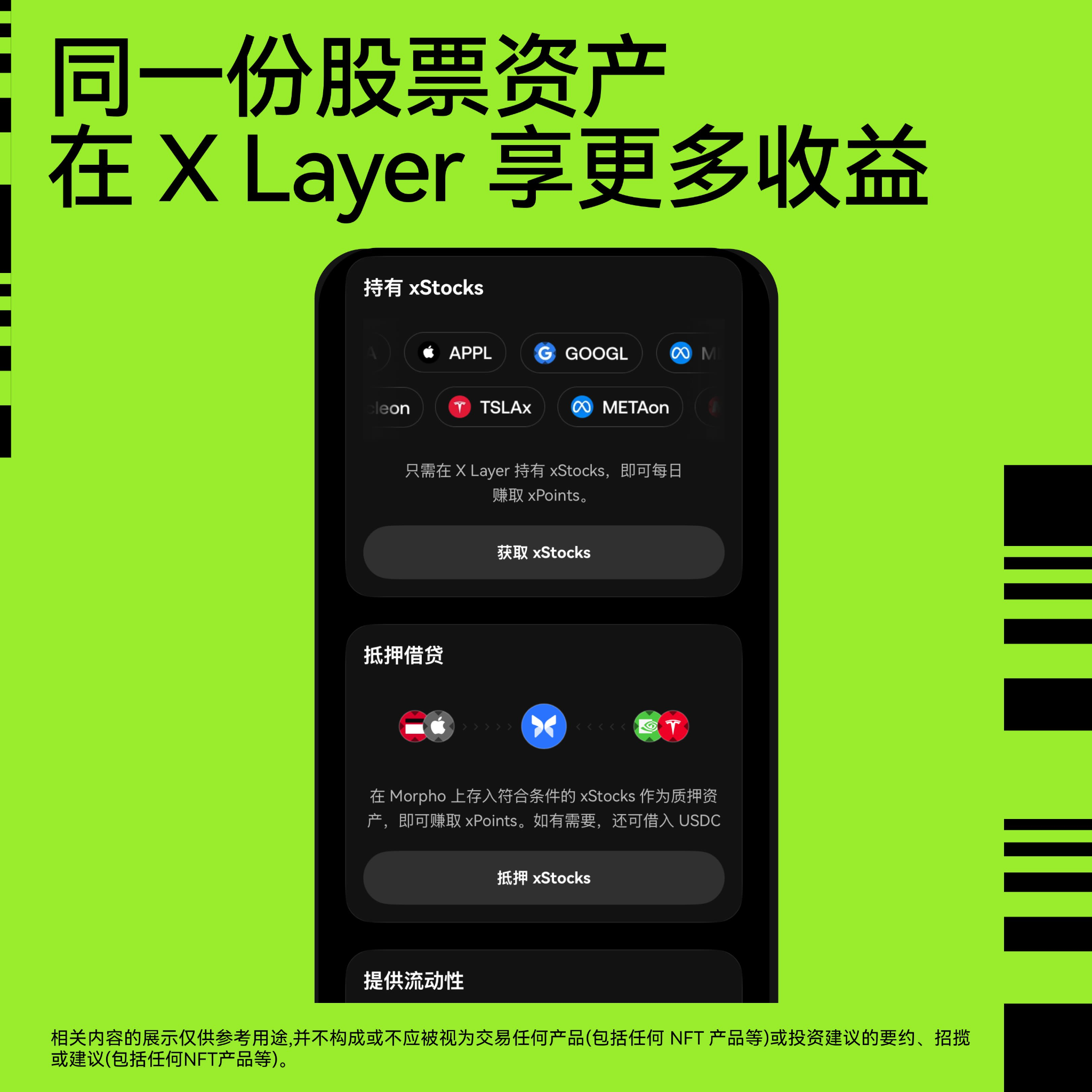
According to the latest updates from the OKX Wallet Chinese official channel, xStocks stock tokens on the X Layer can obtain different earning opportunities through holding, collateralized lending, and providing liquidity, with a maximum xPoints bonus of up to 45% for related activities; at the same time, specific stock token collateralized lending can also participate in the 200,000 USDC prize pool, with an additional reward annualized up to 10%.
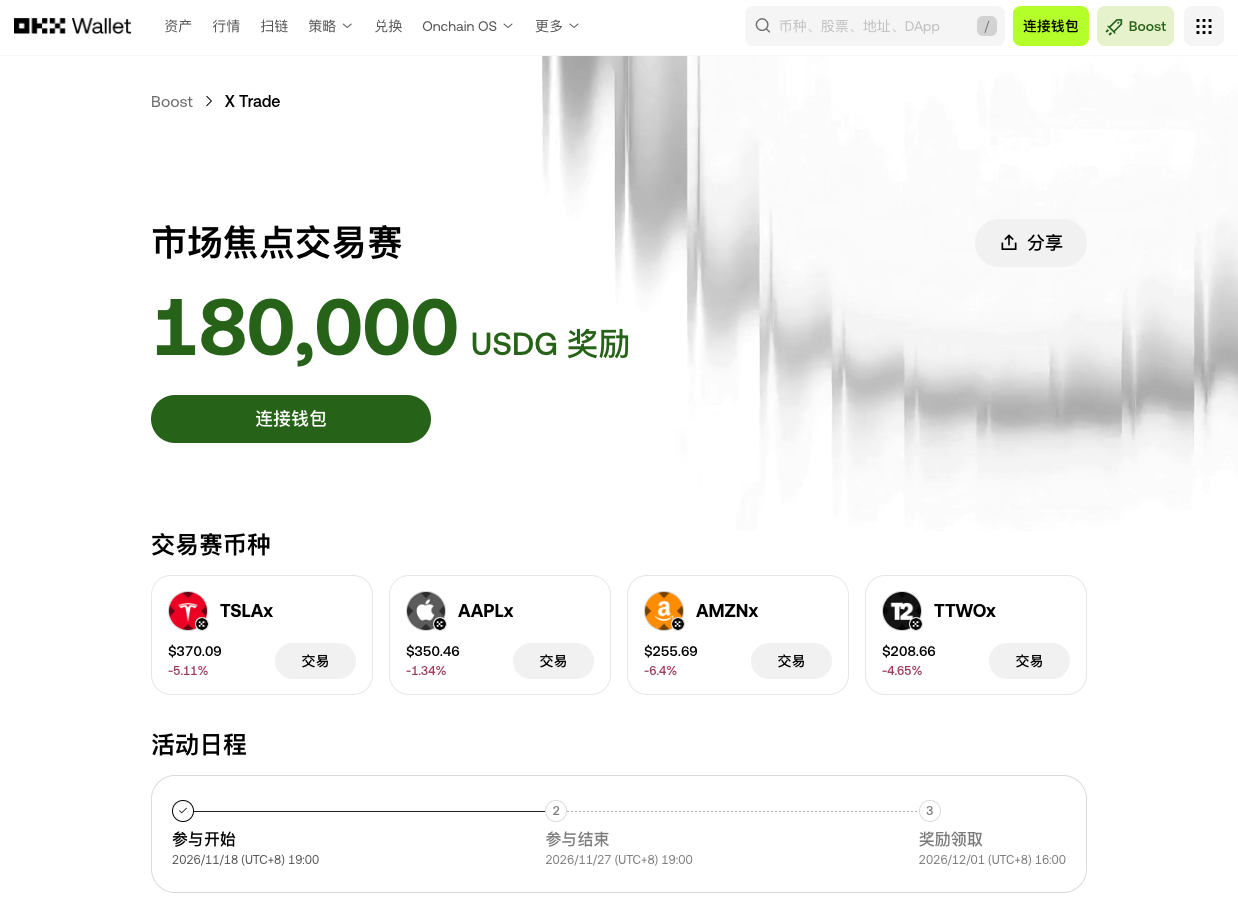
This activity page focuses on another path: providing liquidity for specified xStocks trading pairs to share 200,000 USD rewards and gain xPoints bonuses.
The liquidity pools listed on the current page show APY/APR ranging from approximately 91.55% to 669.17%. However, this is not fixed income, nor does it mean "definitely profitable once deposited." Concentrated liquidity, impermanent loss, price ranges, pool size, and stock token volatility can all significantly alter the final outcome.
Core Information of the Activity
- Activity Type: xStocks RWA Liquidity Incentive
- Reward Scale: 200,000 USD Reward Pool
- Participation Method: Add liquidity to the specified Uniswap V3 liquidity pool on the activity page
- Price Range Requirement: Price range width must be ≥ 8%
- Points Incentive: The activity page shows an additional 25% xPoints bonus before December 20
- Official Promotion: xPoints bonuses can be as high as 45%
- Activity Deadline: December 1, 2026, 15:00 (UTC+8)
- Participation Entry: Must enter through the activity page and complete the operations
- Third-party Participation: Adding liquidity through other Uniswap pages will not count towards the rewards of this activity
It should be noted that the official updates mention an overall xStocks opportunity with a "maximum 45% xPoints bonus," while the specific RWA LP activity page currently states an "additional 25% bonus before December 20." The two may correspond to different activity levels or point calculation criteria, and actual participation should be based on real-time displays on the activity page and the project's final rules. Do not directly assume 45% as a fixed bonus for all LP pools.
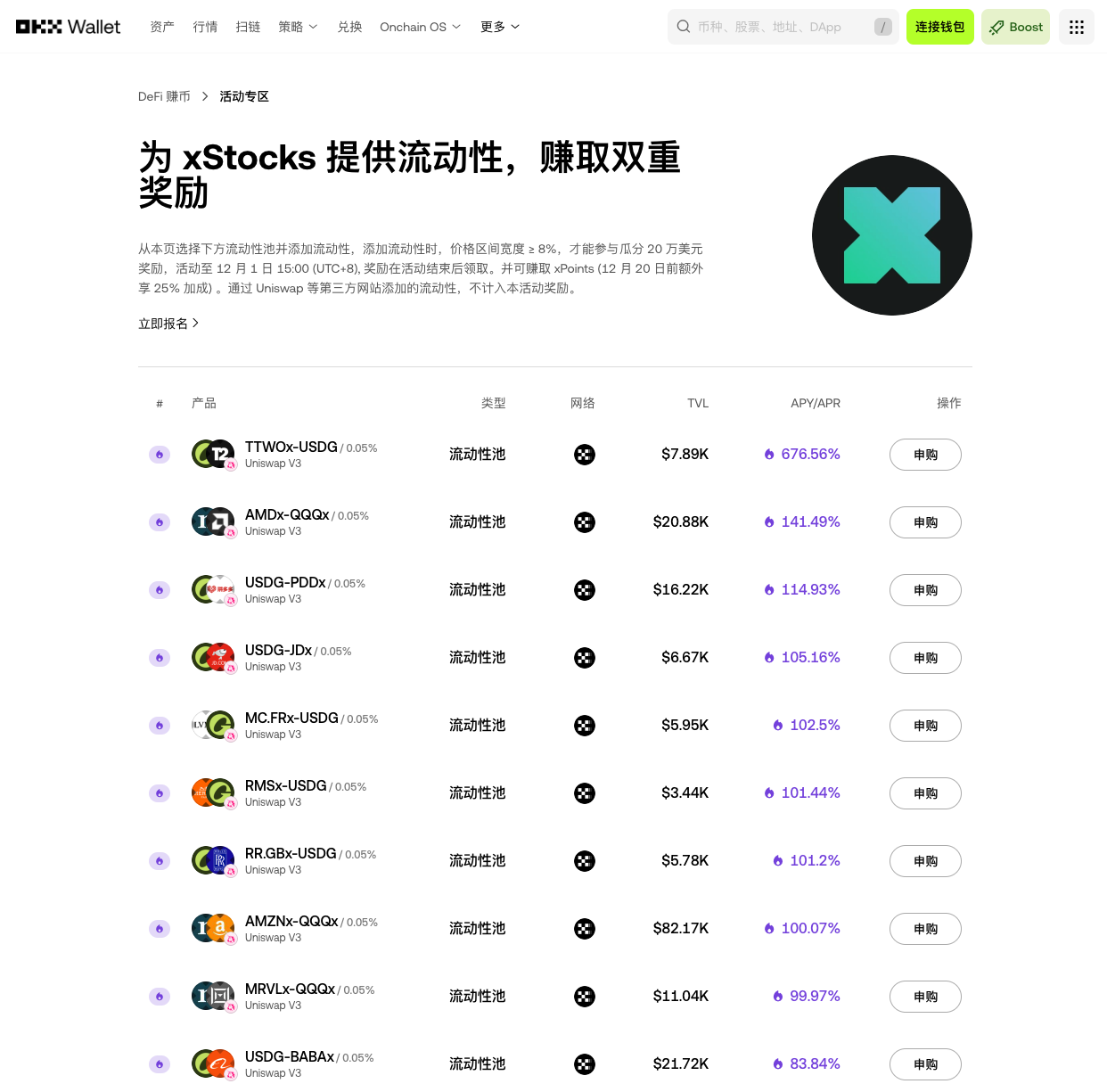
Which Data of the Ten Current Liquidity Pools is Most Worth Watching?
The activity page currently lists 10 Uniswap V3 pools, all with a fee tier of 0.05%, showing a total TVL of approximately 181.79K USD.
TTWOx-USDG: Highest APY/APR on the Page
- TVL: Approximately 7.89K USD
- APY/APR: Approximately 676.56%
This is currently the pool with the highest APY/APR on the page, but its TVL is only about 7.89K USD, indicating a small capital scale.
A high APY may indicate:
- The pool's fee income is relatively high compared to its TVL;
- Activity rewards are amplified under a smaller capital scale;
- Recent trading volume or price volatility is high;
- Little capital flow means yields can change rapidly.
Therefore, 669.17% cannot be understood as guaranteed annual income. Small TVL pools often mean limited liquidity capacity, which could lead to larger price impacts upon exit.
AMDx-QQQx: Semiconductor and Technology Index Combination
- TVL: Approximately 20.88K USD
- APY/APR: Approximately 142.16%
The combination of AMDx and QQQx forms a trading pair of technology growth and index assets. The assets on either side of this pool might be affected by overall tech stock volatility; when correlation is high, managing the price range may be easier to understand. However, if AMDx significantly diverges from QQQx, LPs may still face changes in asset proportions and impermanent loss.
USDG-PDDx: Stablecoin and Single Company Token
- TVL: Approximately 16.22K USD
- APY/APR: Approximately 114.92%
USDG-PDDx is helpful for observing trading demand between stablecoins and individual stock tokens. The stablecoin side reduces part of the price volatility in the combination, but price changes in PDDx may still push LP positions gradually towards USDG or PDDx.
USDG-JDx: Stablecoin and Company Stock Token
- TVL: Approximately 6.67K USD
- APY/APR: Approximately 105.20%
This pool has a small scale with a relatively high APY/APR. Users need to consider the yield along with the actual transaction depth rather than just looking at the percentage.
MC.FRx-USDG: Consumption and Brand Theme
- TVL: Approximately 5.95K USD
- APY/APR: Approximately 102.49%
Pools like this may be affected by the prices of consumer stocks and market sentiment. Due to the small TVL, changes in trading volume and price volatility may more easily alter the page's yield.
RMSx-USDG and RR.GBx-USDG: Relatively Small Stablecoin Trading Pools
RMSx-USDG:
- TVL: Approximately 3.44K USD
- APY/APR: Approximately 101.44%
RR.GBx-USDG:
- TVL: Approximately 5.78K USD
- APY/APR: Approximately 101.21%
Both of these pools exhibit features of small TVL and high page yields. Users should closely monitor the pool depth, price range, actual sources of fees, and price impacts upon exiting.
MRVLx-QQQx: Single Stock and Technology Index Combination
- TVL: Approximately 11.04K USD
- APY/APR: Approximately 100.70%
The combination of MRVLx and QQQx is suitable for observing the volatility of individual stocks relative to the index. The risks for LPs are not just about the prices of the two assets going up or down, but also include the relative price changes between them.
AMZNx-QQQx: The Pool with the Largest Current TVL
- TVL: Approximately 82.17K USD
- APY/APR: Approximately 100.23%
AMZNx-QQQx is the pool with the largest TVL currently listed on the page, accounting for about 45% of the total TVL of the ten pools.
A higher TVL may indicate better trading capacity, but it does not mean there is no impermanent loss. When Amazon's performance changes relative to the Nasdaq 100, the asset proportions of LPs will still constantly adjust.
USDG-NTESx: The Lowest APY/APR on the Page, but Still High
- TVL: Approximately 21.75K USD
- APY/APR: Approximately 91.55%
Among the current ten pools, USDG-NTESx shows the lowest APY/APR on the page, but it is still at a relatively high level. For LPs, a lower page yield does not necessarily indicate a worse opportunity, as actual results need to consider price volatility, impermanent loss, and exit costs.
200,000 USD Rewards and xPoints: Why are they "Dual Incentives"?
The attraction of this activity lies in the fact that the potential returns for users come from more than one source.
First Layer: Transaction Fees Generated by Liquidity Pools
LPs of Uniswap V3 liquidity pools can earn transaction fee income based on trading activities. The pools listed on the activity page have a fee tier of 0.05%, but this does not equal a fixed yield for LPs.
The actual fees depend on:
- The actual trading volume of the pool;
- The proportion of personal liquidity within the effective price range;
- Whether the price consistently remains within the set range;
- The capital scale of other LPs;
- The transaction fees paid by traders.
Second Layer: Activity Rewards
LPs who meet the criteria can participate in sharing the 200,000 USD rewards. The activity rules require a price range width of at least 8% and participants must enter through the designated pools on the activity page.
Third Layer: xPoints
The official activity page shows that before December 20, an additional 25% xPoints bonus can be enjoyed; the official updates promote a maximum of 45% xPoints bonus.
Points themselves should not be directly equated to cash returns. Users need to confirm:
- How points are calculated;
- When they are settled;
- If there are eligibility conditions;
- Whether there will be other uses of redemption, rights, or benefits in the future;
- If the bonuses are differentiated by pool, time, or user levels.
Therefore, a more accurate expression is: This activity provides an opportunity for liquidity rewards and point incentives to stack, but the value of points and final rights cannot be guaranteed in advance.
Price Range of at least 8%, What Does Concentrated Liquidity Mean?
Uniswap V3 does not simply place assets into a pool with an infinite price range but allows LPs to choose a price range.
The activity rules require a price range width of ≥ 8%, which means users cannot set the range too narrow in pursuit of extremely high capital efficiency.
The advantages of concentrated liquidity are:
- Funds can serve a specific price range more effectively;
- Capital utilization may be higher when the price is within the range;
- The same capital may achieve higher fee efficiencies.
But the risks are also more direct:
- Once the price leaves the range, liquidity may no longer earn transaction fees;
- Asset proportions will constantly adjust with price changes;
- Resetting the range may incur gas and transaction costs;
- High APY may only be the result of short-term trading volume or incentives.
Users should not only look at "highest APY," but also judge whether they have the capability to manage the price range.
LP's Most Important Risk to Watch Out For: Impermanent Loss
Assume a pool consists of USDG and a certain stock token. When the stock token rises, arbitrageurs will gradually buy up the stock tokens in the pool, and LPs may end up holding more USDG and fewer stock tokens.
When the stock token falls, the situation may reverse, and LPs may hold more of the declining stock token.
This is the core logic of impermanent loss: LPs’ asset combinations automatically rebalance based on price changes, and the final value may be lower than simply holding both assets.
If the transaction fees and activity rewards do not cover the impermanent loss, the high APY displayed on the page may still not yield positive returns.
It is suggested to use the following framework for calculations:
LP Net Result = Transaction Fees + Activity Reward Value + Expected Point Value − Impermanent Loss − Price Range Management Cost − Gas − Exit Slippage.
If the pool includes two highly volatile stock tokens, such as AMDx-QQQx or MRVLx-QQQx, one should also observe the relative volatility of the two assets.
Why Small TVL Pools Cannot Simply Be Understood as "High Yield Opportunities"?
Currently on the page, the APY/APR of TTWOx-USDG reaches 669.17%, but the TVL is only about 7.89K USD.
This data combination easily attracts users, but it is necessary to first ask three questions:
- Is the page yield contributed by real transaction fees or mainly driven by short-term activity incentives?
- Can the trading depth support one's capital scale?
- Will there be significant price impacts upon exiting?
The yield of small pools may rise quickly due to low trading volume or rewards, and it can also decline rapidly due to capital inflow, falling trading volumes, or price changes.
Conversely, AMZNx-QQQx has a TVL of approximately 82.17K USD, with a page APY/APR of about 100.23%. Although the yield is lower than that of TTWOx-USDG, the larger capital pool might possess different trading capacity characteristics.
This does not mean that AMZNx-QQQx is necessarily safer or more worth participating in; it merely indicates that users need to analyze yield and TVL together.
Three Types of Users, Three Participation Approaches
1. Conservative Observational Type: Research First, Then Experiment Small
Suitable for users encountering concentrated liquidity for the first time.
You can first choose pools with relatively high TVL and easier asset logic, such as AMZNx-QQQx or USDG-NTESx, and then observe with small funds:
- Whether the price consistently remains within the range;
- Actual fee growth;
- Changes in LP shares;
- The proportion of the two assets obtained upon exit;
- Whether activity rewards and xPoints are recorded correctly.
2. Stablecoin Pairing Type: Focus on Single Stock Token and USDG
USDG-PDDx, USDG-JDx, MC.FRx-USDG, RMSx-USDG, and RR.GBx-USDG all belong to the strategy of pairing stablecoins with single stock tokens.
The asset structure of these pools is more intuitive, but the price risk on the stock token side still exists. Users need to judge if they are willing to hold more stock tokens during bearish conditions.
3. Dual Stock Token Type: Focus on Relative Price Changes
AMDx-QQQx and MRVLx-QQQx are composed of two stock-class tokens.
The yields of these pools are closely related to the relative price changes of the two assets. If the trends of both are highly synchronized, the effects of impermanent loss may differ from combinations that go up and down; however, the synchronous relationship is not stable and past correlations should not be assumed as future guarantees.
Conclusion
X Points RWA liquidity activities provide a new on-chain stock token participation method:
- Earn transaction fees through LP;
- Participate in sharing 200,000 USD rewards;
- Gain additional xPoints bonuses during the activity period.
The highest APY/APR displayed on the current page is 669.17% for TTWOx-USDG, but the TVL of that pool is about 7.89K USD; the pool with the largest TVL, AMZNx-QQQx, is approximately 82.17K USD, with a page APY/APR of about 100.23%.
This data is most suitable for establishing an observational framework rather than directly serving as a buying reason.
For ordinary users, a more reasonable approach is:
Look at the trading pairs first, then the price range; first calculate impermanent loss, then look at APY; first confirm the activity entry and point rules, and then decide the capital scale.
Exclusive Benefits for AiCoin Users
Use OKX Web3 Wallet to "Invest in Global Assets"!
Bind invitation code 【AICOIN88】 to enjoy a 10% saving on trading costs (Gas optimization and other benefits)!
Download/upgrade OKX Web3 Wallet now and ride the wave:
https://jump.do/xlink?checkProxy=true&proxyId=24
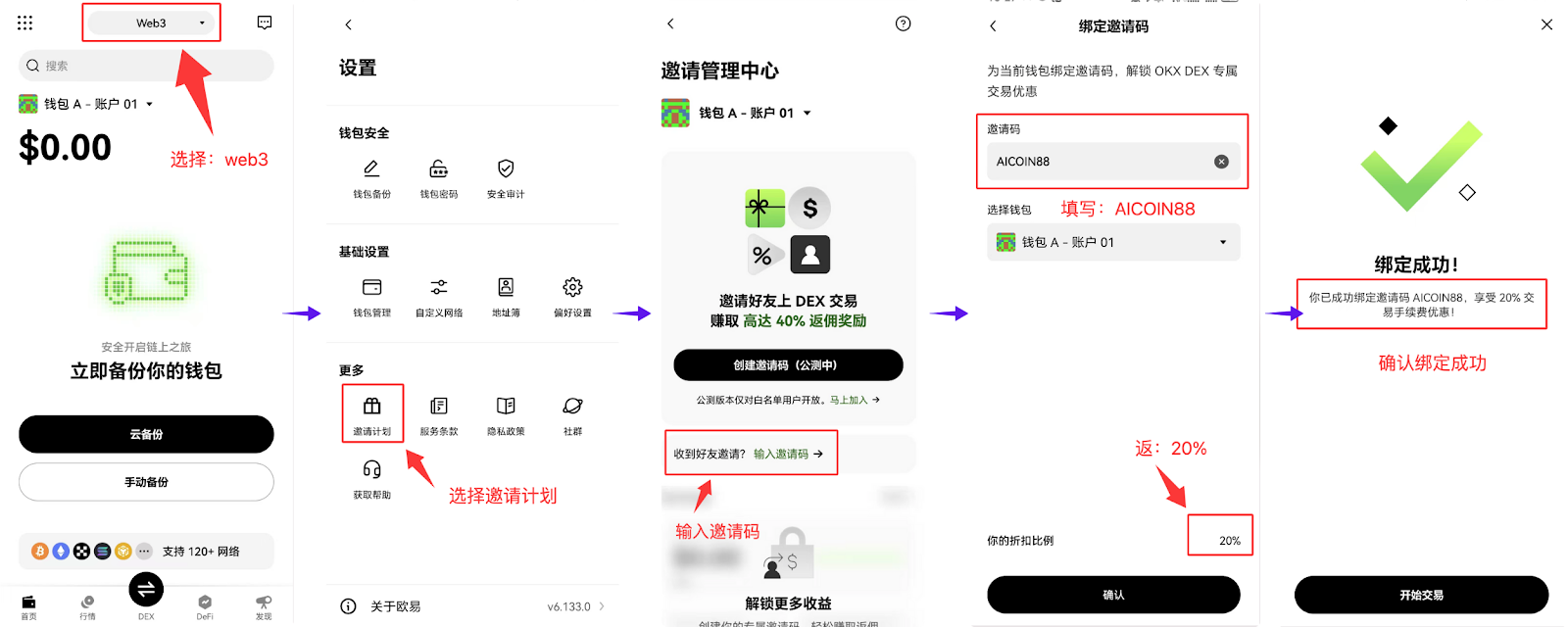
Bind the exclusive invitation code 【AICOIN88】 to OKX Wallet, the web can also operate easily!
https://web3.okx.com/ul/joindex?ref=AICOIN88

Don’t wait any longer, set up the OKX wallet and bind for benefits to harvest new wealth!
免责声明:本文章仅代表作者个人观点,不代表本平台的立场和观点。本文章仅供信息分享,不构成对任何人的任何投资建议。用户与作者之间的任何争议,与本平台无关。如网页中刊载的文章或图片涉及侵权,请提供相关的权利证明和身份证明发送邮件到[email protected],本平台相关工作人员将会进行核查。