AMINA Bank OUSD Support Goes Live for Institutional Clients
Crypto news update: AMINA Bank AG, a crypto bank in Zug, Switzerland, regulated by the Swiss regulator FINMA, says it is the first European bank to offer institutional access to Open USD.
The AMINA Bank OUSD service covers safekeeping of the token and fiat deposits and withdrawals. It is open now to professional and institutional clients.

The bank announced the service on 20 November 2026 in anofficial press release.
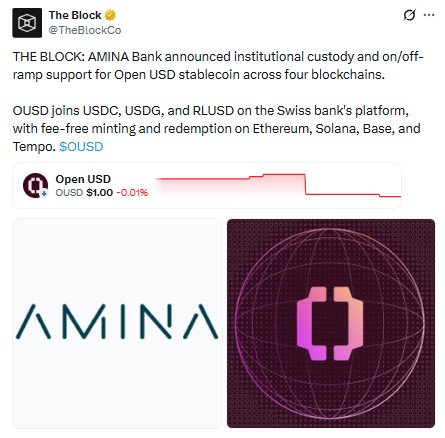
The Block also covered the update on X, noting that the token joins USDC, USDG, and RLUSD on the bank’s platform.
An on-ramp turns bank money into tokens, and an off-ramp turns tokens back into bank money. Custody means the bank holds the tokens on the client’s behalf.
What Open USD Is and Who Backs the Stablecoin Consortium
Open USD (OUSD) is a US dollar-pegged stablecoin aimed at business payments. According to Open Standard’s introduction post, businesses can mint and redeem it at no cost and with no artificial volume limits. Minting creates new tokens against dollars, and redemption swaps them back. Partners receive the reserve earnings, minus a small management fee.
Bridge, a Stripe company, is the day-one issuer under the US GENIUS Act, the federal stablecoin law, the bank says. Reserves are held with institutions including BlackRock and BNY.
Governance is set to move toOpen Standard, an independent entity being established as the permanent issuer. The bank cites a consortium of more than 140 members, including Visa, Mastercard, Stripe, BlackRock, and Coinbase.
OUSD launched on 30 September 2026. The bank’s release puts its market capitalization at about $837 million within the first month. That is a market data figure that changes daily, so check live data before relying on it.
Supported Networks, Fee-Free Minting, and Redemption
The bank says the stablecoin is available on four networks, with fee-free minting and redemption:
Ethereum
Solana
Base
Tempo
Fee-free minting and redemption are features of the stablecoin, not of the bank. The bank’s role is to hold the tokens under Swiss rules and handle fiat conversion. In practice, this gives institutions a bank route for the fiat leg, rather than relying only oncrypto exchanges.
The release does not state the bank’s own custody or conversion fees. Institutions should confirm pricing directly.
Why AMINA Bank OUSD Access Matters for Corporate Treasuries
The bank’s chief financial officer, Mike Foy, said that for corporate treasurers adopting a stablecoin for the first time, the main question is not which token to pick. It is how custody, reporting, and compliance are handled.
The bank’savailable cryptocurrencies page shows how far support goes. As checked on 20 November 2026, it lists OUSD for hot custody only:
Asset | Custody | Tradable | Loan collateral |
USDC | Hot and cold | Yes | Yes |
USDG | Hot and cold | Yes | No |
RLUSD | Hot and cold | Yes | No |
OUSD | Hot | No | No |
Hot custody means tokens are held in online wallets, and cold custody means offline storage. The listing suggests OUSD is at an early stage, with custody and fiat conversion first.
The bank has not said whether trading or collateral use will follow. Other bank and stablecoin developments are collected in thecryptocurrency news section.
What to Check Before Holding Stablecoins at a Bank
The service is for professional and institutional clients only. The bank’s website notes that its services may not be available in every jurisdiction, so eligibility should be confirmed first. Before any transfer, confirm the supported network with the bank.
The AMINA Bank OUSD launch gives institutions a Swiss-regulated custody and fiat route to a consortium-backed stablecoin, starting with hot custody.
Disclaimer: This article is for information only and is not financial advice. Stablecoins and synthetic dollars carry risks, including losing their peg and counterparty risk.
免责声明:本文章仅代表作者个人观点,不代表本平台的立场和观点。本文章仅供信息分享,不构成对任何人的任何投资建议。用户与作者之间的任何争议,与本平台无关。如网页中刊载的文章或图片涉及侵权,请提供相关的权利证明和身份证明发送邮件到[email protected],本平台相关工作人员将会进行核查。