Investment Logic
As the construction costs of data centers soar, the market is starting to worry about regulatory restrictions, export controls, nationwide blackouts, and whether the return on AI investments is truly worth such a massive input. The entire AI trading landscape is experiencing deeper pain swiftly.
Impatient investors—especially institutional funds—are now triggering fierce sell-offs, seriously testing the market's previously unwavering confidence in AI as a "transformational technology."
However, in my view, the series of panic factors rapidly fermenting in this dangerous market have less to do with AI technology itself and stem more from at least three broad macro changes. More specifically, investors, particularly institutional funds, are using this round of deep adjustment in AI to rebalance their portfolios and prepare for a potentially historic rise in the coming months.
Below, I will explain my analysis and why I still maintain the recently raised bullish outlook for the market, especially regarding AI.
The Current Valuation Attractiveness of the Market is Undeniable
Before explaining the three factors currently suppressing the market, I want to first assess where the market currently stands from a very clear mathematical perspective.
The core conclusion drawn from my factual analysis is that the valuation level of the current benchmark index S&P 500 (SP500) remains distinctly attractive.
In my articles from early October and early November, I mentioned that the market previously expected a 13%-14% revenue growth for S&P 500 companies, driving the benchmark index up by 16% in CY2025, with technology stocks including XLK, MAGS, and QQQ becoming key pillars of the S&P 500's strong performance in CY2025.
Compared to last year's expectation of 13%-14% revenue growth, the current market consensus shows that revenue growth for CY2026 is still similar to last year, with the latest forecast at approximately 13.4%, as shown in the following chart.
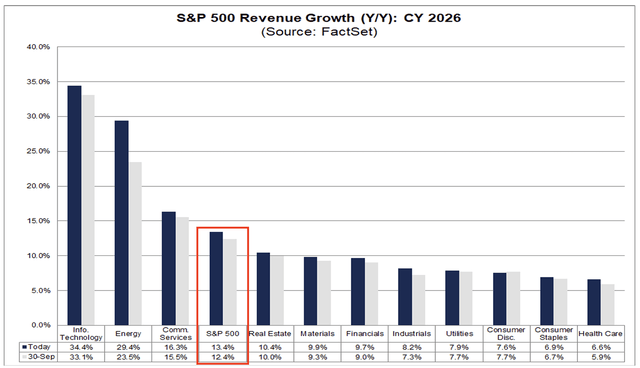
【Original image position: Chart A: Wall Street analysts have upgraded their revenue growth projections for S&P 500 companies by 100 basis points, now expecting a growth of 13.4% (FactSet)】
If I correlate last year's expectations of a 13%-14% revenue growth with the 16% return realized by the S&P 500, and then compare it with this year's current revenue growth projections, I arrive at a target level for the S&P 500 of about 8,000 points, approximately 8%-9% higher than yesterday's closing position of 7,323 points.
Given the current valuation is very attractive relative to future growth rates, I still expect the S&P 500 to rise back towards 8,000 points, while tech stocks and AI beneficiary stocks will again become major driving forces.
Additionally, for investors who might overlook this point, a closer look at Chart A reveals that the market's consensus expectation for 13.4% revenue growth has actually been revised up over the past 30-45 days. Notably, this has occurred during the same time window where panic swept through the entire market—during which AI stocks were hit hardest and doubts about whether this transformational technology can deliver adequate returns deepened.
The Three Current Factors Affecting the Market and What Will Happen Next
Typically, I would place the discussion of valuations in the last part of a macro article. But today, I choose to start with the fundamentals because I want to highlight the attractiveness of the current index valuation. Due to extreme negative sentiment, especially pessimism regarding AI stocks, the current market prices have significantly disconnected from the underlying profitability of businesses.
Before further explaining why the market looks like it has "broken," let's first examine the overall performance this year. In the first half, several technology sub-industries experienced one of the most vigorous rallies in history, with semiconductor stocks even entering an unprecedented run in the second quarter.
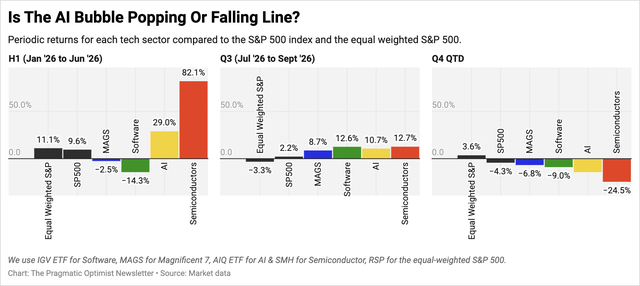
【Original image position: Chart B: Performance comparison of different market sectors, especially AI beneficiary stocks, this quarter to date versus prior quarters this year (Market Data)】
After this vigorous rally in the first half of the year, the market began to enter an increasingly complex environment, as the Fed and the bond market started to reprice liquidity concerns around inflation and geopolitical tensions simultaneously.
Since September, Fed officials have made very hawkish statements and policy stances, continuously emphasizing the need for further tightening of monetary policy to address inflation risks. Yesterday, Reuters reported that Fed Governor Waller supports taking "more aggressive measures" against inflation, further solidifying the market's assessment that the probability of a rate hike in December is close to 100%.
The expectation of a rate hike is the first factor that has suppressed the market over the past 30-45 days.
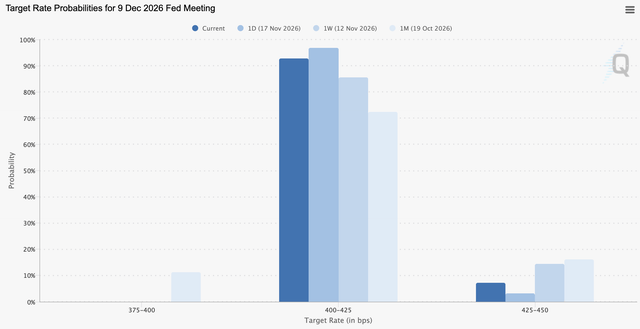
【Original image position: Chart C: The market believes the Fed will raise rates again this year with a probability of 93%-95% (FedWatch)】
Interestingly, despite Governor Waller's support for a tighter policy path, the market's expected probability of a rate hike actually dropped by about 420 basis points yesterday to 92.7%.
In my view, this divergence reflects the bond market weighing the current inflation narrative against the future tightening path hinted by the Fed. As we entered early October, interest rate volatility severely impacted AI trading, as bond yields surged to levels not seen since before the global financial crisis, as shown in the following Chart D.
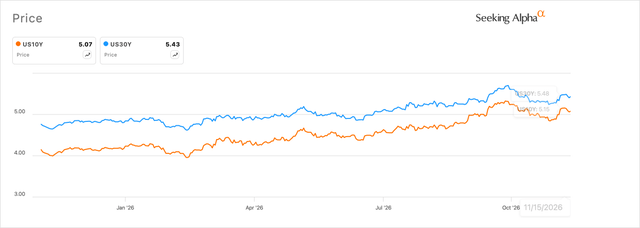
【Original image position: Chart D: The yields of the US 10-year and 30-year bonds soared to multi-decade highs last month (Seeking Alpha)】
The increase in bond yields is the second factor severely suppressing the market—especially AI stocks—because higher interest rates further increase the debt financing costs required for AI data center construction. However, despite bond yields rising for most of the third quarter, they have recently begun to stabilize even in the face of new inflation shocks. In my view, this suggests that the bond market currently views these price pressures more as temporary geopolitical disturbances rather than as long-standing inflation issues.
As shown in the following chart, despite experiencing multiple rounds of geopolitical shocks this year, core CPI has remained within a relatively stable range.
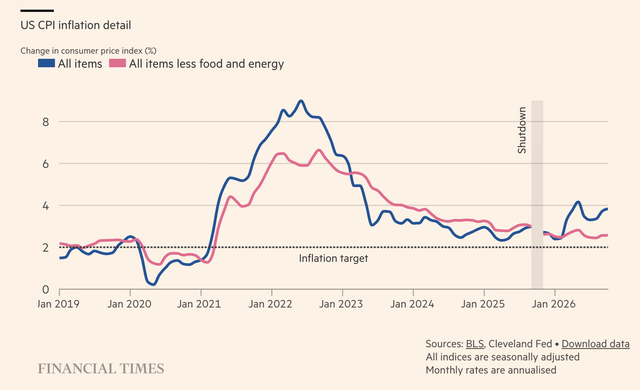
【Original image position: Chart E: Year-over-year inflation comparison in the US—headline CPI vs core CPI (FT)】
The irony in the Fed's current proposed tightening path can be seen from a social media post yesterday: after Governor Waller's hawkish comments on rate hikes, many commodity prices immediately fell. Looking ahead, I expect bond yields to stabilize around current levels, if not decrease further. This should help capital flow back into risk assets.
Lastly, a strong dollar (DXY) has been one of the most painful yet often overlooked headwinds suppressing AI trading. Geopolitical uncertainty, inflation concerns, and the risk that the incoming new Congress may strengthen regulatory scrutiny are all driving funds toward safe-haven assets like the dollar. A stronger dollar can silently drag down the AI industry, as it raises the debt servicing costs for global AI companies that hold dollar-denominated debts, and also presents foreign exchange headwinds for US hyperscalers. As shown in the following chart, the recent tightening rise of the dollar since September has continued to suppress AI stocks, but I believe DXY is in the last stages of forming a peak, or may even have already peaked.
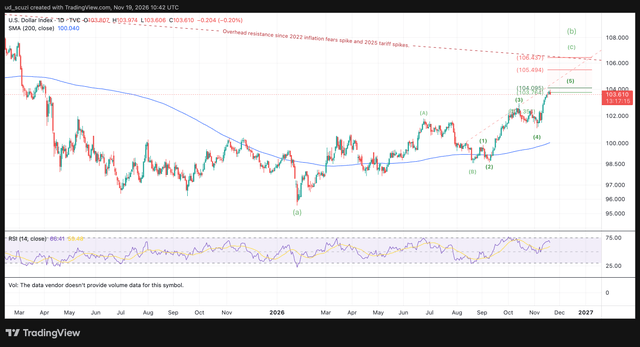
【Original image position: Chart F: Dollar index price movement and author annotations (TradingView)】
This analysis indicates that as the liquidity environment begins to improve, the dollar index may be forming a short-term top, which could drive the stock market higher, especially AI beneficiary stocks. Therefore, so far, the three macro headwinds suppressing the market and AI trading are: the future rate path, surging bond yields, and a strengthening dollar. However, I believe these headwinds are finally beginning to weaken, increasing the likelihood of a short-term market rebound.
Meanwhile, extreme panic has led to a massive exit of institutional funds from medium-term momentum trading, with withdrawal levels returning to those seen during CY2022-CY2023. From my contrarian investment perspective, this actually enhances the possibility of a short-term rebound.
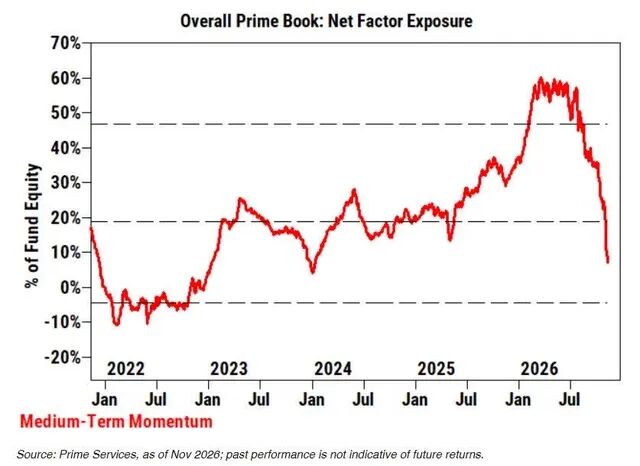
【Original image position: Chart G: Hedge fund medium-term momentum exposure sharply declines after reaching a 60% peak (PrimeServices)】
In my view, when the three previously observed headwinds begin to gradually weaken, and institutional funds significantly exit momentum trading, this combination is creating very favorable conditions for the next strong rebound.
Risks and Other Factors to Note
Over the past 30 days, my visibility regarding the future path of the market has significantly improved, which has led me to adjust the capital allocation in funds accordingly. Although regulatory scrutiny and geopolitical tensions remain significant macro pressures, the current valuation levels indicate that these risks have largely been priced into the market.
As my colleagues have mentioned before, the IPO of Anthropic may even support AI trading, as this IPO received a very high level of oversubscription.
Core Conclusions
In the analysis above, I pointed out that the recent wave of AI sell-offs essentially reflects the asset rebalancing of institutional funds under three major macro headwinds: the Fed's hawkish policy repricing, the peak of bond yields, and the strengthening dollar.
However, as the S&P 500 CY2026 revenue growth expectation has risen to year-on-year 13.4%, it is clear that the current market panic stems more from sentiment than from a deterioration in fundamentals. That is why I still maintain a valuation-centered target of approximately 8,000 points for the S&P 500, which represents about an 8%-9% upside compared to current levels, while continuing to clearly remain bullish on AI stocks.
免责声明:本文章仅代表作者个人观点,不代表本平台的立场和观点。本文章仅供信息分享,不构成对任何人的任何投资建议。用户与作者之间的任何争议,与本平台无关。如网页中刊载的文章或图片涉及侵权,请提供相关的权利证明和身份证明发送邮件到[email protected],本平台相关工作人员将会进行核查。


