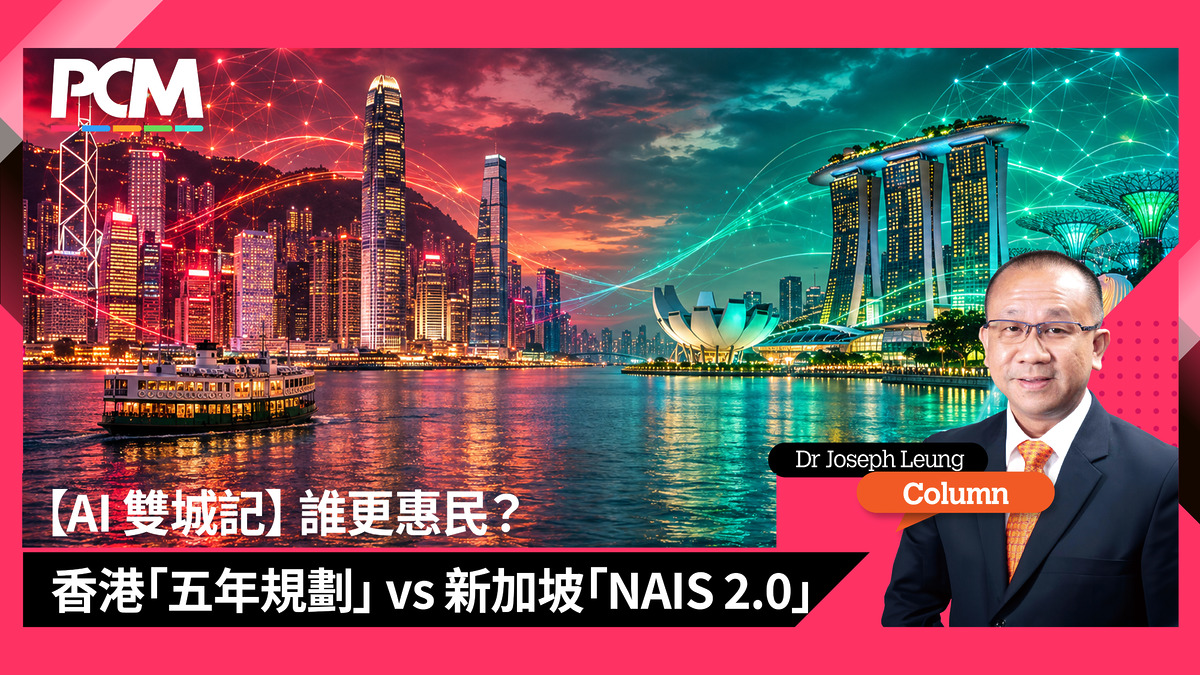
As the global wave of artificial intelligence (AI) sweeps through, Hong Kong and Singapore, as the two major international financial and innovation hubs in Asia, are embarking on a strategic layout concerning competitiveness for the next decade. The Hong Kong Special Administrative Region government is comprehensively advancing the "AI+" action and industry transformation through the "Hong Kong Innovation and Technology Development Blueprint" and the "First Five-Year Plan for Economic and Social Development of the Hong Kong Special Administrative Region (2026–2030)"; Singapore, on the other hand, has launched an upgraded version of the "National Artificial Intelligence Strategy 2.0" (NAIS 2.0), with the core vision of "AI for the Public Good."
These two top-level designs not only reflect the distinct economic structures and geopolitical advantages of both places but also show subtle differences in resource allocation: which strategy is more beneficial for citizen welfare and career development? Which is more attractive to multinational corporations (MNCs)? This article will delve into the analysis from three dimensions: strategic positioning, citizen benefits, and multinational corporate investment environment.
1. Strategic Positioning: "Backed by a Strong Domestic Hub" vs. "Global Systemic Ecosystem"
1. Hong Kong's Five-Year Plan: Leading Industry Upgrading with "AI+" and Infrastructure
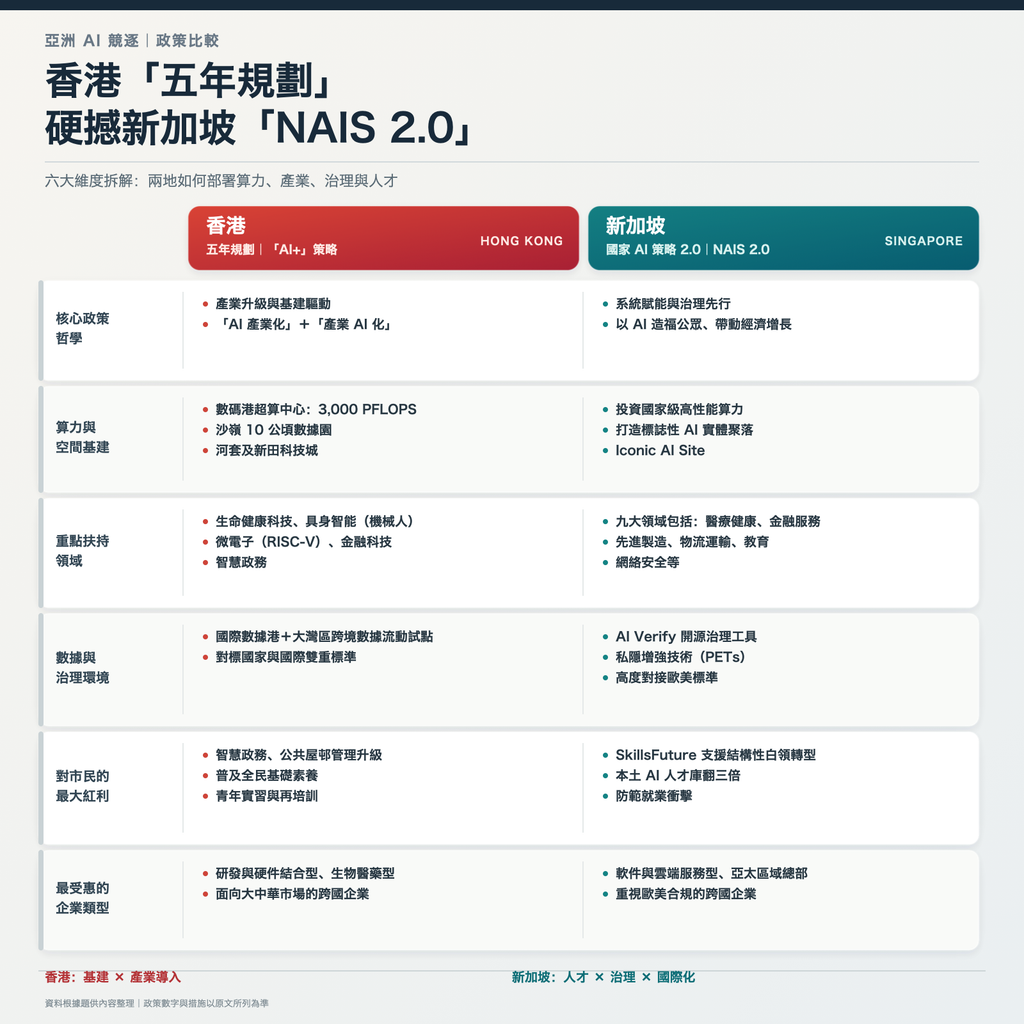
The Hong Kong SAR government's five-year plan closely aligns with the national "14th Five-Year Plan," clearly positioning AI as the "core industry" for future development, aiming to achieve "AI industrialization and industrial AI transformation." Its layout presents a distinct characteristic of "emphasizing infrastructure, robust R&D, and connecting with the Greater Bay Area":
Spatial and computational infrastructure: Constructing a "North, Central, and South" innovation and technology spatial layout (including the Northern Metropolis, Hong Kong-Shenzhen Innovation and Technology Cooperation Zone, the Central Science Park, and the Southern Cyberport). The AI supercomputing center at Cyberport has increased its computing power to 3,000 PFLOPS, and is accelerating the development of a 10-hectare data park in Shatin (expected to be operational by 2029) to provide substantial computing power support.
Research transformation and patient capital: Leveraging the research strength of five local world-class universities, together with the InnoHK research and development platform, the Hong Kong AI Research Institute, and a HKD 10 billion "Innovation and Technology Industry Guiding Fund" along with a HKD 3 billion frontier technology research support scheme, guiding funding into life sciences and health technology, embodied AI, microelectronics, and quantum technology.
2. Singapore's NAIS 2.0: Moving from "Project Pilots" to "System-Level Empowerment"
Singapore launched its first national AI strategy as early as 2019, while the continuously updated NAIS 2.0 released at the end of 2023 elevates AI from an "optional component" to a "national strategic necessity." The core framework revolves around three systems (activity-driven, talent and community, infrastructure and environment), ten enabling factors, and 15 specific actions:
Dual-track goals (excellence and empowerment): On one hand, establishing globally leading "Peaks of Excellence" in nine priority areas such as healthcare, fintech, and advanced manufacturing; on the other hand, comprehensively empowering society and enterprises.
Real investments and governance first: The government committed to invest over SGD 1 billion to support NAIS 2.0 within five years, with an additional investment of over SGD 1 billion to promote the "National Artificial Intelligence Research and Development Plan (NAIRD 2025-2030)." More importantly, Singapore is at the forefront globally in AI governance tools (such as the open-source testing framework AI Verify and Project Moonshot) and privacy-enhancing technologies (PETs), aiming to build a "trusted global AI hub."
2. Who Benefits More? Comparison of Livelihood Applications and Workforce Transformation
To assess whether an AI policy is "beneficial to the public," it is essential not only to consider the conveniences brought by smart cities but also to examine how the government assists citizens in coping with the "risk of job displacement" and "pressures of skill transformation" resulting from AI.
1. Hong Kong: Focusing on Digitalization of Public Services and Universal Education
The five-year plan of Hong Kong primarily reflects its benefits to the public by enhancing the efficiency of public administration, smart city management, and promoting AI literacy among the populace:
Smart governance and livelihood: Integrating government services through "Smart Convenience" (iAM Smart), and introducing IoT sensors and digital monitoring platforms in public housing management to improve maintenance and resource distribution; meanwhile, big data and AI are widely applied in healthcare, transportation, customs, and emergency management.
Universal access and skill enhancement: The government plans to launch the "AI for All" initiative by the first quarter of 2028, providing over 200 training courses and activities, and implementing a "community robot" pilot program. In addition, the Employee Retraining Board (ERB) has been reformed as "Upskill Hong Kong," aligning with an AI skill enhancement initiative that is expected to benefit 40,000 employees and provide 30,000 job and internship opportunities for youth, helping grassroots and young people adapt to transformation.
2. Singapore: Directly Facing "White-Collar Impact" through Comprehensive Empowerment and Protection
In NAIS 2.0, Singapore's consideration for citizen benefits shows a strong sense of crisis awareness and structural safeguards. Prime Minister Lawrence Wong stated during the strategy launch, "Knowledge-based jobs in research, programming, and writing were previously considered safe, but that is no longer the case in the age of generative AI."
Deep adult education and transformation (SkillsFuture integration): Singapore goes beyond mere "awareness" and invests massively in adult education while developing sector-specific AI training programs, supporting enterprises and employees to upgrade in tandem. The government has also redesigned the "AI Apprenticeship Programme," significantly increasing training slots and internship opportunities.
Local talent pool expansion program: Clearly setting quantitative targets, the number of local AI Practitioners will be expanded from about 4,500 to 15,000, ensuring that high-paying technology positions benefit local citizens and permanent residents to the greatest extent.
Risk prevention and cultural preservation: Placing the prevention of deepfake technology, cyber fraud, algorithmic bias, and employment impact at the core, and developing a local multimodal large language model (National Multimodal LLM Programme) to ensure that Southeast Asia's multiple languages and cultures are not marginalized.
[Public Benefit Evaluation]: Singapore Slightly Ahead, Hong Kong Rushing to Catch Up
Singapore is more beneficial for "citizens' long-term livelihoods and career resilience": adopting a "whole-of-government, whole-of-economy" systemic intervention, tightly binding AI strategy with lifelong learning (SkillsFuture), which provides middle-class and white-collar workers with a more tangible safety net and upward mobility ladder.
Hong Kong emphasizes "celerity in public services and foundational accessibility": policies allow citizens to swiftly experience the advantages of e-government, convenience in customs clearance, and intelligent housing estates, but in terms of systematically assisting clerical, junior financial and professional service personnel to cope with structural unemployment, Hong Kong's intervention still falls short of Singapore's detail.
3. Who Is More Business-Friendly? The Game Between Regional Headquarters and Research Establishments
For multinational technology giants, financial institutions, biopharmaceutical companies, and large manufacturers, the choice between establishing operations in Hong Kong or Singapore depends on the company's business focus, compliance requirements, and market considerations.
1. Singapore: "Plug-and-Play" Institutional Advantages and ASEAN Gateway
For a long time, Singapore has been the top choice for multinational corporations to establish their Asia-Pacific regional headquarters (Regional HQ), and NAIS 2.0 further strengthens this advantage:
Customized "Centers of Excellence (CoE)" and policy certainty: The Economic Development Board (EDB) of Singapore actively collaborates with multinational giants to establish industry AI centers of excellence. High transparency and continuity in policies, along with the "National Artificial Intelligence Committee," which is led personally by the Prime Minister, make inter-departmental coordination highly efficient.
Internationally aligned data and compliance environment: The AI Verify testing framework launched is highly aligned with EU's AI Act and US NIST standards. For Western multinational corporations that place a high priority on global compliance, privacy-enhancing technology (PETs), and intellectual property protection, Singapore offers a low geopolitical friction, high-trust "Trusted Hub."
Flexibly attracting top global talent: Establishing a dedicated team to attract global AI creators, offering innovative solutions such as mixed working models, part-time employment, and cross-border collaborations, assisting MNCs to address the shortage of high-level talent.
2. Hong Kong: Unique Advantages of "Comprehensive Industry Chain of the Greater Bay Area" and "Super Data Port"
The five-year plan of Hong Kong offers multinational corporations a large market hinterland, an intact hardware supply chain, and cutting-edge research transformation capabilities that Singapore cannot replicate:
"Research First, Production Later" cooperation within the Greater Bay Area: Hong Kong is vigorously developing "embodied intelligence (such as intelligent robots and autonomous driving)" and "microelectronics/semiconductors." MNCs establishing R&D centers in Hong Kong can leverage the research strength of five world-class universities and directly connect with the world-class advanced manufacturing supply chains in the Pearl River Delta through the Lok Ma Chau Collaborating Zone, achieving rapid transformation with "Hong Kong R&D, Bay Area pilot production, and mass production."
"One Country, Two Systems" in the International Data Port: Hong Kong gathers both local data (through cross-border data flow pilots in the Greater Bay Area) and international data, along with the large-scale data parks in Shatin and HKD 3 billion AI funding programs, providing MNCs seeking to train models that cater to both Chinese and Western contexts, or tapping into China's vast healthcare (such as Lok Ma Chau clinical trials and 2030 drug/device regulatory changes) and financial markets, with irreplaceable strategic value.
Support from capital markets and patient capital: With a world-leading securities market (HKEX optimizes listing rules for emerging industries such as specialized technology and aerospace) and direct investments from Hong Kong Investment Management Company (HKIC), a rich capital pool is provided for companies seeking spin-off listings, mergers, or partnerships.
[Business-Friendliness Evaluation]: Both Cities Have Their Strengths, Depending on Companies' "Strategic Attributes"
Singapore is suited for "MNCs pursuing stable operations and pan-Asia-Pacific outreach": If a company's (such as Western software giants, multinational banks, or consulting firms) core demand is to serve the Southeast Asian (ASEAN) market and requires a seamless data compliance environment with the West, Singapore's establishment costs and compliance risks are lower.
Hong Kong is suitable for "MNCs focused on in-depth R&D transformation and the integration of software and hardware": If a company focuses on life and health medicine, embodied intelligent robots, microelectronics, or aims to use Hong Kong as a springboard into the Chinese mainland market, the land infrastructure, guiding funds, and manufacturing hinterland of the Pearl River Delta that Hong Kong offers will have overwhelming advantages.
4. Conclusion: Moving from Zero-Sum Games to a "Dual-Hub" Layout
In summary, Singapore's "National Artificial Intelligence Strategy 2.0" represents a mature system engineering that is "people-oriented, governance-strengthening, and business-friendly," more solid in safeguarding citizens against AI elimination and enhancing advanced skills, while also providing multinational corporations with a highly predictable "Asia-Pacific headquarters greenhouse."
In contrast, Hong Kong's first five-year plan and "AI+" strategy represents a "bold and infrastructure-first structural breakthrough." Hong Kong is rapidly catching up through smart governance and universal education at the citizen level, but its true trump card lies in deeply integrating internationalized research, finance, common law systems, with the mainland's computing power infrastructure, hardware manufacturing chain, and vast market.
In the future AI competition, both Hong Kong and Singapore are not merely engaged in a zero-sum game. Multinational corporations are likely to adopt a "Dual-Hub" strategy—using Singapore to radiate to ASEAN and the global compliance network, while connecting with the Greater Bay Area in Hong Kong to conduct cutting-edge R&D and hard technology implementation, together reshaping Asia's technological landscape.
This article is reproduced from PCM, with copyright owned by the original author and original media.
免责声明:本文章仅代表作者个人观点,不代表本平台的立场和观点。本文章仅供信息分享,不构成对任何人的任何投资建议。用户与作者之间的任何争议,与本平台无关。如网页中刊载的文章或图片涉及侵权,请提供相关的权利证明和身份证明发送邮件到[email protected],本平台相关工作人员将会进行核查。