Original author: Dong Jing
Original source: Wall Street Insights
The behavior patterns of financial markets are increasingly resembling those of the AI capital expenditure cycle, which seems to have peaked, although there is currently no convincing “evidence at the physical level” to support this judgment. Jefferies believes that the core disagreement in the current market is: is this truly the peak of the AI capital expenditure cycle, or merely a mid-cycle adjustment during the upward cycle?
According to the Trading Room, Jefferies stated in their latest report released on November 19 that multiple risk signals are simultaneously emerging around this core judgment.
NVIDIA's role as the "central bank" in the AI ecosystem is facing pressure for a governance shift, and if its massive off-balance-sheet financial exposure contracts, it will have a systematic tightening effect on the entire AI financing chain;
At the same time, the profitability quality of hyperscalers is being scrutinized more strictly by the market — after excluding non-cash accounting gains related to AI investments, their core profit growth rate is far below the surface figures;
Additionally, the U.S. Department of Commerce’s Bureau of Industry and Security (BIS) announced export license requirements for AI chips to several Southeast Asian countries and Brazil, further reshaping the geographical distribution and expansion pace of global computing power capital expenditure.
The bank believes that these three logical clues are intertwined, forming the core qualitative controversy regarding the current AI capital expenditure cycle.
Market Signals and Cycle Qualitative Analysis: Pricing Leads “Ground Evidence”
The Jefferies report clearly points out that the behavior pattern of financial markets is increasingly resembling the peak of the AI capital expenditure cycle, but currently lacks convincing "ground evidence" to substantiate this judgment.
The report continues the analytical approach from the previous report on November 5, tentatively using market signals as a criterion, deducing the current situation into a contest of two scenarios:
First, this is the true peak of the AI capital expenditure cycle; second, this is merely a mid-cycle adjustment in the upward cycle.
The report asserts that until more fundamental evidence emerges, this judgment remains unresolved and is the most critical qualitative issue facing investors at present.
NVIDIA's "Central Bank" Role: Massive Off-Balance-Sheet Exposure and Governance Shift Risks
NVIDIA has profoundly acted as the "funding party" and "guaranteeing party" for the entire AI ecosystem over the past two years, with its financial exposure far exceeding the general market perception. According to Tomasz Tunguz's summary published on November 12, NVIDIA's related commitments include:
$42 billion for technology acquisition commitments;
$61 billion in equity investments, covering 229 startups and 13 publicly listed companies;
$164.5 billion in leasing guarantees and cloud computing capacity backing, requiring appropriate capital reserve provisions;
$63.1 billion in accounts receivable from clients, with payment terms extending up to one year.
The changes at the governance level are drawing market attention. Colette Kress, who has served as NVIDIA's Chief Financial Officer for 13 years and is currently the interim CEO, holds reservations about the aforementioned large-scale financial risk exposure. The report believes that once NVIDIA shifts from an aggressive matchmaking model to a more prudent financial discipline, it will have a significant tightening transmission effect on the entire AI capital expenditure and financing chain as the "leader" in AI transactions.
“New clouds” (Neoclouds) are under particularly severe pressure. NVIDIA previously viewed “new clouds”—i.e., data center startups—as an important source of alternative computing power demand outside the hyperscalers. It is worth noting that major hyperscalers, including Alphabet's TPU, are advancing their self-developed chips.
As the related turmoil unfolds, CoreWeave's stock price has retraced 25% since the news broke, and its dollar debt yield has risen to about 15.7%, indicating strong credit and survival pressures.
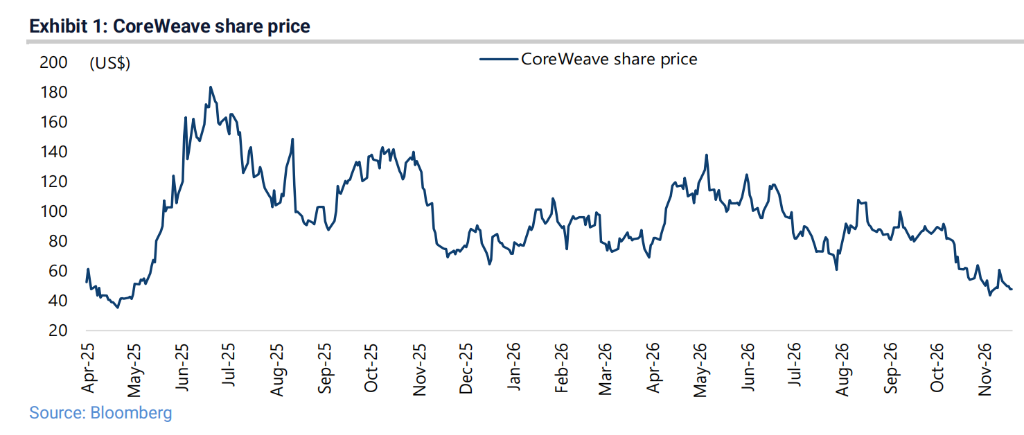
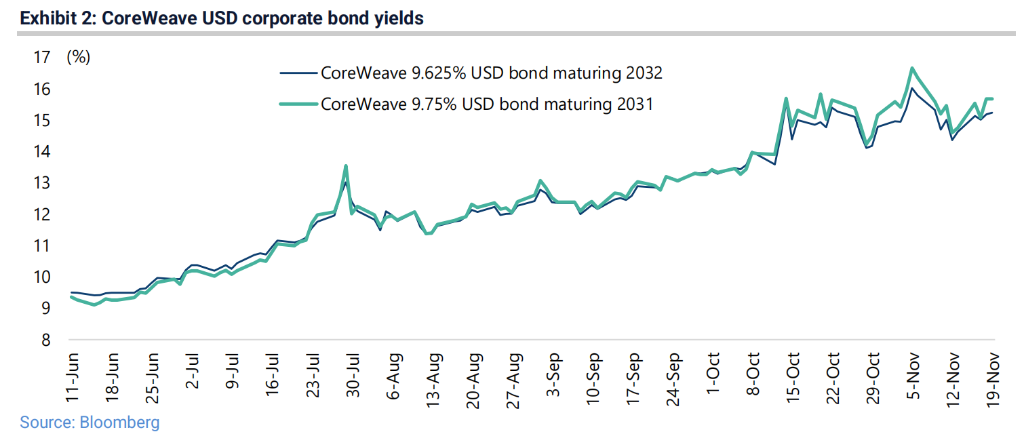
The report believes that if the most speculative demand for computing power shrinks, it could lower the pricing for other participants, creating downward pressure on the overall supply-demand dynamics of AI computing power.
Profit Dissection of Hyperscalers: Reflexivity Warning on Capital Expenditure Returns
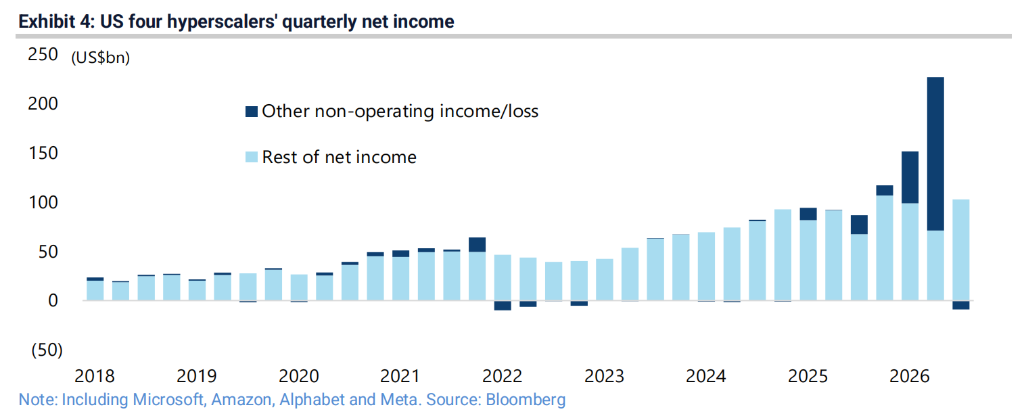
The Jefferies report conducted a deep analysis of the profit structures of Microsoft, Amazon, Alphabet, and Meta, revealing that the prior profit growth largely depended on non-cash accounting earnings from AI-related investments, rather than substantive improvements in core operating profits.
The report tracked “other non-operating income and losses,” primarily consisting of unrealized accounting gains and losses from unlisted AI-related investments. This quarterly total has suddenly reversed from +$155 billion in 2Q26 to -$9 billion in 3Q26, directly reflecting the recent accounting pullback due to declines in AI-related asset prices.
On an annualized basis, the data is equally intriguing: for the past 12 months ending in 3Q26, the combined annualized net profit of the four has increased by 73% compared to the 12 months ending in 1Q25, an increase of $248 billion (from $340 billion to $588 billion). However, of this increment, the annualized "other non-operating income" soared 18 times from $12 billion to $209 billion, contributing the vast majority of the increment ($198 billion), while the remaining annualized net profit, excluding this item, grew only 15%, adding $51 billion (from $329 billion to $379 billion).
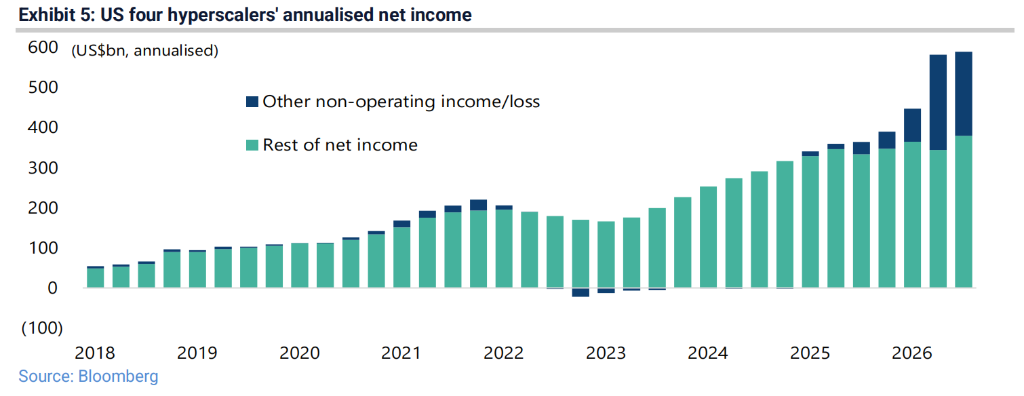
The report points out that this highlights the amplifying effect of the previous AI bull market’s "reflexivity" on accounting profits, making the market increasingly sensitive to the actual return rate of enormous capital expenditures. As AI-related asset prices adjust, this "reflexivity" is operating in the opposite direction.
At the same time, the U.S. Department of Commerce's Bureau of Industry and Security (BIS) announced export license requirements for AI chips exported to countries like Southeast Asia.
The confluence of tightened export controls, upgraded regulatory scrutiny, and a tightening financing environment means that cross-border computing power expansion and some data center projects relying on external funding will face higher compliance and funding thresholds. The report believes that this will affect the geographical distribution and expansion slope of global AI capital expenditure.
免责声明:本文章仅代表作者个人观点,不代表本平台的立场和观点。本文章仅供信息分享,不构成对任何人的任何投资建议。用户与作者之间的任何争议,与本平台无关。如网页中刊载的文章或图片涉及侵权,请提供相关的权利证明和身份证明发送邮件到[email protected],本平台相关工作人员将会进行核查。


