Abstract
• The time slice market combines price direction, fixed time windows, and outcome settlement, transforming continuous market conditions into binary events that can be individually priced, traded, and settled. Compared to generalized prediction markets, its underlying assets, duration, and settlement rules are more standardized, and trading behavior is closer to short-cycle probability trading in financial markets.
• The prices of short-cycle contracts can reflect the market's collective judgment on outcomes, but they are also influenced by liquidity, market maker risk compensation, inventory pressure, transaction costs, and user risk preferences, and cannot be directly equated to objective probabilities.
• As the time granularity continues to approach the second level, differences among data delays, order confirmations, server times, database times, and settlement times will more directly affect trading fairness. The impact of spreads, fees, and slippage will also further increase in a short window.
• Gate has productized short-cycle directional trading, covering 5-minute, 15-minute, 1-hour, and 4-hour price change events for crypto assets like BTC and ETH, and has further expanded into stock event contracts.
Introduction
The time slice market is a trading form that combines price direction, fixed time windows, and outcome settlement. Users face a clear binary question rather than an open-ended directional view: at the end of a 5-minute, 15-minute, 1-hour, or 4-hour window, is the price of the underlying asset up or down compared to the starting point? Continuous market conditions are thus segmented into events that can be individually priced, traded, and settled.
This type of market shares a system framework with generalized prediction markets, where future outcomes have uncertainties, participants express judgments through trading, and contract prices aggregate dispersed information, with the correct side receiving payouts based on pre-established rules. The U.S. Commodity Futures Trading Commission (CFTC) summarizes event contracts as having clear events, limited outcomes, fixed payouts, and expiration times, with prices typically reflecting the collective judgment of participants on outcomes.
The uniqueness of the time slice market lies in its treatment of the short-term direction of financial asset prices as event variables, standardizing the duration to minutes or hours, and relying on continuous market conditions, order books, data sources, and automated settlement systems. Gate has covered 5-minute, 15-minute, 1-hour, and 4-hour directional events for crypto assets like BTC and ETH, and launched stock event contracts.
1. Concepts and Mechanism: Time Itself Enters the Contract
1.1 From Continuous Prices to Discrete Events
In traditional spot trading, users buy assets intending to sell them at a certain point in the future, with returns depending on price changes during the holding period. Time affects returns but typically does not directly constitute the outcome condition of a single transaction. Perpetual contracts allow users to establish positions around directions but lack a fixed expiration; options involve expiry dates, strike prices, and premiums, but their return functions are more complex.
The time slice market writes a fixed-length future time segment into the product definition and provides limited results at the end of the window. Let the underlying asset be X, the starting point of the window be t0, the endpoint of the window be t1, the starting price be P0, and the settlement price be P1. If P1 is greater than or equal to P0, the result is Up; if P1 is less than P0, the result is Down. Traders do not need to predict a specific target price beforehand; the focus shifts to judging the direction of sign(P1-P0).
This processing compresses decision-making dimensions and lowers the bar for product understanding. Users typically only need to determine three variables: which underlying asset to trade; how long to choose; and whether to bet on upward or downward. The contract price and quantity determine the profit and loss structure, and the settlement rules determine whether the result is valid. Thus, the time window is no longer just an observation interval on the price chart but is part of contract rights, risk boundaries, and final payouts.
The time slice market also changes the way prices are expressed. Suppose the settlement value of a bullish share is 1 USDT, and the market quote is 0.6 USDT; ignoring fees, spreads, and risk preferences for now, this price can be interpreted as the market's collective judgment on the likelihood of an upward outcome being about 60%. However, the price cannot be directly equated to objective probability because it also includes market maker risk compensation, inventory pressure, liquidity discounts, transaction costs, and user risk preferences.
1.2 Settlement Source, Time Stamps, and Cycle Structures
The credibility of the time slice market relies on settlement rules. P0 and P1 do not have to equal the transaction price of a particular exchange at a certain second; the platform needs to predefine price sources, sampling methods, time stamps, time zones, handling of data loss, and boundary conditions. If time-weighted average price is used, the impact of a single extreme transaction on the final result is relatively limited; if a point price is used, settlement is closer to the market state at a given moment but is more susceptible to instantaneous liquidity and abnormal pricing influences.
The length of the cycle determines the market's microstructure. A 5-minute window may be affected by sudden news, order book imbalances, funding rates, futures basis, trading volume, and short-term arbitrage; a 15-minute window can absorb more trading and information; 1-hour and 4-hour windows more easily reflect trends, macro events, and cross-market linkages. The shorter the cycle, the faster the feedback speed, and the higher the proportion of noise, spreads, and execution delays in returns.
The time window also determines the continuity of trading behavior. Continuously rolling 5-minute sessions may share most price paths, and users can repeatedly adjust positions within the same market conditions; the trading volume and prices of preceding and subsequent events are not independent of each other. The resulting market is more akin to high-frequency trading on a continuous probability curve rather than a series of unrelated betting questions.
2. Borders with Generalized Prediction Markets
2.1 Common System Framework
Generalized prediction markets organize trading around future event outcomes. Events can be election results, sports games, weather conditions, economic data, company announcements, or whether financial assets increase in value over a given period. Markets usually provide binary or multiple outcomes; users buy shares representing certain outcomes, prices are formed by order books or automated market-making mechanisms, and ultimately settle according to public rules.
The time slice market shares four common characteristics with it. First, both convert uncertain futures into tradable outcomes. Second, market prices bear the information aggregation function, compressing dispersed judgments into dynamic quotes. Third, the correct side usually receives a fixed or pre-agreed payout, while the incorrect side loses settlement value. Fourth, market credibility depends on clear event definitions, credible data sources, independent settlement rules, and stable dispute resolution mechanisms.
From the perspective of informational function, the value of prediction markets comes not just from trading profits but also from concentrating dispersed knowledge into an observable price. The CFTC’s public documentation views event contracts as market tools usable for forecasting, risk management, and information aggregation. Polymarket's product documentation explains the outcome share prices as the market's immediate expression of the probability of event occurrence, but simultaneously emphasizes that prices are determined by supply and demand and do not equate to fixed odds provided by the platform.
2.2 Five Key Differences
First, the event variables are different. Event variables in generalized prediction markets derive from politics, sports, weather, policies, and economic data, while financial prices are just one among many types of events. The time slice market directly treats the direction of the underlying price relative to the starting point as the event variable, making the event highly isomorphic to financial conditions.
Second, the term structure is different. The duration of generalized prediction markets can range from minutes to years, with users potentially awaiting a match, an official statistic, or an election result. The main feature of the time slice market is standardized short cycles, where events can be continuously generated, and users receive feedback on results quickly.
Third, the settlement data is different. Political or sports markets usually await confirmation of results from official agencies, event organizers, or public documents, which may face text interpretation and confirmation delays. Financial directional markets rely on indexes, exchange prices, oracle data, or specified weighted prices, thus needing to address issues of data synchronization, time zones, trading hours, suspensions, and anomalous quotes.
Fourth, the capability structure is different. Generalized prediction markets depend on news gathering, event knowledge, and factual judgments; the time slice market relies more on reading market conditions, analyzing order books, understanding volatility, executing quickly, and maintaining capital discipline. The shorter the window, the more pronounced the impact of the market's microstructure on the macro narrative.
Fifth, the risk profiles are different. The main risks in generalized prediction markets include ambiguous event definitions, information asymmetry, insufficient liquidity, and settlement disputes. The time slice market must also endure behavioral risks brought by high noise, high turnover, and continuous feedback of results. Users may easily interpret a series of short windows as repeated arbitrage opportunities, underestimating the cumulative impact of spreads, fees, slippage, and erroneous judgments.
Therefore, the time slice market can be seen as a more financialized sub-direction within generalized prediction markets. It retains the outcome pricing and information aggregation functions of prediction markets while making underlying assets, timing, and settlement rules more standardized trading products.
3. Trading Structure of Short-Cycle Prediction Markets: On-Chain and Centralized Platforms
3.1 5-Minute Market: Predict.Fun Moving from Marginal Shares to Nearly Half Transactions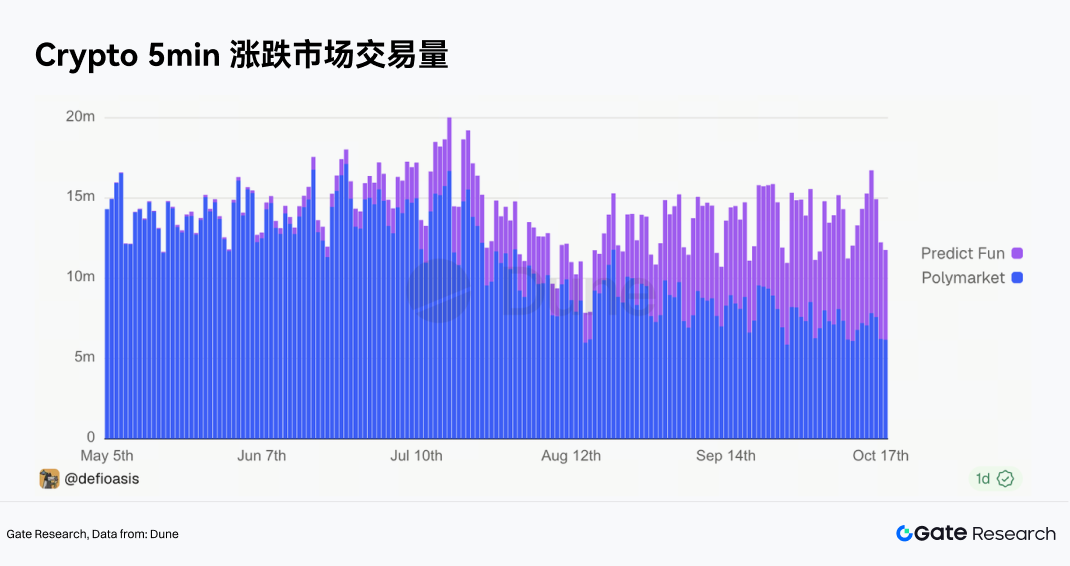
From May 5 to October 18, 2026, the Predict.Fun 5-minute crypto up-down market has cumulatively traded about $1.866 billion, with a total of about 144.2 million transactions, an average daily trading volume of about $11.18 million, an average daily transaction volume of about 863,300 transactions, and around 13,000 average daily independent traders; Predict.Fun had a cumulative trading volume of about $481 million, approximately 49.6 million transactions, an average daily trading volume of about $2.88 million, average daily transaction counts of about 297,000, and about 5,138 average daily independent traders.
The combined trading volume of the two platforms was approximately $2.347 billion. In terms of cumulative trading volume, Predict.Fun accounted for 20.5%; by cumulative transactions, it accounted for about 25.6%; by adding daily independent trader counts, it accounted for about 28.3%. Predict.Fun’s share increased progressively from capital scale to transaction counts to participant numbers, indicating that its users typically have lower average single transaction amounts and higher transaction frequencies. The average transaction amount at Polymarket is about $12.95, while at Predict.Fun, it’s about $9.69. The lower trading volume share compared to transaction count share indicates that it formed a stronger structure of high-frequency small transactions rather than relying on a few large funds to secure share.
The speed of changes in platform shares is better at indicating what is happening in the 5-minute market than the total volume. In May, Predict.Fun’s trading volume share was only about 0.72%, rising to 4.31% in June, reaching 16.46% in July, 24.59% in August, 40.46% in September, and further increasing to 47.93% by October 18. The change in transaction count proportion is even faster, already reaching 52.65% in October. During the same period, Polymarket maintained a large cumulative scale, but its monthly trading volume dropped from about $373 million in May to about $128 million by October 18; Predict.Fun rose from about $2.706 million in May to about $11.78 million in October. In terms of total volume, the market is still dominated by Polymarket; however, in terms of market share, the competitive landscape has shifted from a single platform dominating most activity to two platforms jointly meeting short-cycle demand.
Transaction peaks also indicate platform structural changes. Polymarket’s highest daily trading volume was approximately $17.12 million, occurring on June 25; Predict.Fun reached a daily peak of about $8.90 million on October 15; the combined daily trading volume peak of both was about $20.03 million on July 17. Predict.Fun’s peak occurred later, and by October, its transaction counts had already exceeded Polymarket, indicating that its growth is not merely a simple replication of early capital scale but rather accumulates order flow through higher transaction frequency and lower single transaction amounts first. For platform competition, whether users can form a continuous trading habit is more crucial for determining subsequent share.
3.2 15-Minute Market: Polymarket First, Predict.Fun Accelerates in Later Stages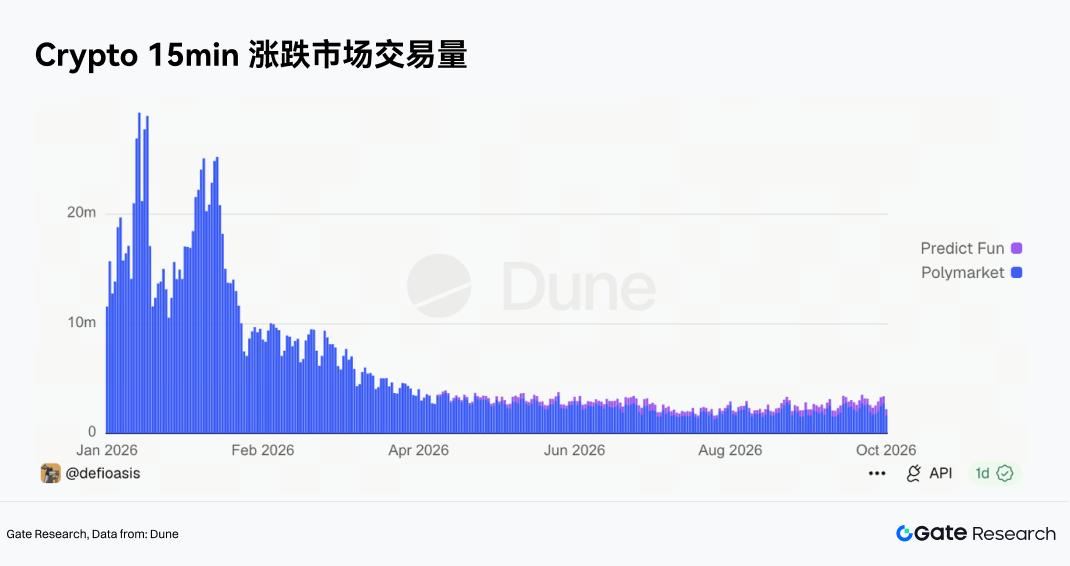
From early 2026 until now, Polymarket’s 15-minute crypto up-down has accumulated a trading volume of approximately $1.754 billion, with around 118.8 million transactions, an average daily trading volume of about $6.027 million, an average daily transaction count of about 408,300, and an average of about 7,063 independent traders daily. Predict.Fun has accumulated a trading volume of around $75.97 million, about 8.3 million transactions, with an average daily trading volume of about $261,000, an average daily transaction count of about 28,500, and approximately 1,194 average daily independent traders.
Predict.Fun launched its 15-minute market on April 26, gradually expanding trading activity thereafter. Its average single transaction amount is about $9.15, while Polymarket’s is around $14.76. Similar to the 5-minute market, Predict.Fun's transaction count shares exceed its volume share, indicating that its participants tend to engage in smaller, frequent short-cycle trading; the difference lies in the more pronounced first-mover advantage in the 15-minute market, where Predict.Fun has not yet formed a capital-bearing capability equal to Polymarket.
The monthly variations in the 15-minute market present a two-phase structure. At the beginning of the year, Polymarket’s trading volume was concentrated in January and February, at about $523 million and $442 million, respectively, then dropped to about $254 million in March, while August and September recorded approximately $56.32 million and $57.77 million respectively. Predict.Fun only had about $204,000 in April, rising to about $7.71 million in May, around $17.07 million in July, about $15.64 million in September, and about $12.07 million by October 18. The monthly trading volume share for Predict.Fun increased from 0.15% in April to 21.31% in September, and further to 22.81% in October; the transaction count share reached 34.31% in October. Predict.Fun is in a catch-up stage in the 15-minute market, but its order frequency is growing faster than its capital share, clearly exhibiting characteristics of short-term trading.
When comparing these two cycles together, it becomes evident that platform competition relates to time granularity. The 5-minute market has quicker trading feedback, enabling Predict.Fun to swiftly gain transaction counts and trader shares in the latter segment of the sample; the 15-minute market has a larger historical accumulated scale, with Polymarket’s early accumulation still evident. The platform's advantages are not synchronized across all cycles; users’ preferences for cycle lengths, settlement frequencies, and transaction costs will result in different competitive outcomes.
3.3 On-Chain TradFi 15-Minute Market: Asset Expansion Begins with High Liquidity Underlyings
Predict.Fun launched TradFi 15-minute up-down markets for stocks and commodities on August 13, 2026, with an average single transaction amount of about $10.12.
Asset distribution shows that the TradFi short-cycle market has yet to form a balanced variety structure. QQQ has a cumulative trading volume of about $159,700, accounting for 21.1%; MU has about $128,000, accounting for 16.9%; NVDA has about $110,100, accounting for 14.6%; SPCX has about $108,200, accounting for 14.3%. The top four assets combined account for approximately 66.9% of the sample trading volume, while QQQ and SPY two ETFs account for about 30.3%. Early demand is more concentrated on index products, well-known tech stocks, and assets that already have higher market attention; the expansion of asset quantity does not equate to uniform diffusion of trading demand.
Additionally, the cumulative scale of newly added assets remains generally small, suggesting that TradFi products first need to build order flows relying on high liquidity and strong recognition underlyings before directing user attention to longer-tailed assets. For the platform, stocks, indices, and commodities share the same trading interface, but this does not imply they can achieve the same liquidity; underlying recognition, trading hours, and pricing volatility characteristics directly determine market depth.
3.4 Gate Event Contract Rule Samples
Gate event contracts have turned the same categories of short-cycle directional trading into platform products. Official data shows that the first batch of crypto event contracts by Gate covers underlyings like BTC and ETH, supporting 5-minute, 15-minute, 1-hour, and 4-hour cycles. Users choose bullish or bearish positions and buy shares through the order book; after the event ends, the correct direction settles according to the rules while the shares of the incorrect direction lose settlement value. The contract price ranges from 0.01 to 0.99 USDT, with winning shares settled at 1 USDT. The product does not provide leverage and does not involve additional margin calls or forced liquidations due to price fluctuations. Before the event concludes, users can sell their positions through the order book.
Gate uses the target price at the start of the cycle as the target price for settling BTC and ETH events, utilizing the time-weighted average price for BTC and ETH provided by Chainlink for result determination. If TWAP is greater than or equal to the baseline price at the cycle's start, the result is up; if below, the result is down. This rule shifts the basis for settlement from a single instantaneous transaction point to public data flows and time-weighted methods, which can reduce the impact of single anomalous transactions on results.
3.5 Two Layers of Product Relations at Gate: Polymarket Access and Own Event Contracts
The relevant products at Gate need to be understood in two layers. The first layer is Polymarket ecosystem access. Gate event contracts integrate the Polymarket ecosystem, bringing relevant events and market information into Gate's trading environment, allowing users to participate in related event trading using USDT without establishing an on-chain wallet separately.
The second layer consists of Gate's own BTC and ETH short-cycle price direction event contracts. The result determination of these crypto events uses Chainlink’s BTC/USD and ETH/USD data streams and time-weighted average price, recording the baseline price at the start of the cycle and comparing TWAP with the baseline price at the end of the cycle. The integration of the Polymarket ecosystem with Gate’s crypto event contract’s settlement sources is not a single concept; the former corresponds to event markets and information entry, while the latter corresponds to the price determination rules of Gate contracts.
Overall, the trading data from Polymarket and Predict.Fun are used to analyze user behavior, platform competition, and asset expansion in the on-chain short-cycle market; Gate's rules are used to observe how centralized platforms transform directional predictions into tradable, pre-exitable, and automatically settled products.
4. Multi-Asset Horizontal Expansion: From Crypto Direction to TradFi
4.1 Crypto Market First
Crypto assets are suitable as early carriers for the time slice market due to reasons including continuous trading times, high global participant density, frequent price fluctuations, and mature digital infrastructure. Platforms can continuously generate 5-minute and 15-minute windows in a round-the-clock market without having to wait for traditional exchanges to open. The market attention and liquidity for BTC and ETH provide a clearer observation basis for short-cycle directional products.
The crypto market also features cross-platform interactivity. Spot, perpetual contracts, options, on-chain transactions, and centralized exchange quotations influence each other, allowing different types of traders to simultaneously observe short-term price changes. As a result, short-cycle event contracts have strong immediacy, enabling users to break down market judgments into independent events, and platforms can consistently create new trading opportunities.
4.2 Stocks, Indices, and Other TradFi Underlyings
Gate's official introduction of stock event contracts shows that the first batch includes MU, SNDK, SKHYNIX, and Yushutech, providing 5-minute and 15-minute cycles. Stock spot trading usually revolves around ownership, company fundamentals, valuation, and long-term value, whereas stock event contracts narrow the focus to price directions within specified time windows.
The demand for stock event contracts comes from various types of users. Short-term stock traders can break down intra-day judgments into clearer time units; macro traders can observe short-term feedback regarding indices, interest rates, employment data, and company financial reports; crypto platform users can engage in traditional asset short-cycle directional trading within a familiar order book environment. For the platform, stocks and index products can extend users' observation scenarios from 24/7 digital assets to different trading periods within the global financial market.
4.3 Product Challenges in TradFi Migration
Expanding asset categories does not mean that informational advantages can be directly replicated. Stock prices may quickly incorporate overnight news at the moment of market opening, with 5-minute results easily affected by gaps, announcements, and large single orders. Index products involve component stock weights, index calculation frequencies, spot and futures differences, and closing handling. Forex and commodities are impacted by the timing of macro data releases, liquidity center shifts, term structures, and basis influences. The same 5-minute window does not have the same statistical significance across different assets.
Stocks, indices, and forex also have different trading calendars. The opening and closing times of U.S. stocks, Korean stocks, and other markets, pre-market and post-market arrangements, midday breaks, holidays, suspensions, limits, and circuit breaker rules differ. Event contracts need to clarify tradable time periods, handling during breaks, whether to suspend settlements during suspensions or circuit breaks, and how settlement prices relate to market conditions.
TradFi migration will drive three types of research methods. The first is the event-driven method, observing short-term directions around financial reports, central bank speeches, economic data, and company announcements. The second is the cross-market relative value method, comparing indices, futures, spots, sector stocks, and related digital assets within the same time period. The third is the microstructure method, using transaction volumes, order book depth, opening gaps, volatility, and order flows to assess buying and selling pressures.
The TradFi time slice market will not only insert stock codes into the template of crypto products but will also incorporate opening gaps, news shocks, market calendars, and cross-market transmissions into pricing. Only platforms capable of accommodating these differences have the opportunity to transform stock short-cycle trading from a one-off activity into a stable market.
5. Short-Cycle Vertical Expansion: From Minute-Level to Second-Level
5.1 The Appeal of Second-Level Markets
The minute-level market continuing to explore down to the second level is a natural product direction that will emerge in time slice markets. 5-second, 15-second, 30-second, and 60-second windows can increase event density, allowing users to observe more independent results within the same hour, and enabling market makers, quantitative traders, and data tools to create finer product tiers.
Second-level products can also provide faster feedback. Strategies can complete testing in shorter cycles, and price shocks and cross-asset transmissions can be observed more easily. Sudden news may first affect futures, forex, or crypto assets before propagating to related stocks and indices; second-level markets provide a finer temporal scale for studying this transmission process.
5.2 Low Latency and Settlement Fairness
The main constraint on second-level markets is data latency. Client displays, server matching, data source collection, order confirmations, and settlement engines may operate on different timelines. If one user places an order based on an earlier quote while another user places an order based on the updated price, the trading conditions faced by both sides may not be symmetrical. Network delays that are tolerable in 5-minute windows may directly alter outcomes in a 10-second window.
Spreads, fees, and slippage will also quickly rise in second-level markets. If the theoretical advantage per event is less than transaction costs, continuous participation only amplifies negative expectations. Low-latency products also need to handle timestamp absences, repetitions, disorder, data source interruptions, and precision at boundary moments, clarifying whether to use server time, data source time, or block time as the standard.
The choice of settlement source also requires caution. Instantaneous prices are easily influenced by individual anomalous transactions, cross-market spreads, and liquidity exhaustion; short-window TWAP can smooth out abnormal fluctuations but may produce settlement delays. Platforms must also establish auditable data records, anomalous rollback mechanisms, fair matching rules, and anti-manipulation monitoring to prevent centralized orders, volume spoofing, order book inducement, and self-trading affecting results.
5.3 Returns, Risks, and Behavioral Feedback
Assuming a user buys a bullish contract for c USDT, with correct payouts at 1 USDT and ignoring fees, the gross return when correct is 1-c, and the loss when incorrect is c. If the win rate is p, the expected gross return for a single contract is:
p(1-c)-(1-p)c=p-c
Only if the actual win rate exceeds the breakeven probability represented by the purchase price does the trade have a positive theoretical expectation. After factoring in fees, spreads, slippage, and capital occupation, the required actual win rate must be higher. A low price does not necessarily mean good value, and a high price does not mean the outcome has been confirmed by the market. High win rates and high odds need to be measured together.
Risks in the time slice market include directional risk, model risk, execution risk, settlement risk, and behavioral risk. The absence of leverage can limit the maximum loss per event but does not eliminate cumulative losses from continuous trading. Events of 5 minutes, 15 minutes, and 1 hour may also be affected by the same macro news, and positions dispersed across different periods may not truly be diversified.
Rapid feedback can also amplify chasing losses, continuous betting, expanding positions after a series of short-term victories, and excessive turnover. The risk boundary in short-cycle markets doesn't just stop at limiting single-event maximum losses but needs to cover cumulative losses from consecutive events, the correlated risks between different periods of the same underlying, and the collective impact of the same news across multiple markets.
6. Liquidity and Market Quality: From Trading Volume to Sustainability
6.1 Market Makers and Cross-Cycle Structure
Whether the time slice market can operate sustainably depends on the liquidity loop among users, market makers, and the platform. Users wish to transact at fair prices and can exit when necessary; market makers need to compensate for inventory, volatility, and settlement risks through spreads; platforms need to continually generate events and maintain stable market discovery.
Short-cycle market-making risks differ from those in ordinary spot market-making. Market makers must manage not just the price positions of the underlying asset but also the inventory of binary outcomes nearing expiration. Near the starting price, minor fluctuations can cause rapid changes in contract prices; after sudden news, market makers need to simultaneously adjust underlying prices, implied probabilities, risk limits, and depth on both sides. If the settlement source is unstable or anomaly handling is unclear, quotes will demand higher risk compensation.
A time structure can form between different cycles. 5-minute, 15-minute, 1-hour, and 4-hour contracts can provide directional expectations for different durations. If short-cycle trading volumes suddenly increase without long cycles responding, it usually reflects immediate events or short-term funds entering; if prices and depth improve across multiple cycles simultaneously, it is closer to sustained entry by trend-following funds. The value of cross-cycle comparisons lies in judging whether short-term activity is an isolated pulse or indicates a change in market structure. Researchers can compare implied probabilities, speed of price changes, spreads, and liquidity across cycles to observe how short-term shocks enter medium-term expectations, provided that consistent underlying definitions, time boundaries, and settlement guidelines are used across different events.
6.2 From Trading Volume to Market Quality
Trading volume can only demonstrate that capital has passed through the market and does not certify market quality. In the on-chain up-down market, the total trading volume peak in the 5-minute market occurred on July 17, while the peak trading volumes for Polymarket and Predict.Fun occurred on June 25 and October 15, respectively; the peaks of trading volume and transaction counts in the 15-minute market also did not occur on the same day. The misalignment of peaks indicates that market activity stems from alternating entries of different trader groups and platforms; high trading volumes and high trading frequencies do not equate to the same thing.
For time slice markets, sustainability depends on whether trading depth and transaction costs can keep up with trading frequencies. If trading volume is high but quotes concentrate around a few large orders, regular users may still face wider spreads; if transaction counts are numerous but single amounts are small, the market may have good turnover rates but may not support large positions; if independent traders increase without corresponding depth, new demand might amplify price shocks. Both on-chain prediction markets exhibit a structure where the proportion of transaction counts exceeds that of trading volumes, indicating that the foundational activity of short-cycle products derives from high-frequency small behaviors, and platforms need to prioritize solving issues of continuous transactions, spread, and exit capacity.
Market quality is also reflected in whether liquidity can be retained after peaks. A trading spike driven by news may uplift trading volume but can quickly fade after the event ends; a stable market should maintain acceptable buy-sell spreads, market depth, and exit capabilities even after a contraction in trading volume.
7. Future Directions and Conclusions: From Single Events to Time Surfaces
7.1 Time Surfaces, Combination, and Information Services
Future time slice markets may form a multidimensional product matrix consisting of underlyings, time, direction, and settlement rules. Underlyings can expand from BTC and ETH to stocks, indices, forex, commodities, and interest rate-related assets; time can extend from 1 hour and 4 hours to 15 minutes, 5 minutes, and second-level windows; outcome variables may also broaden from up-down to ranges, volatilities, relative performances, and cross-asset spreads.
Multiple cycle contracts for the same asset can be organized into “time surfaces.” Users can observe market implied probabilities and probability change speeds across different durations, allowing researchers to identify the term structure of sentiment. Rapid rises in short-cycle probabilities while long-cycle probabilities remain unchanged may represent immediate shocks; synchronized changes across multiple cycles indicate an adjustment in market trend judgments.
Combination is another path. Platforms can combine different time windows of the same underlying, indices and sector stocks, or crypto assets with related stocks to create relative directional or cross-market strategies. Combination products can enhance capital efficiency but can also increase rule complexities during pauses, suspensions, abnormal data occurrences, and partial settlement failures. Combination must be established on the foundation of single event markets having sufficient depth.
Event contract prices may also develop into real-time information services. Platforms can offer short-term probability data by combining historical calibration, probability changes, remaining time, transaction depths, and market states. Data displays must differentiate between market prices, model probabilities, and statistical frequencies, avoiding packaging a single quote as a certain fact.
7.2 Standardization, Compliance, and Long-Term Value
If cross-platform markets use different underlying prices, timestamps, and anomaly rules, comparisons and interoperability become challenging. The industry may gradually form a unified event description format, including underlying identifiers, baseline prices, settlement prices, sampling intervals, data sources, time zones, trading periods, pause conditions, fees, and dispute processes.
Compliance and appropriateness building are equally crucial. Short-cycle binary products possess strong immediate feedback characteristics; low single transaction thresholds, continuous results, and rapid settlements may incite impulsive trading. Platforms need to enhance risk warnings, position limits, cooling-off periods, anomaly trading monitoring, and user stratification. Stocks, indices, and other TradFi underlyings also need to consider various jurisdictions' requirements regarding derivatives, event contracts, customer qualifications, gambling attributes, and market manipulation.
7.3 Conclusion
The time slice market combines price direction and fixed time windows, forming an event-driven trading product characterized by binary outcomes, clear expirations, fixed payouts, and continuous events. It shares outcome pricing and information aggregation mechanisms with generalized prediction markets but exhibits stronger financial market properties regarding event variables, time structures, settlement data, trading rhythms, and risk profiles.
The long-term value of the time slice market lies in creating a more precise expression mechanism for time, price, information, and risk. For market participants, it provides directional tools with limited loss and clear outcomes; for platforms, it demands stable execution, transparent settlements, and cross-asset rules; for researchers, it offers a new window for observing probability pricing, order flows, cross-market transmissions, and user behavior.
Reference Links:
• Dune, https://dune.com/defioasis/event-contracts
• CFTC, https://www.cftc.gov/LearnandProtect/PredictionMarkets
• Polymarket, https://docs.polymarket.com/faq
• Gate, https://www.gate.com/zh/help/event-contracts/event-faq/100550
Gate Research Institute is a comprehensive research platform for blockchain and cryptocurrencies, offering readers in-depth content, including technical analysis, hot insights, market reviews, industry research, trend forecasts, and macroeconomic policy analysis.
Disclaimer
Investment in cryptocurrency markets involves high risks; users are advised to conduct independent research and fully understand the nature of the assets and products purchased before making any investment decisions. Gate is not responsible for any losses or damages caused by such investment decisions.
免责声明:本文章仅代表作者个人观点,不代表本平台的立场和观点。本文章仅供信息分享,不构成对任何人的任何投资建议。用户与作者之间的任何争议,与本平台无关。如网页中刊载的文章或图片涉及侵权,请提供相关的权利证明和身份证明发送邮件到[email protected],本平台相关工作人员将会进行核查。


