Author: SoSoValue Research

On November 19, Anthropic went public on Nasdaq. Investors who bought at an issue price of $83 made a profit of 17.1% by the close; investors who bought at an opening price of $111.50 lost 12.9% by the end of the day. Both bought into the same rapidly growing company, but the divergence lies in how much that growth is worth.
A set of numbers in the prospectus illustrates this divergence better than the first-day price increase. In the third quarter of this year, Anthropic's revenue increased by approximately $5.4 billion compared to the previous quarter, while computing and infrastructure costs rose by about $4.3 billion. Calculating based on the account increments of both quarters, for every additional $1 in revenue, there is nearly 80 cents in new computing cost. This ratio will fluctuate significantly with the pace of computing procurement and delivery, yet it highlights the problem behind the nearly $1.8 trillion valuation: The more widespread Claude becomes, the more companies spend on AI; how much of the profit can be retained for Anthropic's shareholders?
$15 billion in first-minute trading, yielding two types of first-day returns
Anthropic's opening price was up 34.3%, hitting a high of $115.10 during the day, a rise of 38.7%. Based on the fully diluted valuation corresponding to the opening price, the company’s worth briefly exceeded $2 trillion, ranking sixth in global media rankings at that time. The closing price returned to $97.17, lowering the fully diluted valuation to about $1.77 trillion, below the level at which SpaceX closed its first day of trading.
According to Yahoo Finance, the first trading minute of Anthropic saw approximately $15 billion in transactions, but half an hour later, the stock price had dropped about 13% from the opening price. In its comparison of 21 large U.S. IPOs, this represented the weakest first half-hour performance since 2008. For the company, pricing the stock at $83 and with an offering size of about $81.3 billion has set a new global IPO record. For buyers who entered the market only after the opening, the first transaction had to pay $28.50 more per share than what the allocated buyers paid. The massive transaction in the first minute recorded this turnover under premium pricing, and buyers willing to accept this price soon faced a test.
The market environment that day also raised the valuation threshold. The Nasdaq dropped about 2.3%, and the Philadelphia Semiconductor Index fell 2.4%. Rate futures have already highly factored in a 25 basis point rate increase by the Federal Reserve in December. For companies that need to lock in years of computing power and gradually recoup investments, an increased discount rate will reduce the present value of future profits. Bloomberg economist Anna Wong is concerned that this IPO could be the “last burst of fuel” for the current AI market. Her reasoning is more worthy of discussion than the first-day stock price: according to her observation, since the end of September, the actual unit price of Claude has decreased, usage has dramatically increased, yet market share has not improved correspondingly. If more access comes from price cuts, both users and computing suppliers may benefit before model shareholders do.
A $5 billion short-term computing procurement changed quarterly earnings
The commercial demand for Claude has become quite considerable. Anthropic's revenue in the third quarter reached $17 billion, compared to about $1.4 billion in the same period last year. However, from the second quarter to the third quarter, revenue increased from $11.6 billion to $17 billion, while computing and infrastructure costs rose from $5.6 billion to $9.9 billion. The revenue corresponding to every $1 spent on computing and infrastructure costs dropped from $2.08 to $1.72. During the same period, the adjusted operating profit margin decreased from 19% to 15%; under U.S. accounting standards, the company shifted from an operating profit of $974 million to an operating loss of $567 million, the latter also accounting for equity incentive and non-cash donation expenses.
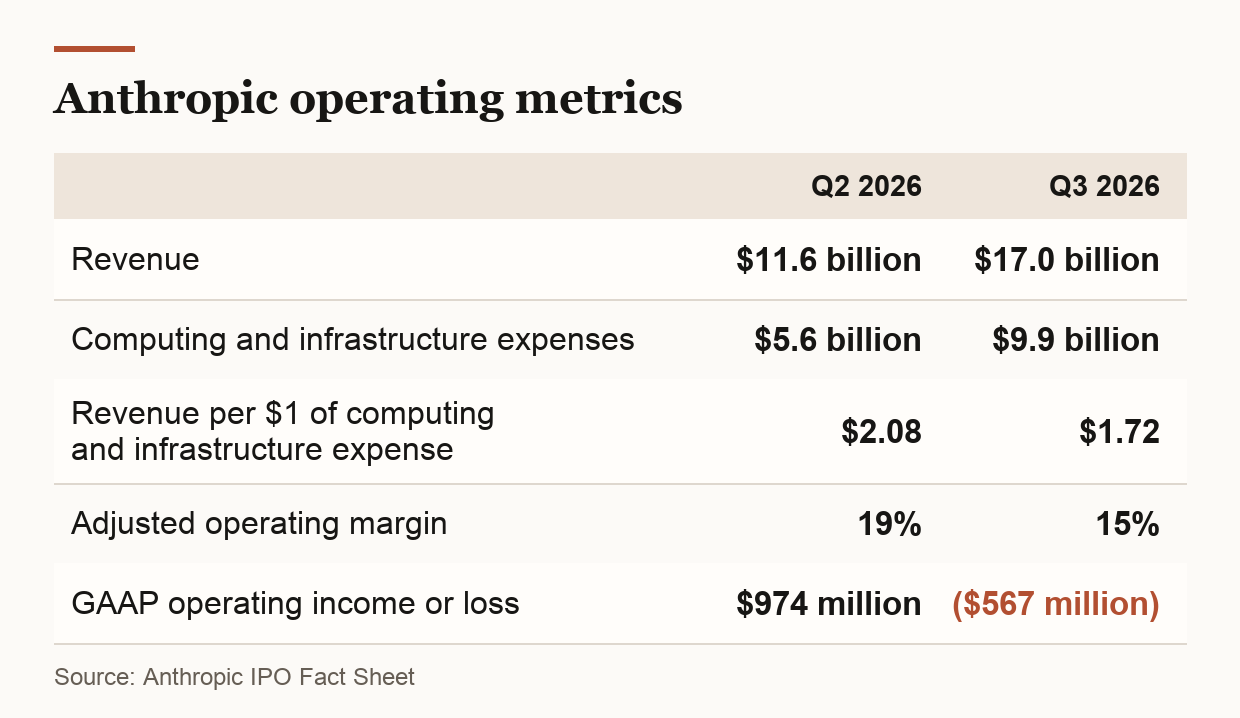
The turning point occurred in computing delivery. In the third quarter, $5 billion in computing power came from short-term procurements, with prices significantly higher than comparable long-term agreement prices. When demand surged unexpectedly, timely purchases of high-priced computing could support client businesses, at the cost of pressuring quarterly profit margins. Signing long-term agreements in advance can reduce unit costs but leaves Anthropic with another risk: once capacity is delivered, even if clients switch to cheaper models or slow down deployment, the company still has to fulfill procurement commitments.
This is also the most substantial basis for bullish investors. In the same period last year, every $1 spent on computing and infrastructure costs only corresponded to $0.68 in revenue, while this third quarter reached $1.72. As long-term procurement replaces expensive temporary capacity, as long as the payment volume is sufficient to fill the new capacity, both revenue and profit margins have the potential to grow together. Conversely, if competition forces Anthropic to continue lowering prices, the money saved from procurement may more often be passed on to customers. The post-IPO financial report will allow investors to compare these two forces on a quarter-by-quarter basis.
The same power contract holds two values on the books of two companies
As of the end of September, Anthropic disclosed computing commitments of about $90 billion, of which approximately $7.07 billion will expire within the next 12 months. For companies providing capacity, long-term contracts increase the visibility of future orders; for Anthropic, contracts lock in supply but require it to continually find customers willing to pay. Both sides may profit from Claude's growth, but on the day the order is signed, the supplier has already gained another business, while Anthropic still has to sell that capacity.
The interests of both parties are also connected through equity. Google, Microsoft, Nvidia, AMD, Broadcom, Micron, and TSMC's investment arms agreed to collectively purchase $26 billion worth of concurrent private shares at the issue price. Industry partners' willingness to invest enhances Anthropic's ability to fulfill its procurement plans; for enterprises simultaneously involved in both supply and equity, new orders bring income opportunities, and the valuation fluctuations of model companies will also impact investment returns. Treating both private equity subscriptions and computing orders as evidence of growth in terminal demand can lead to double counting the effect of the same industrial capital.
The situation for software companies is more nuanced. A tool that charges by seats may give customers a reason to pressure prices or reduce seats upon renewal if some functions can be accomplished directly by Claude. Another software vendor, who controls customer data, approval authority, and delivery processes, might use the same model to cut service costs, keeping the savings on their profit and loss statement. The decisive factor is who controls customer relationships and which contracts allow the charging of efficiency gains brought about by automation.
Market products have also emerged to track this differentiation. According to SoSoValue, SoDEX has launched $ANT spot and perpetual contracts. SSI has introduced two observation indices to track the business opportunities and competitive pressures brought by the widespread adoption of Claude. ANTBEL tracks suppliers and partners likely to benefit, while ANTHAT follows companies facing competitive pressures from cutting-edge AI models. The relative performance of these two groups of companies provides a perspective for observation, while subsequent financial reports can validate the expectations reflected in stock prices: how many profitable new orders the former group has added, and how many customers and pricing powers the latter group has retained during renewals.
For Anthropic, the benchmark left on the first day of trading includes not only the closing price of $97.17 but also the $1.72 revenue corresponding to every $1 in computing costs. In the coming quarters, if short-term procurement decreases and this ratio rises, while operating profit margins improve, the nearly $1.8 trillion valuation will gain an operational support. If Claude's usage continues to reach new highs while these indicators continue to weaken, then the commercial value of AI will still be expanding, but more of the profits will fall into the hands of suppliers and customers.
免责声明:本文章仅代表作者个人观点,不代表本平台的立场和观点。本文章仅供信息分享,不构成对任何人的任何投资建议。用户与作者之间的任何争议,与本平台无关。如网页中刊载的文章或图片涉及侵权,请提供相关的权利证明和身份证明发送邮件到[email protected],本平台相关工作人员将会进行核查。


