TL;DR
- The minutes from the October 2026 meeting show that nearly all participants believe further rate hikes are necessary, with December rate increases priced in at over 90% in the futures market, and the dollar index reaching a 19-month high.
- Gold, silver, and copper all fell during the same week. Gold was sold off as a source of liquidity for cash, while the sell-off in copper came from crowded long positions being closed, and the tightness in Chinese spot markets indicates that copper demand has not collapsed.
- Relevant instruments: gold and silver ETFs, copper ETFs and copper mining stocks, dollar index, and 10-year US Treasuries.
On November 18, 2026, spot gold fell approximately 3.2% in a single day, reaching its lowest level since September 2025. Silver dropped about 5%. Three-month copper on the London Metal Exchange fell by 5.7%, the lowest since April. On the same day, the dollar index stood at about 104, a 19-month high.
Based on past experience, when stock and AI-related positions pull back, funds typically flow into gold. This time, they did not.
For ordinary investors, understanding this round of declines requires a comparison. US Treasuries offer about 5% yield, while gold yields nothing on that day. Higher interest rates and a stronger dollar increase the opportunity cost of holding gold. This explains the first layer of pressure on gold and silver, but does not explain why copper was also sold off on the same day, nor why the decline in gold prices far exceeded the dollar's rise.
Why were these three categories of assets sold off together in the same week? The common background was the upward shift in interest rates and the strengthening dollar, while the simultaneous unwinding of crowded positions acted as an amplifier. Separating the two layers helps to clarify what gold and copper are each experiencing in their declines.
After the minutes, December rate hike is priced at over 90%
On October 28, 2026, the Federal Reserve maintained the federal funds rate range at 3.75% to 4.00%, with a voting result of 10 to 2, two officials advocating for a 25 basis point hike. The minutes released on November 18 indicated that almost all participants believed further hikes were necessary under the baseline scenario. A few mentioned that if inflation data were unfavorable, a move larger than 25 basis points could be considered in December.
This reflects the judgment at the time of the October meeting, not a decision made for December. The market treats it as a done deal because the implied probability in interest rate futures has risen to over 90%. This probability is priced from trading, not from the voting outcome.
Official statements have reinforced the same direction. Fed Governor Waller openly discussed a 50 basis point hike in December, and a faster rate hike path in 2027. New York Fed President Williams stated that tightening should continue, but not necessitate drastic action. Both pointed towards another rate hike, with the only divergence being the magnitude. The dollar index rose for about seven trading days, reaching its highest level since April 2025, directly reflecting this set of expectations.
Gold's decline is five times that of the dollar's gain
Gold prices have fallen about 10% over the last seven trading days, while the dollar has only increased by about 2%. Currency conversion can only explain a small part of this; the remainder comes from position and momentum.
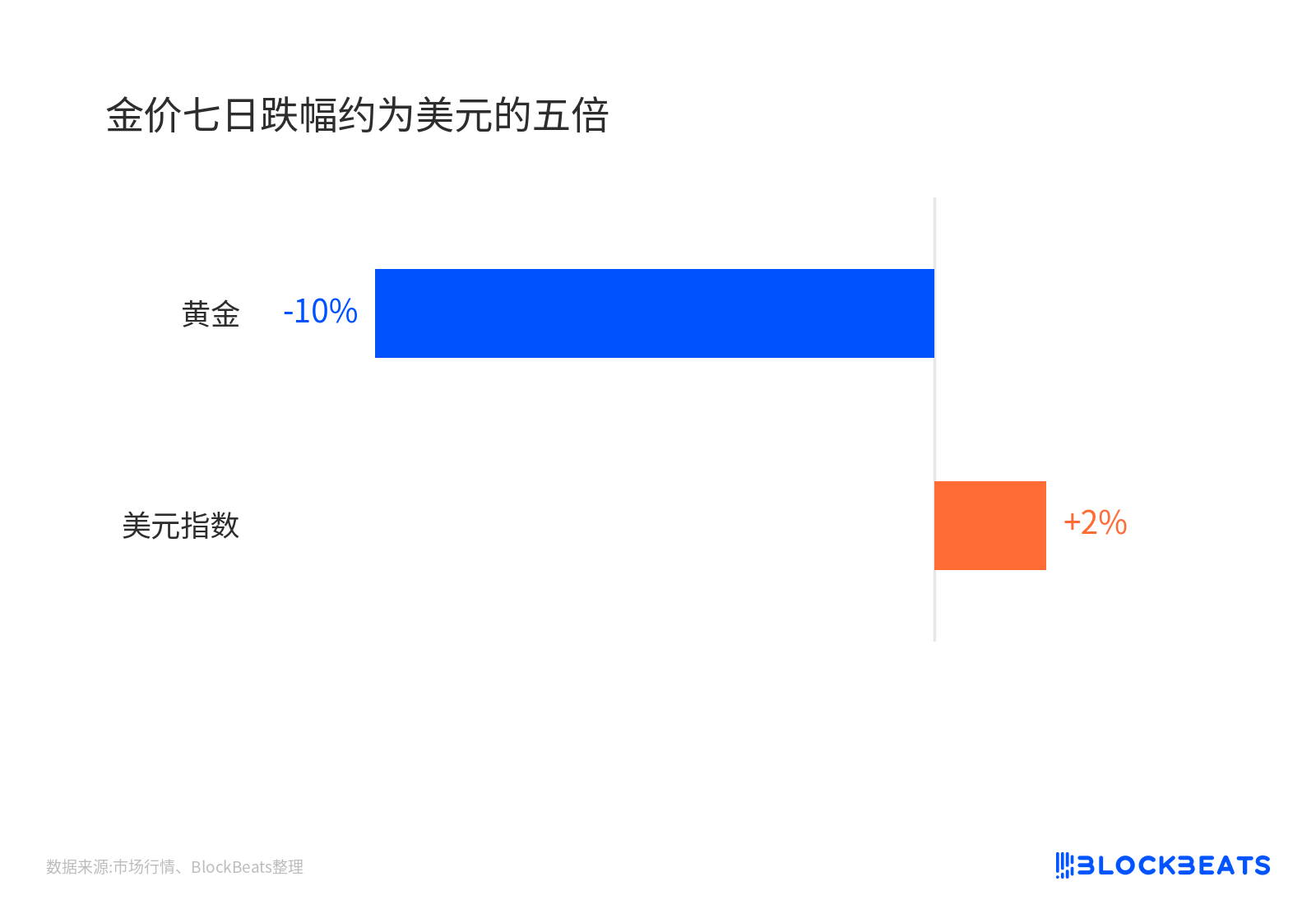
Gold price drop over seven days is about five times that of the dollar
An easily overlooked detail is that much of the drop in gold prices on the 18th occurred before the minutes were released. The minutes appeared more like a confirmation of existing pricing rather than a starting point for selling. On the same day, the yield on the 10-year Treasury note actually fell by about 8 basis points, further dropping to approximately 5.05% on the 19th, marking four consecutive days of decline. This round of declines cannot be attributed to rising yields; the dollar was strengthening concurrently.
Chris Gaffney of EverBank attributes the pressure on gold prices to interest rate expectations and a strong dollar. Niki Shiels of MKS PAMP provided another layer of explanation, indicating that gold is a liquidity asset used to raise cash in the short term. When stock and AI positions are both retracing, selling gold for cash happens more quickly than other assets. This explains why gold does not rise when the stock market drops, but it is a mechanistic judgment and cannot validate the sources of selling one by one.
Gold ETF holdings remain very high. While policies continue to lean towards tightening, there is still space for this portion of positions to be liquidated. Gold is not devoid of safe-haven demand, but rather too many people hold it, causing marginal buyers to withdraw in the face of higher rates.
Funds are retreating while China is rushing to buy
Copper fell more sharply than gold. On the 18th, London copper dropped 5.7%, and copper on the New York Mercantile Exchange fell as much as 6.7% during trading. Viewing futures and spot together reveals two opposing directions.
On the futures side, positions are retreating. The net long positions for funds in copper have fallen from a peak in mid-September to less than half, with both AI demand and tariff stockpiling narratives being unwound.
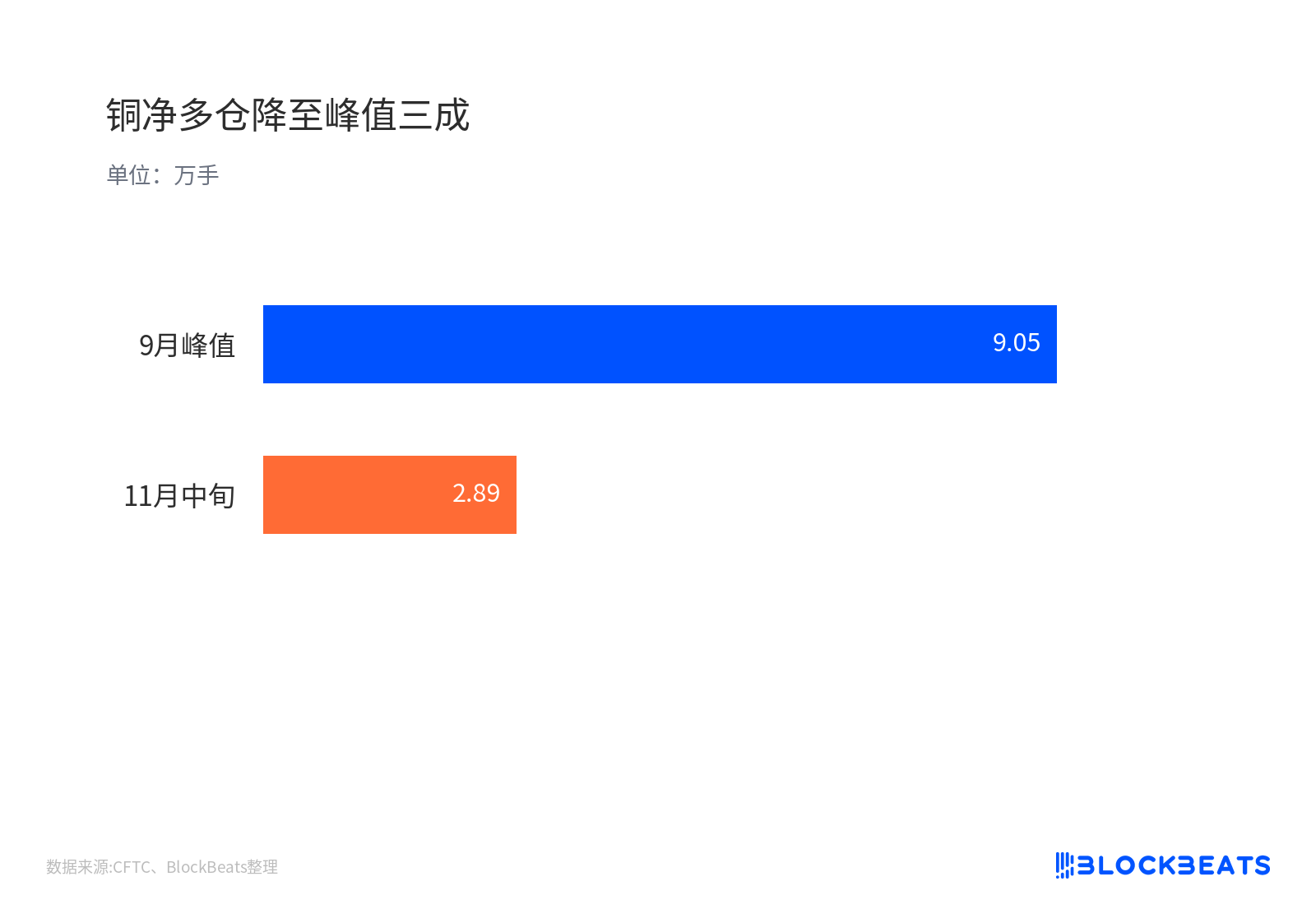
Net long positions in copper have fallen from peaks in September to less than half
On the spot side, the situation is different. Shanghai Futures Exchange copper inventories have dropped to their lowest level since December 2023, and Yangshan copper premiums have risen significantly. The latter is a markup for imported copper, and the increase indicates tightness in the spot market. The US has locked a large amount of copper in warehouses under tariff expectations, while Chinese buyers want immediate deliveries.
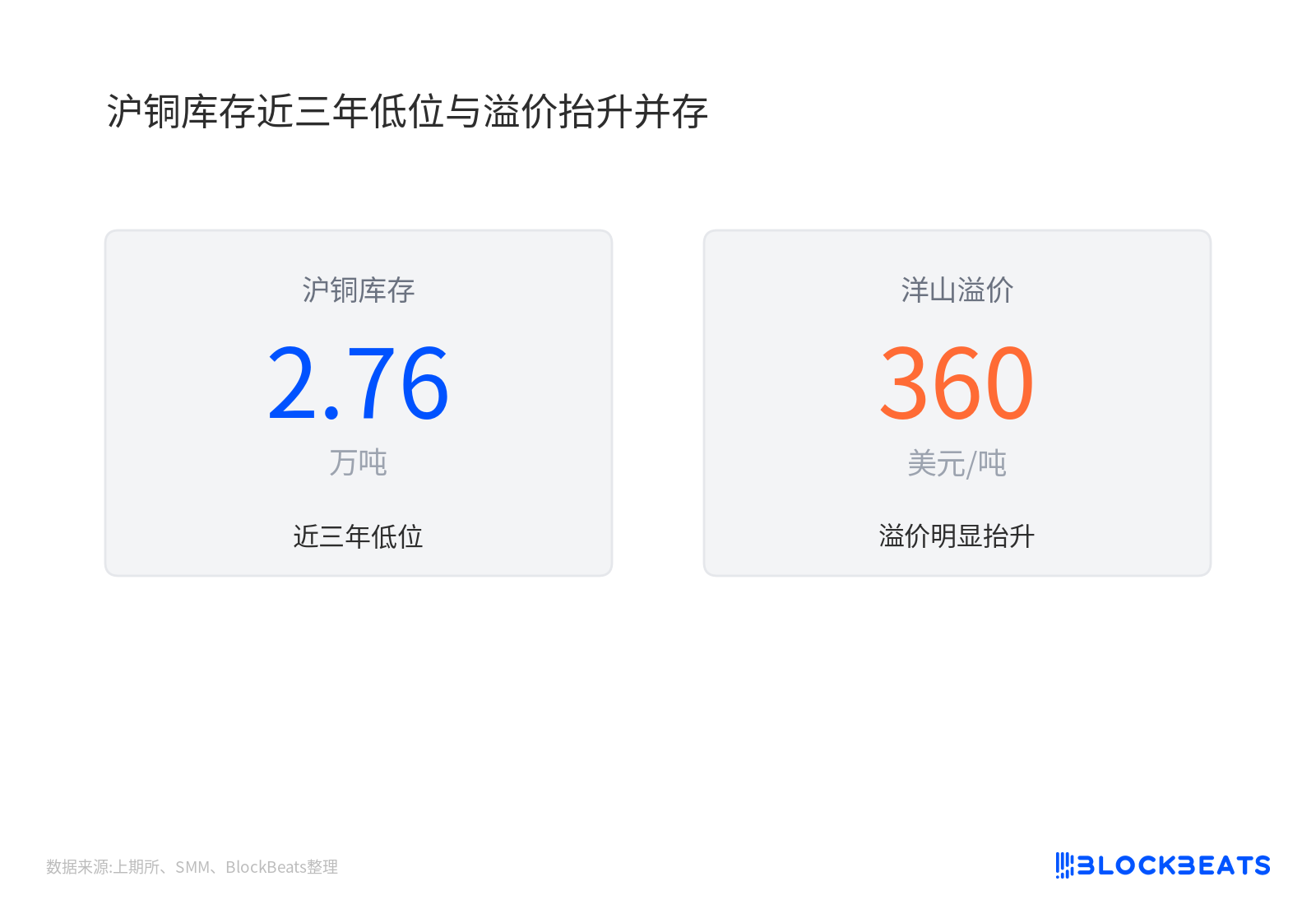
Shanghai copper inventory at near three-year low alongside rising premium
This difference is precisely where Goldman Sachs and Nicholas Snowden of Mercuria differ from French bank trade views. Goldman Sachs believes the recent copper correction is more related to positions, indicating that there is no loosening in fundamentals and maintaining a high price framework for 2027 while alerting to downside risks. Snowden thinks the current copper demand is more indicative of a recessionary environment. The French bank describes US stockpiling and AI fund flows as a bubble. They argue over the same thing: whether this round of sell-off is due to positions or demand.
On the 19th, London copper rebounded about 0.4%, failing to follow gold's continued weakness. The tightness in Chinese spot markets does not confirm that copper prices will rise immediately, but it is sufficient to negate the simple conclusion that demand from China has suddenly collapsed.
Dollar, tariffs, and AI spending determine how far the divergence can go
The interest rate meeting on December 8 to 9 will be a recent verification point. Currently, futures pricing is based on a 25 basis point increase, with the probability of a 50 basis point increase being only in the single digits to just over 10%. If only a 25 basis point increase is implemented and the wording is not more hawkish, the dollar might give back some of its gains, and the first layer of pressure on gold and silver may alleviate first.
The verification point for copper lies in another direction. Whether the US tariffs on refined copper take effect will determine if the inventory locked in warehouses will flow back. Whether AI capital spending is genuinely being cut will determine whether the narrative of AI demand for copper can be maintained. Neither of these issues are under the decision scope of the December meeting, yet they will determine whether spot premiums and futures prices will converge again.
On the 19th, copper rebounded while gold remained weak, indicating divergence has begun, but with only one trading day, it cannot be taken as evidence of a trend ending. A more prudent judgment is that this was a cross-sale triggered by both the upward shift in the interest rate anchor and the clearing of crowded positions. Gold was sold off for cash, while long paper positions in copper were liquidated. The tightness of the spot market in China is the variable that is least cooperative with the bears in this round of clearing.
免责声明:本文章仅代表作者个人观点,不代表本平台的立场和观点。本文章仅供信息分享,不构成对任何人的任何投资建议。用户与作者之间的任何争议,与本平台无关。如网页中刊载的文章或图片涉及侵权,请提供相关的权利证明和身份证明发送邮件到[email protected],本平台相关工作人员将会进行核查。


