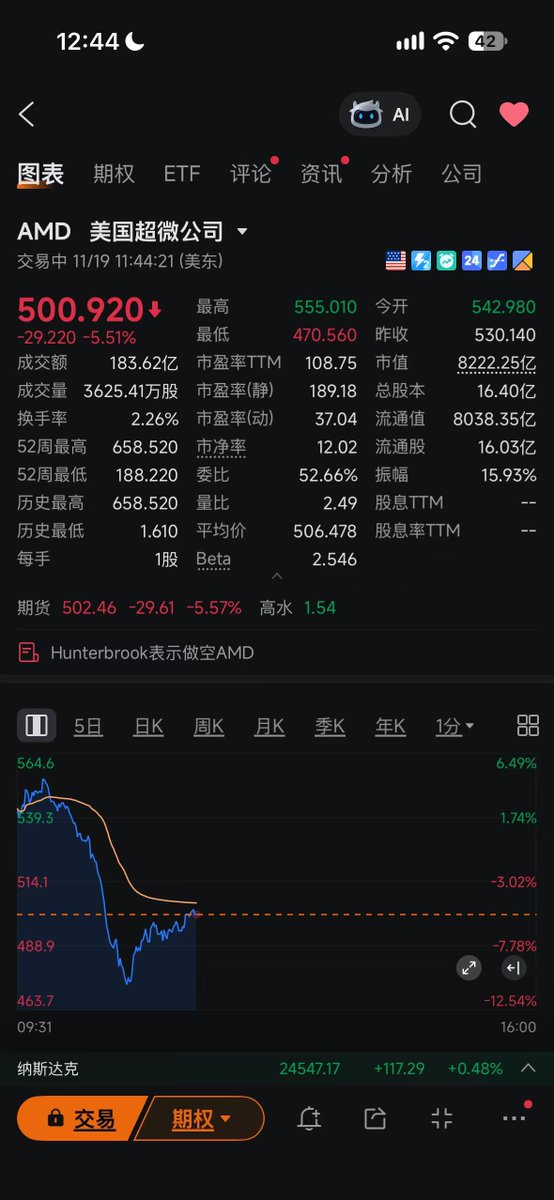
Tonight $AMD plummets due to Hunterbrook Capital's short report!🧐
Many friends are asking what happened to $AMD? Did Su's mom cheat as well?
The core trigger is a heavyweight report just released by the short-selling firm Hunterbrook, which completely exposes AMD's compliance and supply chain vulnerabilities!
I just finished reading the complete report, and I'll explain it here. In the past, we always thought the risks from export controls and entity lists were all on Nvidia, while AMD was happily profiting on the sidelines. But this report shatters that illusion; when it comes to circumventing supply and geopolitical risks, AMD is stepping on just as many landmines as Nvidia.
Specifically, there are four bombs going off simultaneously:
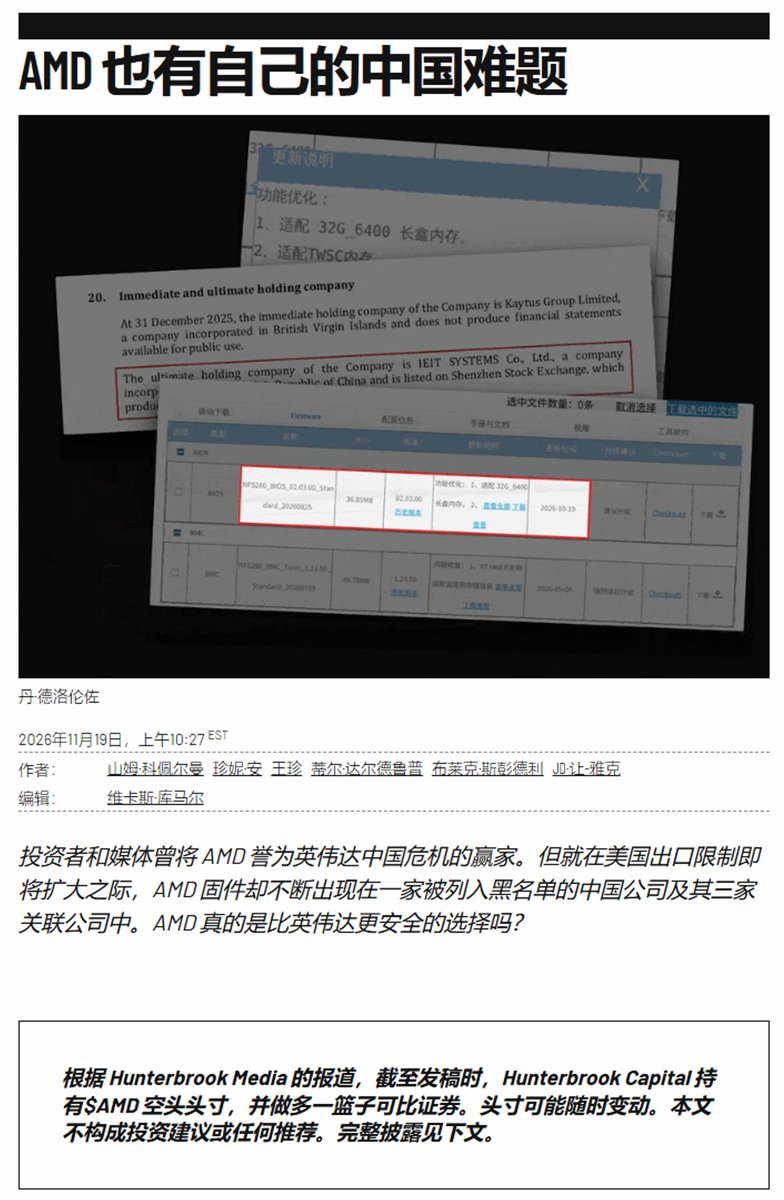
1️⃣ A blacklisted server giant is still obtaining AMD's latest firmware. Inspur Information was placed on the entity list by the U.S. Department of Commerce back in March 2025. According to the regulations, without a license, nothing can be provided to them, and the Department's stance is to reject all approvals. But Hunterbrook uncovered that Inspur, after being blacklisted, still received at least six versions of AMD's latest firmware updates (the core software that enables chips to run in servers), with the most recent just on October 19 of this year.
2️⃣ The "shell company" that went overseas has been confirmed. After being cornered, three deeply connected companies emerged: China's Maginfra, Singapore's Kaytus, and California's Aivres. They are all publicly selling their own brand servers equipped with AMD chips, but the firmware used underneath is almost identical to Inspur's, in simple terms, it's "rebranding to continue selling".
Looking through financial reports and audit accounts, Aivres was previously called Inspur Systems (a subsidiary of Inspur), and Kaytus's ultimate parent company is also Inspur. Previously, The New York Times and The Wall Street Journal only focused on Aivres helping Nvidia to distribute chips to Southeast Asia (for example, exporting over $3 billion worth of Nvidia’s computing power to serve Alibaba and ByteDance's data centers). Now everyone discovers that AMD is also deeply tied to this line. AMD's official website even lists Aivres as a server manufacturer for Instinct AI chips, and Aivres just launched new products in July this year.
3️⃣ Singapore's "golden channel" is about to be blocked. This is the real killer that has caused the crash. A new regulation just took effect today: shipping advanced chips to Singapore and four other countries now requires a license. It's crucial to note that in the fiscal year 2025, AMD's billing amount in Singapore alone reached $4.28 billion, accounting for over 10% of total sales! Even worse, by January 10, 2027, any overseas subsidiary that is more than 50% owned by a blacklisted company will also be subject to restrictions. By then, these shell companies like Kaytus will all be out of business, and AMD's lucrative business will face delays or even supply interruptions.
4️⃣ The "China dependency syndrome" for revenue and capacity is too deep. The report also revealed many old accounts: AMD's 2025 annual report shows a licensing income of $67 million, which turns out to come from two joint ventures in China that have been blacklisted since 2019; the product catalog from February of this year even listed servers from the blacklisted company Zhongke Shuguang's shell company Cancon.
The underlying logic is that AMD not only has over 20% of its revenue coming directly from mainland China and Hong Kong, but even the assembly, testing, and packaging of crucial chips are mostly controlled by Tongfu Microelectronics. The two joint ventures that Tongfu holds 85% of handle most of AMD's testing and packaging work, while AMD only accounts for 15%, and even lent them $100 million, which has yet to be repaid by the end of September. In May this year, Su’s mom personally went to Suzhou to cut the ribbon with the local leader for a new factory.
Before releasing the report, Hunterbrook asked AMD if they obtained a license; AMD first delayed and said they would respond the next day, but ultimately went silent, and the other related companies also collectively remained quiet.
The logic of market sentiment is very simple: previously, everyone gave AMD a high valuation because they believed it could both reap AI benefits and avoid regulatory penalties. Now it turns out that it is not only deeply involved in gray channels, but even the most critical testing and packaging capacity and over 30% of Asian revenue are hanging in the air. Once this uncertainty emerges, funds will undoubtedly run away!
In summary, the risks in AI semiconductors need to be addressed one by one. Personally, I feel it will take some more time. Simply put, the cheap chips from U.S. capital haven't been collected enough yet; this handover of chips is expected to require more funds like Silicon Valley genius Leopold's Situational Awareness Fund to blow up before it can conclude, and without bloodied chips, Wall Street's greed won't stop!🧐
免责声明:本文章仅代表作者个人观点,不代表本平台的立场和观点。本文章仅供信息分享,不构成对任何人的任何投资建议。用户与作者之间的任何争议,与本平台无关。如网页中刊载的文章或图片涉及侵权,请提供相关的权利证明和身份证明发送邮件到[email protected],本平台相关工作人员将会进行核查。


