The recent cryptocurrency market can be said to be extremely cold, but it is precisely in such moments that we can better discern the resilience and value of projects. As the saying goes, the big waves wash away the sand; only when the tide retreats do we know who is swimming naked and who is bravely moving forward! 🧐
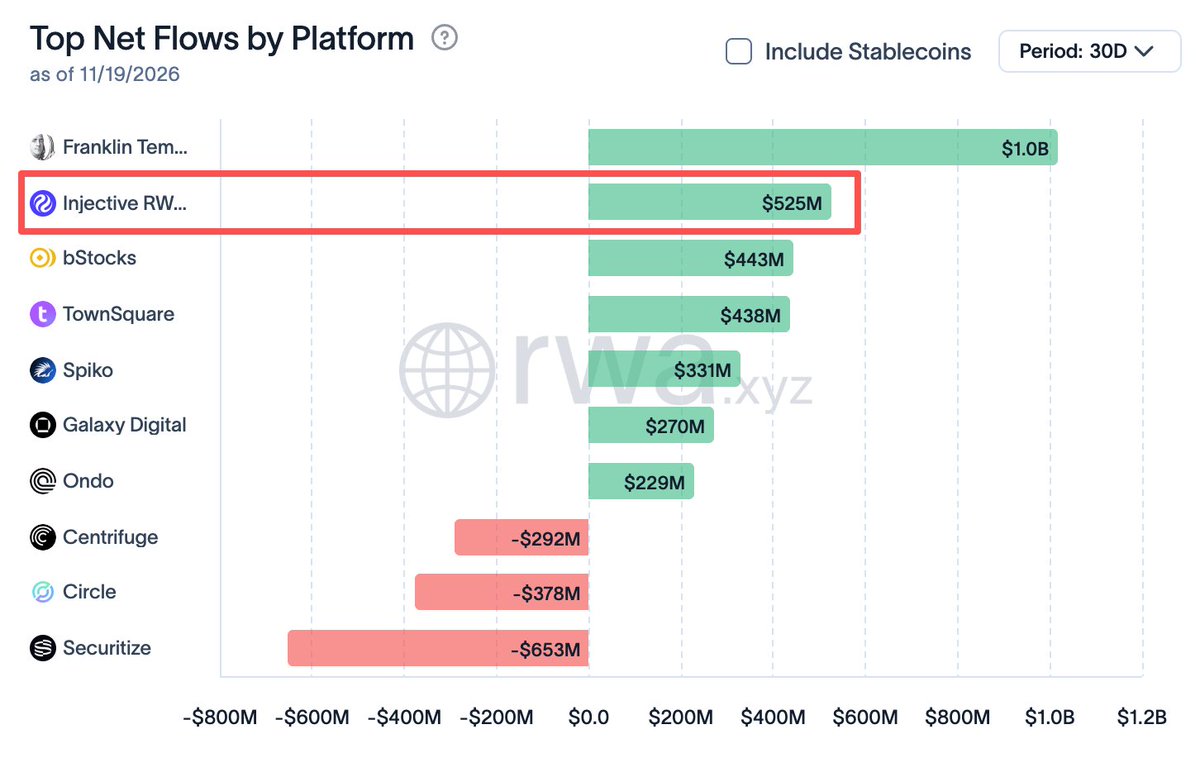
Today, our researcher reported a piece of data to me 📊. Since we have been observing the growth of the #RWA track for a long time, we found an unusual discovery today: over the past 30 days, the #Injective public chain has unexpectedly increased by 525 million dollars in funds, second only to the trillion-dollar traditional asset management giant Franklin Templeton, as shown below! 👇
So I checked the information and found an interesting event. The company listed on the New York Stock Exchange, Pentiv (formerly Pineapple Financial), moved 525 million dollars in real estate mortgage loans onto the @injective chain in just one day!
Following this wave, the total scale of tokenized mortgage loans on Injective has directly broken 1.5 billion dollars, with a month-on-month increase of 49%. According to current data 📊, it is also the largest tokenized real estate public chain in the entire network, without a doubt.
Looking back at the RWA track, many people might still be stuck in the thinking of two years ago, focusing on standardized assets like government bonds and money market funds. But think about it, what is the largest asset class in the world? It is actually real estate, which is also the heaviest and hardest nut to crack in traditional finance.
Previously, records of mortgage loans were scattered across outdated systems in various institutions, with mismatched data, slow circulation, and high verification costs, creating pure information islands. What Pentiv is doing is quite practical:
• Recording the data of each loan directly on the Injective chain
• Protecting the privacy of borrowers
• Providing transparency of the underlying assets, which can be audited at any time
Moreover, this is just the beginning. Their goal is to migrate over 10 billion dollars in historical mortgage loans. At the same time, the company has also set a 100 million dollar $INJ allocation plan. Using someone else's chain to run a business and actually buying their tokens with real money, this binding essentially means they are family now!
Extending the timeline, Injective has recently been advancing very rapidly in traditional finance. The team is constantly taking action:
• Secured SEC registration as a transfer agent, followed by the launch of Institutional Rail, which provided a direct dedicated channel for banks and large asset managers
• POSCO International and LG CNS from South Korea chose it as a pilot for trade receivable tokenization
• BDACS launched South Korea’s first Korean won stablecoin on it
• On November 6, founder Eric Chen and the CEO of @CanaryFunds jointly rang the bell for the $INJ staking ETF ($INJC) on Nasdaq
Overall, one side is Wall Street ETFs opening capital access, while the other side is the real mortgage assets of US-listed companies moving onto the chain. While others are still debating whether RWA is a pseudo proposition, Injective has already consumed traditional assets at the billion-dollar level, developing rapidly.
The changes in the fundamentals of $INJ are worth ongoing close tracking. Of course, the current market is cold, so we must observe and research more before taking action! DYOR 🙏
免责声明:本文章仅代表作者个人观点,不代表本平台的立场和观点。本文章仅供信息分享,不构成对任何人的任何投资建议。用户与作者之间的任何争议,与本平台无关。如网页中刊载的文章或图片涉及侵权,请提供相关的权利证明和身份证明发送邮件到[email protected],本平台相关工作人员将会进行核查。


