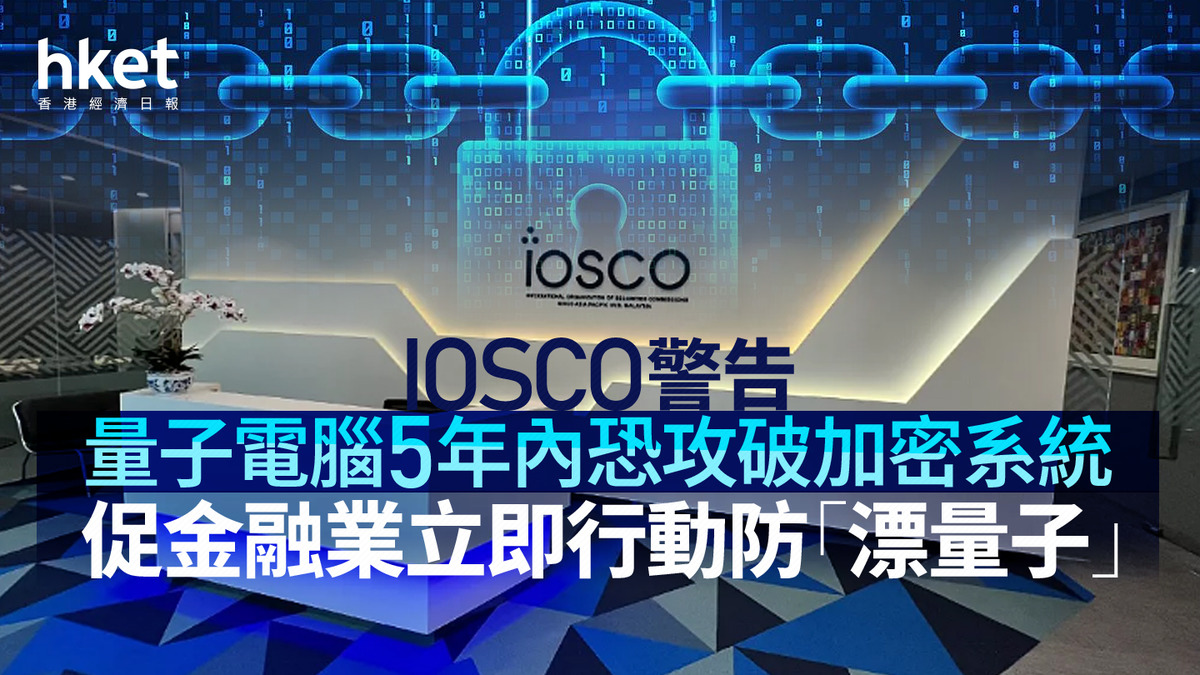
International Organization of Securities Commissions Warns Quantum Computing Threatens Financial Encryption Security
Blockchain Systems Face Quantum Cracking Risks and Upgrade Challenges
Regulatory Bodies Urge Financial Industry to Immediately Plan, and Prevent Quantum Misinformation
The International Organization of Securities Commissions (IOSCO) published a report on Thursday (19th), urging the global financial industry to "immediately take action" to address the risks posed by Quantum Computing, while warning that powerful quantum computers may weaken core financial functions such as encrypted communications within the next five years, with blockchain systems being particularly vulnerable.
IOSCO, which covers regulatory bodies across more than 130 jurisdictions, pointed out in its "Final Report on the Impact of Quantum Computing on Financial Markets" that some quantum computing platforms are already "highly advanced," solving complex mathematical problems at speeds far exceeding current supercomputers, which could crack widely used digital information and public key encryption technologies.
Decentralization of Blockchain Difficult to Coordinate; Upgrading Faces Severe Challenges
The report specifically names cryptocurrency and blockchain systems as facing extremely high risks, as blockchain relies on traditional cryptography for protection. Once quantum computers come into practical use, hackers will be able to quickly crack relevant encryption codes. IOSCO stated that it is even more challenging for blockchain to shift to post-quantum cryptography because system upgrades require the entire decentralized network to reach coordination, rather than merely routine software updates, describing it as a "fundamental redesign" involving operational and governance challenges.
IOSCO pointed out that the financial industry’s preparation for quantum security is still in the early stages, with most institutions only increasing awareness, identifying high-risk encrypted assets, and making preliminary plans, without entering the actual migration testing and execution phase. Additionally, the development of artificial intelligence (AI) may further compress the time institutions have to detect and respond to cyber attacks. Regulatory bodies urge financial enterprises to immediately formulate migration plans, test new technologies, and coordinate with software, cloud services, and infrastructure providers.
Prevent "Quantum Washing" Misinformation to Protect Investors; Listed as Regulatory Focus for 2027
Although quantum computing has developmental potential in areas such as portfolio optimization, derivative pricing, risk management, and fraud detection, IOSCO's survey shows that currently no jurisdictions surveyed have practical operational deployments, limited only to research and pilot testing.
As the concept of quantum becomes more prominent, capital markets are also accelerating their influx. According to McKinsey data, investment in quantum technology startups reached 12.6 billion dollars last year, soaring more than five times compared to 2024; US President Donald Trump also signed an executive order this June to strengthen America's quantum capabilities.
In this regard, IOSCO reminds national regulatory bodies to be vigilant against the phenomenon of "Quantum Washing," and to strictly guard against companies exaggerating the maturity or performance of their quantum technologies to mislead investors. IOSCO Board Chairman Jean-Paul Servais emphasized that although practical quantum computers capable of cracking existing encryption technologies have not yet emerged, the scale and duration of system transformation are significant, and the entire financial ecosystem must begin preparations from today. IOSCO will also list quantum issues as a priority focus for 2027.
This article is reproduced from Hong Kong Economic Daily, and the copyright belongs to the original author and original media.
免责声明:本文章仅代表作者个人观点,不代表本平台的立场和观点。本文章仅供信息分享,不构成对任何人的任何投资建议。用户与作者之间的任何争议,与本平台无关。如网页中刊载的文章或图片涉及侵权,请提供相关的权利证明和身份证明发送邮件到[email protected],本平台相关工作人员将会进行核查。


