
Text|Wang Xinyi
Editor|Zhang Yuxin
From GPT-6 Astra to Fable 5.2, the iteration of model versions continuously refreshes people's understanding of AI capabilities. People's expectations for more powerful AI are often pinned on the arrival of the next version.
Between two version updates, the model completes tasks through context, and its parameters usually remain unchanged. So, can the model continuously internalize verified experiences and knowledge after being put into use, modify model parameters, and transform them into reusable abilities for subsequent tasks?
Wuyazhi's solution is to equip the model with a "plug-in brain" that can rewrite its parameters in seconds.
According to the report from "Intelligent Emergence", Wuyazhi has recently completed hundreds of millions in angel round and angel plus round financing, with investors including Wuyuan Capital, Sequoia China, Lenovo Star, Zhongguancun Science City Fund, and Gobi Partners,FlowCapital serves as the financial advisor for this financing round. The funds will mainly be used for technological breakthroughs and product implementation of the company's self-developed real-time RSI model.
Wuyazhi was established in June 2026, with Assistant Professor Zhang Muhan from Peking University as the Chief Scientist, focusing primarily on continuous learning of parameters and real-time RSI (Recursive Self-Improvement), allowing the model to continuously iterate, update parameters, and enhance its intelligence after leaving the factory.
Zhang Muhan graduated from Shanghai Jiao Tong University with a bachelor's degree and earned his Ph.D. in Computer Science from Washington University in St. Louis, USA, under the tutelage of Washington University's endowed professor and AAAI and IEEE fellow Chen Yixin. After obtaining his Ph.D., he conducted research on large-scale graph machine learning systems at Facebook. He returned to China in 2021 and currently serves as an Assistant Professor and Ph.D. Supervisor at the Institute of Artificial Intelligence, Peking University.
As early as around 2018, while researching graph neural networks, Zhang Muhan began to consider the neural network itself as a computational graph, using another network to understand its structure and predict its performance. Now, he extends this research idea to continuous learning, directly generating parameter updates for the base model via a hyper-network, making new knowledge part of the model itself.
A hyper-network is a network capable of generating part or all of another neural network's parameters, outputting the weights or parameter updates required by the target network based on input tasks, data features, or model states. Once the hyper-network is trained, it can directly generate parameter updates based on new knowledge, reducing the need for repeated training processes.
The early validation of this idea is reflected in the SHINE paper released by Zhang Muhan and collaborators in February 2026, which was subsequently included in ICML 2026. The main content of this research is that, through a single forward computation of the hyper-network, context is transformed into parameter updates for the base model, allowing the model to answer related questions without reading the original text.
Furthermore, they also observed that the hyper-network trained on English corpora demonstrated internalization capabilities for Chinese materials. This means that the hyper-network can still generate effective parameter updates when faced with unseen materials. This unexpected generalizability has shown Zhang Muhan the potential of this technical route and prompted him to decide to further expand the scope of training and explore the boundaries of the model's continuous learning capabilities.

From version iteration to continuous learning
The current mainstream direction of RSI largely follows the AI for AI approach, using existing models to write code, optimize operators and training infrastructure, synthesize data, helping the next generation of models to complete training faster and better, and then using stronger models to accelerate the next round of R&D.
Wuyazhi's bet on RSI is not to train the next base model. According to Zhang Muhan, retraining a new model every few months, this "re-manufacturing" approach is not very continuous and is too time-consuming and energy-intensive. "Humans do not learn like this; what we learned before has already been consolidated into long-term memory and skilled abilities, reflected in the changes in the strength and structure of connections between neurons," he said.
Therefore, Wuyazhi has turned its attention to continuous learning, hoping to enable the model to absorb new incremental knowledge based on existing capabilities, reducing the consumption associated with repeated retraining.
Compared to continuous retraining, the continuous learning path that Zhang Muhan bets on has two advantages—cost savings and timeliness. New knowledge can be directly generated as parameter updates through the hyper-network, reducing the dependence on total retraining and eliminating the need to constantly wait for the model version updates that happen every few months.
In his view, continuous learning is also a necessary part of AGI (Artificial General Intelligence). Long-range tasks will continually accumulate new information and sometimes need to unlock new capabilities beyond the fundamental abilities of the model; however, the content that can be directly utilized by single inferences is limited by the context window, and the model's capabilities are also constrained by the factory parameter limits of the base model; expanding the window further increases computational and memory overhead. Therefore, Zhang Muhan hopes that the model can encode some experiences into the parameters, continuously accumulate beyond limited context, and continuously acquire new abilities during the inference process.
At the current stage, there are several different technical explorations of continuous learning, such as using efficient parameter tuning methods like LoRA to absorb new knowledge or improving capabilities through reinforcement learning from experiences. These methods can be combined, but online updates often still require backpropagation; in high-frequency learning scenarios, the cost of updates and catastrophic forgetting remain problems to solve.
Wuyazhi has chosen a differentiated path for continuous learning, pre-training a hyper-network to learn to directly generate parameter updates for the base model based on new contexts.
Zhang Muhan tells us that the hyper-network used for generating parameters is pretrained from scratch, cannot be post-trained based on open-source large models, and the data also needs to be collected independently; both the architecture design and training methods have undergone massive exploration. It needs to allow the hyper-network to handle unseen materials while ensuring that the base model retains its original abilities after continuous learning. In Zhang Muhan's view, these remain the core technical challenges. He also emphasizes: "Allowing it to learn continuously does not mean learning everything. Which information is worth learning, and whether updates will impact existing abilities and safety, these need to be studied alongside learning capability."
How to train such a hyper-network? In the simplified process outlined in the paper, they input the collected materials into the hyper-network, which generates parameter updates for the base model, then checks if the updated base model can recite or continue relevant content. The loss calculated based on the model's performance will be backpropagated to the hyper-network to adjust its parameters, allowing it to generate more effective updates the next time.
How these capabilities will ultimately be delivered is still being explored by the team. Currently, the team has expanded the scale of knowledge internalization from about 1K tokens during the paper stage to millions of tokens, and the relevant abilities are still undergoing further validation.

Allowing enterprises and individuals to have dedicated models
If one wants to learn Cao Xueqin's writing style, is it possible to summarize the first 80 chapters into a skill document and then have the model write accordingly? Zhang Muhan believes it is very difficult.
This is because language style includes subtle habits of word choice, word frequency, and collocations. Long narratives also involve the consistency of character traits, plots, and details. These rules are hard to outline item by item, but encoding these rules into model parameters offers another possibility.
This is also his understanding of "compression equals intelligence": compressing patterns from a large amount of content into parameters is necessary to form generalizable intelligence. Unlike RAG (Retrieval-Augmented Generation), which temporarily invokes fragmentary information, parameter compression can extract experiences, logic, and regulations from vast corpora and transform them into long-term reusable model capabilities.
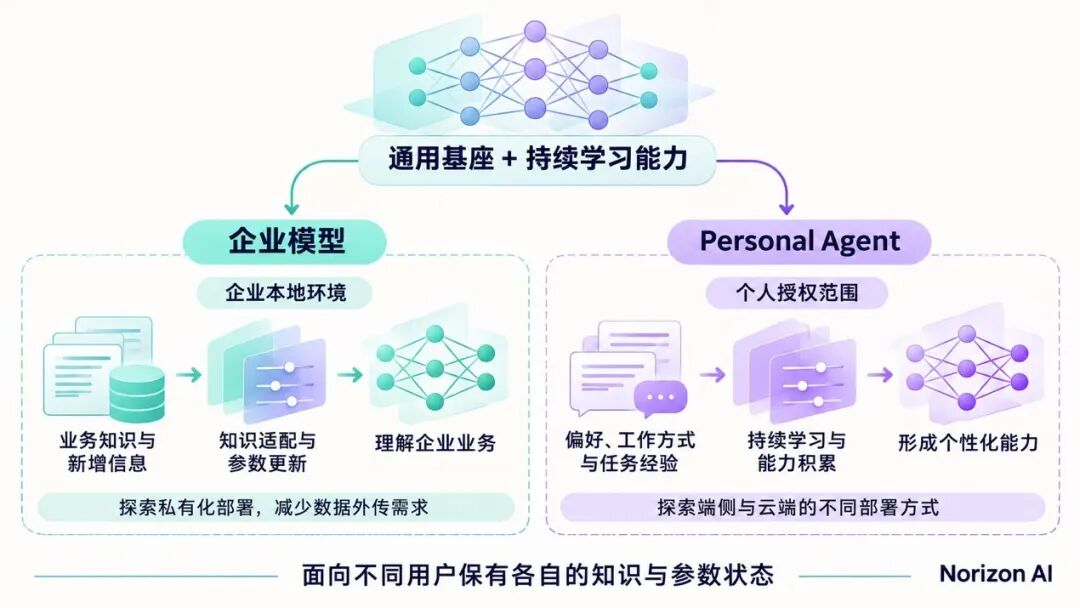
Similar demands also exist in enterprise and personal agents. Enterprises want the model to master their business knowledge, while individuals hope that AI can gradually understand their preferences and working styles. These pieces of information accumulate during use; how to enable the model to utilize them effectively and long-term presents an opportunity that Wuyazhi has seen.
In Zhang Muhan's view, they are betting on an RSI direction that is closer to commercialization. "Based on our current research progress, we have achieved the capability for rapid internalization and learning at a seconds level under mid-long data scales. This means that we have some potential for landing in many scenarios."
Specifically, they are trying two directions—enterprise and Personal Agent.
Enterprises have a large amount of internal data and produce new business information daily, with a significant portion of this data being real-time, professional, and confidential. For enterprises that cannot upload data to external platforms and do not have enough resources and technology to build model training systems, hyper-networks can help write data into model parameters in real-time, allowing models to gradually adapt to and understand the enterprise's own business.
The benefit is that enterprises can privatize deployment, completing model learning and updates locally, which hopes to lower the threshold for enterprises to update models locally and reduce the need for sensitive data to be transmitted to external platforms. Wuyazhi also considers data security and privacy protection as important considerations in R&D, hoping to allow enterprises to effectively utilize the value of their data while retaining management and control over it.
The other direction is the Personal Agent. An agent serving users for a long time will continually accumulate dialogue, work records, and task trajectories. In Zhang Muhan's vision, Personal Agents can not only master user preferences, experiences, and working styles but also continuously learn from the internet and other environments, acquiring capabilities that exceed those of the user while maintaining an understanding of the user.
Moreover, these models may be deployed on the edge or run in the cloud. On the edge, it can explore scales of models from 1B to 27B; in the cloud, by sharing bases and maintaining some personalized parameters, it can reduce the costs of providing dedicated models for different users.
Wuyazhi hopes to provide continuous learning capabilities for different users on top of a general base model. Currently, the team is promoting research based on open-source models to train the corresponding hyper-networks.
It is reported that Wuyazhi has gathered a group of young researchers, including talents with backgrounds from Peking University, Tsinghua University, MIT, and others, as well as gold medal winners from the Olympic competitions, ICPC, and researchers in directions like post-training and agents, with a team size of more than 20.
Zhang Muhan expects that in the next three to five years, or even in a shorter time, continuous learning might become a universal capability of models. In the future, models could break free from standardized, customized version upgrade schemes from large companies and self-evolve in different work scenarios, allowing them to continuously acquire new abilities after leaving the factory. If this vision becomes a reality, people's expectations for stronger AI might change as well.
Image source|Provided by the enterprise
免责声明:本文章仅代表作者个人观点,不代表本平台的立场和观点。本文章仅供信息分享,不构成对任何人的任何投资建议。用户与作者之间的任何争议,与本平台无关。如网页中刊载的文章或图片涉及侵权,请提供相关的权利证明和身份证明发送邮件到[email protected],本平台相关工作人员将会进行核查。


