The IPO pricing for Anthropic has been announced: $83 per share, with 98 million shares issued? No, it's 980 million shares. According to the official announcement, Anthropic is issuing 980 million Class A common shares, expected to begin trading on Nasdaq under the ticker "ANT" on November 19, 2026.
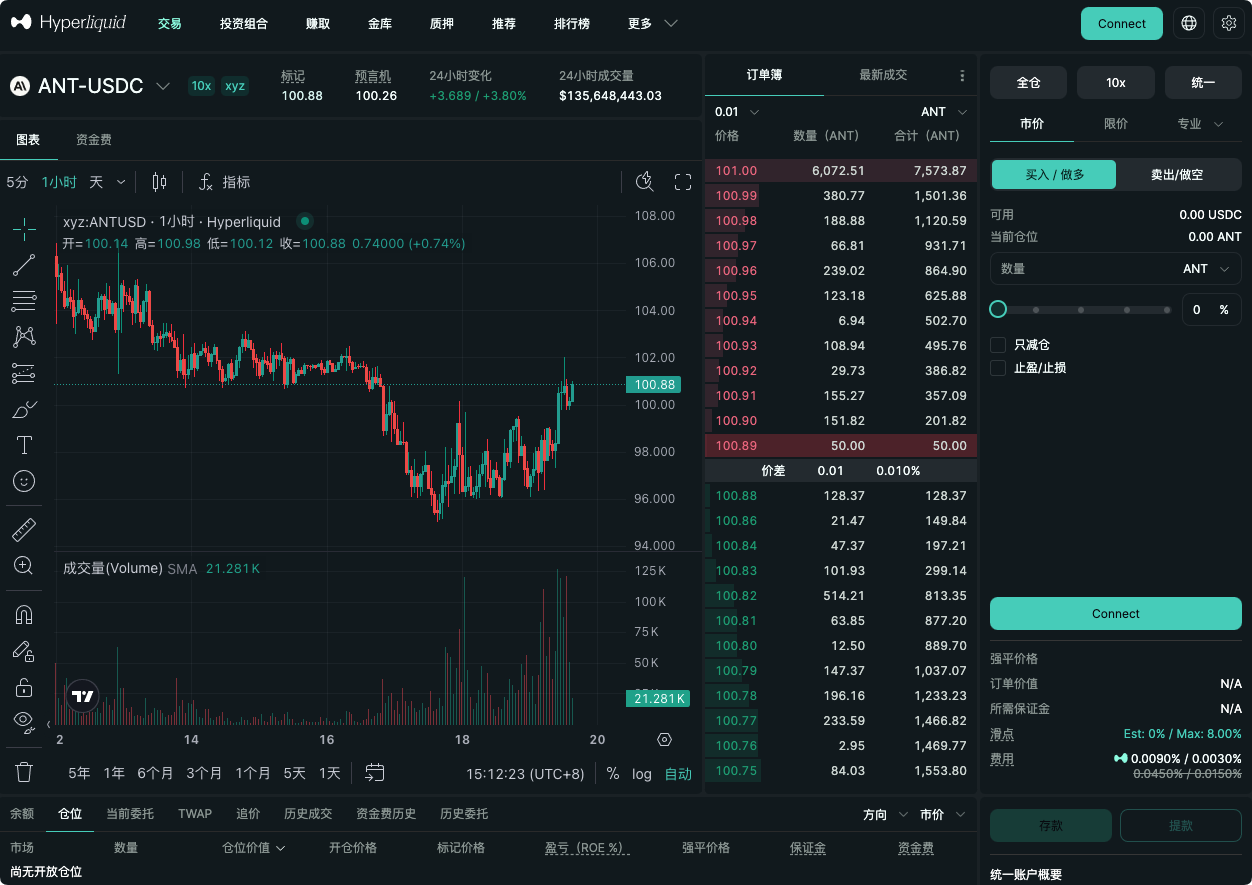
Before the first transaction occurs in the public market, the cryptocurrency sphere has already priced the shares close to $99.
AiCoin's dynamic data shows that around 09:16 Beijing time on November 19, Binance's ANT contract was about $98.80, OKX was approximately $98.91, and Bitget was around $98.87; on Hyperliquid, TradeXYZ was about $98.57, and Entropy, after converting based on its published estimate, was approximately $97.86.
Meanwhile, two addresses on Hyperliquid held four ANT-related short positions on TradeXYZ and Entropy, with a nominal total of about $97.05 million in unrecognized profit of approximately $3.21 million. Based on the current published conversion factor of 17.62 from Entropy, the two addresses combined had about 988,600 equivalent short positions, with a weighted entry price of about $101.41.
This looks like a story of "IPO investors making money while on-chain shorts are facing liquidation."
However, the truly interesting point is: even if ANT rises to $100 after its listing, investors who received shares at $83 benefit, and this set of shorts established at an average of $101.41 may continue to profit.
This is not a logical contradiction, but rather two traders have completely different cost bases.
Between $83 and $99, there are two pricing systems
The official announcement from Anthropic confirmed the IPO issuance price of $83, with 980,000,000 Class A common shares issued, most of which were sold by Anthropic, with some from selling shareholders; the stock is expected to start trading on Nasdaq on November 19.
AiCoin cited an early issuance range of $70 to $78. The final $83 was not only above the upper limit of the original range but also accompanied by an expansion of the issued shares to 980 million.
Therefore, at least three different prices exist in the market simultaneously:
- $83: The issuance cost for IPO participants;
- About $98 to $99: The prices willing to trade ANT-related contracts on trading platforms before listing;
- The Nasdaq price after formal listing: Re-determined by the first actual transaction on the public market and subsequent buy/sell orders.
The three prices cannot be equated directly.
$83 is the primary market distribution price. $98 to $99 represents a price expression in the pre-market derivatives market. The first transaction on Nasdaq has to be formed through matching in the public market.
New investors calculate gains from $83, pre-market longs begin to assess risk from around $98, while on-chain shorts might calculate P&L starting from approximately $101.41.
Thus, when ANT rises to $100 after listing, it is not surprising that both investors and shorts can profit simultaneously.
A group of shorts’ gains or losses depend on where they started selling
AiCoin's organization of this group of on-chain shorts shows:
- Address 0x…cd8ce holds about $71.65 million in short positions, with an unrealized profit of around $3.16 million;
- Address 0x…9b412 holds about $25.39 million in short positions, with an unrealized profit of about $48,000;
- The two addresses have a combined nominal short position of about $97.05 million;
- Based on the 17.62 multiplier estimate, that's approximately 988,600 equivalent short positions;
- The weighted entry price is about $101.41;
- The current indicative liquidation price is around $148.
Using the simplest static model representation:
Short Gross P&L ≈ (Weighted Entry Price − Settlement Price) × Equivalent Shares
If we ignore funding rates, fees, slippage, and conversion rules, considering only the 988,600 equivalent short positions:
- Settlement Price $100: Gross profit for shorts is approximately $1.39 million;
- Settlement Price $95: Gross profit for shorts is approximately $6.33 million;
- Settlement Price $110: Gross loss for shorts is approximately $8.49 million.
Meanwhile, investors who received shares at $83 would see a paper gain of about 20.5% at $100; at $95, the paper gain would still be about 14.5%.
This represents two outcomes under the same candlestick:
Buyers at the issuance price see "how much it has risen"; pre-market shorts see "how much it has dropped from $101.41."
For shorts, the rise of ANT from $83 to $100 is meaningless because they did not establish their position at $83. For new investors, the drop from $101.41 to $100 has no significance either, as they did not short sell at $101.41.
The real comparison needed is the entry price, contract quantity, and settlement method for each trader.
This is not simple risk-free arbitrage
Seeing a price difference of several dollars between $83 and $99, many people's first reaction is: buy the cheap IPO, then sell the expensive pre-market contracts.
The reality is not that simple.
First, ordinary investors may not get the $83 allocation
$83 is the issuance price, not a public spot price that anyone can buy at that price. IPO allocations involve subscription qualifications, distribution ratios, and lock-up or delivery arrangements. The "issuance price" cannot be treated as a price available for instant purchase.
Second, pre-market contracts do not equal one share of actual stock
ANT-related products on TradeXYZ and Entropy are perpetual or price exposure products, not equating to real stock ownership. Hyperliquid's official documentation indicates that the maximum leverage for perpetual assets varies by asset, ranging from 3x to 40x; maintenance margin is related to maximum leverage.
This type of product typically does not automatically confer voting rights, dividend rights, corporate governance rights, or rights to physical stock delivery. Its value derives from the contractual expression of ANT's price rather than genuinely holding Anthropic Class A stock in an account.
Third, Entropy's conversion factor remains an estimation parameter
AiCoin explicitly uses the 17.62x conversion factor published by Entropy. According to this multiplier, the two addresses represent about 988,600 equivalent short positions, with a weighted entry price of about $101.41.
However, the final conversion factor, IPO conversion rules, settlement prices, and market rules may determine actual profits and losses. The estimated share count does not equate to the final settled share count, and the nominal scale shown on the chain does not equal the quantity of stocks that can be delivered directly.
Fourth, unrealized profit does not equal cash in hand
Currently, about $3.21 million of unrealized profit is merely a floating result calculated based on the marked price at that time. If ANT's price rises quickly, the unrealized profit for shorts may shrink rapidly; if there is insufficient liquidity, the actual execution price when closing positions may also diverge significantly from the marked price.
AiCoin mentions that the indicative liquidation price for major shorts is around $148. This indicates that in scenarios of $100 or $110, there may still be margin buffers for positions, but does not mean that traders can ignore funding rates, additional margin, and market impact.
Why the first transaction after opening is more important than "99 dollars"
Before trading officially begins, pre-market contracts assume the price discovery function.
They express market expectations for the price on the first trading day of Anthropic in advance. Binance's ANT contracts recorded about $163 million in trading volume over the past 24 hours, with an open nominal scale of about $149 million; Hyperliquid's TradeXYZ logged about $89.1 million, with Entropy at around $30.36 million, totaling about $119 million across both markets; the open nominal scale for both is approximately $375 million.
This means that before the actual stock begins trading, related derivatives markets have already accumulated hundreds of millions in trading volume and nominal positions.
However, there is a critical limitation to the pre-market price discovery: it may resonate between multiple derivatives markets rather than providing a final confirmation from the stock spot market.
Once the first public transaction occurs on Nasdaq, the market will have a new reference price. What needs to be observed next is not whether "pre-market prices are accurate," but rather:
1. Whether the first transaction is significantly higher or lower than $98 to $99;
2. Whether TradeXYZ and Entropy synchronize to adjust marked prices;
3. Whether this group of nearly $100 million in short positions reduces, rolls over, or continues to hold;
4. Whether the price difference between Binance, OKX, Bitget, and Hyperliquid widens;
5. Whether the decrease in OI is voluntary closing or due to liquidation resulting in passive disappearance of positions.
If the first spot transaction is significantly above pre-market prices, shorts will quickly face unrealized loss pressures; if the actual transaction is below pre-market prices, pre-market longs will need to reinterpret the premium they previously paid.
The value of Hyperliquid lies in turning event trading into observable data
The most noteworthy aspect of the Anthropic case is not whether a particular address can make millions, but how event-driven trading leaves continuous observable traces on-chain.
In traditional markets, it is difficult for ordinary users to see real-time specific short positions, average entry prices, and unrealized profits and losses for a trading account. Perpetual positions on Hyperliquid can be tracked through public account data, market prices, OI, and liquidation information.
Of course, on-chain visibility still has its limits.
You can see a particular address's short positions on TradeXYZ and Entropy, but you cannot see its complete portfolio in Binance, OKX, OTC markets, real stocks, or other brokerage accounts. A seemingly directional short might be a hedge for a long position in another market.
Therefore, on-chain positions should be understood as a "visible leg," not as the full balance sheet of the trader.
This is also why these two addresses cannot be simply labeled as "shorting Anthropic." They might be engaging in event arbitrage, hedging inventory, or even holding opposite positions in other markets.
For such events, what data should be observed
For ordinary users, the most valuable thing is not to copy these two addresses, but to establish a set of observation processes.
Look at price differences, not just one platform
Simultaneously observe the IPO issuance price, real stock price, centralized exchange ANT contracts, TradeXYZ and Entropy prices. When different market prices diverge, first determine whether they are measured in the same units and settlement rules.
Observe whether OI changes accompany price changes
Price increases with OI rising usually indicate new positions entering; price increases with OI declining may indicate short covering; price decreases with OI rising could suggest new shorts being established.
Looking solely at price changes does not determine whether the momentum is driven by new capital or by position liquidations.
Watch funding rates and liquidation prices
Hyperliquid's official documentation states that the oracle price will participate in calculations for funding rates and marked prices, with marked prices further used for margin, liquidation, and triggering of stop-loss and take-profit orders.
This means that traders cannot focus solely on the latest transaction price on candlesticks. What truly affects the survival of positions is the marked price, margin rate, funding rate, and liquidation rules.
Observe whether large positions adjust proactively
If after the first spot transaction, shorts quickly reduce positions, it indicates traders may choose to lock in profits; if shorts continue to increase, this may suggest they believe pre-market prices are still too high; if positions remain unchanged, it prompts consideration of whether they have hedging combinations in other markets.
AiCoin's mobile app helps users consolidate ANT-related market data, candlesticks, trading volumes, OI, funding rates, liquidation, and large trades into a unified observation framework. The real value lies not in "following the whales' trades," but in observing how prices, positions, and liquidity change simultaneously at event nodes.
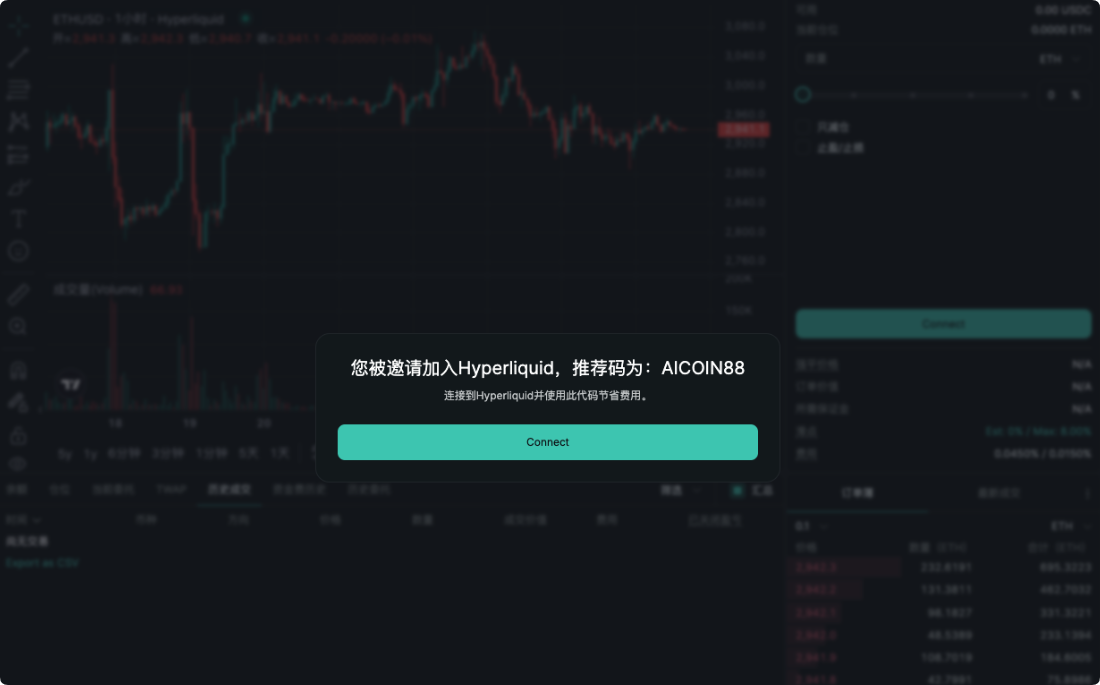
If you wish to connect to Hyperliquid and continuously monitor related markets, you can use the exclusive entry: Connect to Hyperliquid.
Invitation code: AICOIN88. Eligible trades will receive 4% commission rebate, with specific rebate qualifications, calculation guidelines, and arrival times subject to event rules.
Conclusion: In the same listing, there can be three completely different winners
Anthropic's IPO places three market layers on the same timeline:
- Primary market investors acquire shares at $83;
- Pre-market traders transact ANT-related price exposures at approximately $98 to $99;
- Shorts on Hyperliquid assume downside risk at an equivalent average price of about $101.41.
When ANT's price lists at $100, the three do not face the same profit or loss.
Issuance price buyers might still witness about a 20.5% paper gain; shorts entering at $101.41 may retain about $1.39 million in gross profit; if the price continues to rise to $110, shorts could potentially realize a gross loss of about $8.49 million.
What this transaction really teaches the market is not "shorts are clever" or "IPO investors make profits," but a more fundamental principle:
Any arbitrage, hedging, or whale position must first clarify its cost basis, contract units, settlement rules, and hidden legs.
The value of Hyperliquid lies in presenting these prices, positions, and liquidation signals more transparently; AiCoin's value is in helping users put signals scattered across different markets into the same observation process.
But transparency does not mean risk-free, and on-chain visibility does not equate to replicating the complete strategies of professional institutions.
Exclusive Benefits for AiCoin Users
👉 When binding a Hyperliquid account, enter the invitation code AICOIN88 to enjoy 4% commission rebate
🔗 Exclusive registration link:
https://app.hyperliquid.xyz/join/AICOIN88
📖 Beginner's Tutorials:
- "AiCoin PC Hyperliquid Authorization Trading Tutorial":
https://www.aicoin.com/zh-Hans/article/514197
- "AiCoin Mobile Hyperliquid Authorization Trading Tutorial":
https://www.aicoin.com/zh-Hans/article/541383
- "Entry-Level Guide! Ultra-detailed Pictorial Tutorial for First Time Trading on Hyperliquid":
https://www.aicoin.com/zh-Hans/article/510225
📖 Community Interaction:
- Telegram:
- Discord:
- AiCoin Group Chat:
https://www.aicoin.com/link/chat?cid=N6OVMor5g
The content of this article represents the author's personal views only and does not reflect the stance of this platform. The views, conclusions, and suggestions herein are for investor reference only and do not constitute any investment advice related to this platform. Investing in US stocks entails market risks, regulatory risks, and compliance risks with local laws and regulations (especially forex controls, foreign investment reporting, etc.).
免责声明:本文章仅代表作者个人观点,不代表本平台的立场和观点。本文章仅供信息分享,不构成对任何人的任何投资建议。用户与作者之间的任何争议,与本平台无关。如网页中刊载的文章或图片涉及侵权,请提供相关的权利证明和身份证明发送邮件到[email protected],本平台相关工作人员将会进行核查。