Author: AiPlot Research Institute
Focus: RWA / Digital Assets / In-depth Analysis of Financial Infrastructure
Website:https://aiplot.com/?utm_source=aicoin
1. First Change the Problem: RWA Tokens Are Not a Homogeneous Asset Class
Discussions around the RWA market often place "tokenization scale", "number of partners", "popularity" and "token price" on the same narrative chain. However, the RWA value chain contains at least five different links:
1. Asset Rights Layer: Legalize and map ownership, beneficiary rights, claims, or redemption rights corresponding to real assets such as gold, funds, government bonds, loans, receivables, into tokens.
2. Data and Verification Layer: Reliably transmit real-world information such as price, net asset value, reserves, company actions, collateral status, etc. onto the blockchain, triggering restrictions or automated processes during anomalies.
3. Issuance and Compliance Layer: Handle KYC/whitelisting, freezing, transfer restrictions, investor qualifications, custody, redemption, and legal documents.
4. Network Payment, Settlement, and Interoperability Layer: Provide ledgers, gas, cross-chain messaging, atomic settlements, smart contract execution, and institutional system connections.
5. Governance, Liquidity, and Application Layer: Decide on protocol parameters, manage risks, provide lending or trading markets, and possibly form token economic links through fees, burning or staking mechanisms.
However, the most important classification is:
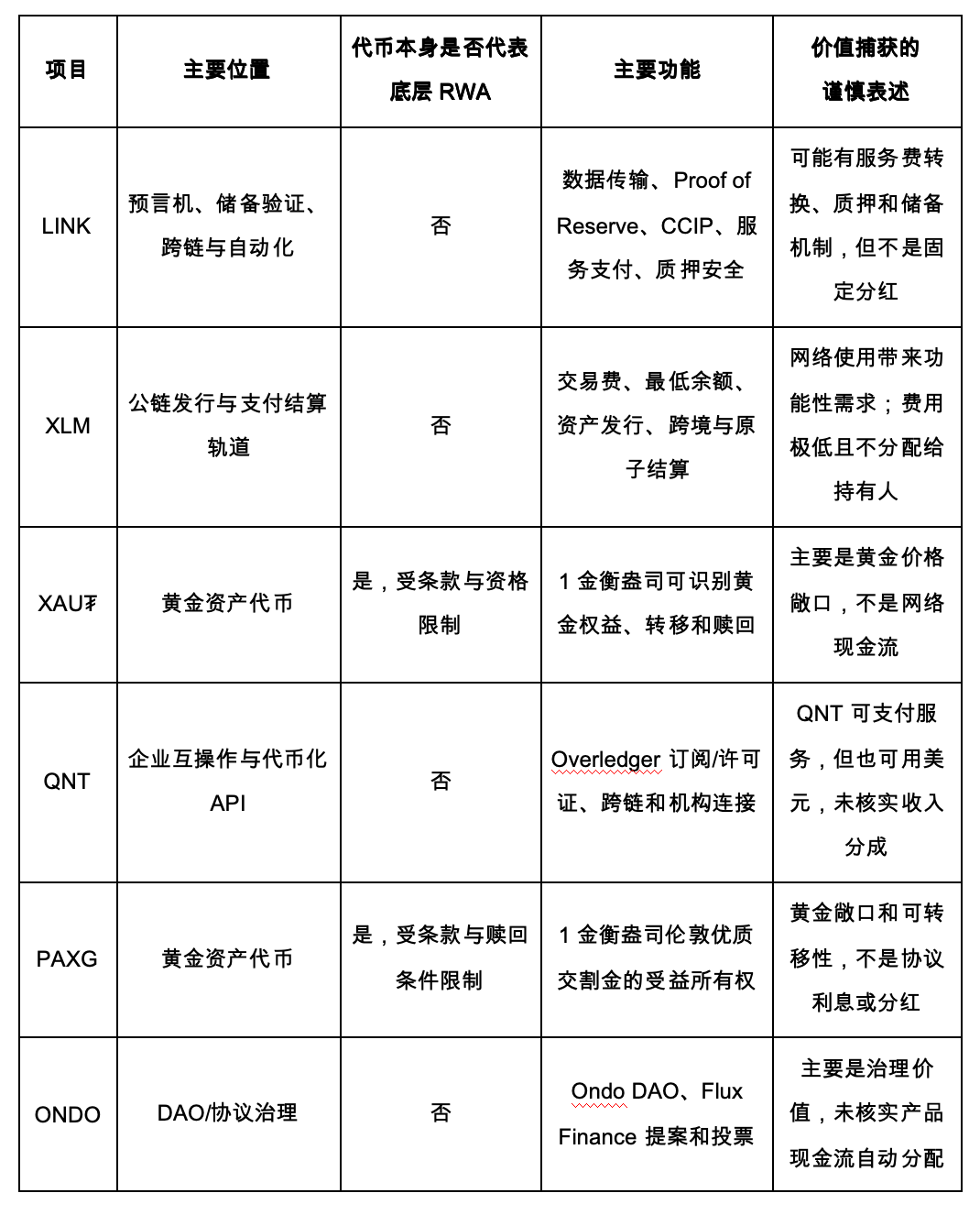
- Tokens Representing Real Assets: PAXG, XAU₮. Their core is the rights to gold and conditional redemption/transfer, not maintaining blockchain consensus.
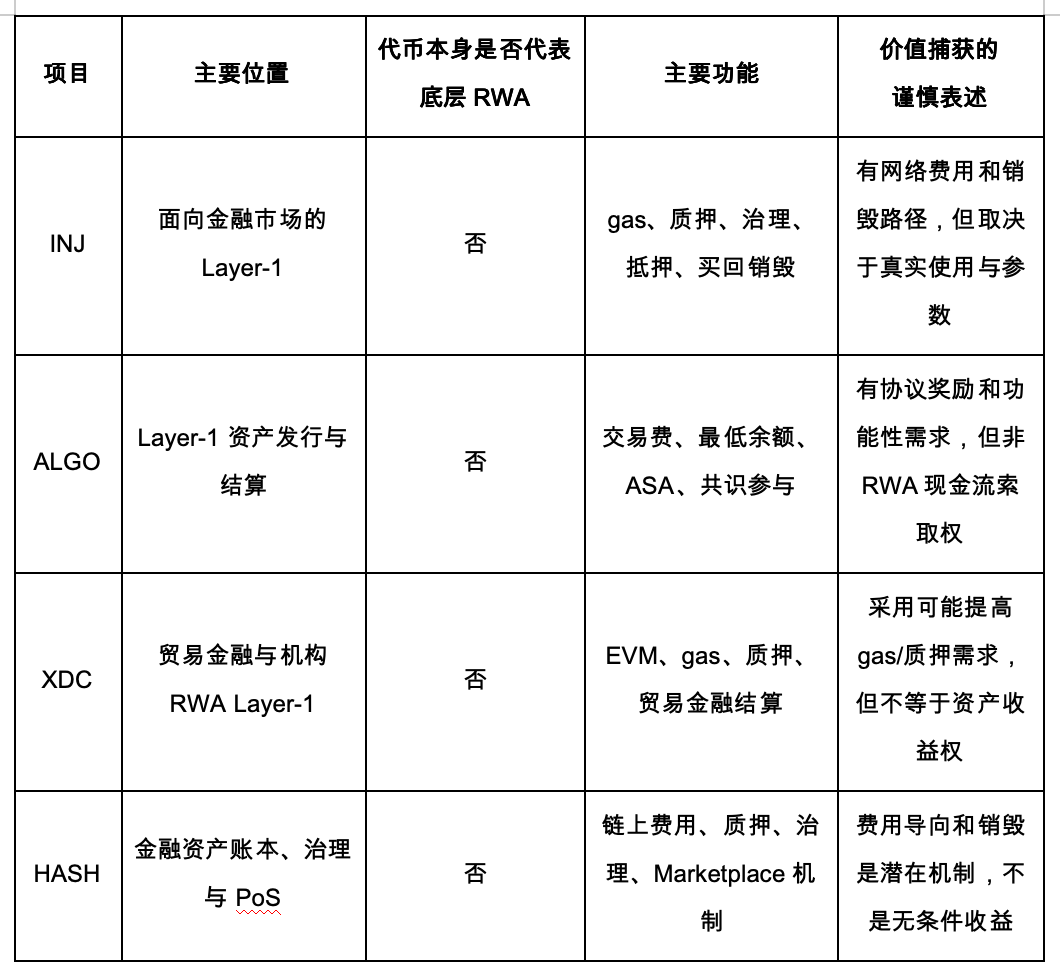
- Network Tokens Carrying RWA: XLM, INJ, ALGO, XDC, HASH. They are network payments, resource pricing, consensus security, collateral, or governance assets; RWA issued on the network do not automatically become the underlying assets of these tokens.
- Infrastructure Tokens Providing Data or Interoperability for RWA: LINK, QNT. They connect real-world data, institutional systems, and multiple chains, but do not represent verified or connected assets.
- Governance Tokens: ONDO. They primarily carry DAO/protocol governance rights and must be strictly distinguished from ONDO issued OUSG, USDY or other products.
2. What Problems Each of the Ten Tokens Solves in the RWA Chain
3. Asset Rights Layer: PAXG and XAU₮ Are the Two Cases Closest to "RWA Tokens"
3.1 PAXG: Digital Certificate of Beneficial Ownership of Gold
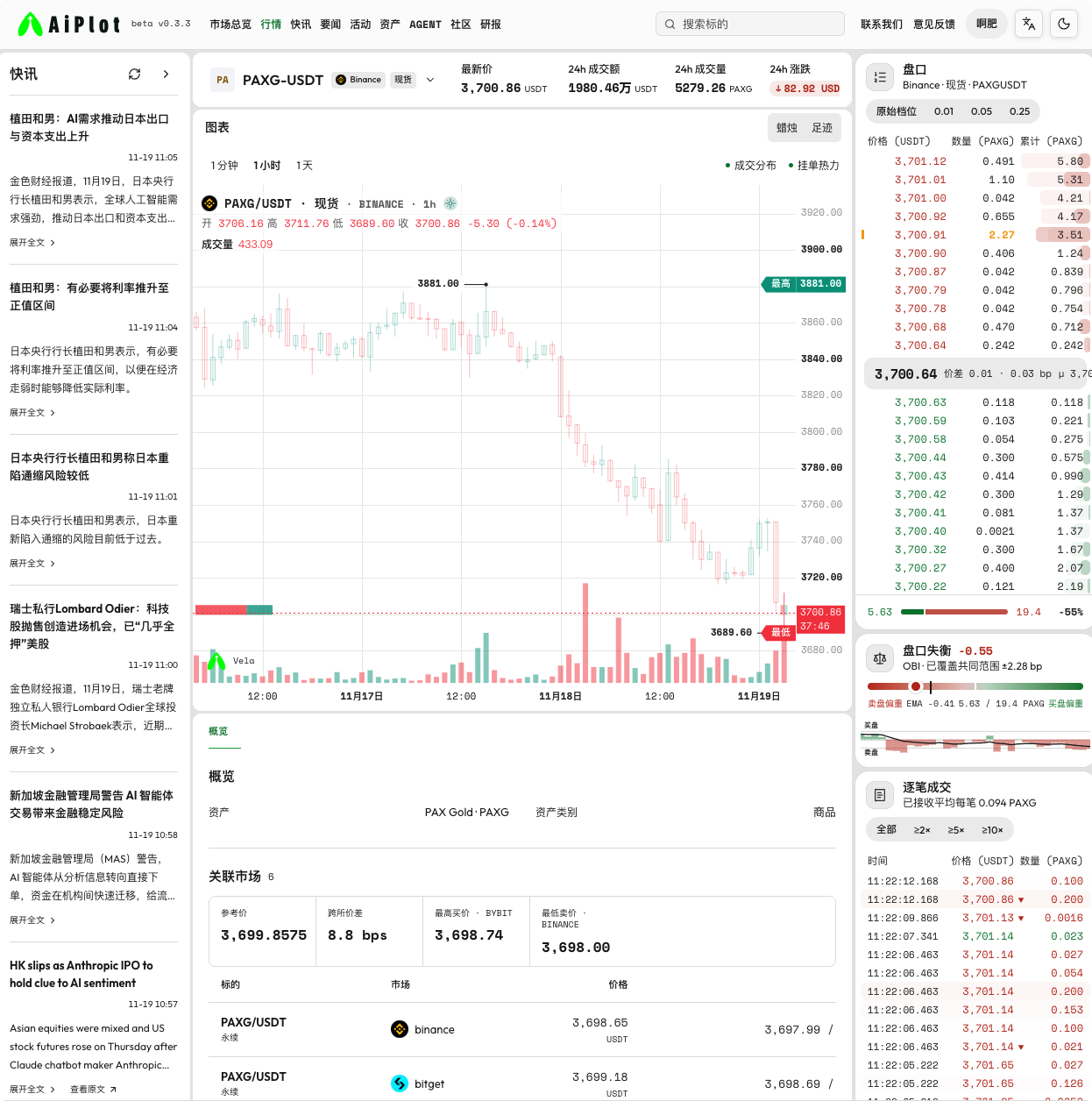
Paxos' PAXG corresponds to London Good Delivery gold on a one-to-one basis. The official terms describe it as a proportional beneficial ownership of gold that is held in custody by Paxos Trust and stored in LBMA-approved vaults; each PAXG corresponds to one troy ounce of gold. It can be transferred, held, and traded on Ethereum and can also be accessed via wallets, exchanges, and some DeFi/lending protocols.
This fundamentally differs from network tokens: The value basis of PAXG is primarily the gold price, reserves, and custody arrangements, not Ethereum transaction volume. Eligible clients can convert it according to rules into US dollars, unallocated gold, or allocated gold; physical redemption typically requires at least 430 PAXG corresponding to a whole gold bar and incurs fees and delivery arrangements. PAXG is not a governance token, a consensus token, nor an interest or dividend tool promised by Paxos to holders.
3.2 XAU₮: Rights to Gold, On-Chain Transfer, and Conditional Redemption
Tether Gold's XAU₮ represents indivisible rights to one troy ounce of gold in specific, identifiable LBMA London Good Delivery bars. The official page supports querying related bar serial numbers, weight, and purity; the token can be transferred in Ethereum ERC-20 and BNB Chain BEP-20 forms and can be traded on listed markets.
However, "representing gold" cannot be simplified to "any holder can withdraw a small piece of physical gold at any time". Physical redemption requires KYC, qualification checks, and a sufficient number of tokens corresponding to a whole gold bar (the official FAQ exemplifies around 430 XAU₮, adjusted according to the actual bar weight), fees, and Swiss delivery. The issuer also has the option to attempt to sell the gold bars and remit the proceeds in USD via wire transfer, but this is not an unconditional repurchase commitment by the issuer.
XAU₮ does not have official commitments of interest, dividends, or staking income. Its primary revenue sources are fluctuations in gold prices, as well as reserves, custody, market liquidity, and redemption credibility. The convenience of token transfers is an asset attribute, not an independent network cash flow.
3.3 Discriminating Between Asset Tokens and Network Tokens
Holders of PAXG/XAU₮ at least face assertions of rights related to underlying gold from a legal and product terms perspective; however, holders of XLM, ALGO, XDC, or INJ do not automatically acquire ownership, returns, or redemption rights corresponding to assets simply because these tokens issued on the chain involve funds, government bonds, or trade finance. It is essential to review the specific issuers, custodians, investor qualifications, transfer restrictions, and redemption documents.
4. Data and Interoperability Layer: LINK and QNT Connect Assets but Do Not Own Assets
4.1 LINK: Oracles Are a Necessary Condition for RWA Usability, Not RWA Ownership
Chainlink's position in the RWA chain is to transmit prices, net values, reserves, corporate actions, and other real-world information onto the blockchain and support the monitoring, cross-chain distribution, and settlement of tokenized assets through Proof of Reserve, CCIP, and automated capabilities. Proof of Reserve can be used for monitoring reserves of stablecoins, wrapped assets, and tokenized assets, even triggering minting pauses, redemption restrictions, or circuit breaker logic; CCIP is used for messages and token transfers across public chains and private chains.
LINK is a network-native digital commodity that pays for oracle services and compensates node operators; Chainlink's documentation also describes billing methods such as subscription, pay-per-use, revenue sharing, and enterprise integration. Staking attempts to link LINK to the cryptoeconomic security of oracle services.
The adoption of RWAs increases the potential demand for trustworthy data and cross-chain services, while LINK's value capture depends on service fees, LINK conversion ratios, reserve arrangements, staking coverage, and actual usage.
4.2 QNT: The Permission Requirement for Enterprise Interoperability Does Not Equal Protocol Cash Flow
Quant/Overledger targets enterprises, financial institutions, and capital markets by providing an API gateway connecting traditional financial systems, payment infrastructures, and multiple blockchains, and supports asset tokenization, cross-chain trading, and smart contract execution.
QNT is defined in official terms as a utility token that can be used for Quant products and services, including Overledger licenses and specific staking functions; however, the official FAQ also clearly states that Overledger platform fees can be paid in US dollars. Thus, QNT indeed has product payment demands, but the intensity of this demand is influenced by whether enterprises choose to pay in QNT, the number of licenses, and product adoption. No verification has been observed that QNT holders enjoy Quant company's profits, protocol income, or cash flows from RWA assets.
5. Network Tokens Carrying RWA: A Gap Between Usage and Value Capture
5.1 XLM: Issuance and Settlement Track, but Fees Do Not Constitute Holder Dividends
Stellar supports issuing assets identified by issuer accounts, which can represent fiat currencies, fund shares, bonds, or equity; issuers can also implement compliance control through trust lines, freezing, whitelisting, etc. The official RWA page positions Stellar as an infrastructure for issuance, compliance, distribution, and about five seconds final settlement.
XLM is Stellar's native asset used for transaction fees and account minimum balances. The current document states that transaction fees are paid in XLM, and accounts must also maintain a base reserve. Holding trust lines, open orders, or other ledger entries will increase the minimum balance requirements.
However, official materials state that transaction fees enter a locked account and are not distributed to holders or validators. Therefore, payment volume and RWA issuance can increase usage demand but do not directly translate into XLM's protocol revenue. Moreover, XLM should not be considered ownership certificates of funds, government bonds, or stablecoins on Stellar.
5.2 INJ: Financial Market Layer-1 with a More Defined Path to Burn
Injective provides issuance, permission management, trading, lending, and settlement modules for financial markets; the RWA module supports whitelisting, KYC/permissions, and compliance parameters, capable of carrying tokenized government bonds, funds, and stablecoins.
INJ has four categories of network functions: paying transaction fees, PoS staking and security, governance, and collateral; official materials also describe how the remaining portion of transaction fees enters a buyback and burn process on-chain, where transaction fee assets are auctioned for INJ and burned, with some ecosystem application revenue also entering relevant auction funds.
This adds an additional layer of potential supply contraction beyond "network usage drives token demand," but caution is still needed: the amount burned depends on actual transaction fees and application revenue and must be viewed alongside inflation minting, staking commissions, market demand, and governance parameters. INJ holders therefore do not gain rights to profits from tokenized government bonds, funds, or loans.
5.3 ALGO: ASA Is a Container for RWA, ALGO Is a Network Resource
Algorand supports the tokenization of assets such as bonds, funds, real estate, and commodities through ASA, smart contracts, atomic transfers, and low fees. ASA can set freezing, revocation, whitelisting, and role controls, which help compliance but also mean investors must bear issuer control and counterparty risks.
ALGO is used for transaction fees, account minimum balances, DeFi interactions, and consensus participation. The official trading reference states that the minimum transaction fee is 0.001 ALGO, and the base minimum balance is 0.1 ALGO; creating or holding more assets and application states will raise the balance requirements. Qualified actively participating consensus accounts can earn protocol rewards, but this is not passive holding rewards and does not grant rights to RWA cash flows.
Thus, the locked value growth of RWA on Algorand primarily indicates increased usage at the ASA/application layer; only when these applications indeed use ALGO to pay for resources, stake, or participate in consensus will there be a formation of marginal demand for ALGO.
5.4 XDC: Infrastructure Token for Trade Finance Scenarios
XDC is an EVM-compatible Layer-1 native token used for gas; XDPoS 2.0 supports network security through staking XDC, with the official documentation mentioning a minimum stake of 10,000,000 XDC for Masternodes/Validators.
The XDC official designates the network for digitizing, tokenizing, and settling trade finance assets such as invoices, bills of lading, letters of credit, and receivables, extending to private credit, commodities, and regulated tokenization.
However, there may be a significant gap between the scale of trade finance operations and XDC value capture: applications can settle using stablecoins or other assets, while XDC only assumes gas or security functions; trade receivables in ecosystem projects do not belong to XDC holders. In research, what needs to be measured are actual gas, staking scales, validator structures, and whether applications must use XDC, rather than just tallying the RWA scale on promotional pages.
5.5 HASH: Financial Asset Ledger and Fee-Oriented Mechanism
Provenance defines HASH as its native public utility, governance, and PoS security token for on-chain fees, staking, trading, and governance; validators and delegators staking HASH can earn network fee rewards.
The official whitepaper page also describes the HASH Marketplace: 40% of network fees and 100% of settlement fees are directed to this mechanism, allowing participants to use HASH to bid for assets, with winning bids permanently burning. This provides a more concrete fee-token relationship than merely "paying gas," but still cannot be seen as unconditional dividends: actual fees, Marketplace participation rates, asset bidding scale, distribution rules, and burn execution need to be continuously verified.
6. Governance Layer: ONDO's Core Is Not the Underlying Assets but Decision-Making Power
ONDO is the governance token of Ondo DAO and Flux Finance. Holders can participate in economic parameters, smart contract upgrades, and other protocol matters through on-chain proposals and voting, with voting power calculated based on holdings and able to be delegated.
Flux Finance is a lending/buyback market that can use tokenized assets like OUSG as collateral; OUSG itself is an independent tokenized fund product providing economic exposure to short-term U.S. Treasury bills and GSE securities, with its own qualified investor, subscription, redemption, and legal arrangements.
Therefore, discussions of ONDO's value should revolve around the quality of governance: Does governance affect key parameters? Are proposal thresholds and quorums reasonable? How do committees, multi-signature, and upgrade permissions constrain? Can governance be transformed into protocol resources, risk control, or ecosystem growth? The scale of Ondo's RWA products cannot be directly substituted for cash flow analysis of ONDO tokens.
7. When Will Utility Convert to Token Demand, and When Is It Just Network Usage?
An actionable judgment formula is:
Token Demand Intensity = Degree of Necessity × Frequency of Use × Locking/Consuming Ratio × Real Economic Scale ÷ Substitutability
7.1 Situations Where Demand Is More Likely to Occur
1. Protocols Force Token Payments: For example, gas, account minimum balances, service fees, or issuance licenses must use the token.
2. Tokens Must Be Locked to Provide Security or Permissions: Validators, delegators, governance proposal deposits, collateral, or whitelisting qualifications require token lock-up.
3. Use Will Consume or Burn Tokens: Mechanisms such as buyback burns of transaction fees or Marketplace bidding burns can create a more direct link between usage and supply.
4. Settlement Assets Are Tokens Themselves: The buying and redemption of PAXG/XAU₮ revolves around the asset tokens themselves rather than any network tokens carrying them.
7.2 Situations That Are Only Network Usage
1. Applications can settle using stablecoins or other assets, while native tokens only pay minimal gas.
2. Network fees go into FeeSink, locked accounts, or funds, rather than being distributed to holders.
3. Enterprises can purchase services in USD, and the token is merely an optional payment method.
4. Project partnerships, RWA locked scales, or address growth did not trigger token lock-up, consumption, or cash flow distribution.
5. Staking rewards come from inflation rather than actual economic fees; this requires separate analysis of supply dilution.
7.3 Four Common Logical Errors
- Writing "supporting RWA" as "token representing RWA".
- Writing "transaction fees denominated in tokens" as "holders receiving transaction fees".
- Writing "stakable" as "having stable income".
- Writing "growth in tokenized scale" as "token prices must inevitably rise".
8. Why Growth in RWA Adoption Often Fails to Translate into Token Value
8.1 Scale May Remain at the Product Level
The asset scale of funds, government bonds, gold, and loans may grow, but the value stays with the issuer, custodian, fund share holders, or product token holders, not the underlying network tokens. PAXG/XAU₮ are examples of asset tokens; XLM, ALGO, XDC, INJ, HASH are network tokens carrying these products, and the two cannot be confused.
8.2 Substitute Payment Assets Weaken Capture
If RWA applications settle using USDC, fiat, or other stablecoins, the native token may only assume one-time gas. Documentation for XLM, XDC, QNT, etc., indicates that usage of the network or product does not equate to all processes must using their tokens.
8.3 Revenue and Holder Rights Are Not the Same
Even if protocols charge fees, it is essential to inquire about the flow of revenue: Is it directed to locked accounts, foundations, validators, service providers, ecological incentives, or token reserves? The fee conversions of LINK, buyback burns of INJ, and market orientation of HASH all have different mechanisms and cannot be summarized simply as "has fees".
8.4 Supply Side May Offset Demand Side
Staking rewards, foundation releases, inflation minting, unlocks, validator commissions, and liquidity incentives may offset new purchase demands. For network tokens such as ALGO, INJ, XDC, HASH, usage demand and new supply should be placed on the same table.
8.5 Legal Rights Determine the Quality of Asset Tokens
"There is a token on-chain" does not equate to "the holder owns the real assets". Verification of issuer, custody, bankruptcy isolation, redemption qualifications, minimum redemption amounts, freezing rights, transfer restrictions, and applicable laws must be checked. The rights of gold tokens are also constrained by these conditions; network tokens typically do not confer rights to underlying assets.
9. Establishing RWA Research Tracking Framework with AiPlot
The role of AiPlot is not to create simple leaderboards for tokens but to break down asset scales, network distributions, product changes, transactions, and token performance into comparable data layers.
9.1 Asset Scale Layer: First Look at "What Is Tokenized"
Establish an asset ledger for each product: asset type, issuer, custodian, chain, token supply, net asset/reserve scale, subscription/redemption, holder qualifications, redemption thresholds, and update times. Gold products must separately track the number of bars, weight corresponding to each token, reserve audits/reports, and actual redemption rules; funds, government bonds, and credit products must distinguish NAV, total issuance, circulation, and redeemable amounts.
Key metrics include:
- Asset Scale: AUM/reserve value, supply, circulation, and net inflow.
- Asset Quality: Reserve type, duration, credit risk, custody, and audit status.
- Rights Quality: Ownership, beneficiary rights, claims, economic exposure, or purely synthetic exposure.
- Liquidity Quality: Primary subscription and redemption, secondary transactions, spreads, depth, and redemption waiting times.
9.2 Network Distribution Layer: See Where RWA Is Used, Who Pays for Resources
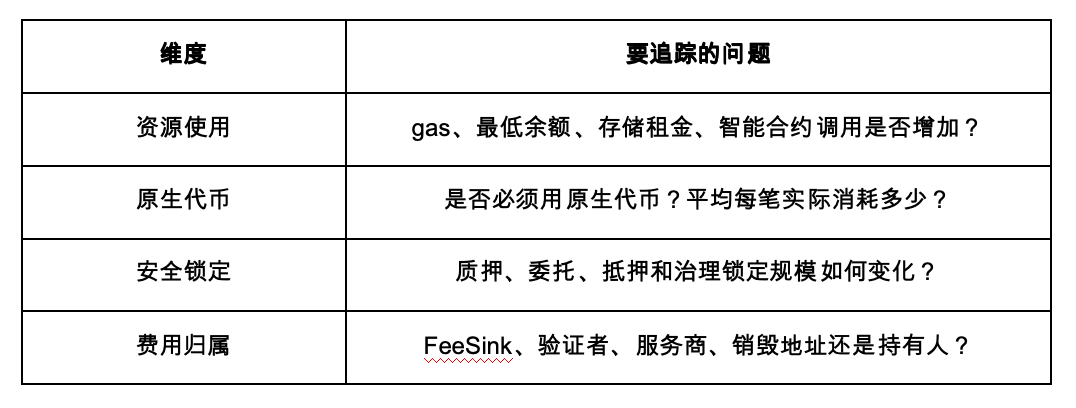
Statistic the distribution of Ethereum, Stellar, Injective, Algorand, XDC, Provenance, etc. by asset, transaction, holder, and contract activities. Do not merely look at the "total" post-bridge; deduplicate native issues and cross-chain wraps, and identify the settling assets on each chain: native tokens, stablecoins, asset tokens, or fiat systems.
Can create four columns for each chain:
9.3 Product Change Layer: Monitor "Rights" Instead of Just Marketing
AiPlot should preserve version snapshots of product terms and official documents, focusing on capturing: changes in redemption qualifications, minimum redemption amounts, rates, freezing/blacklist rights, reserve disclosures, supporting chain changes, investor restrictions, governance upgrades, and contract modifications. For ONDO, separate ONDO documentation and OUSG/other product terms; for LINK, separate Proof of Reserve, CCIP, Payment Abstraction, and staking modules.
9.4 Transaction Layer: Break Down "Adoption" into Real Actions
At least track: active addresses, effective holders, number of transfers, transfer amounts, number of transactions, average and median transfer sums, primary subscriptions/redemptions, secondary transactions, DEX/CEX depth, spreads, borrowing utilization rates, collateral rates, and liquidations. It is essential to differentiate between bots, internal transfers, bridges, batch minting, and actual terminal user transactions.
9.5 Token Performance Layer: Do Not Just Graph Prices
Establish a unified yield and risk dashboard for the ten tokens: price, circulating market cap, fully diluted valuation, changes in circulation, staking rates, unlocks, inflation, buybacks/burns, volatility, maximum drawdown, liquidity, and correlation to gold/U.S. Treasury yields/crypto market benchmarks. PAXG/XAU₮ should be compared with gold benchmarks; network tokens should be analyzed in lag correlation with RWA usage metrics, gas, fees, staking, and supply metrics.
10. Conclusion: The Most Important Thing Is Not "Which Is the Most Popular," but Where Value Lies
The ten projects are not the same RWA investment targets:
- PAXG, XAU₮ are closer to the assets themselves, with the research focus on gold prices, reserves, custody, redemption, and liquidity; they are not network cash flow tokens.
- LINK, QNT provide data, oracle, cross-chain, or institutional interoperability, with the research focus on whether services are paid for, whether token usage is enforced, how fees convert, and who benefits.
- XLM, INJ, ALGO, XDC, HASH carry issuance, trading, settlement, and security, with the research focus on resource consumption by RWA applications, what settlement assets are used, whether tokens need to be locked, and how fees and inflation play a role.
- ONDO is primarily a governance token, with the research focus on whether governance has actual power, whether it can improve protocol economics, rather than just adding the scale of Ondo products directly to ONDO valuations.
A rigorous conclusion for RWA research must answer three questions: Who holds real asset rights? Who pays for the infrastructure? Who ultimately gains cash flows or economic benefits from supply contractions? If these three answers do not reside in the same token, adoption growth cannot be directly equated to token price logic.
For more data and analysis, please follow Aiplot:
https://aiplot.com/?utm_source=aicoin
📖 Community Communication:
-Telegram:
https://t.me/+IIYMcJigBAo4Mjg1
The content of this article represents only the author's personal views and does not represent the platform's position. The opinions, conclusions, and suggestions in this article are for investors' reference only and do not constitute any investment advice related to this platform. The market carries risks, and investments should be made cautiously.
免责声明:本文章仅代表作者个人观点,不代表本平台的立场和观点。本文章仅供信息分享,不构成对任何人的任何投资建议。用户与作者之间的任何争议,与本平台无关。如网页中刊载的文章或图片涉及侵权,请提供相关的权利证明和身份证明发送邮件到[email protected],本平台相关工作人员将会进行核查。