This article is from Tiger Research. For a long time, traditional financial giants exploring asset tokenization have generally been constrained by regulatory red lines and data privacy requirements, limiting experimental scenarios strictly within permissioned private chains. However, from the early Canton privacy consortium network pilot to the recent proactive extension of business reach to the high-performance public chain Solana, DTCC's tokenization strategy has undergone a significant paradigm shift.
While private ledgers addressed compliance and permission isolation, their inherent flaw of liquidity fragmentation makes them difficult to carry the ultimate vision of inter-agency capital connectivity. This article deeply analyzes DTCC's three-tiered evolution path in tokenization architecture, systematically detailing how it builds the next-generation capital market settlement foundation by leveraging the global liquidity of public blockchains while adhering to strict settlement disciplines.
Traditional Financial Settlement Giants Moving to On-Chain World
The Depository Trust & Clearing Corporation (DTCC) is one of the most important central nerves in the global financial system, almost monopolizing the backend clearing and settlement of all U.S. stocks, fixed income products, and inter-institutional securities transactions.
In the traditional financial world, any securities transaction from agreement to final ownership transfer typically requires a lengthy T+1 or even longer settlement cycle, relying on an intricate inter-institutional reconciliation network.
With the rise of real-world asset (RWA) tokenization, DTCC recognized early on that distributed ledger technology could compress reconciliation costs to nearly zero and achieve near real-time atomic settlement around the clock.
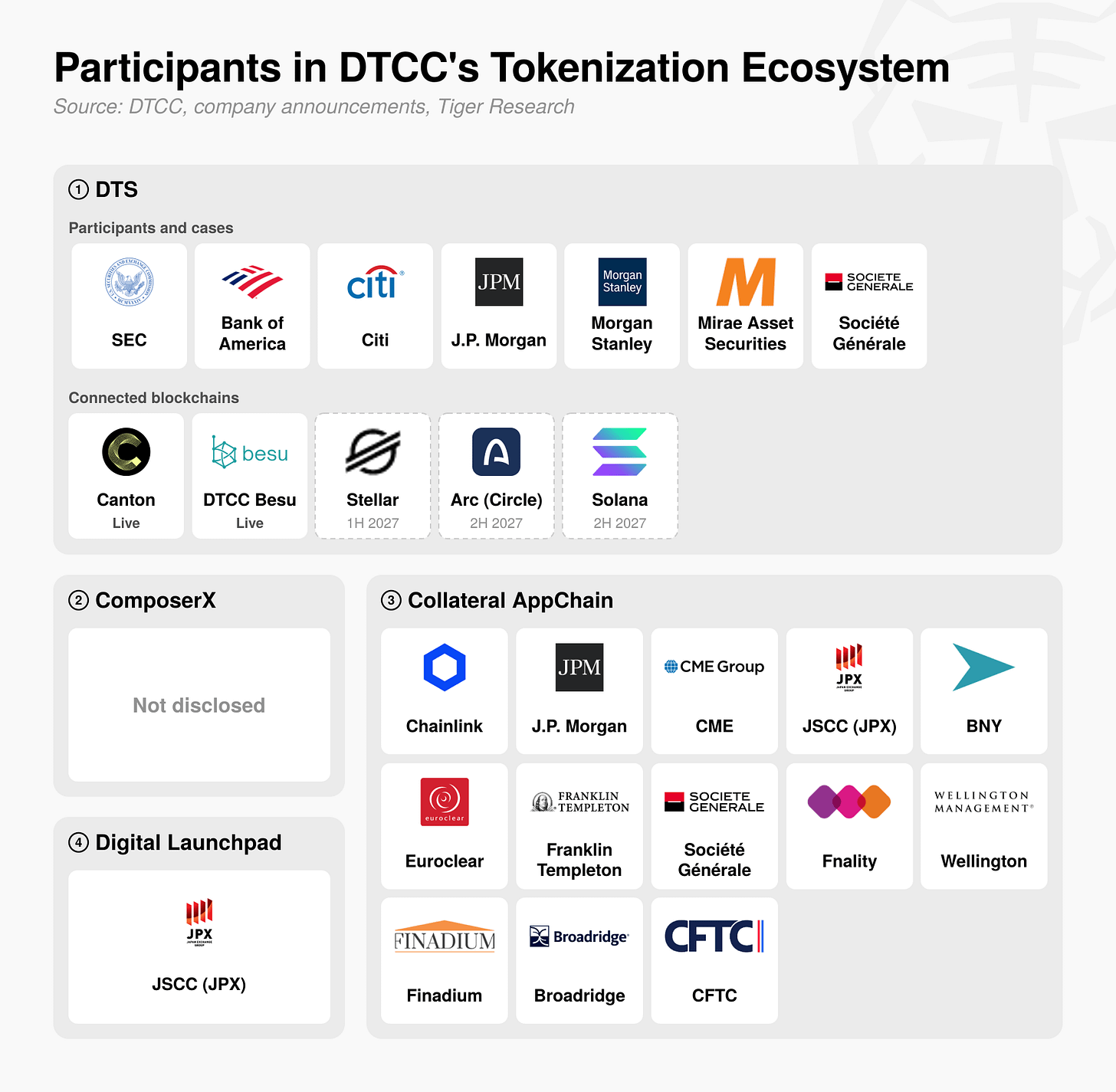
Phase One: Privacy-Centric Canton Network Experiment
In the early exploratory stage of asset digitization, DTCC collaborated closely with top Wall Street institutions such as JPMorgan and Goldman Sachs, deeply participating in the construction and stress testing of the Canton network.
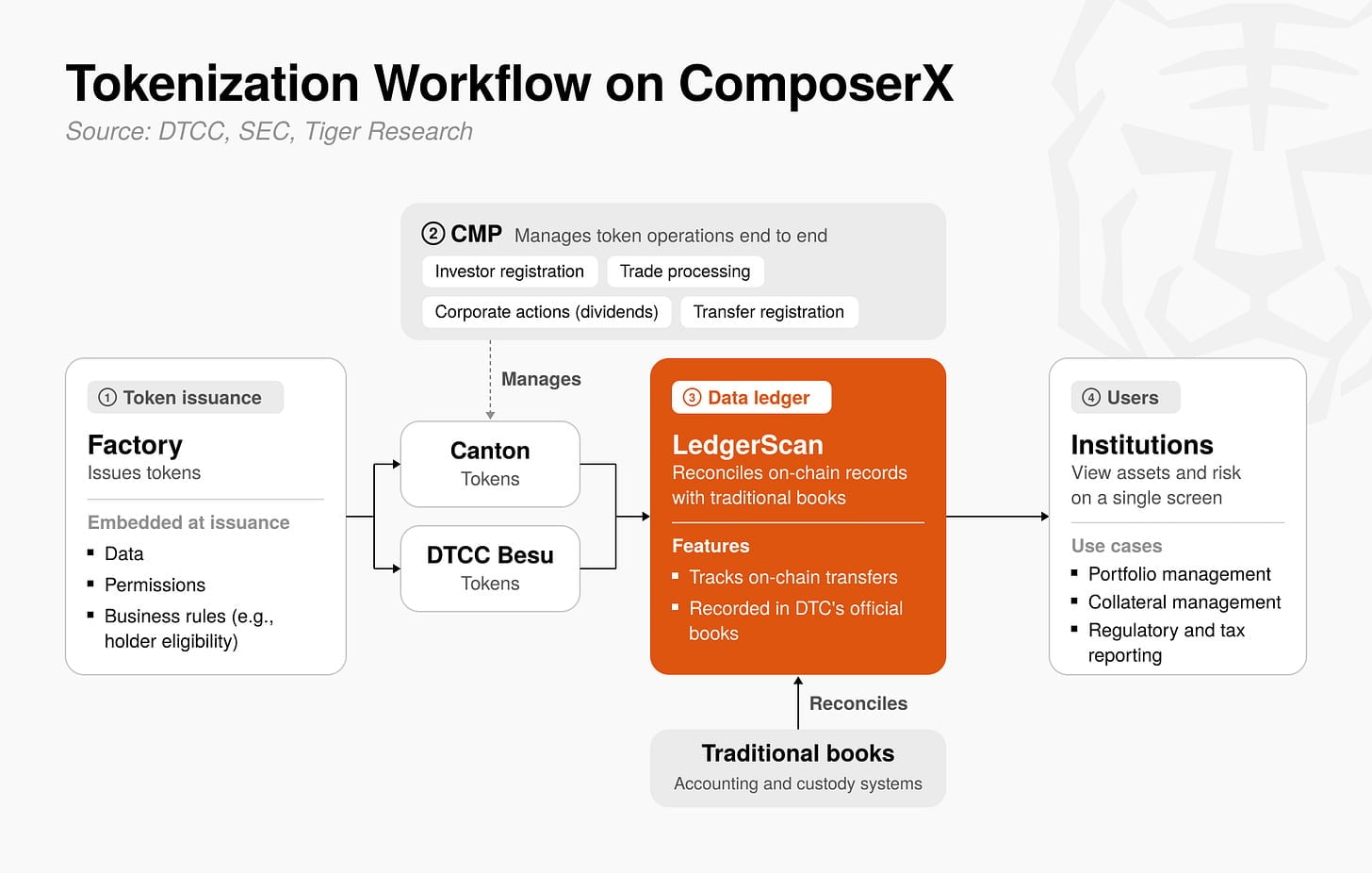
Canton, designed as an enterprise-grade privacy blockchain for regulated financial institutions, has the key technical feature that allows organizations to achieve consistent settlement between different independent subnets while protecting transaction privacy.
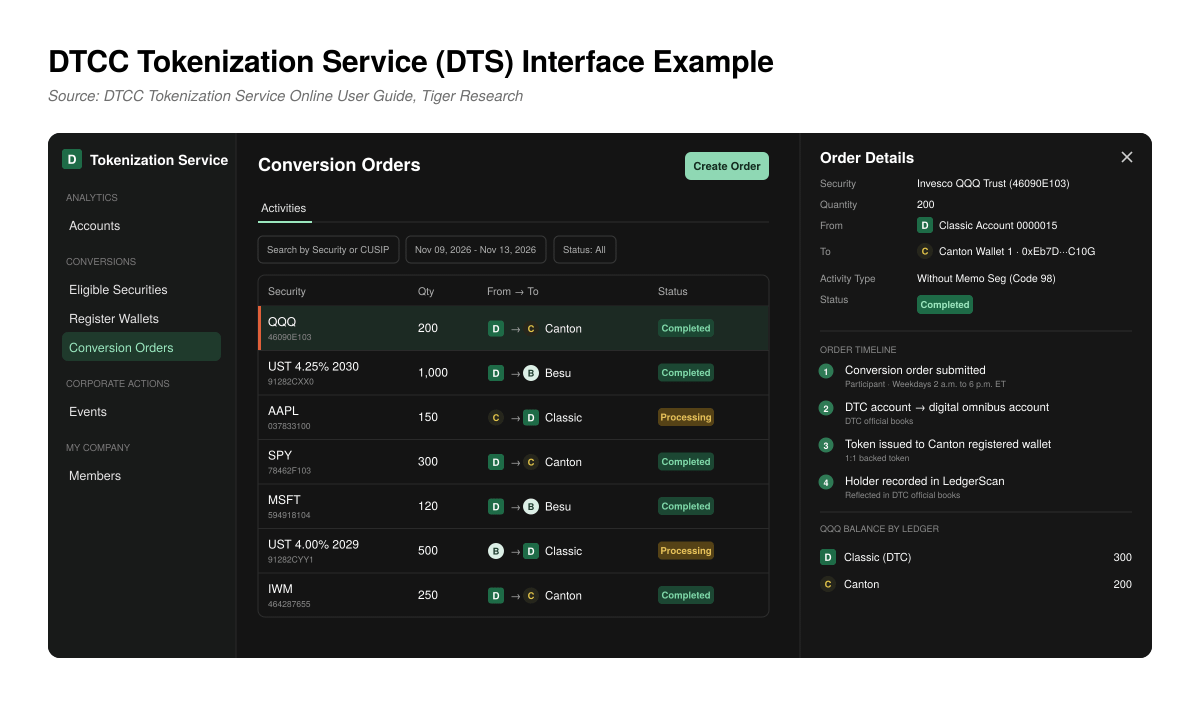
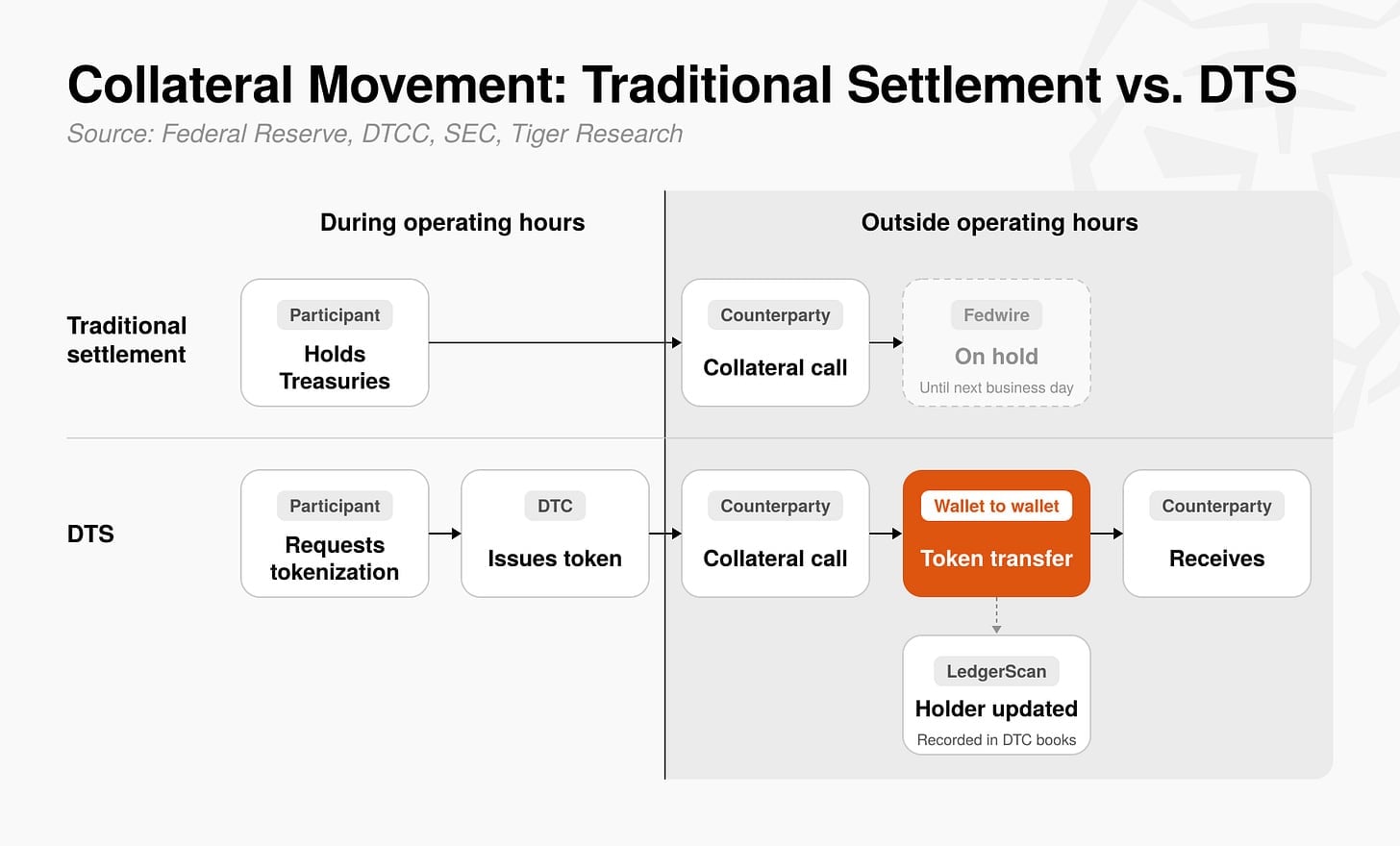
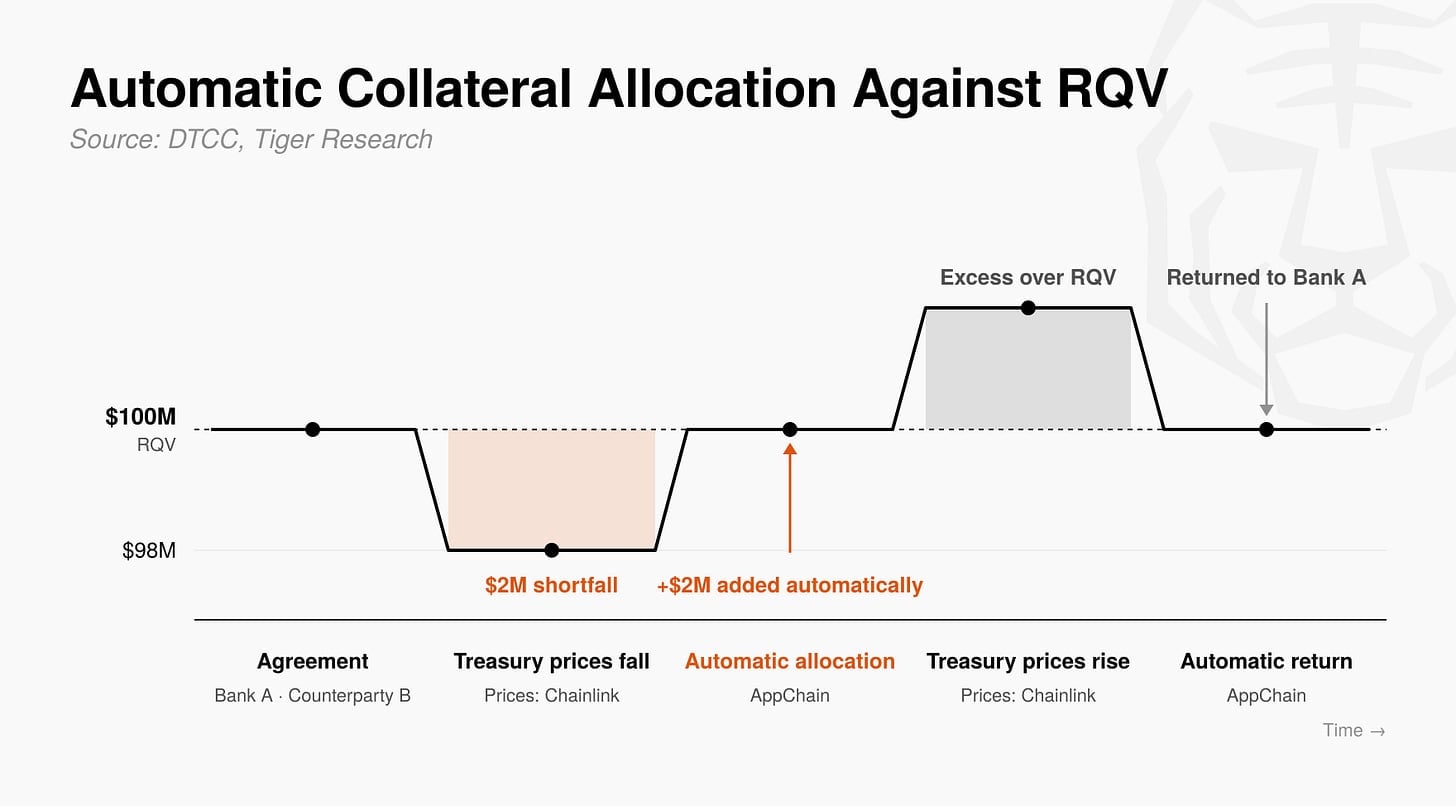
Through the Canton network, DTCC successfully validated the engineering feasibility of cross-asset collateral flow, real-time margin addition, and privacy data isolation.
However, private consortium chains are inherently limited by strict entry thresholds, locking participants firmly within existing licensed financial institutions and unable to access the broader global retail and on-chain native liquidity pools.
Breakthrough Strategy: Why Target the Solana Public Ecosystem
As institutional demands for liquidity depth further increased, DTCC began actively assessing the performance limits of public chains in carrying ultra-large-scale securities settlement tasks.
The high Gas costs and relatively slow confirmation delays of the Ethereum mainnet made high-frequency securities clearing economically unfeasible; while Layer 2 solutions reduced costs, they introduced additional complexities of liquidity fragmentation and cross-Rollup settlement finality.
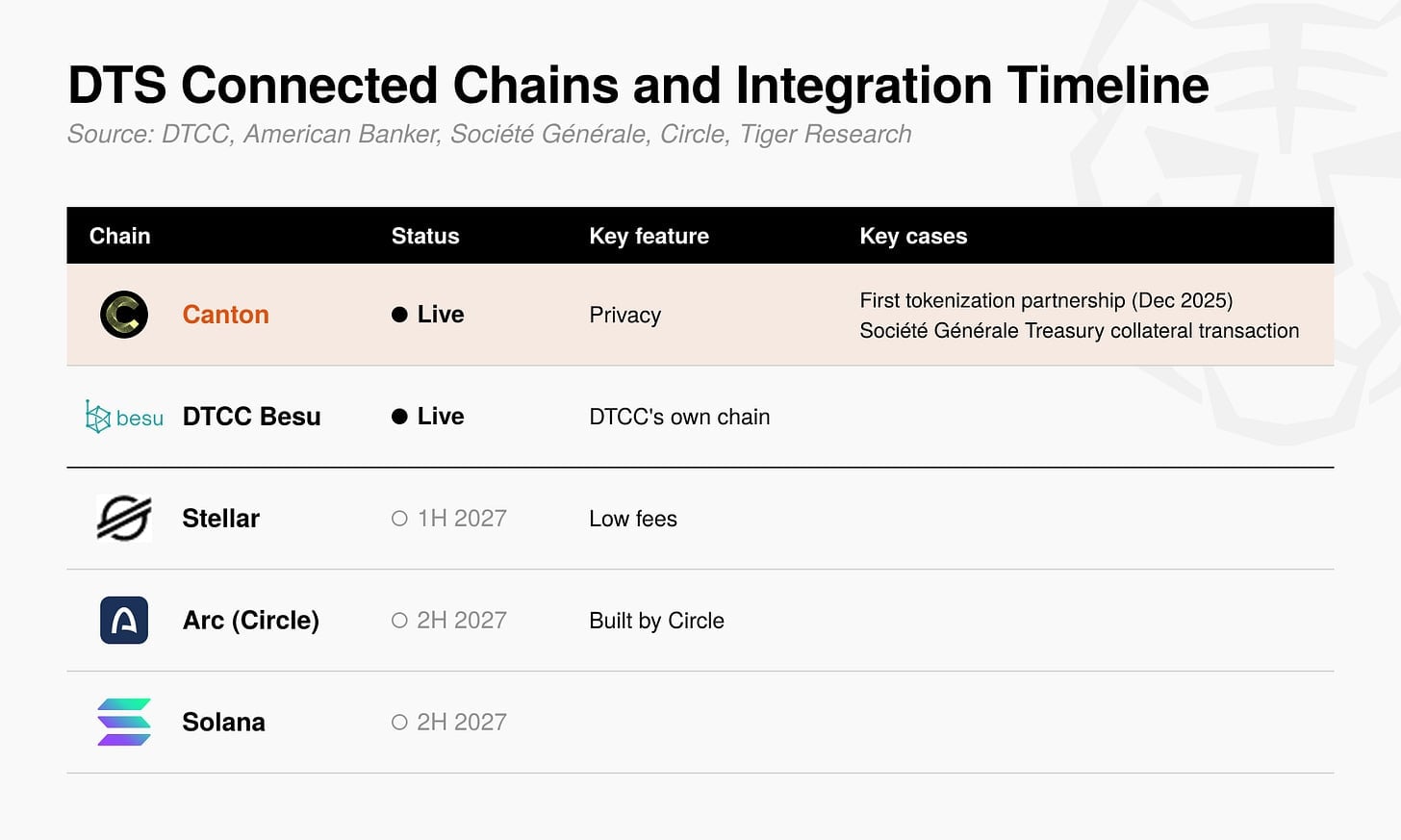
Against this backdrop, Solana, with its single global state, ultra-low transaction fees, and sub-second confirmation speed, became a core subject of investigation for traditional financial institutions entering the public chain space.
By introducing the programmable expansion function Token2022 standard (such as transfer hooks, confidential transfers, and native interest calculations), financial institutions can finally natively embed anti-money laundering (AML) and transaction compliance checks on the public chain without relying on complex smart contract encapsulations.
Parallel Evolution of Hybrid Architecture
It’s worth noting that embracing public blockchains does not mean DTCC will completely abandon its private chain system.
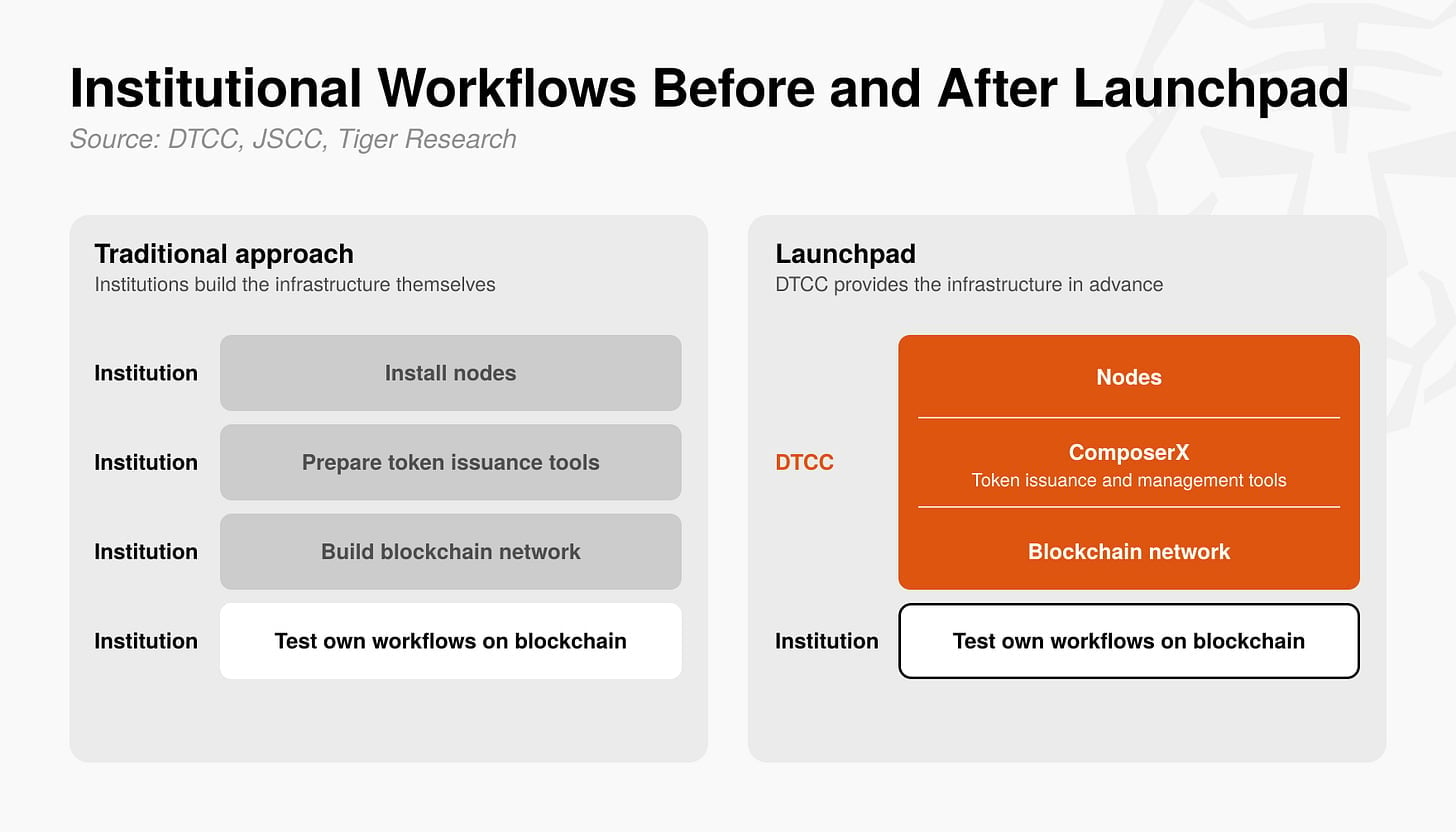
On the contrary, Tiger Research explicitly pointed out in their report that DTCC is building a dual-track hybrid architecture of "internal privacy backbone network + external public chain liquidity interface."
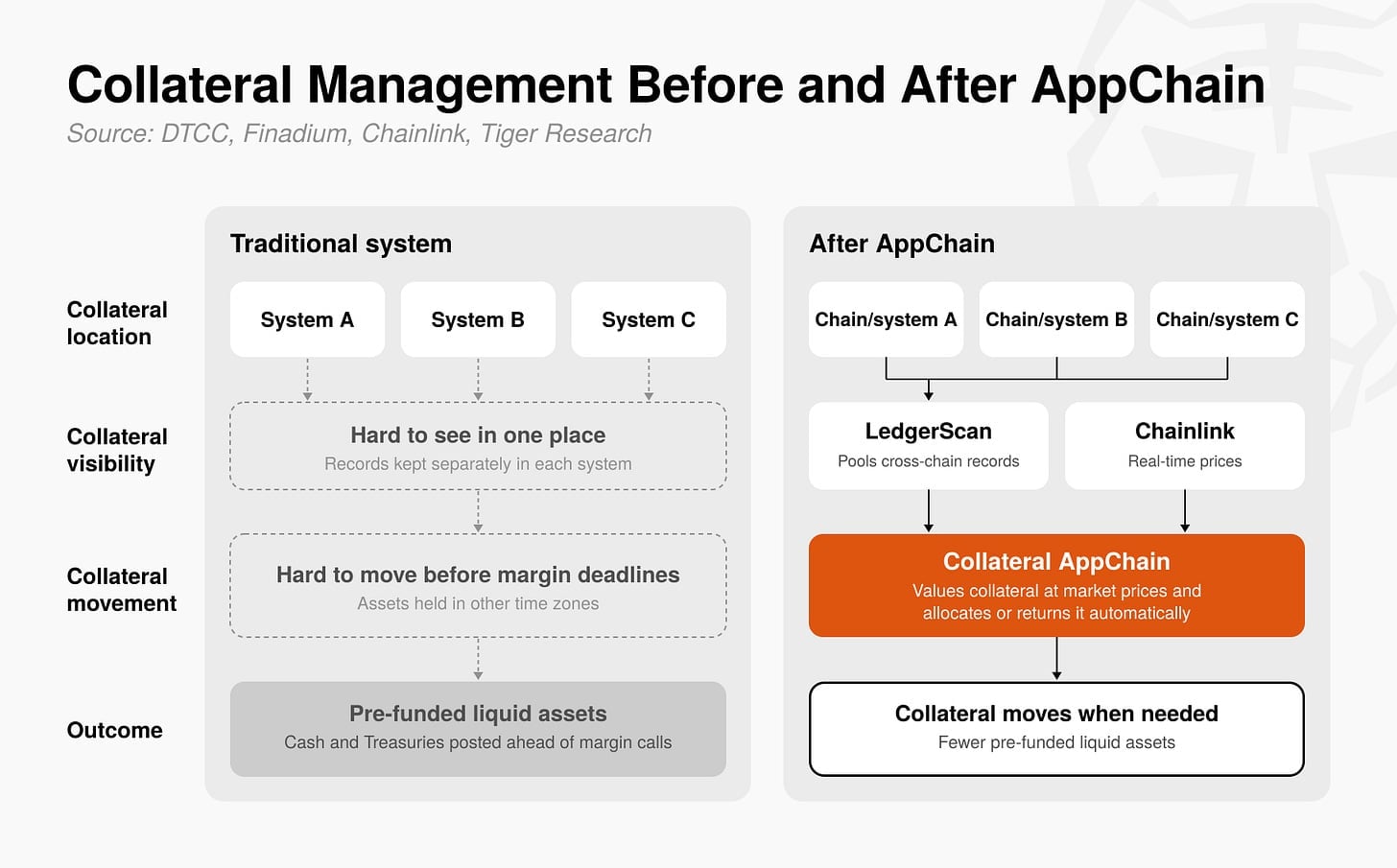
At the base layer, inter-institutional ultra-large position transfers and core securities ledgers remain embedded in highly confidential permissioned chain nodes; at the upper layer, tokenized shares, compliant with packaging, can be mapped to high-performance public chains like Solana through cross-chain interoperability protocols, freely integrated into global decentralized lending and liquidity pools.
Regulatory Compliance and Future Challenges
Despite the technical architecture nearing maturity, the large-scale implementation of tokenized securities on public chains still faces stringent regulatory scrutiny.
The U.S. Securities and Exchange Commission (SEC) maintains a highly cautious stance regarding the eligibility of compliant securities held directly in non-custodial wallets, tracing ultimate ownership, and determining jurisdiction.
Every step DTCC takes is essentially a balance-seeking act between the regulatory red lines in Washington and cutting-edge financial technology innovation.
The leap from a closed local network to an open global settlement network, though fraught with resistance, inherently carries the leap in capital efficiency that is irreversibly reshaping the financial underpinnings of Wall Street.
免责声明:本文章仅代表作者个人观点,不代表本平台的立场和观点。本文章仅供信息分享,不构成对任何人的任何投资建议。用户与作者之间的任何争议,与本平台无关。如网页中刊载的文章或图片涉及侵权,请提供相关的权利证明和身份证明发送邮件到[email protected],本平台相关工作人员将会进行核查。


