The opportunities in DeFi are shifting from pure token mining to deposits, lending, and asset collateralization that are closer to real financial operations.
On November 18, OKX Wallet's Chinese official announcement stated that Morpho was officially deployed to X Layer, and in cooperation with Gauntlet and xStocksFi, it brings USDC yields and stock token collateralized lending scenarios to on-chain users.
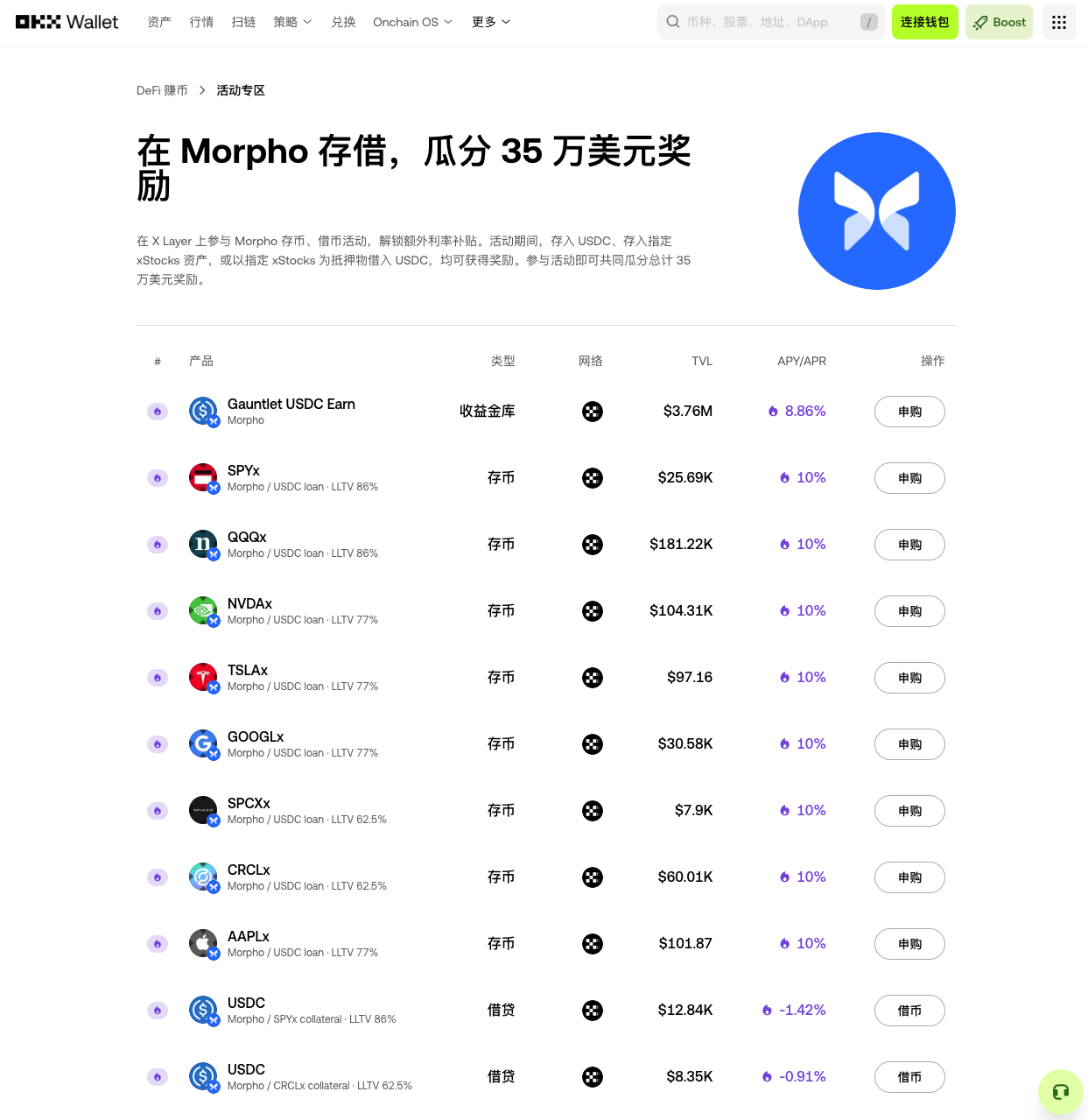
This event has a total incentive of 350,000 USDC, and there are not just one method of participation, but it is split into three pathways:
- Stock token collateralization: 200,000 USDC prize pool, with an additional reward annualized up to 10%;
- USDC deposits: 100,000 USDC prize pool, with an additional reward annualized up to 3%;
- Borrowing: 50,000 USDC prize pool, with an additional reward annualized up to 2%.
This means users can choose strategies based on their assets and risk preferences: those with stock-type RWA can consider collateralization; those holding USDC can focus on deposits; users with clear funding purposes and repayment plans may consider borrowing.
How to Understand the 350,000 USDC Reward?
1. Stock Token Collateralization: Up to 200,000 USDC Prize Pool
Stock token collateralization is the largest part of this event, accounting for about 57.1% of the total prize pool.
Users can deposit specified xStocks assets into the Morpho-related market as collateral to borrow USDC. Official updates show that this part's additional incentive can be up to 10% annualized.
From the event page, the supported collateral assets include:
- SPYx: S&P 500 ETF related tokens;
- QQQx: Nasdaq 100 ETF related tokens;
- NVDAx: Nvidia related tokens;
- TSLAx: Tesla related tokens;
- GOOGLx: Google A related tokens;
- SPCXx: SpaceX related tokens;
- CRCLx: Related stock tokens;
- AAPLx: Apple related tokens.
2. USDC Deposits: 100,000 USDC Prize Pool
The USDC deposit reward scale is 100,000 USDC, with the official updates showing an additional reward annualized up to 3%.
The main deposit product listed on the event page is Gauntlet USDC Earn Morpho. The TVL of this yield treasury is about 3.76M USD, with the page displaying APY/APR of about 8.86%.
It should be noted that the 8.86% is the APY/APR displayed at a specific point in time on the page and does not equate to a fixed interest rate, nor can it simply be summed up with the additional reward annualized 3%. Actual yields need to be calculated comprehensively based on base yields, activity rewards, fund scales, duration of activities, and changes in rules.
3. Borrowing: 50,000 USDC Prize Pool
The borrowing incentive is 50,000 USDC, with the official updates indicating an additional reward annualized up to 2%.
Borrowing is not a risk-free way to receive rewards. Users need to consider:
- The decline in the price of collateral assets;
- Changes in borrowing interest rates;
- Liquidation thresholds and LLTV;
- Oracle price fluctuations;
- Repayment deadlines and liquidity;
- Changes in reward value.
If there is no clear funding purpose and repayment plan, it is not recommended to borrow solely for the rewards.
What Data is Currently Displayed on the Event Page?
The current product list of Morpho X Layer shows the following data.
USDC Yield Treasury
- Gauntlet USDC Earn Morpho: TVL approximately 3.76M USD, APY/APR approximately 8.86%.
Stock Token Deposit Market
- SPYx: TVL approximately 25.69K USD, page shows annualized approximately 10%, LLTV 86%;
- QQQx: TVL approximately 181.22K USD, page shows annualized approximately 10%, LLTV 86%;
- NVDAx: TVL approximately 104.31K USD, page shows annualized approximately 10%, LLTV 77%;
- TSLAx: TVL approximately 97.16 USD, page shows annualized approximately 10%, LLTV 77%;
- GOOGLx: TVL approximately 30.58K USD, page shows annualized approximately 10%, LLTV 77%;
- SPCXx: TVL approximately 7.9K USD, page shows annualized approximately 10%, LLTV 62.5%;
- CRCLx: TVL approximately 60.01K USD, page shows annualized approximately 10%, LLTV 62.5%;
- AAPLx: TVL approximately 101.87 USD, page shows annualized approximately 10%, LLTV 77%.
USDC Lending Market
The page also displays the USDC lending market collateralized by different xStocks, such as:
- SPYx collateralized USDC: TVL approximately 12.84K USD, page shows APR approximately -1.42%, LLTV 86%;
- CRCLx collateralized USDC: TVL approximately 8.35K USD, page shows APR approximately -0.91%, LLTV 62.5%;
- NVDAx collateralized USDC: TVL approximately 52.5K USD, page shows APR approximately -0.82%, LLTV 77%;
- TSLAx collateralized USDC: TVL approximately 48.58 USD, page shows APR approximately 0.01%, LLTV 77%;
- SPCXx collateralized USDC: TVL approximately 3.95K USD, page shows APR approximately 0.05%, LLTV 62.5%;
- GOOGLx collateralized USDC: TVL approximately 15.29K USD, page shows APR approximately 0.06%, LLTV 77%;
- QQQx collateralized USDC: TVL approximately 90.61K USD, page shows APR approximately 0.07%, LLTV 86%;
- AAPLx collateralized USDC: TVL approximately 50.93 USD, page shows APR approximately 0.13%, LLTV 77%.
These data are snapshots from the event page at a specific moment in time. TVL, APY/APR, borrowing rates, and available amounts may continue to change, and the numbers in the screenshots should not be regarded as fixed commitments.
What is LLTV? Why does it determine liquidation risk?
LLTV, or Loan to Liquidation Value, appears multiple times on the event page. In simple terms, LLTV indicates that when the value of the collateral falls to a certain ratio, the position may enter into a liquidation risk zone.
For example:
- LLTV 86%: The buffer space relative to the borrowing scale is small;
- LLTV 77%: The buffer space is medium;
- LLTV 62.5%: Relatively more conservative, but the borrowing limit is usually lower.
The higher the LLTV, it does not mean higher yields, nor does it mean better capital efficiency. It usually means that users can borrow funds closer to the value of the collateral, but when prices fall, the liquidation buffer may also be smaller.
If users borrow USDC using QQQx or SPYx as collateral, special attention is needed to:
- Whether stock index assets have a rapid pullback;
- Whether the on-chain price diverges from the underlying market;
- Whether the oracle price updates in a timely manner;
- Whether borrowing rates change;
- Whether there is enough USDC available for replenishing collateral or repaying loans.
Why is Stock Token Collateralization the Biggest Opportunity in this Event?
From the perspective of prize pool size, the stock token collateralization part has 200,000 USDC, making it the largest among the three types of rewards.
Its attraction mainly comes from three aspects.
First, Release the Capital Efficiency of RWA Assets
Traditionally, users holding stocks or ETFs primarily rely on price appreciation to gain returns. On-chain collateralized lending provides another approach: obtaining USDC liquidity using stock-type tokens as collateral without immediately selling the assets.
This can be used for:
- Short-term capital turnover;
- Retaining exposure to stock-type assets;
- Participating in other on-chain strategies;
- Portfolio rebalancing.
But this is not "free money." When the collateral assets drop, users may need to add more collateral, repay the loans, or bear liquidation losses.
Second, Additional Rewards Form a Dual Yield Structure with Base Yields
After depositing specified xStocks, users may simultaneously gain base market yields and additional activity rewards. The page shows that the activity annualized for most stock token deposit markets is 10%, but the final yield depends on activity rules, fund scale, and effective participation time.
Users cannot treat the displayed 10% on the page as risk-free fixed income, nor can they assume that activity rewards will last indefinitely.
Third, Stock-type Assets Begin to Connect with DeFi Mechanisms
Assets like SPYx, QQQx, NVDAx, and TSLAx originally belonged to stock or ETF narratives, but now they are included in the lending market of Morpho, indicating that RWA is no longer just an on-chain price display, but is attempting to enter collateralization, lending, and capital efficiency scenarios.
Three Participation Methods for Different Users
Method One: USDC Deposit
This is suitable for users who wish to control directional risk, hold USDC, and focus on activity rewards.
Key participation points:
- Select from the Morpho USDC earn products listed on the official activity page;
- Check the current APY/APR, TVL, and activity rewards;
- Pay attention to how rewards are calculated based on time, deposit amount, or other rules;
- Calculate the network fees and cost of capital usage;
- Do not consider the APY displayed on the page as a fixed rate.
This is relatively easy to understand among the three methods, but risks related to protocols, smart contracts, stablecoins, and reward changes still exist.
Method Two: Stock Token Deposit
This is suitable for users who already hold or are willing to research xStocks.
Key observations can include:
- The index exposure of SPYx and QQQx;
- The single company risks of NVDAx, TSLAx, GOOGLx, and AAPLx;
- The liquidity and price volatility of SPCXx and CRCLx;
- Whether TVL matches actual trading depth;
- Whether activity rewards can cover price volatility and capital costs.
Stock token deposits are not the same as stablecoin deposits. Users must bear the risks of underlying stock price declines and token mapping.
Method Three: Collateralized Borrowing
This is suitable for users with a clear plan for using USDC and understanding of LLTV and liquidation mechanisms.
It is advisable to control the borrowing ratio and not push positions close to the liquidation line just for the pursuit of capital efficiency. Even if the page shows an additional borrowing reward annualized up to 2%, if the price of collateral assets drops by 20%, the rewards may far from cover liquidation losses.
Data Analysis Perspective: Which Pools Are Worth Observing?
QQQx Deposit Pool: Currently High TVL
The QQQx deposit pool page shows a TVL of approximately 181.22K USD, which is relatively high among stock token deposit pools, with an LLTV of 86%.
QQQx represents exposure related to the Nasdaq 100 ETF, with a high concentration of tech stocks. A higher TVL may indicate more participants, but a high LLTV also means that lending positions need to strictly control risks.
NVDAx Deposit Pool: Concentrated on Technology and AI Themes
The NVDAx deposit pool page shows a TVL of approximately 104.31K USD, with an LLTV of 77%.
Assets related to Nvidia usually attract high market attention, but chip cycles, AI capital expenditures, and valuation fluctuations may lead to rapid price changes. Users cannot ignore collateral price risks just because the asset is popular.
CRCLx, SPCXx: Smaller Scale, Focus on Liquidity Observations
The CRCLx and SPCXx deposit pool pages show TVLs of approximately 60.01K USD and 7.9K USD, respectively, both with an LLTV of 62.5%.
A lower LLTV provides a relatively larger liquidation buffer, but smaller TVLs also mean users need to pay closer attention to liquidity, bid depth, and exit costs. Smaller pools may experience more pronounced price impacts and capital inflow and outflow fluctuations.
Gauntlet USDC Earn: Focus on the Combination of Base Yields and Activity Rewards
The Gauntlet USDC Earn Morpho page shows a TVL of approximately 3.76M USD, with an APY/APR of about 8.86%.
The key for such yield treasuries is not simply chasing the highest numbers but to break down:
- Where the base yields come from;
- Whether activity rewards are calculated independently;
- Whether yield rates change with fund sizes;
- Whether there are withdrawal limits or delays;
- Who manages the underlying protocols and strategies.
Before Participating, It is Essential to Calculate Real Returns
A simple estimation framework is:
Real net yield = Base yield + Activity rewards − Borrowing interest − Price fluctuation losses − Impermanent losses − Gas − Protocol and transaction costs.
For users depositing USDC, the focus is whether base yields and activity rewards can cover the cost of capital and protocol risks.
For users depositing stock tokens, the focus is whether additional yields can cover the risk of asset price declines.
For borrowing users, the focus is on borrowing costs, collateral volatility, and liquidation losses, rather than the rewarded annualized number displayed on the page.
Conclusion: The Value of 350K USDC Lies in Bringing RWA into Real DeFi Capital Efficiency Scenarios
The event launched by Morpho on X Layer has a total reward of 350,000 USDC: 200K for stock token collateralization, 100K for USDC deposits, and 50K for borrowing.
Its significance lies not only in the amount of rewards but also in placing three types of on-chain financial behaviors within the same activity framework:
- Obtaining yields with USDC;
- Obtaining liquidity with stock tokens;
- Improving capital usage efficiency through collateralized borrowing.
However, the larger the rewards, the clearer distinctions need to be made between yields and risks. For ordinary users, a more prudent strategy is:
If you have USDC, then research deposits; if you have quality RWA, then research collateralization; only with clear purposes and repayment plans, consider borrowing.
Exclusive Benefits for AiCoin Users
Use the OKX Web3 wallet to “Invest in Global Assets”!
Bind with invitation code 【AICOIN88】 to enjoy a 10% savings on transaction costs (Gas optimization and other benefits)!
Download/upgrade the OKX Web3 wallet now and catch the opportunity:
https://jump.do/xlink?checkProxy=true&proxyId=24
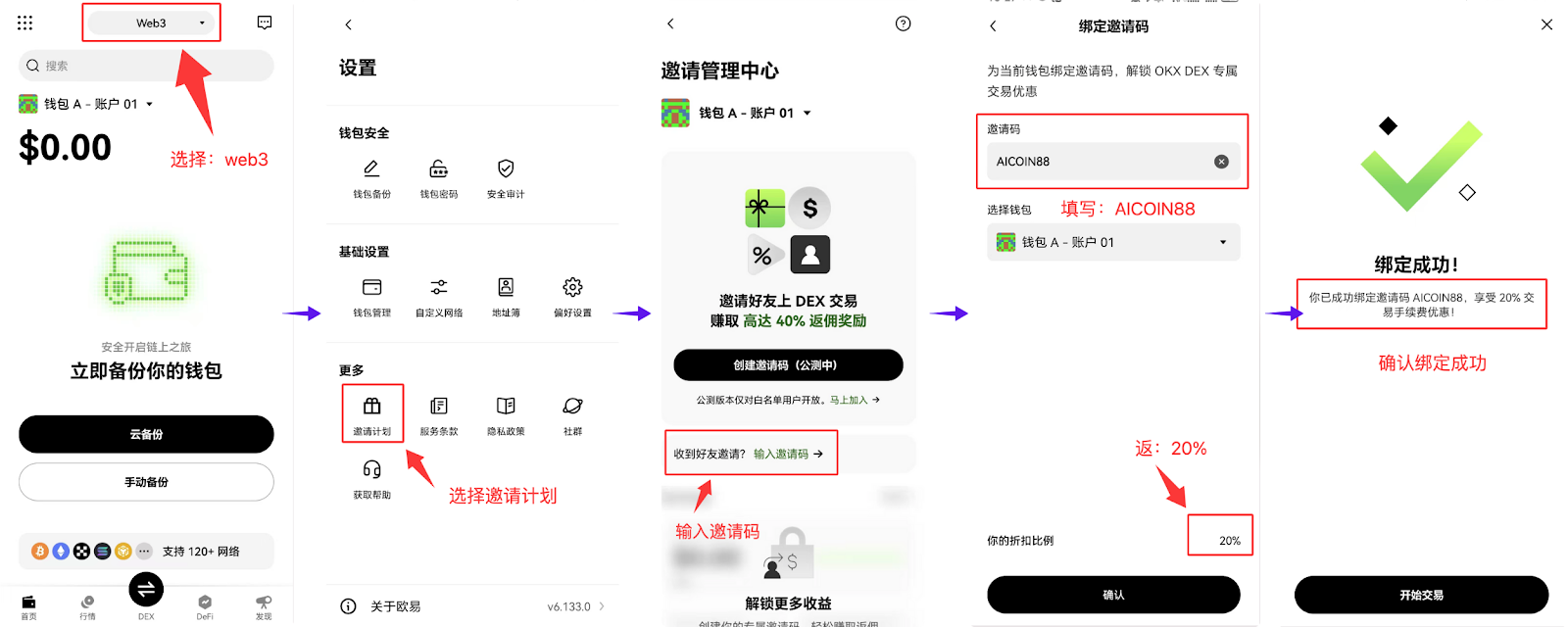
Use exclusive invitation code 【AICOIN88】 to bind the OKX wallet; the web version can also be operated easily!
https://web3.okx.com/ul/joindex?ref=AICOIN88
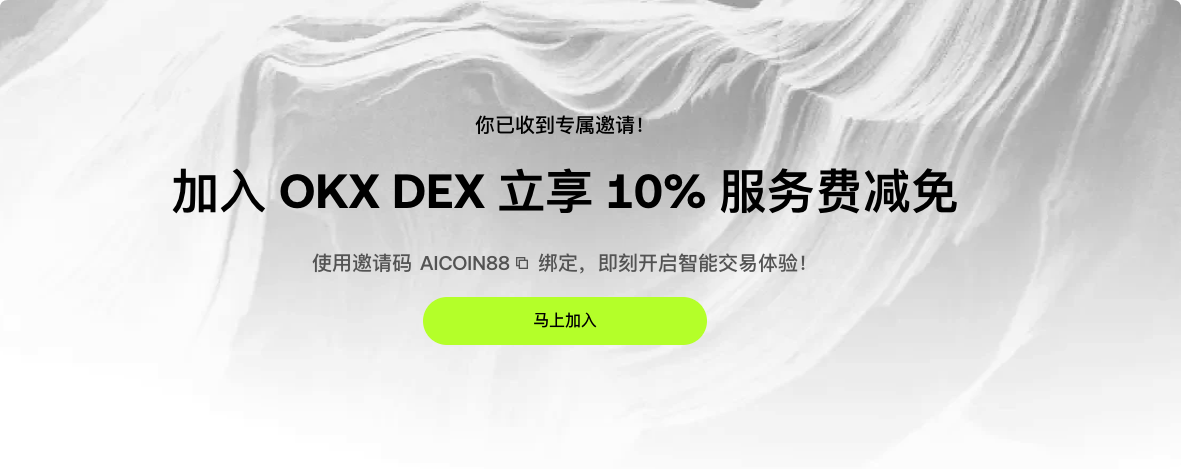
Don’t wait, set up the OKX wallet, bind the discount, and start acquiring new wealth!
免责声明:本文章仅代表作者个人观点,不代表本平台的立场和观点。本文章仅供信息分享,不构成对任何人的任何投资建议。用户与作者之间的任何争议,与本平台无关。如网页中刊载的文章或图片涉及侵权,请提供相关的权利证明和身份证明发送邮件到[email protected],本平台相关工作人员将会进行核查。