The recently concluded Q3 financial report season can be described as a competition of misery among German car companies.
In the third quarter, Volkswagen reported revenue of 75.277 billion euros and an operating loss of 5.86 billion euros, marking the largest single-quarter loss in the past ten years; for the first three quarters, revenue was 233.378 billion euros, selling 6 million cars, with a profit of 71 million euros.
Looking solely at the automotive business, revenue in the first three quarters slightly decreased from 213.132 billion euros in the same period last year to 205.617 billion euros, but operating profit changed from 2.216 billion euros to a negative 1.972 billion euros.
The main issue is one-time costs: software company CARIAD and battery operations accrued 2.3 billion euros, with a goodwill impairment of 6.4 billion euros for Porsche, plus a 1 billion euro reduction in assets from joint ventures in China. If these losses are added back, the financial report isn't as bad as it appears.
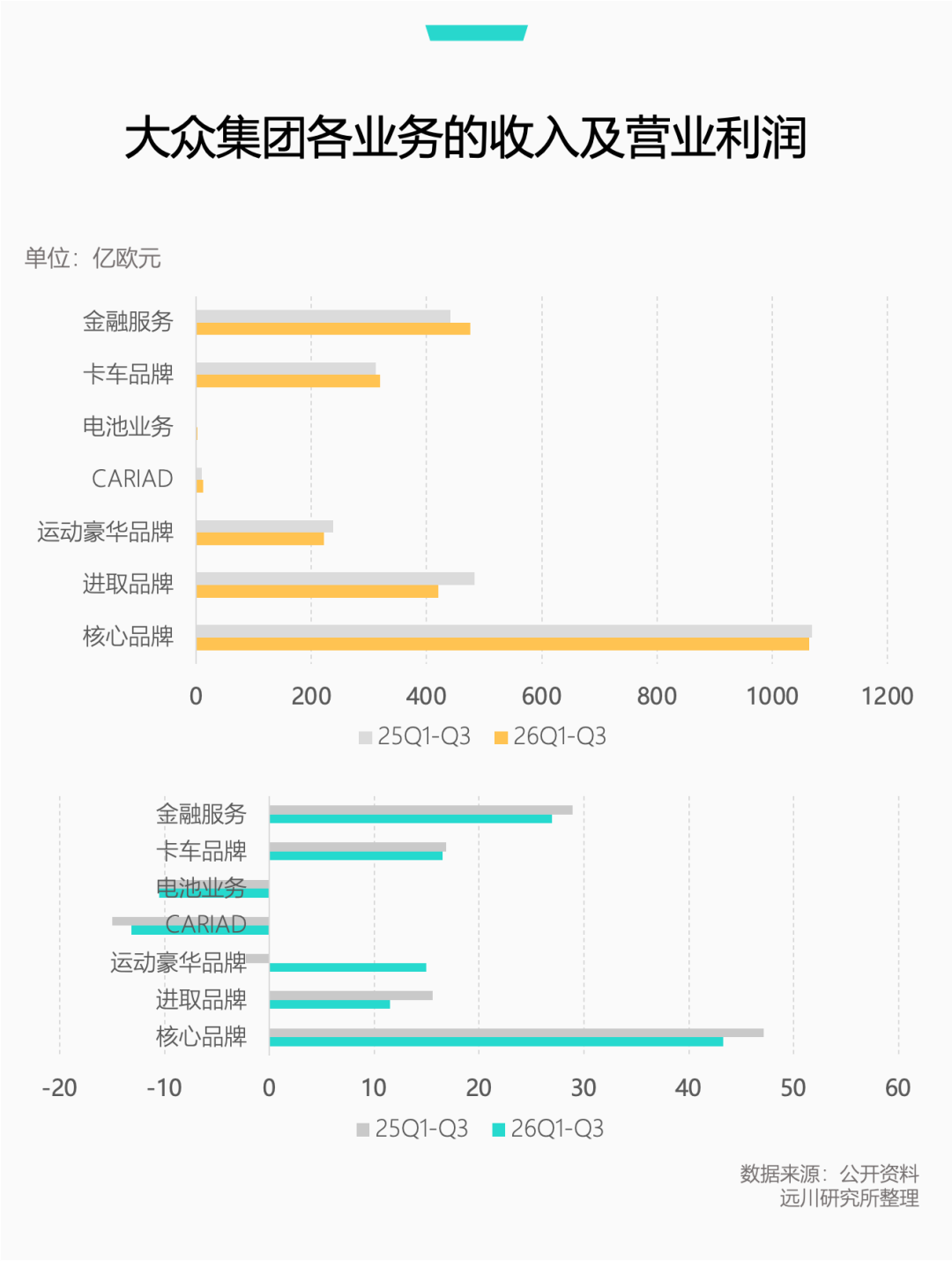
The revenue and profit of each brand in the table do not take offset items into account
As a representative of Germany's high-end manufacturing, BBA (Benz, BMW, Audi) faces significant pressure.
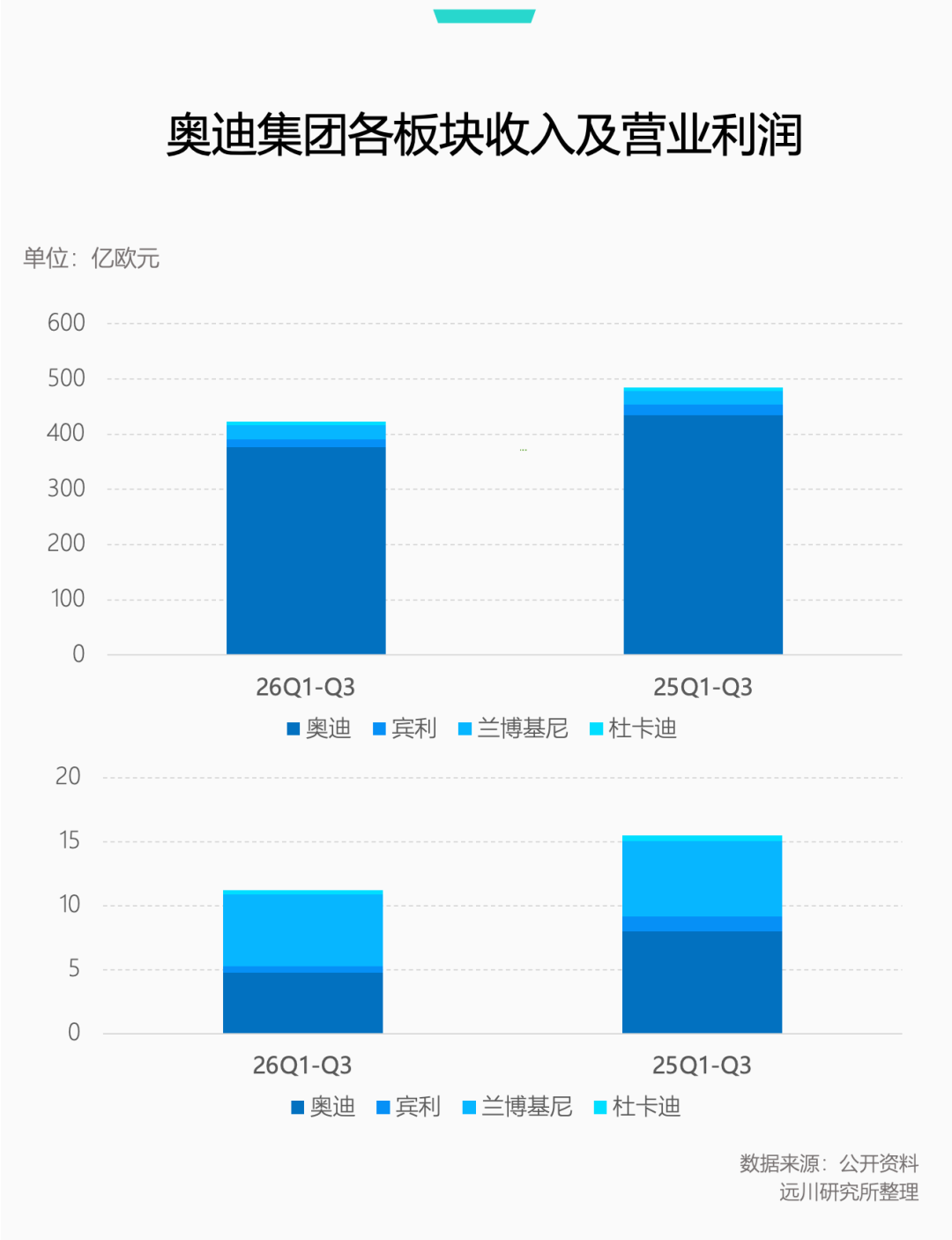
Audi’s financial report includes four brands: Audi, Bentley, Lamborghini, and Ducati, which belong to Volkswagen's "Progressive Brands" group.
However, the growth of the Progressive Brands in the third quarter was not promising, with revenue at 12.886 billion euros, a year-on-year decline of 18.5%, and operating profit at 29 million euros, a year-on-year decline of 93.9%.
Audi accounted for over 90% of sales, but only contributed 40% of the profits, with most earnings coming from the high-margin Lamborghini.
BMW's situation is also not optimistic, with third-quarter revenue at 30.452 billion euros and operating profit at 1.589 billion euros. For the first three quarters, revenue and operating profit were 92.718 billion and 5.224 billion euros, respectively, down 7.3% and 35.2% year on year.
According to BMW's official statement, excluding the impact of U.S. tariffs, depreciation and amortization from the acquisition of the remaining stake in Brilliance BMW caused a 1.2% decrease in profit margins, but even without this cost, the automotive business profit has already dropped by a quarter.
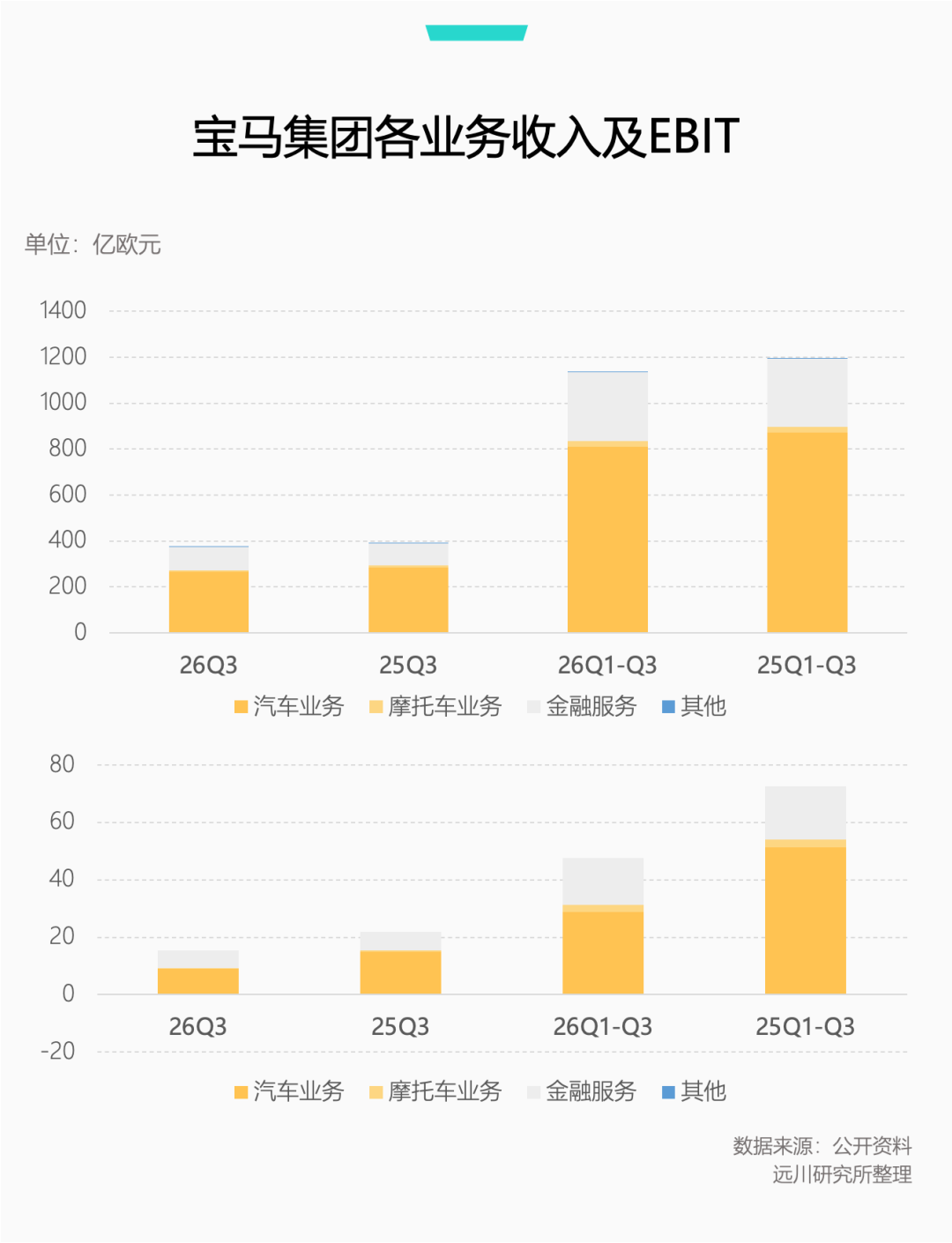
The revenue and profit of each business in the table do not take internal transaction offsets into account
Next door, Mercedes-Benz reported third-quarter revenue of 22.374 billion euros from its passenger car business, with adjusted EBIT halved to 560 million euros; for the first three quarters, revenue was 68.319 billion euros, with adjusted EBIT down 40% year on year.
Mercedes had no one-time costs, the main reason being poor car sales. In the third quarter, free cash flow plummeted by 87%, partly due to cash usage of 2.06 billion euros from increased inventory.
The management explained it was to prepare for a sales surge in the fourth quarter, but whether the produced cars can be sold remains to be seen until the fourth-quarter report.
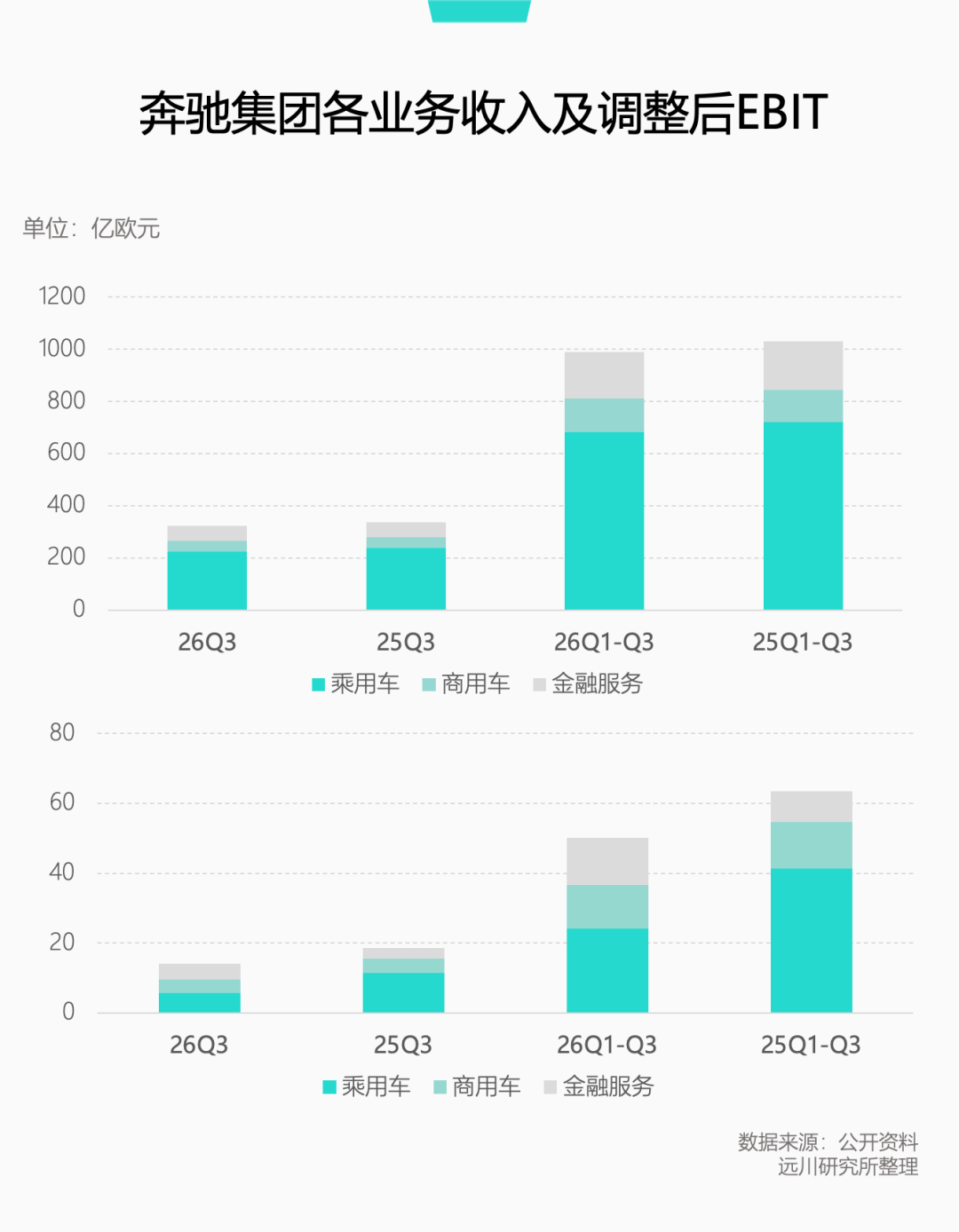
The revenue and profit of each business in the table do not take internal transaction offsets into account
Where is the issue?
The biggest variable
The problem lies in the Chinese market.
In the third quarter, Mercedes-Benz's global vehicle sales fell by 6.4% year on year, and total sales in the first three quarters dropped from 1,601,600 to 1,503,100 vehicles. BMW's delivery volume in the third quarter was 551,000, down 6.3%, and for the first three quarters, it also fell by 4.9% to 1,707,800 vehicles.
However, if we exclude the Chinese/Asia-Pacific market, Mercedes-Benz's sales in the first three quarters rose by 3% year on year. BMW saw an increase of 1.28% compared to the previous year.
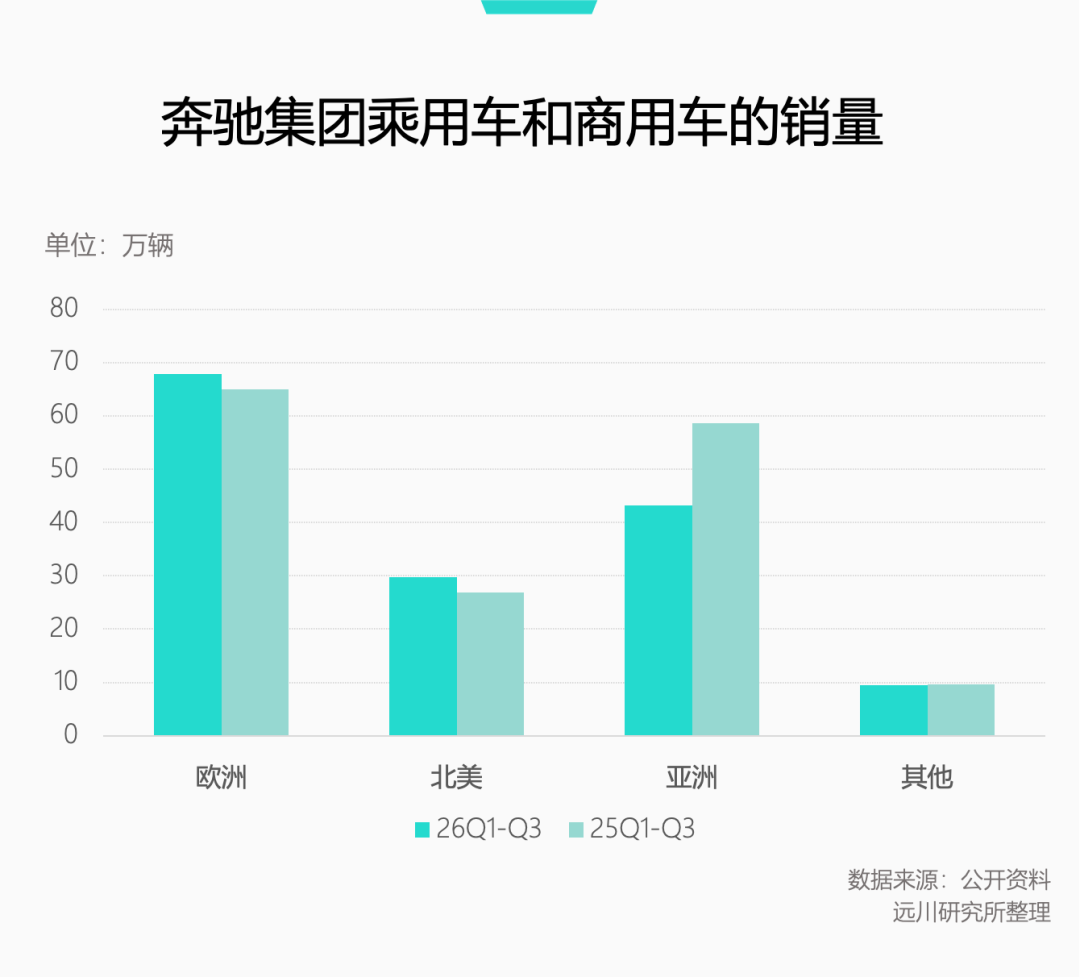
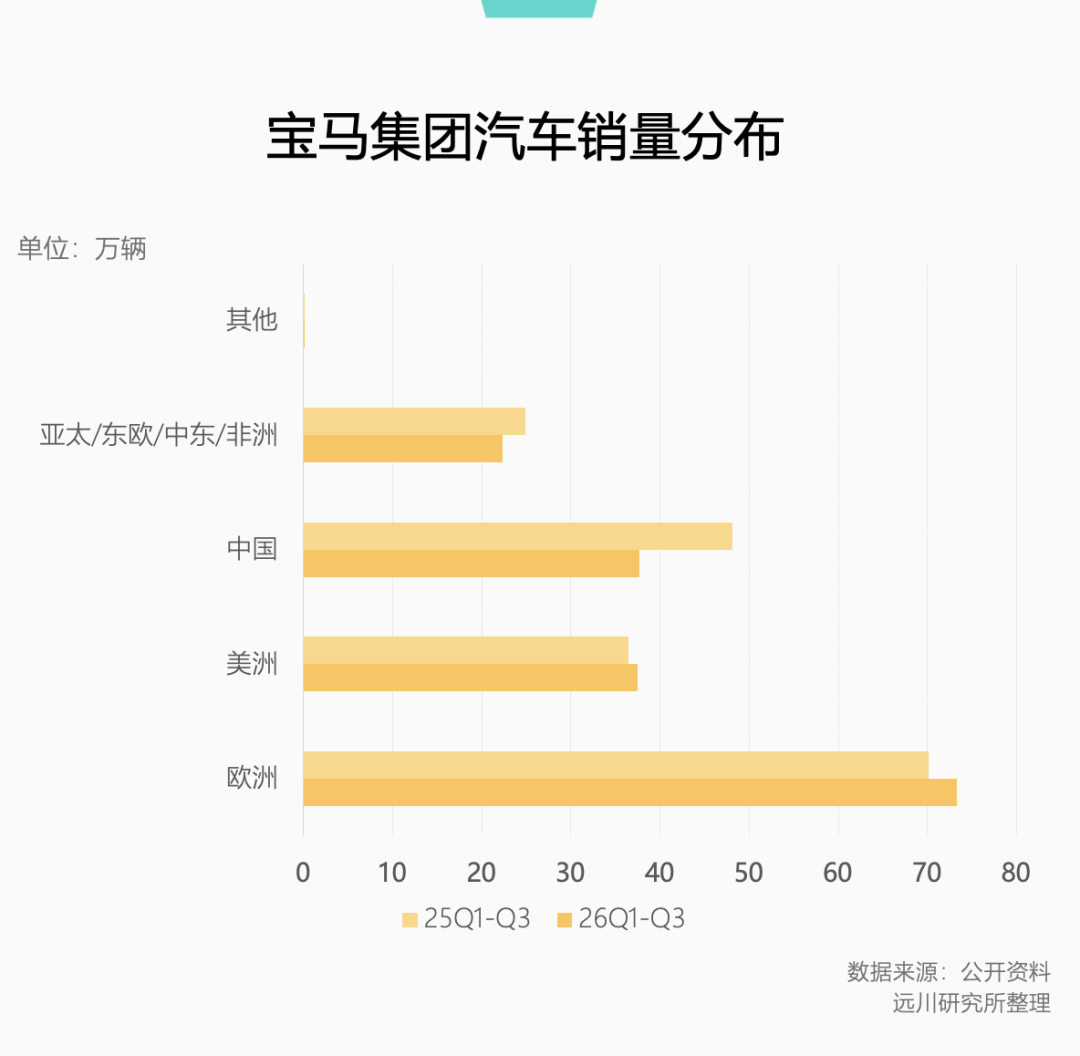
For Volkswagen, excluding the Chinese market, sales still declined, but the situation improved significantly.
In the first three quarters, Volkswagen's global sales fell by 9.3%. After excluding the Chinese/Asia-Pacific market, sales only declined by 0.03%, which can be almost ignored.
For the Progressive Brands group that Audi belongs to, overall sales fell by 11.3% in the first three quarters, and without China, the decline narrowed to 3.7%.
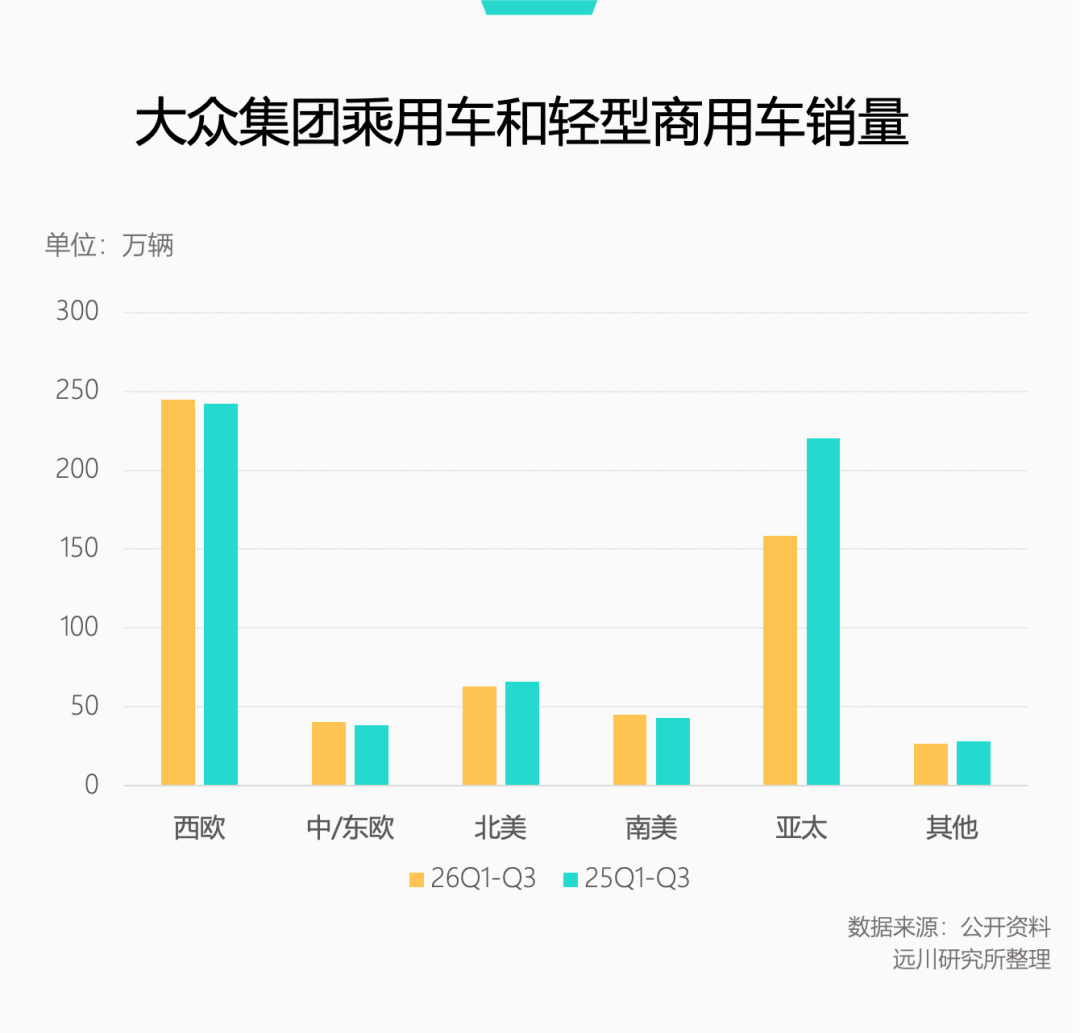
This means that the global sales of German car companies have all been dragged down by the Chinese market, and the reason for this situation lies in the sales structure.
Domestic retail penetration of new energy vehicles exceeds 67%, with pure electric vehicles accounting for nearly 70%. However, in this largest new energy market globally, German car companies mainly sell fuel vehicles.
Sales of new energy vehicles from Mercedes-Benz and BMW account for around 25%, and in the third quarter, while global sales of pure electric vehicles were increasing, only the performance in China was dismal.
According to data from Yiche, in the first three quarters, Mercedes sold less than 10,000 new energy vehicles domestically, while the GLC and E-Class maintained their strength, with sales exceeding 160,000 units. BMW's petrol-to-electric product i3 barely sold over 1,000 units on average per month, only one-tenth of the fuel 3 Series.
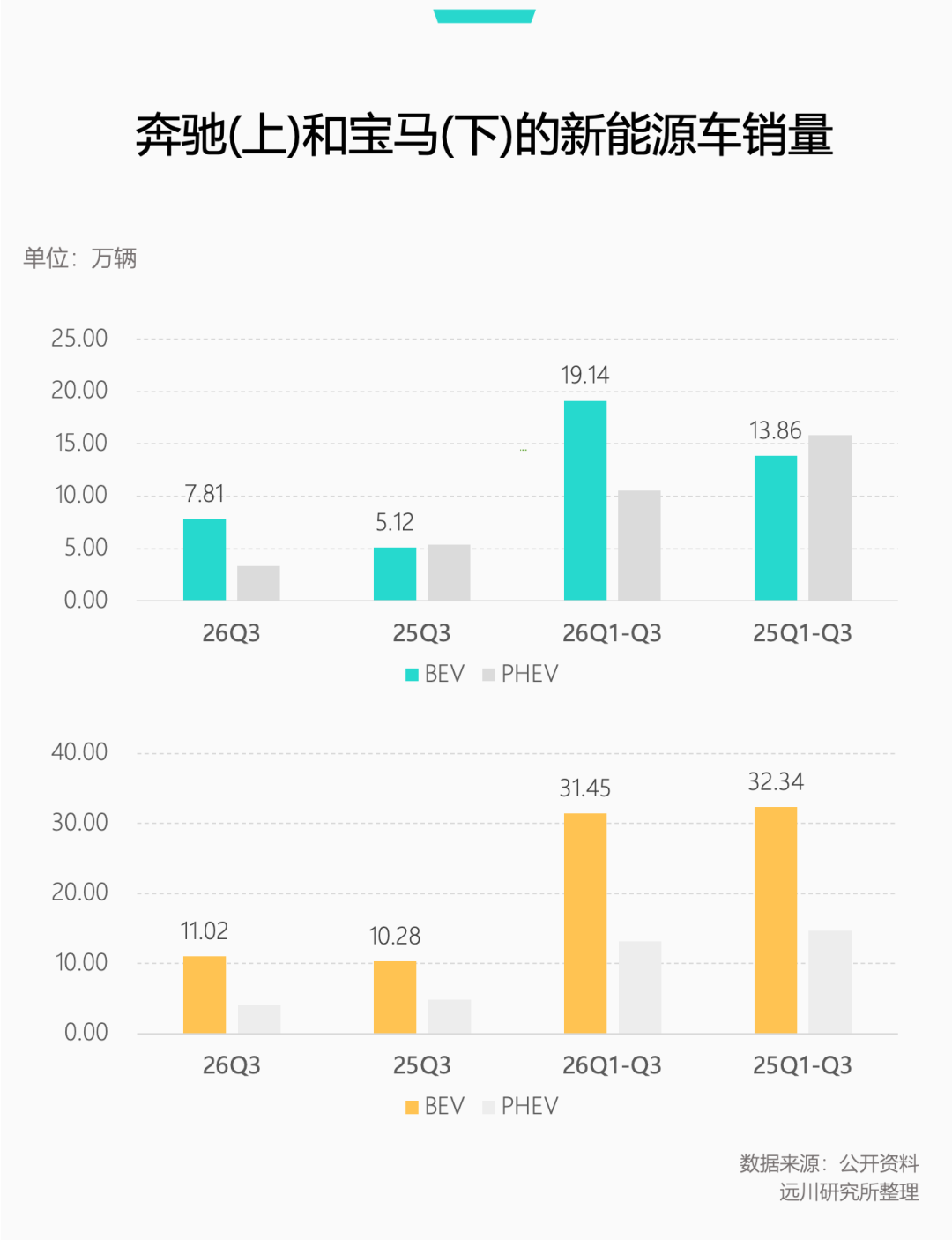
Volkswagen is more typical; they sold a lot of new energy vehicles, but they went to customers in Europe and America.
Taking pure electric vehicles as an example, in the third quarter, Volkswagen delivered 18,000 units in China, down 30.1% year on year; in the first three quarters, they delivered 48,900 units, down 42.5% year on year. In China, for every 40 vehicles delivered by Volkswagen, only one is pure electric, while in Europe, it's one in every five.
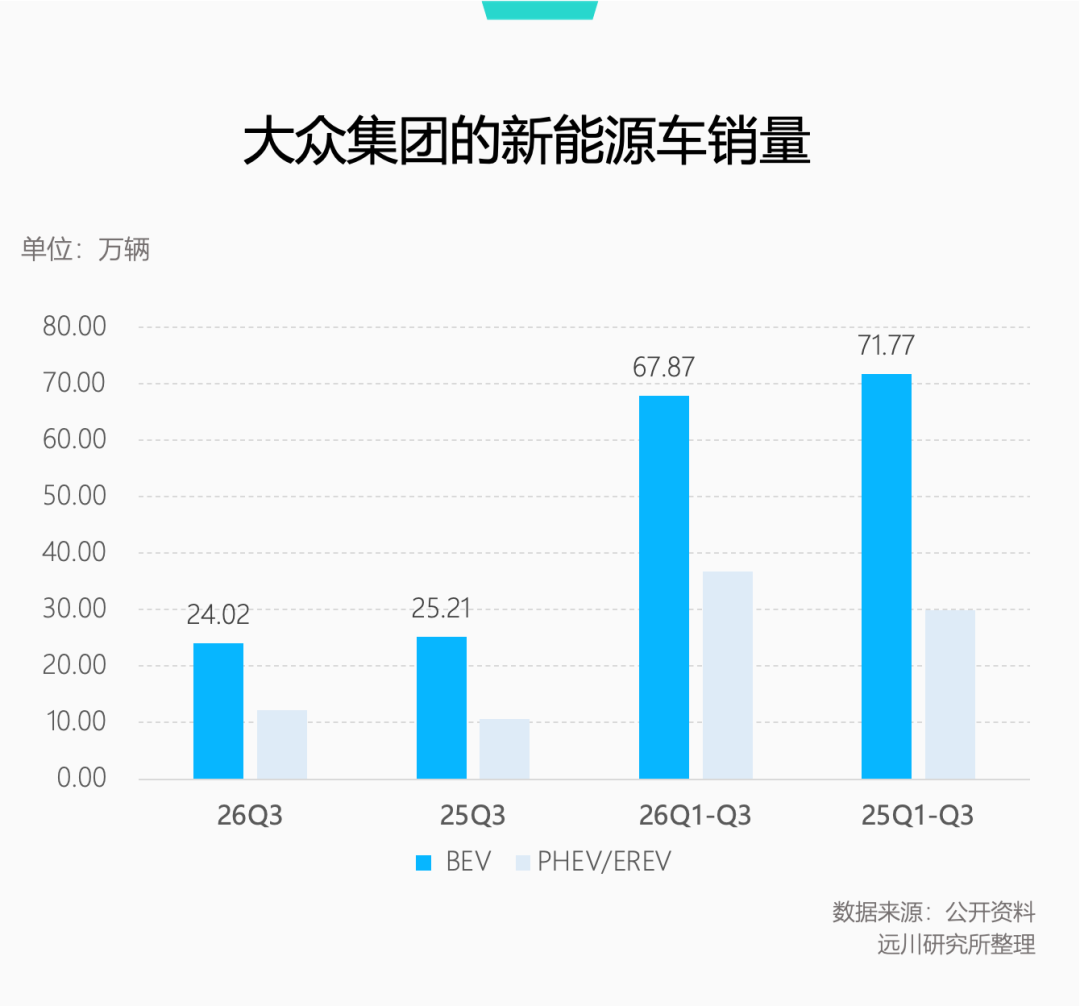
With pure electric vehicles not selling well and the fuel vehicle market collapsing rapidly, this dual pressure has directly pushed German car companies to the verge of an ICU.
In the first three quarters, Mercedes-Benz's sales in China dropped from 433,900 to 300,000, halving compared to the same period in 2021. BMW's sales in China for the first three quarters totaled 376,400, almost half of the 670,000 units sold during the same period in 2021.
Volkswagen's decline is even more severe, with third-quarter sales in China down by 38.7%, and total sales for the first three quarters plummeting from 1,973,100 to 1,375,200 vehicles, a loss of 600,000 units, enough to support a new force.
It's not that the Germans are not working hard; it's just that the new generation of pure electric vehicles came too late.
Waiting for pure electricity until white-headed
In a year where pure electric models are rapidly advancing in the Chinese market, German giants happen to be in a transitional period for their pure electric products.
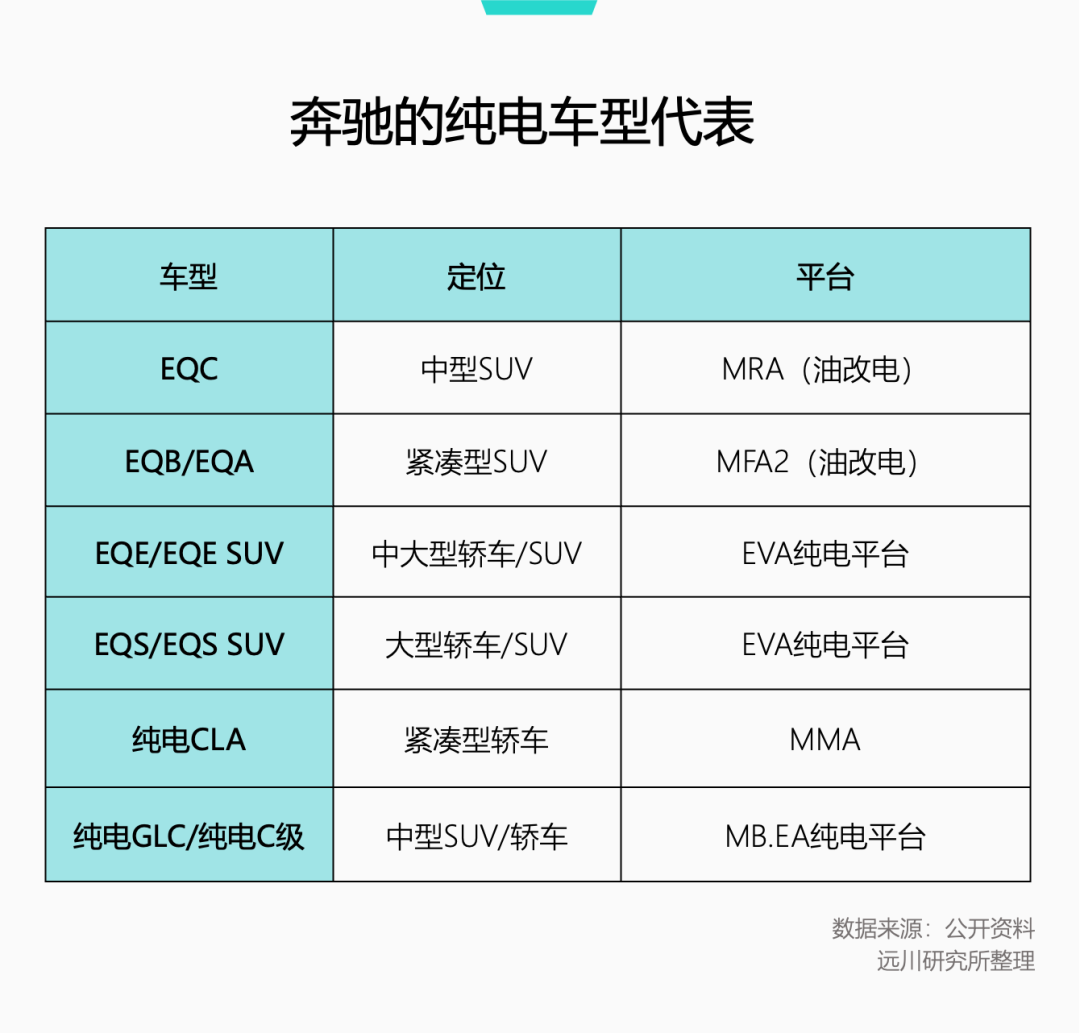
Mercedes-Benz is the most typical example; in 2019, they hastily launched the oil-to-electric EQC to try the waters, then aimed to turn around with the pure electric platform EVA, but the first model EQS was released amid low sales.
Both the EQS and EQE, the original pure electric models, faced setbacks, and Mercedes-Benz clearly suffered, cutting the next-generation pure electric platform MB.EA-Large and instead continuing to fix EVA. As EQ series models gradually phase out, the two new platforms are finally arriving late:
MMA platform for compact cars and MB.EA-M pure electric platform for mid-size vehicles.
This means that from 2019 to 2022, after the concentrated launch of the EQ series, Mercedes-Benz had no new pure electric products to market. Last year, the next generation of pure electric vehicles was launched, and large-scale model releases had just begun, barely missing the growth in pure electric penetration.
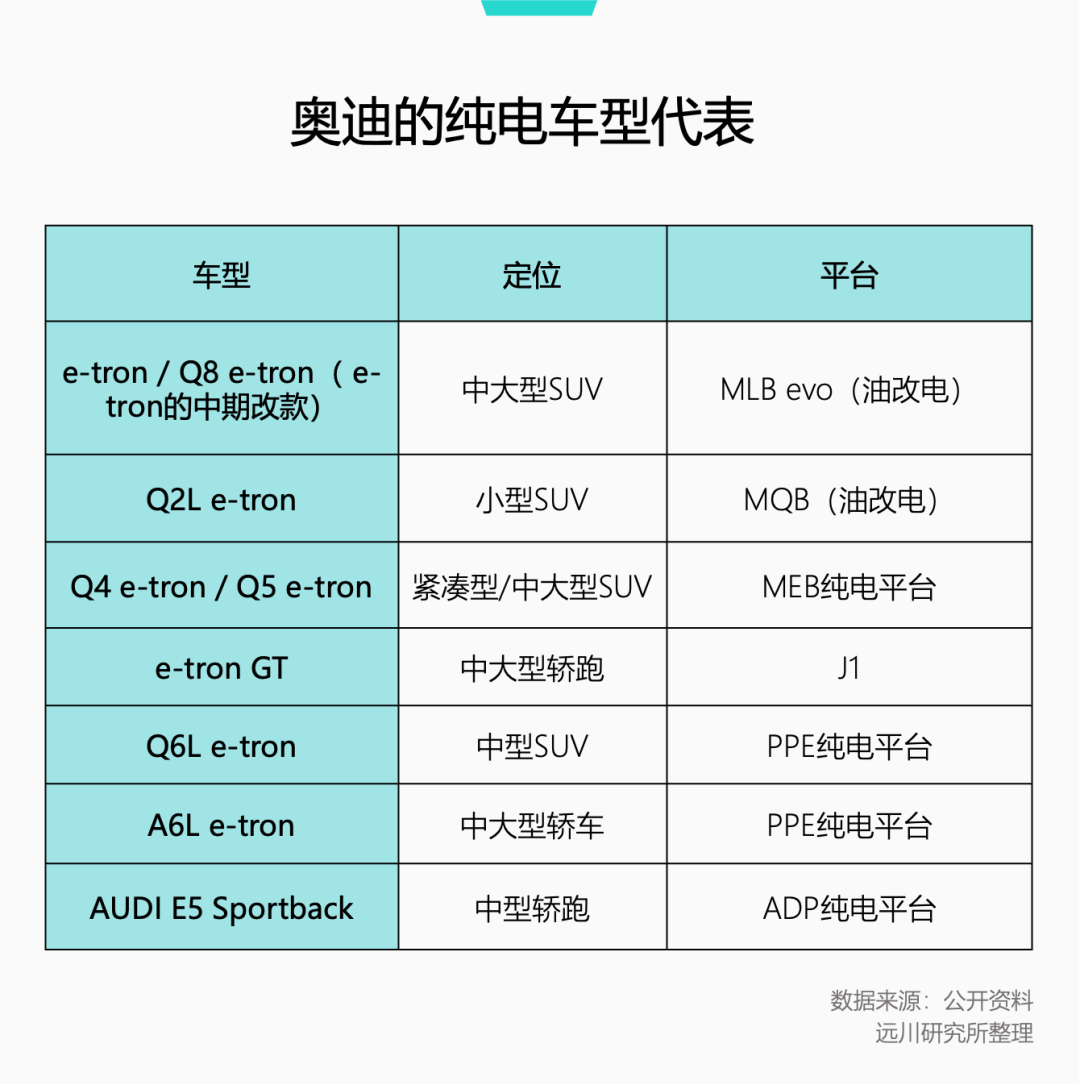
Audi's situation is similar. In 2018, the Audi oil-to-electric model e-tron debuted, announcing at the same time a collaboration with Porsche on the pure electric platform PPE, with the first model originally planned for release in 2022, but development progress has been delayed repeatedly.
As a result, Audi had to rely on Porsche’s J1 platform to produce the e-tron GT while using Volkswagen's MEB platform for the Q4/Q5 e-tron, spending the entire year of 2023 merely patching up these two models.
It wasn't until last year that the PPE platform began mass production, coupled with the newly developed ADP platform specifically for the Chinese market.
This means that there was nearly a three-year gap before Audi's pure electric models could properly update. The old e-tron series failed to establish a solid market presence, and the next generation of pure electric vehicles had just taken the baton, mainly serving to fill product gaps.
Volkswagen is slightly different. By the end of 2019, Volkswagen was the first to launch the pure electric MEB platform with the initial car ID.3 performing decently; following that, the ID.4, ID.5, and ID.6 were released in connection. However, since the ID.7 launched in 2023, the speed of releasing pure electric models has started to slow down, entering a prolonged two-year gap.
The issue faced by Volkswagen is more practical; they have a pure electric platform but a deficient electronic architecture, putting them at a competitive disadvantage domestically. Internal development at CARIAD has not gone smoothly, resulting in the ultimate platform SSP's launch being pushed back to 2029.
To fill this gap, Volkswagen has done two things: firstly, allowing the Chinese team to lead the development of a new CMP platform; secondly, abandoning the original electronic architecture in favor of a jointly developed CEA electronic architecture with XPeng, delaying the new platform's launch compared to Mercedes-Benz and Audi.
Compared to Volkswagen, which arrived early but found themselves late, BMW can be considered the most conservative and dogmatic one.
Since the launch of the domestically produced iX3 in 2020, all pure electric vehicles from BMW in China have been based on the CLAR platform, meaning oil-to-electric transformations, sticking to one path.
As the demand for pure electric vehicles becomes increasingly robust, patching together is no longer feasible; BMW finally revealed its new generation (Neue Klasse) of pure electric vehicles, with the overseas version launched in August and deliveries to the Chinese market not expected until the first quarter of next year.
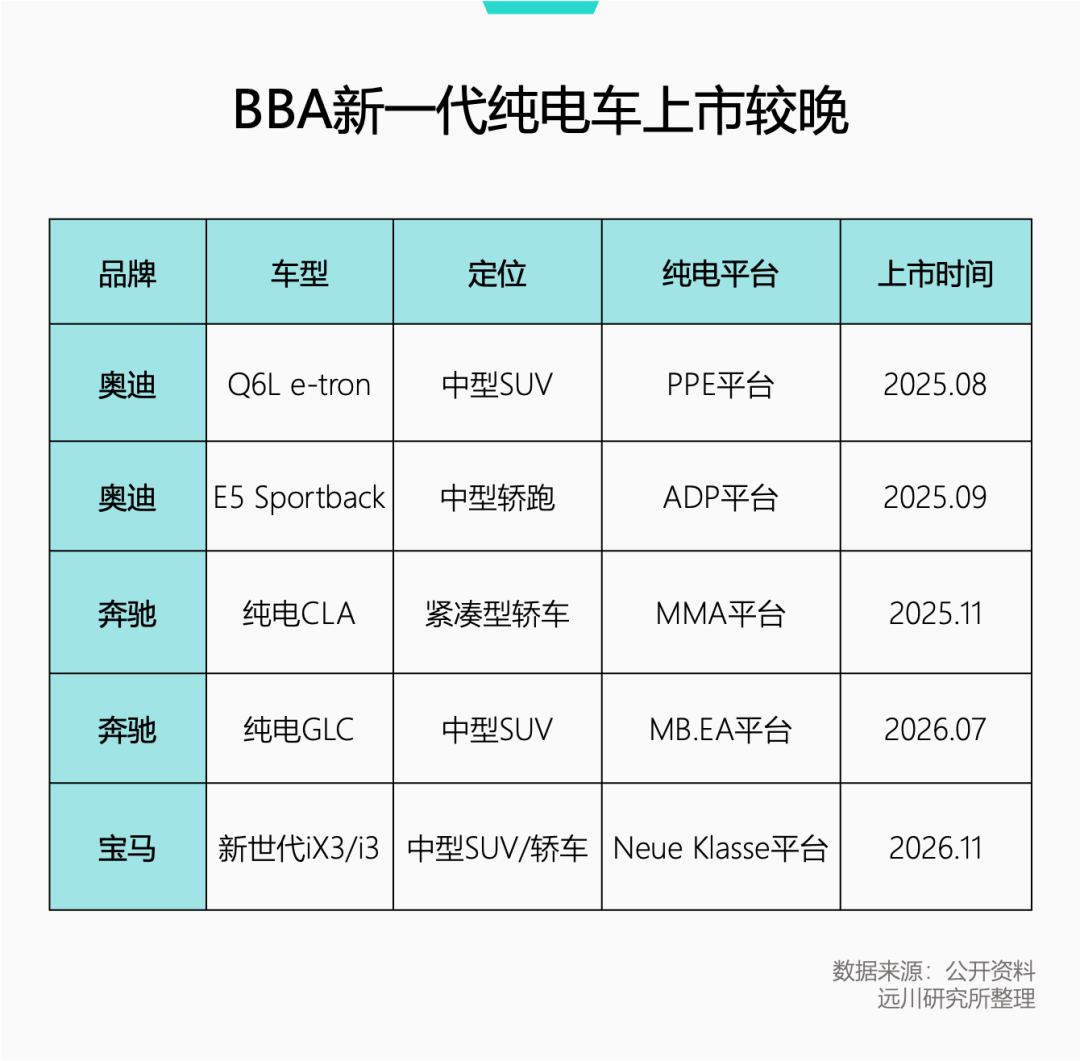
At this pivotal moment for model updates, German car companies are facing similar awkward situations:
The old platform pure electric vehicles are being phased out and retired, while the new platform pure electric vehicles have just been unveiled, and the models have not been widely rolled out. In a year where pure electric vehicles are rapidly penetrating the Chinese market, they perfectly hit the timing gap.
The delayed product arrival is a cyclical issue; once new vehicles start to be released, it will naturally improve. However, if heavily investing in new models still does not outperform local new forces, then it becomes a structural problem.




免责声明:本文章仅代表作者个人观点,不代表本平台的立场和观点。本文章仅供信息分享,不构成对任何人的任何投资建议。用户与作者之间的任何争议,与本平台无关。如网页中刊载的文章或图片涉及侵权,请提供相关的权利证明和身份证明发送邮件到[email protected],本平台相关工作人员将会进行核查。


