Original | Odaily Star Daily (@OdailyChina)
Author | Asher (@Asher_0210)
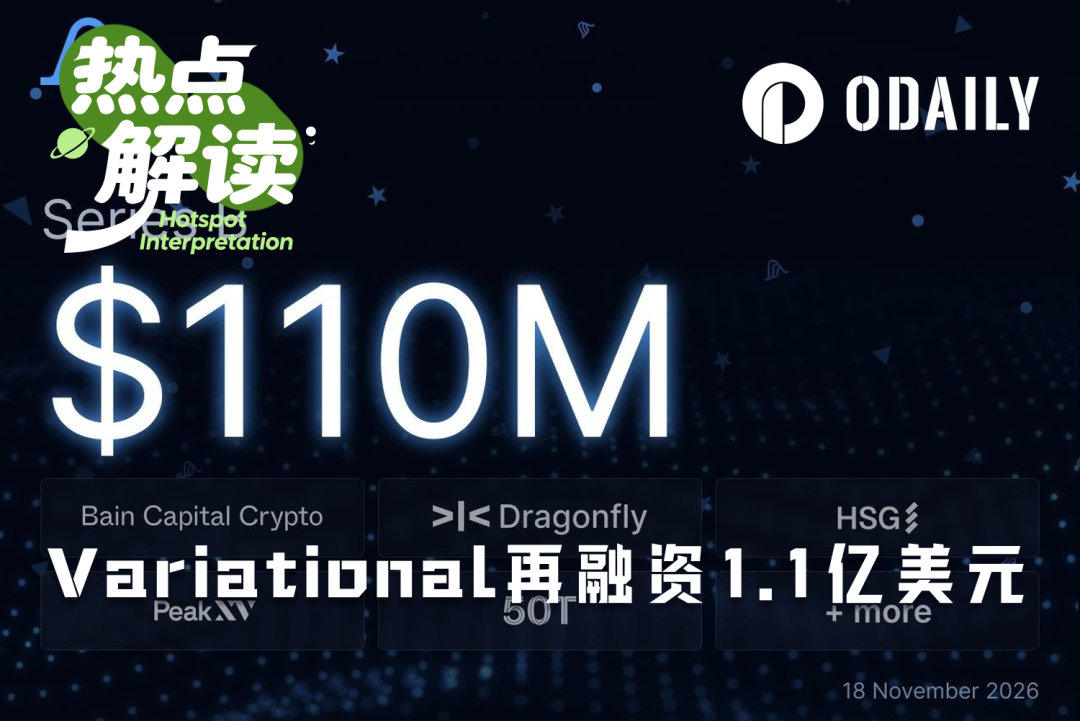
The fundraising in the crypto industry has slowed down, yet the perpetual DEX protocol Variational, which has not yet issued its token, announced last night that it has completed a $110 million Series B financing, with a post-financing valuation of $1.5 billion. This round was led by Bain Capital Crypto, with participation from Dragonfly Capital, HSG, Peak XV, and 50T Funds.
In May this year, Dragonfly just led Variational's $50 million Series A round. Six months later, Dragonfly participated again, with the Series B financing amount exceeding twice that of the Series A round. Together, Variational has raised $160 million this year.
A platform that started with crypto perpetual contracts now derives more than half of its daily trading volume from traditional markets such as stocks, indices, and gold. How did Variational bring these trades on-chain?
Variational: A zero-fee Perp DEX deployed on Arbitrum
Variational is a Perp DEX platform deployed on Arbitrum, headquartered in the Cayman Islands, with its core product being Omni. In simple terms, users can trade mainstream crypto assets like BTC, ETH, SOL, as well as long-tail assets, stocks, commodities, volatility indices, and other types of perpetual contract markets on Variational.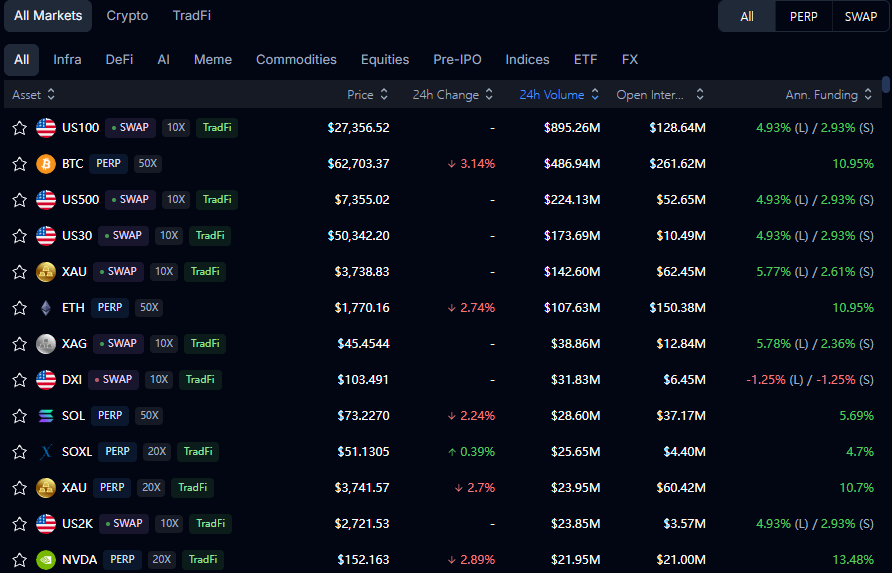
Compared to most Perp DEXs, Variational's most intuitive feature is zero trading fees. When users trade on Omni, the platform does not charge conventional trading fees; the main costs come from spreads, slippage, funding rates, and deposit/withdrawal fees.
Additionally, Variational adopts a broker-like model to access multi-source liquidity, including traditional financial market makers, crypto-native market makers, and mainstream trading platforms. Specifically, when users place an order, the built-in market maker OLP in Omni quotes directly and undertakes the trade, then hedges in the external market as needed.
Thus, even if a new market has just launched on Omni, as long as there is sufficient liquidity in the external market, OLP can provide quotes to users without waiting for buy/sell orders on the platform to accumulate slowly. Traditional assets have become the most actively traded market under this model. Since its launch in September this year, the total trading volume of traditional asset contracts on Omni has exceeded $80 billion.
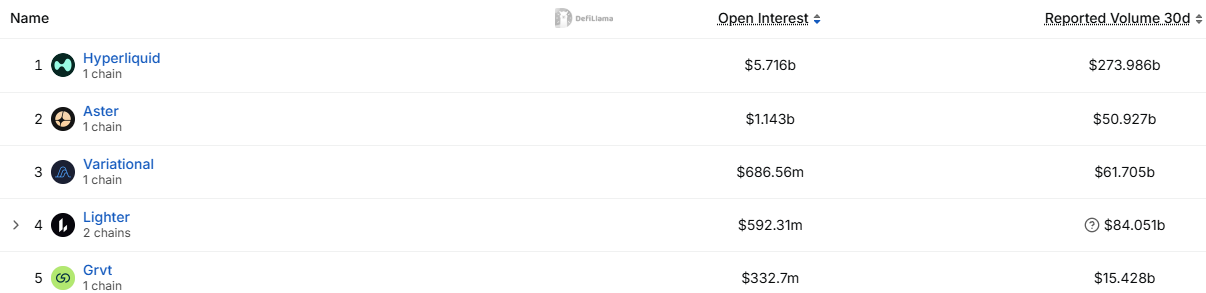
According to data from DefiLlama, Variational's trading volume has surpassed $61.7 billion in the past month, and the current open contract volume exceeds $680 million, ranking third in the Perp DEX sector. It is noteworthy that among the top five Perp DEXs by open contract volume, Variational is the only platform that has not yet issued a token.
The team still plans for a TGE this year, but the probability given by the prediction market is only 60%
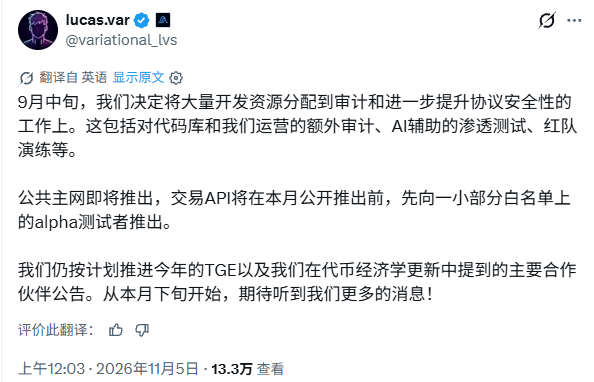
As early as September, when Variational announced its token economic model, it stated that the TGE date for VAR was set for the fourth quarter of 2026. On November 5, Variational co-founder Lucas Schuermann posted on X that VAR is still planned to go live within this year, and the major collaborations mentioned earlier will be announced as scheduled, with the team expecting to disclose more progress starting in late November.
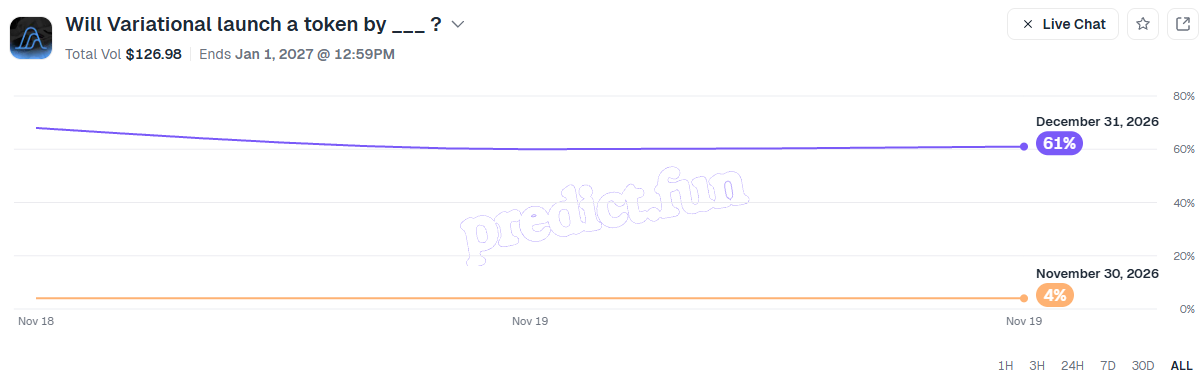
However, the prediction market is not optimistic about VAR's TGE this year. According to predict.fun data, the probability of Variational issuing a token by December 31 is only 61%, and the probability for November 30 is just 4%. From these two time points, the market is more inclined to expect VAR to launch in December, while also leaving considerable room for a delay until next year.
For points players, the TGE date also determines when points will stop being issued. Variational originally planned to end the points activity at the end of the third quarter, followed closely by the issuance of VAR. With the advancement of significant strategic cooperation, the project has adjusted its token issuance timeline, and the points activity will continue until the TGE, issuing 150,000 points weekly.
According to estimates from third-party dashboards, approximately 10.3 to 10.5 million points had been issued by mid-November. If VAR goes live at the end of December, the total points are expected to increase to about 11.3 to 11.4 million points. Based on the total points at the end of December, if VAR's FDV is $1 billion, $1.5 billion, and $2 billion, the theoretical value of each point would be approximately $28, $42, and $56, respectively.
Small token contracts may be Variational's breakthrough point to challenge Hyperliquid
In the past, even when trading small tokens, larger orders had the opportunity to transact on Hyperliquid at market price. Now, this advantage is weakening. HyperIndex compared 38 small token contracts and found that in the past year, the median amount of orders available for trading close to market price on Hyperliquid has decreased by 82%, while during the same period, Binance and OKX fell by 61% and 78%, respectively.
The thinning of small token orders on Hyperliquid means that the same large order may have to sweep through more price ranges to complete the trade, giving Variational the chance to capture that trading volume. How much market share this $110 million financing can bring to Variational will depend on whether Omni can increase the position limits on more small tokens, reduce the transaction costs for large orders, and allow traders to close positions at reasonable prices even during significant price fluctuations.
免责声明:本文章仅代表作者个人观点,不代表本平台的立场和观点。本文章仅供信息分享,不构成对任何人的任何投资建议。用户与作者之间的任何争议,与本平台无关。如网页中刊载的文章或图片涉及侵权,请提供相关的权利证明和身份证明发送邮件到[email protected],本平台相关工作人员将会进行核查。


