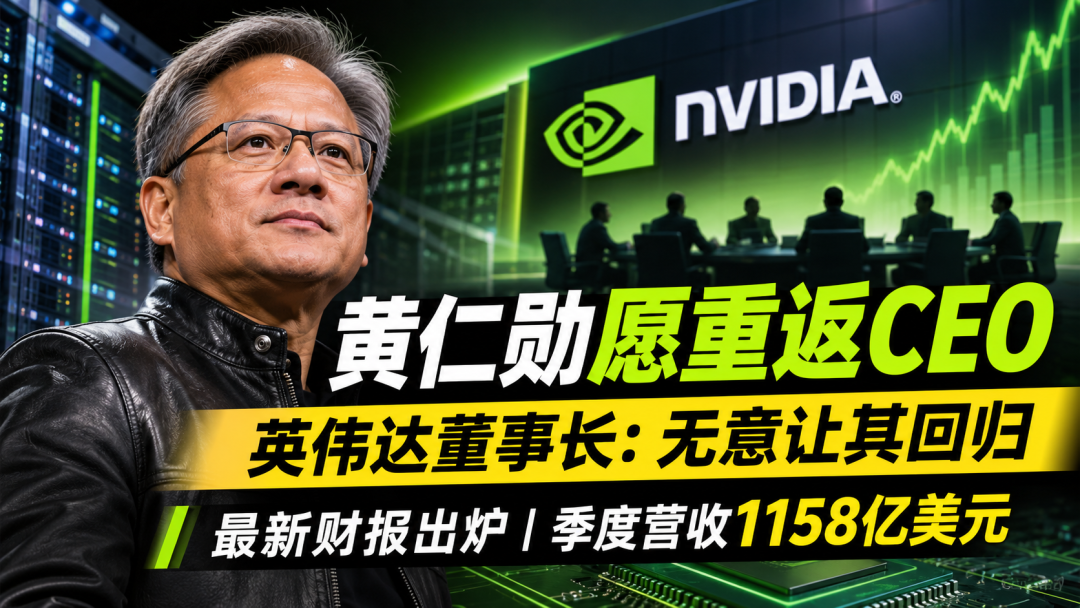
One night, two sentences brought this grand drama to a climax.
The first sentence came from Jensen Huang. A week after resigning, this founder of Nvidia publicly spoke for the first time, writing a long letter that essentially conveyed: I heard that many people hope I will return, and if the board believes that my return aligns with the best interests of shareholders, employees, the company, and the United States, I will be very honored to return to Nvidia as CEO.
The second sentence came from Nvidia's newly appointed chairman, Harvey Jones. During the earnings call that evening, the first thing he stated was to shut down the conversation: "The Nvidia board unanimously accepted his resignation and has no intention of allowing Jensen Huang to return as CEO."
A step was offered, but the other side did not extend a hand.
Within a week, from the pedestal to being out
Looking back in time, the whole matter was so fast that it was hard to react.
On November 9, Jensen Huang sent an internal letter to all employees, admitting infidelity and publicly apologizing. The board immediately initiated an independent investigation. At that time, everyone thought that this personal moral issue could probably be resolved by apologizing and cooling off for a while.
Then things escalated. On November 12, The New York Times revealed that Jensen Huang was also involved in an extramarital affair with Kimberly Powell, the vice president of Nvidia’s healthcare business—who directly reported to him.
This changed the nature of the situation. Previous issues might have been embarrassing, but they were ultimately about personal life; however, a relationship with a direct subordinate was unavoidable in terms of conflicts of interest and corporate governance. For a company valued at tens of trillions of dollars, sitting in the eye of the AI storm, having such a bombshell attached to its founder and CEO, the board could not pretend not to see it.
On November 13, Nvidia officially announced: Jensen Huang resigned from his positions as CEO, president, and board member, effective immediately. After leading the company for 33 years, leaving in this way would probably not be something even the best storytellers would dare to write.
He wants to come back, but his words are quite restrained
Looking at Jensen Huang's latest letter, it was indeed written very carefully.
He did not say, "I want to come back," but instead handed the decision-making power to the board—"If the board believes... I will be very honored to respond to these calls." He once again admitted to making serious mistakes in his personal life and promised to fully cooperate with the independent investigation. Even at the end of the letter, he simply did not discuss the company anymore and left a sentence for his family:
"To my family, I love you. I will strive for the rest of my life to become worthy of your love."

There are many who support him. The online petition demanding his reinstatement has gathered over 190,000 signatures, and some employees within the company have also posted messages of support.
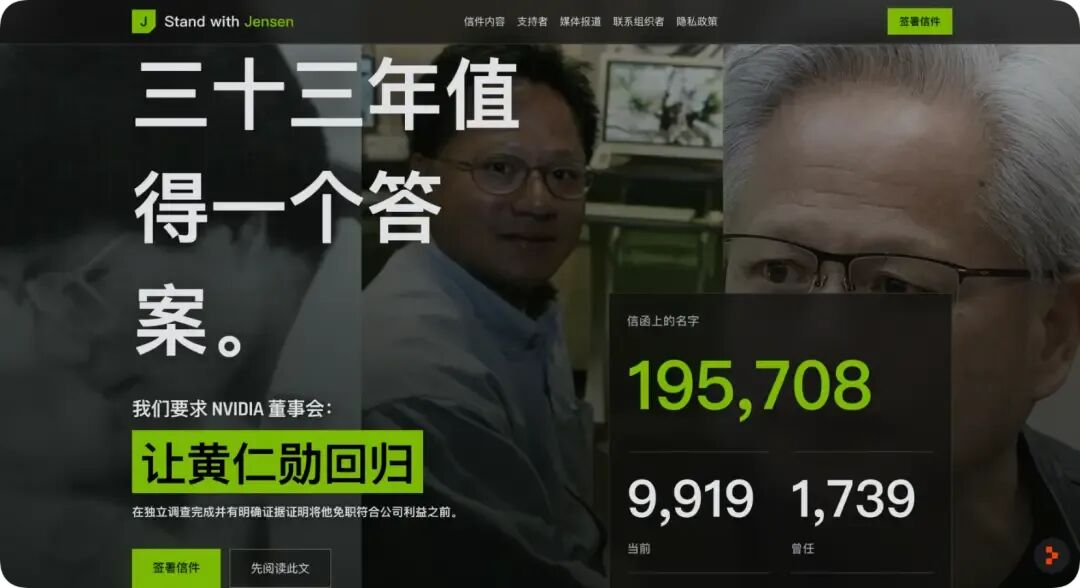
However, the board's attitude left no room for negotiation.
Jones made it very clear during the call: Jensen Huang resigned after disclosing some of his personal behaviors, which were "inconsistent with the company’s code of conduct, standards, and cultural norms"—note that this is the chairman using official language in an official setting to reiterate the reasons for his exit.
Currently, Nvidia is searching for a formal CEO candidate both internally and externally. Jones stated that they hope to finalize the decision soon, but "will not rush to make a decision just to save time." To translate: there’s no candidate in sight, but it definitely isn’t you.
Ironically, the earnings report is flawless
This call served another purpose: it was Nvidia's first report card after Jensen Huang's departure and also the first major test for interim CEO Kress.
How did it perform? Almost perfect.
In the third fiscal quarter of FY2027, Nvidia's revenue reached $115.8 billion, a year-over-year increase of 103% and a quarter-over-quarter increase of 20%, far exceeding market expectations of $109.1 billion. This marks the company's 17th consecutive quarter of surpassing Wall Street expectations.
Data center revenue was $107.6 billion, up 110% year-over-year. Adjusted earnings per share were $2.68, while the market expected $2.48. The non-GAAP gross margin was 74.9%, also surpassing expectations.
The guidance is even more aggressive: revenue for the next fiscal quarter is expected to be around $130 billion, exceeding analysts' expectations of $125.2 billion—and this does not include any revenue from data center chips in China. Kress even raised the growth forecast for FY2028 from 70% to 75%, revealing that the company’s cloud business backlog has reached $2.5 trillion, up from $2 trillion three months ago.
The Vera Rubin new platform has started strongly, and next year’s Vera Rubin Ultra and 2028’s Feynman are on the schedule. The board also approved an additional $150 billion in share buybacks, with $28.1 billion already repurchased in this quarter.
Once the earnings report was released, Nvidia’s stock rose over 4% in after-hours trading, with the AI hardware sector also seeing widespread gains.
In other words, from a purely operational data perspective, Nvidia continued to function as usual without Jensen Huang, the machine kept running, and the engine kept turning.
Does Nvidia really not need Jensen Huang?
On paper, yes. But beyond the numbers, several questions are not so easily bypassed.
The stock price has yet to recover. Since the start of the controversy, Nvidia's stock has dropped over 16%, with about a 17% decline this year, bringing its market value down to around $3.8 trillion. Just last week, it recorded six consecutive declines, marking the longest losing streak since 2012. This earnings report can only stop the bleeding temporarily; the market's real concern is not with this quarter's numbers, but the execution risk in the "post-Jensen Huang era"—Morgan Stanley has already lowered Nvidia's data center sales expectations for 2027 and 2028 by about 10%.
The investigation is still ongoing. The board's independent investigation into Jensen Huang is still in progress, while a new National Security and Export Control Oversight Committee has been established. Chip exports, regulatory pressures, and management behavior standards are the real issues weighing on Nvidia.
There is an even more fundamental question, articulated frankly by an executive at US ETF issuer Direxion: the biggest highlight of this earnings report is that Nvidia proved that the AI story is grander than Jensen Huang himself.
This statement is half right. The demand for AI is indeed at an epoch-making level and will not disappear due to the departure of a CEO. But the other half is: Nvidia has been Nvidia for the past 33 years precisely because of that founder who worked seven days a week, directly managed over 60 subordinates, and insisted on not having a subordinate reporting structure. The founder is never just a variable in a financial model for a company.
Now, this founder has publicly expressed a desire to return, but the board flatly rejected it, and the formal CEO is still being auditioned. How long can this interim CEO Kress hold on, who will be the next, and what will the investigation uncover—all steps are hanging in suspense.
At the end of the letter, Jensen Huang stated that he would strive for the rest of his life to become worthy of his family's love. Whether he can answer that on the family side will depend on his own efforts.
As for Nvidia, the board has already submitted its answer in one sentence: without you, we can still come in first.
However, this course still has a few semesters to go.
免责声明:本文章仅代表作者个人观点,不代表本平台的立场和观点。本文章仅供信息分享,不构成对任何人的任何投资建议。用户与作者之间的任何争议,与本平台无关。如网页中刊载的文章或图片涉及侵权,请提供相关的权利证明和身份证明发送邮件到[email protected],本平台相关工作人员将会进行核查。


