The company behind the Claude AI model, Anthropic, is preparing to go public. Founded in 2021 by a group of researchers involved in several key breakthroughs in artificial intelligence, the company did not launch its first commercial product until early 2023. On October 26, Anthropic submitted its prospectus to the SEC; on November 2, the company updated its third-quarter performance; on November 10, a second revised prospectus published the price range for the shares, and the company also initiated a roadshow, a series of promotional meetings with investors leading up to its IPO. The stock will be listed on Nasdaq under the ticker symbol ANT.
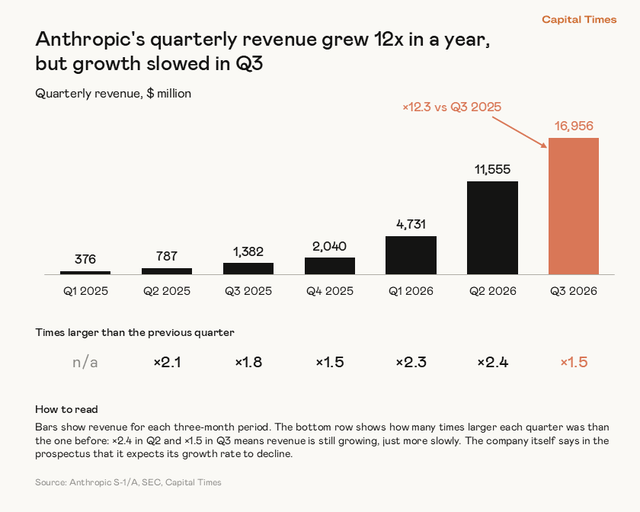
In the past year, Anthropic saw its quarterly revenue grow 12 times, from $1.4 billion to $17 billion. By comparison, Nvidia (NVDA), which performed best in this round of AI boom, only saw a year-on-year growth rate of 3.7 times in its strongest quarter at the end of 2023. This is understandable, as Anthropic has only just begun to generate its first batch of substantial revenue.
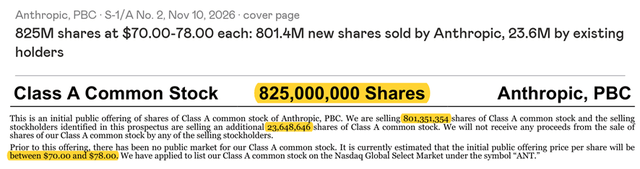
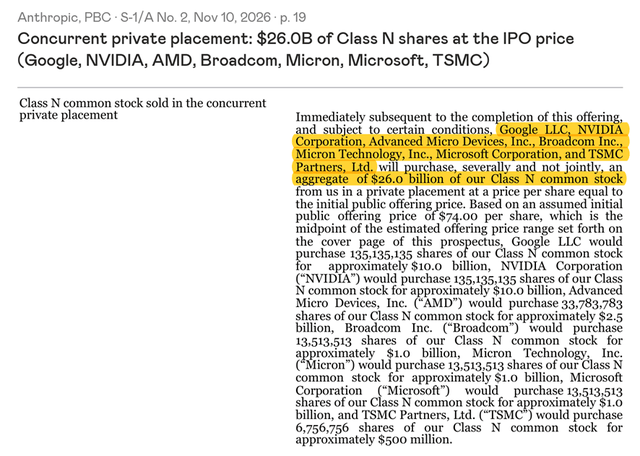
So, how much are investors willing to pay for such growth? In early October, the market discussed a valuation as high as $2 trillion. However, after the Nasdaq 100 fell 6.4% on November 5, some potential investors began discussing a valuation of $1.2 trillion to $1.3 trillion, according to Bloomberg. On November 10, the company finally set its IPO price range at $70-78 per share. If we only count the shares that will be immediately available after the IPO, the corresponding valuation is about $1 trillion; if we account for all possible shares that may emerge in the future—including employee options, stock grants, and remaining Amazon (AMZN) convertible notes—then the valuation corresponds to approximately $1.22 trillion to $1.36 trillion. Anthropic plans to issue 801 million new shares, while existing shareholders will also sell another 24 million shares. Additionally, Google (GOOG), Nvidia, AMD (AMD), Broadcom (AVGO), Micron (MU), Microsoft (MSFT), and TSMC (TSM) will purchase $26 billion worth of stock at the IPO price.
[Original image location: Anthropic S-1/A No. 2 prospectus cover (Capital Times annotation)]
[Original image location: Anthropic S-1/A No. 2 page 19 (Capital Times annotation)]
I used the DCF, or discounted cash flow model, to value Anthropic, arriving at a total company value of about $920 billion, which already includes the cash raised from the IPO, corresponding to about $53 per share. So, let's take a look at what this highly anticipated IPO actually offers.
What the prospectus tells us
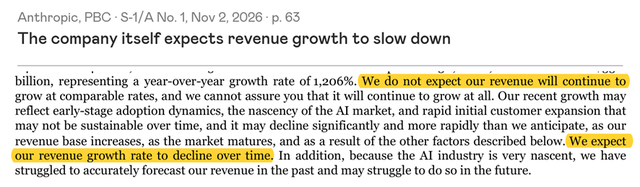
**Revenue —** In the third quarter of 2026, Anthropic sold services worth $17 billion, compared to only $1.4 billion a year ago. Companies that were already Anthropic's clients one year ago now pay about 9 times what they paid at that time. The number of clients spending over $100,000 per year has increased from 950 to over 11,900. However, growth has started to slow: second-quarter revenue increased 2.4 times quarter-on-quarter, while in the third quarter it was only 1.5 times. The company also warned in the prospectus that future growth rates will decline.
[Original image location: Fig. 1: Quarterly revenue (Capital Times)]
[Original image location: Anthropic S-1/A No. 1 page 63 (Capital Times annotation)]
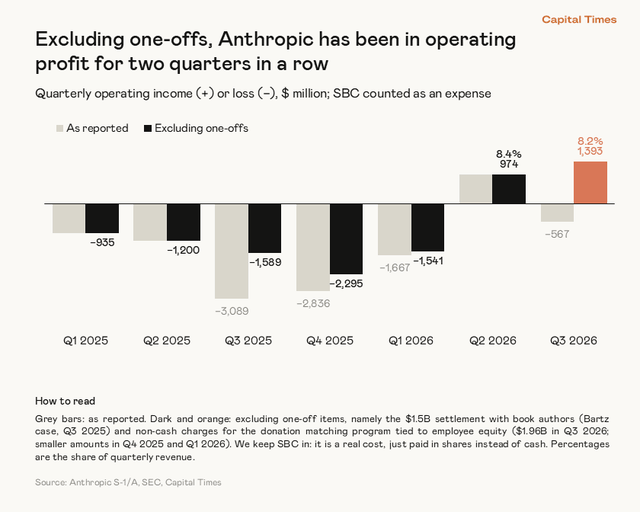
**Profit —** On paper, the losses are massive: losses in the first nine months reached $104 billion. However, $94 billion of that is not actual cash spent but accounting losses caused by the revaluation of convertible notes previously issued to investors by the company, which will convert into stock in the future. The higher the company's valuation, the higher the value of the notes, and the changes between the two are accounted for as losses. From the core business perspective, Anthropic is actually no longer losing money: excluding one-time items, operating margins in the past two quarters reached 8.4% and 8.2%. I included stock-based compensation as an expense, while the company itself excluded it, therefore the profit margin disclosed by the company for the first nine months is 12%. More importantly, this business has genuinely begun to generate cash: operating cash flow for the first nine months reached $6.6 billion.
[Original image location: Fig. 2: Operating income excluding one-time items (Capital Times)]
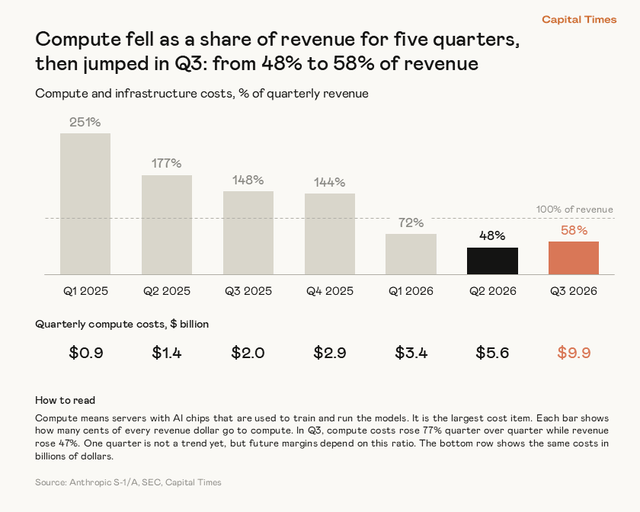
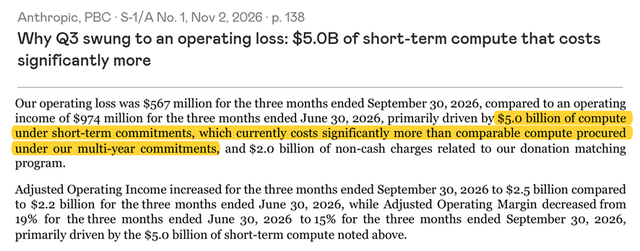
**Servers are the biggest cost —** To train models and provide services to customers, Anthropic has to rent computing power, which means servers located in data centers equipped with AI chips. This cost reached $9.9 billion in the third quarter and accumulated to $18.8 billion in the first nine months. In my view, this is the most noteworthy number in the entire prospectus. For five consecutive quarters, the ratio of computing costs to revenue declined from 251% down to 48%. This means that each quarter, the proportion of revenue spent on server resources is decreasing. However, in the third quarter, this ratio rose back to 58%: computing costs grew by 77%, while revenue only grew by 47%. The company explained that this was due to additional short-term contracts for computing power, which are significantly more expensive than long-term multi-year contracts. Of course, a single quarter cannot establish a trend, but this ratio is more important for understanding how much Anthropic can actually earn in the future than any other number.
[Original image location: Fig. 3: Compute costs as a share of revenue (Capital Times)]
[Original image location: Anthropic S-1/A No. 1 page 138 (Capital Times annotation)]
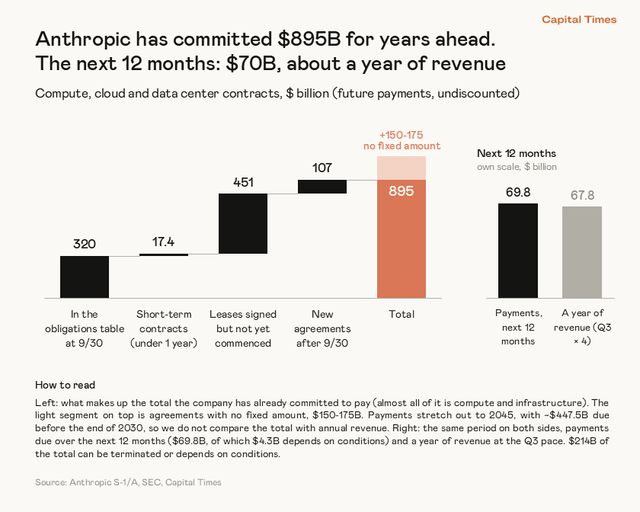
**Long-term commitments —** Anthropic has signed contracts worth about $895 billion for servers and data centers, with payment terms extending even to 2045. Partners include Amazon—at least $110 billion by 2036; SpaceX's (SPCX) AI division, formerly xAI—up to $120.5 billion by 2029; Nscale—up to $44.6 billion; and AMD—over $20 billion; along with Google, Microsoft, and Broadcom. This is not traditional debt; rather, it is the costs the company must pay for computing capacity over many years. The company actually only has $6.2 billion in actual debt—Amazon convertible notes, which, according to the terms, will eventually convert into stock.
[Original image location: Fig. 4: Anthropic long-term contract commitments (Capital Times)]
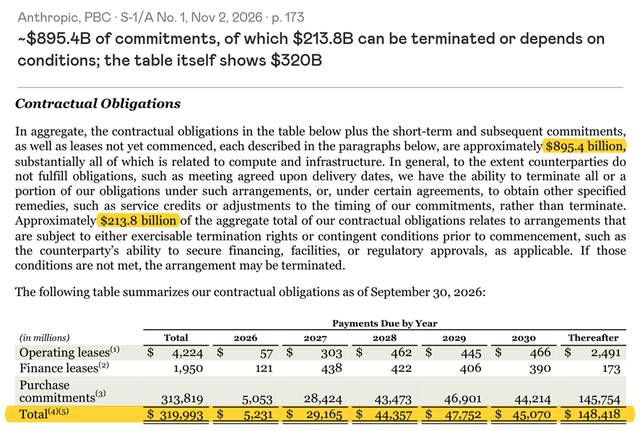
[Original image location: Anthropic S-1/A No. 1 page 173 (Capital Times annotation)]
Anthropic's primary strategic investors remain Amazon and Google: these two companies are investing in Anthropic while also selling computing power to it. At the time of the IPO, only a portion of Amazon's convertible notes will immediately convert into stock, corresponding to 277 million shares; the remaining portion will gradually convert quarterly, ultimately potentially converting into 1.84 billion shares. Meanwhile, Google will purchase $26 billion worth of stock at the IPO price along with Nvidia, AMD, Broadcom, Micron, Microsoft, and TSMC.
**Shares —** The value of each share is essentially the company's overall value divided by the number of shares, so I accounted for every potential share that could exist in the future. The company currently has 2.2 billion common shares. On this basis, we must add the preferred shares held by investors—each of which will convert into 10 common shares, increasing by 8.6 billion shares; Amazon’s convertible notes increase by 1.8 billion shares; employee options increase by 1.7 billion shares after deducting the portion that the company can “repurchase” through exercise; RSUs increase by 1.1 billion shares after deducting shares withheld for taxes; charitable funds and donation plans increase by 900 million shares; and then there are 800 million new shares issued at the IPO itself, as well as 350 million shares from private placements. In total, there are approximately 17.5 billion shares, which is nearly 8 times the current number of publicly traded common shares. We can quickly verify: in May of this year, when financing occurred, Anthropic's valuation was $965 billion, corresponding to $58.90 per share, which means the total diluted share count before the IPO was approximately 16.4 billion shares, very close to my calculation of 16.5 billion shares.
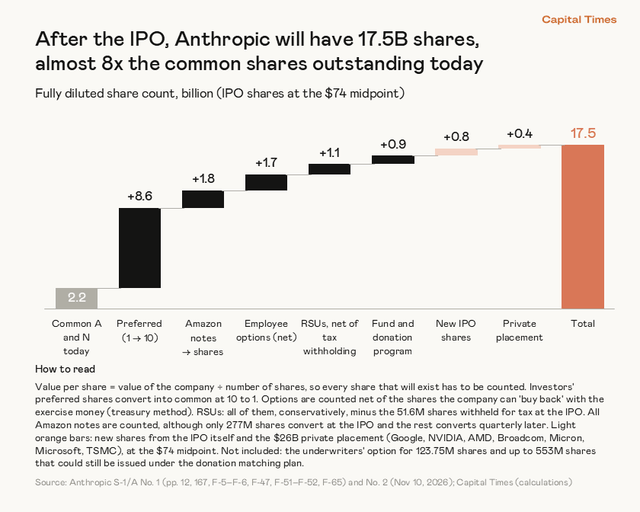
[Original image location: Fig. 5: Fully diluted share count post-IPO (Capital Times)]
Will this money be enough? After the IPO, the company will have about $213 billion in cash, while it needs to pay about $70 billion in the next 12 months, and the company itself is already starting to generate cash. Therefore, I do not see any issues with these payments in the short term. The real risk lies elsewhere: the entire business model is built on the assumption of continued revenue growth.
[Original image location: Anthropic S-1/A No. 2 page 130 (Capital Times annotation)]
How much past investors have paid
As early as 2023, Anthropic's valuation was only about $4 billion. By March 2025, the valuation reached $61.5 billion; it reached $183 billion in September; and by February 2026, it reached $380 billion. In the most recent round of financing in May 2026, investors put in $65 billion, corresponding to a company valuation of $965 billion. This means that in just 14 months, the company's valuation has increased almost 16 times. As of September 30, Anthropic's own financial records value its shares at about $70, corresponding to an overall company valuation of about $1.15 trillion. And this just happens to be the starting point of the IPO price range.
In early October, the IPO valuation discussed in the market once reached as high as $2 trillion. Subsequently, AI stocks began to cool, and prior to the roadshow, market discussions had dropped to $1.2 trillion to $1.3 trillion. The price range of $70-78 per share is 19% to 32% higher than the $58.90 that investors paid during the May financing round. The range given by named market participants cited by Bloomberg varies from about $1 trillion to $1.3 trillion to $1.4 trillion.
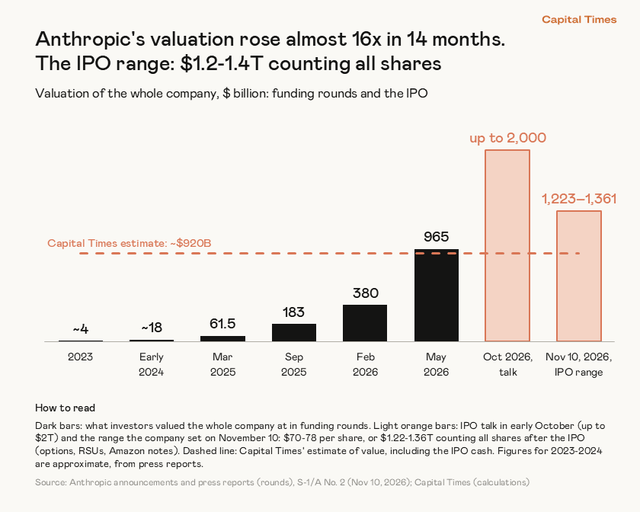
[Original image location: Fig. 6: Valuations by funding rounds and IPO range (Capital Times)]
If we look at the situation from the perspective of per-share prices, it is as follows: the February financing price was $25.91, May was $58.90, and as of September 30, it was $70.04. The last number is calculated based on the options table: $119.103 billion intrinsic value ÷ 1.177 billion options, plus $2.91 exercise price = $70.04. The company did not directly disclose this number, but it is the per-share value used for employee options.
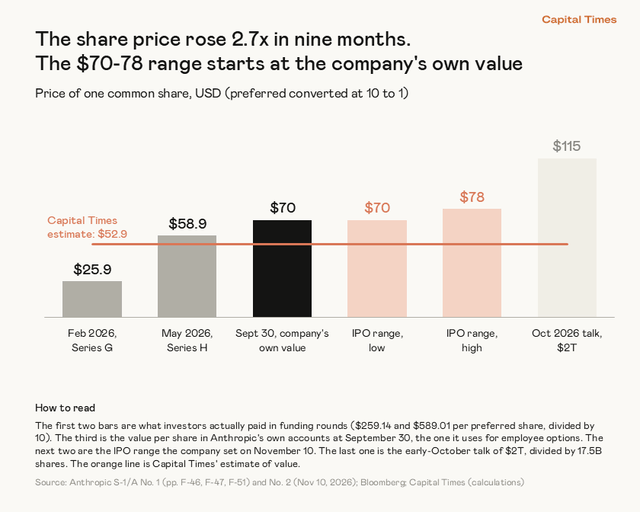
[Original image location: Fig. 7: Changes in single share price (Capital Times)]
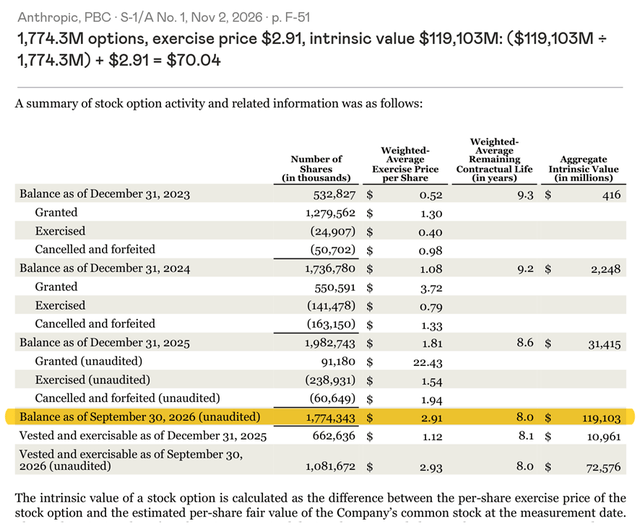
[Original image location: Anthropic S-1/A No. 1 page F-51 (Capital Times annotation)]
Value and price
The renowned valuation expert Aswath Damodaran has long emphasized the need to distinguish between these two concepts. **Value** refers to how much money a business can earn for its owners over its entire lifecycle, discounted to today's dollars. **Price**, on the other hand, is how much the market is willing to pay based on how similar companies are currently trading. I used the DCF model to calculate value: projecting how much money the company can earn in the future and discounting those cash flows to today. I will separately show market comparable valuation multiples, viewing them as “prices” without mixing price with value. The final results mainly depend on three factors.
1. How much can Anthropic sell in the future
For next year, I assume revenue will reach $100 billion. The company did not provide a formal forecast, so this is my own estimate, and I think it is quite conservative: after a 47% quarter-on-quarter growth in the third quarter, I assume future quarterly growth will be only 16%. Even so, the year-on-year revenue growth rate would still be close to 80%, which is already very fast for a company of this scale. My caution arises from the fact that quarter-on-quarter growth has decreased from 2.4 times to 1.5 times, and the company itself expects further slowdowns in the future. Moreover, a forecast for one year is actually not that important: if revenue remains constant a decade from now, whether next year it is $68 billion or $120 billion will ultimately have only about a $2 impact on the per-share valuation.
The new prospectus has already provided the first verification data: as of October 31, the company's annualized revenue run rate had reached approximately $81 billion, $10 billion more than a month ago. The company's method of calculation is: the fees charged in the past 28 days based on usage × 13, plus monthly subscription revenue × 12. The company also clearly reminded that this is not a future forecast. To reach $100 billion in revenue next year, this run rate only needs to grow by about 3% per month, and October's actual growth was 14%. So, if anything, $100 billion could even be a conservative estimate. However, its impact on the company's value remains very limited: even if next year it reaches $120 billion instead of $100 billion, the per-share valuation would only increase by less than $1.
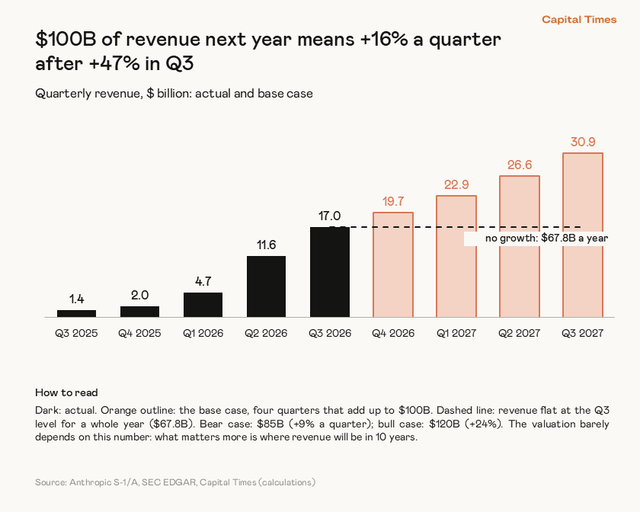
[Original image location: Fig. 8: Next year's revenue—current actual levels and base scenario (Capital Times)]
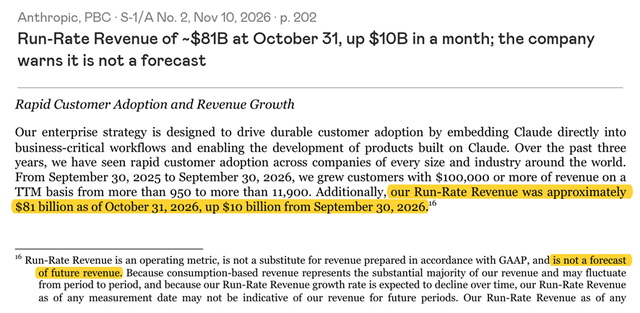
[Original image location: Anthropic S-1/A No. 2 page 202 (Capital Times annotation)]
The truly important question is **how much the company can sell ten years from now.** My base scenario assumes revenue will reach $430 billion. This is the most critical assumption in the entire valuation: for every increase or decrease of $50 billion in revenue ten years later, the per-share value will change by about $4. I do not attempt to predict the entire AI market, so I choose to reference historical events. The larger the company, the harder it becomes to continue growing at a high rate. After surpassing $100 billion in revenue, Apple (AAPL) grew at an average annual rate of 11%, Meta (META) and Microsoft at 14%-15%, Alphabet at 17.5%, and Amazon at 22%, which are among the fastest growth cases. My base scenario adopts Alphabet's growth rate; the bull market scenario uses Amazon's growth rate, corresponding to revenue of $715 billion in ten years; the bear market scenario is between Apple and Microsoft, corresponding to $250 billion.
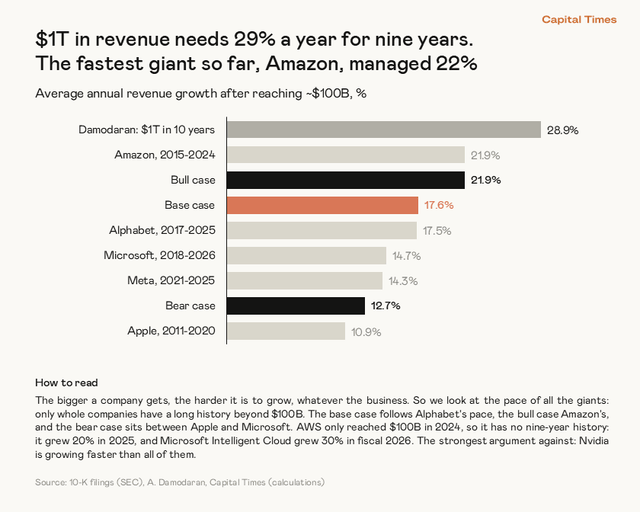
[Original image location: Fig. 9: Growth rates after revenue surpasses $100 billion (Capital Times)]
The business closest to Anthropic is the cloud computing divisions of Amazon, Microsoft, and Google. However, AWS did not surpass $100 billion in revenue until 2024, so we do not yet have a sufficiently long history to observe how these businesses grow after breaking that scale. In 2025, AWS grew by 20%, while Microsoft's cloud business grew 30% in FY2026.
Damodaran's assumptions are much more aggressive: he expects revenue to reach $1 trillion ten years from now. To achieve that figure, Anthropic would need to maintain a 29% annual growth rate for nine consecutive years, which is faster than any historical giant of that scale has ever achieved. He does not hide this point: in his model, you can choose from multiple “stories” about AI, from “work tools”—corresponding to $200 billion in revenue—to “massive replacement of human jobs”—corresponding to $1.2 trillion in revenue. The $1 trillion he uses lies between “selective replacement” of $800 billion and “massive replacement” of $1.2 trillion. My bull market scenario is lower because I am reluctant to take growth that no company has ever achieved at such a scale directly as a benchmark. However, the strongest counterexample to me is Nvidia, which is indeed growing faster than all previous examples. The AI boom could very well break historical patterns.
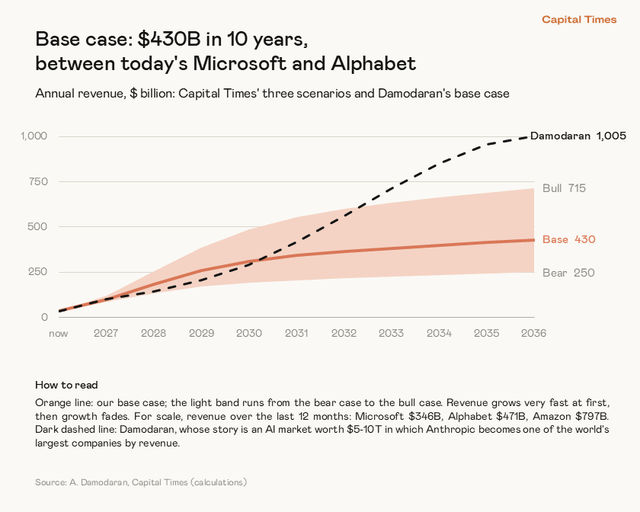
[Original image location: Fig. 10: Revenue scenarios and Damodaran's base case (Capital Times)]
2. How much profit can be made from every dollar of revenue
The second question is the operating margin, which is how many cents of profit can ultimately be retained from every $1 of sales revenue. My base scenario assumes 30%. This is the average level of Amazon's cloud business AWS over the past eight years, and both companies' business models share some similarities: pay-per-use, enterprise customers, and large numbers of servers. The bull market scenario assumes 40%, while the bear market scenario adopts the peer median of 21.5%. Why not assume higher? Because Anthropic rents servers from these cloud service providers, which means it must first pay for the other party's profit, and recently these costs have risen as a proportion of revenue. According to my revenue forecasts, to justify the IPO price range of $70-78 per share, Anthropic would ultimately need to achieve an operating margin of 48%-54%. This is even higher than Microsoft's 47%, with only Nvidia's 65% being higher than it.
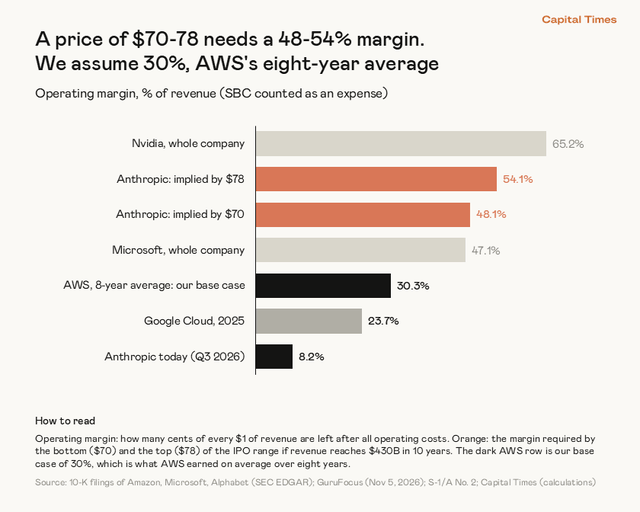
[Original image location: Fig. 11: Required operating margins for the IPO price range (Capital Times)]
3. Discount rate
The $1 earned by the company ten years from now is not worth the $1 today because you have to wait, and you may ultimately not get it at all. The discount rate is the annualized rate of return that investors demand for waiting and taking on risks. The higher the discount rate, the lower the present value of future cash flows, and thus the lower the company's valuation. I used an 11.6% discount rate for the first five years, which drops to 9% as the company matures. The logic is simple: the yield on U.S. Treasury bonds—I used 4.85%—plus a risk premium similar to that of comparable tech companies. As for the risk of complete company failure, I calculated that separately, setting it at 10% in my base scenario.
Damodaran uses a discount rate of 9.7%. He views the server contracts as debt, while the cost of debt financing is lower than the cost of equity, resulting in a lower weighted average discount rate. Some of his readers have critiqued this. I, however, retain all these contracts as expenses. Both approaches can logically be consistent, and the impact of the discount rate on the final result is not as significant as people generally imagine. Even using Damodaran's discount rate directly, my valuation would only rise from $53 per share to $57 per share.
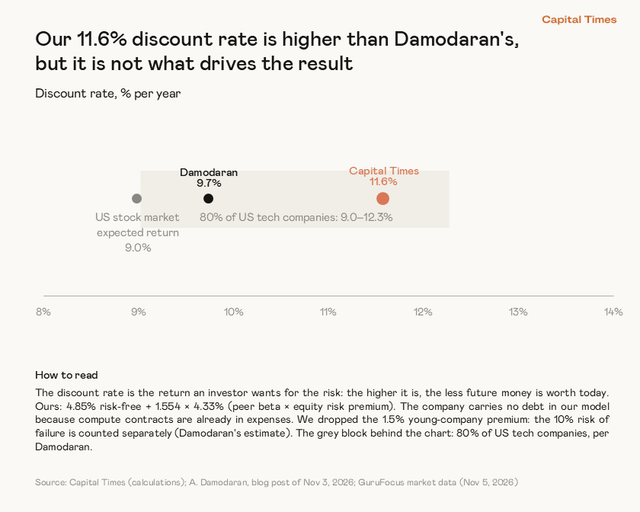
[Original image location: Fig. 12: Discount rate (A. Damodaran, Capital Times)]
Final result
Putting all factors together, I arrive at three scenarios. The numbers below include cash raised from the IPO, as well as the newly issued shares valued at the midpoint of the $74 IPO price:
Scenario | Revenue in ten years | Operating margin | Per share value | Total company value | Weight |
|---|---|---|---|---|---|
Bear | $250 billion | 21.5% | $21 | $361 billion | 25% |
Base | $430 billion | 30% | $46 | $801 billion | 50% |
Bull | $715 billion | 40% | $99 | $1.73 trillion | 25% |
Weighted result | $53 | $924 billion |
Now let's compare this value to the market price. My rules are very simple: if the price is 25% or more above the value, I will not buy. The IPO price range of $70-78 per share is 32%-47% higher than my estimated value of $53 per share, with a midpoint of $74 being 40% higher. Therefore, my conclusion is: even at the lower end of the issuance price, it should be avoided. Only when the stock price drops to around $66 or lower does “waiting to observe” begin to seem reasonable.
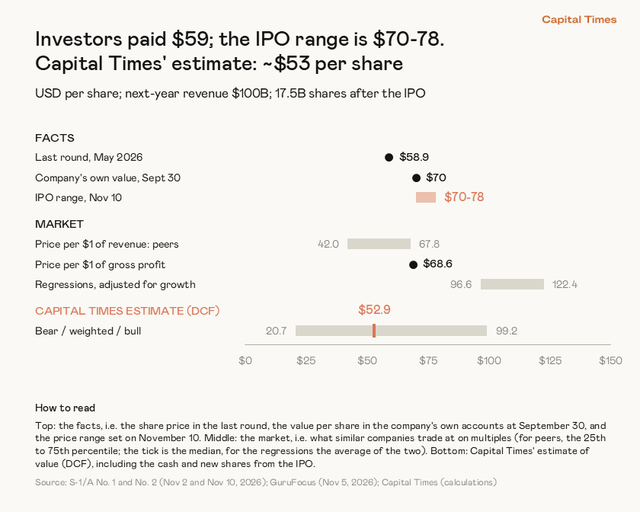
[Original image location: Fig. 13: Facts, market price and per share value (Capital Times)]
What you must believe to make this price reasonable
I also reversed the model to calculate: for every market price, how much revenue must Anthropic achieve ten years from now to prove it is reasonable?
Required price/valuation to justify | Assuming 30% operating margin: revenue in ten years | Assuming 40% operating margin: revenue in ten years |
|---|---|---|
$70 (approximately $1.22 trillion) | $757 billion | $534 billion |
$74 (approximately $1.29 trillion) | $812 billion | $573 billion |
$78 (approximately $1.36 trillion) | $868 billion | $612 billion |
$1.5 trillion | $979 billion | $690 billion |
$2 trillion | $1.39 trillion | $978 billion |
For reference, over the past 12 months, Amazon's revenue was about $797 billion, Walmart (WMT) was $736 billion, Alphabet was $471 billion, and Microsoft was $346 billion. So, the IPO price of $70-78 per share implies that you must believe that ten years from now, Anthropic can achieve revenue comparable to today's Amazon at a 30% operating margin; or at a 40% margin, exceed today's Alphabet in revenue. This is certainly not impossible, but I believe the probability of this stock ultimately being valued at least $74-78 is only 9%, and the probability of reaching at least $70 is 15%; while in any combination of growth rates and margin rates that I tested, a $2 trillion valuation is not reasonably supported. These probabilities are just my personal judgments, which is why I presented the complete model.
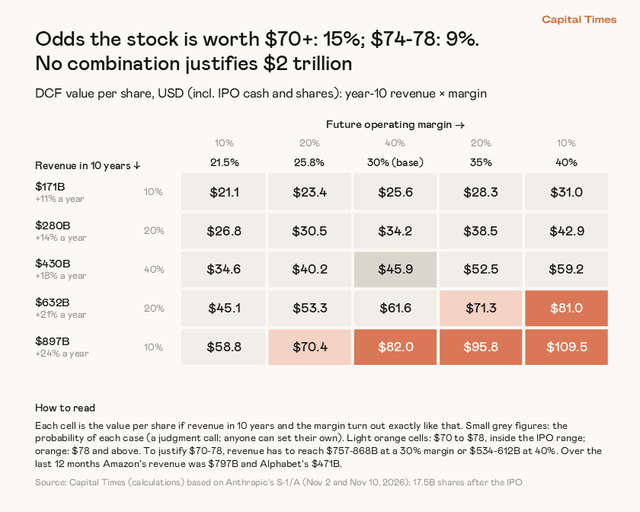
[Original image location: Fig. 14: Per share value corresponding to different revenues and margins (Capital Times)]
Why the market might be willing to pay a higher price
On November 6, Bloomberg described how quickly market discussions changed. In early October, investors were discussing a high valuation of $2 trillion; after the company held investor briefings, market discussions focused on $1.4 trillion to $1.5 trillion; after the Nasdaq 100 fell 6.4% in a single day, according to anonymous sources, some potential investors began discussing a valuation of $1.2 trillion to $1.3 trillion. Named market participants provided valuations ranging from HSBC's approximately $1 trillion to Gallo Partners' $1.3 trillion to $1.4 trillion. On November 10, the company officially set the IPO price range at $70-78 per share. In the valuation spreadsheet publicly shared by Aswath Damodaran, analyst consensus was about $1 trillion.
When considering from a “price” rather than “value” perspective, these numbers are easier to understand. The IPO price of $70-78 per share corresponds to about 10-11 times next year's revenue, higher than about three-quarters of peers—at around 10 times—and close to Nvidia's level of about 11 times. If multiple regression is performed on peer valuation multiples against growth rates, the model could even arrive at valuations between $1.7 trillion and $2.1 trillion, although this method effectively directly incorporates today's extremely high growth rates into the price, while this growth is already slowing.
For comparison, at the IPO price—approximately $1.2 trillion to $1.4 trillion accounting for all potential shares—you can completely buy Palantir (PLTR), Palo Alto (PANW), SAP (SAP), and CrowdStrike (CRWD) combined. These four companies collectively generate $70 billion in sales annually, creating $17 billion in operating profit. Meanwhile, Anthropic has only sold $35 billion in the past 12 months while recording an operating loss of $4 billion. Of course, on the other hand, Anthropic has grown 12 times in the past year, and given the revenue speed in the third quarter, its current sales scale is comparable to those four companies.
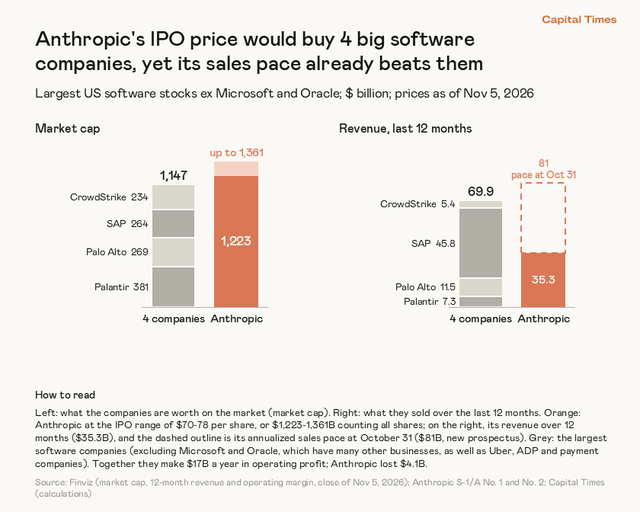
[Original image location: Fig. 15: Anthropic and comparison with four large software companies (Capital Times)]
Another method is to compare enterprise value to revenue from the past 12 months. I made this comparison with 150 U.S. software and large tech companies. At the IPO price of $70-78 per share, Anthropic's enterprise value is equivalent to 29-32 times its revenue from the past 12 months, with only Palantir, CrowdStrike, and Cloudflare (NET) having higher multiples in the entire sample. If we switch to the October annualized revenue run rate of $81 billion instead of the past 12 months of revenue, the multiple drops to 12.5-14 times. Even so, there are still only 14-17 companies in my list that are more expensive than Anthropic.
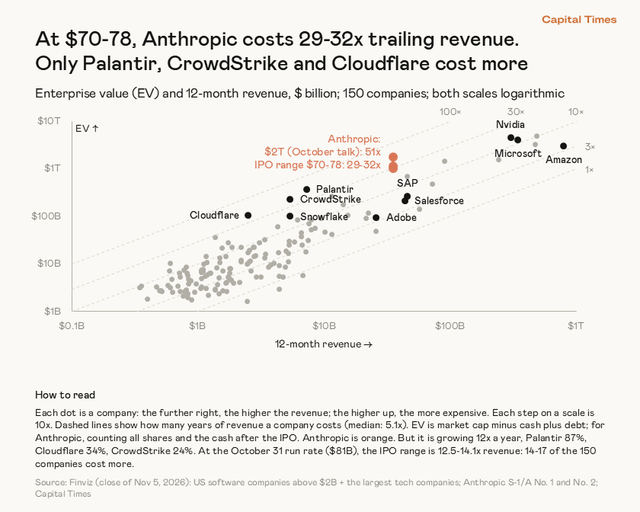
[Original image location: Fig. 16: Comparison of enterprise value to revenue multiples (Capital Times)]
Aswath Damodaran's valuation is currently one of the most well-known independent valuations at about $1.45 trillion. To understand where our differences lie, I plugged in his revenue and margin assumptions into my model, ultimately arriving at about $1.4 trillion, very close to his result. Therefore, our differences are not really related to valuation methods but stem almost entirely from one number: **revenue in the tenth year.** If we use Damodaran's revenue growth path, then the IPO range of $1.22 trillion to $1.36 trillion seems reasonably valid; if we adopt my revenue path, then that price appears obviously too high.
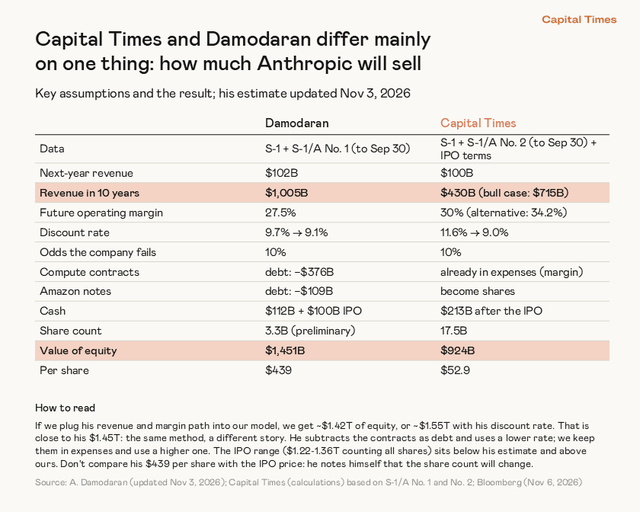
[Original image location: Fig. 17: Comparison of Capital Times and Damodaran valuations (A. Damodaran, Capital Times)]
Weaknesses in my valuation
The revenue ten years from now is the assumption I am least confident about. My model is based on how the largest companies have grown after breaking $100 billion in revenue historically. If AI truly is a brand-new economic category, then historical patterns may not apply at all, which means I may have seriously underestimated Anthropic.
Additionally, I currently only see a sudden increase in server costs for one quarter. If it turns out that the 58% ratio of computing costs to revenue is merely a one-time phenomenon, then a long-term operating margin of 34% would seem more reasonable, and my per-share valuation would rise from $53 to $56.
The scenario weights and probabilities are also purely my judgment. Other analysts could reasonably adopt different weights.
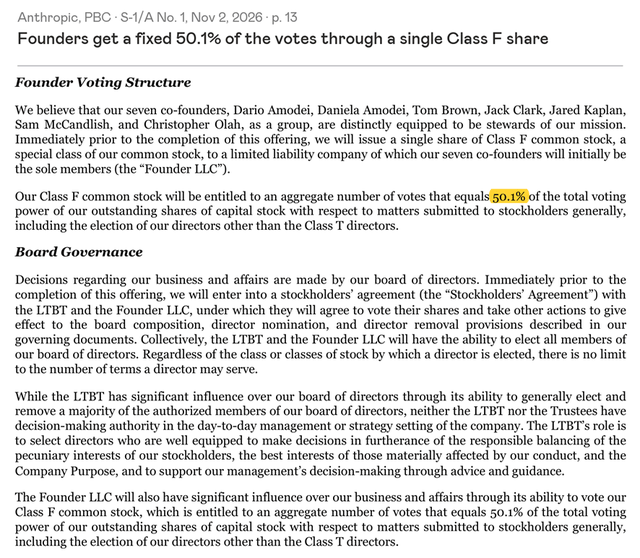
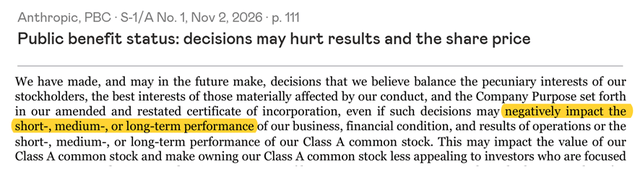
Furthermore, there are corporate governance issues that I did not factor into the valuation at all. The founder controls 50.1% of the voting rights, and an independent trust is responsible for selecting most of the directors, while Anthropic's Public Benefit Corporation status means the company can make decisions that align with its public benefit goals even if they may harm stock prices. Damodaran believes this should bring a significant governance discount. If his judgment is correct, then both his valuation and mine are actually too high.
[Original image location: Anthropic S-1/A No. 1 page 13 (Capital Times annotation)]
[Original image location: Anthropic S-1/A No. 1 page 111 (Capital Times annotation)]
Conclusion
Anthropic is one of the fastest-growing companies I have seen, and its core business has now begun to turn a profit. However, even so, a valuation of about $1.2 trillion to $1.4 trillion essentially means the market is assuming that Anthropic can grow to the size of today's Amazon over the next decade. My own valuation is about $920 billion, which already includes cash raised from the IPO, corresponding to about $53 per share.
I will also be particularly attentive to the timing of the IPO. SpaceX went public in June this year, at a time when sentiment in the AI market was most fervent, and its current stock price is below the IPO issuance price. A major listing conducted while market attention is near its peak similarly provides early investors with the opportunity to sell part of their holdings. In my view, this IPO of Anthropic will become a very important test: whether the market is still willing to pay high valuations just for the “AI story” itself, or whether it has begun to demand to see how much actual cash this business can generate.
I remain generally optimistic about AI. However, at the price range of $70-78 per share, the market price is 32%-47% higher than my estimated intrinsic value, so I give Anthropic a “Sell” rating. I would prefer to wait and observe after the company goes public, hoping for a much cheaper entry price.
免责声明:本文章仅代表作者个人观点,不代表本平台的立场和观点。本文章仅供信息分享,不构成对任何人的任何投资建议。用户与作者之间的任何争议,与本平台无关。如网页中刊载的文章或图片涉及侵权,请提供相关的权利证明和身份证明发送邮件到[email protected],本平台相关工作人员将会进行核查。


