Written by: Sam, Techub News
Introduction
A proxy key used for web transactions, can it transfer assets from an account to a stranger? The controversy over the loss of approximately 4.56 million USDT disclosed by an Aster user has brought this question to the forefront.
The parties involved claim that the private key of the main wallet was not lost, and that they did not sign the transactions in question one by one. Aster's CEO has publicly stated that the user suffered losses after the API Wallet private key was leaked. The two statements are not necessarily contradictory: the main wallet and the proxy wallet can use different keys. What truly needs to be verified is what exactly the involved proxy key was allowed to do at that time, and under what rules the platform allowed the funds to be withdrawn.
Core Summary
- Aster user furongfei stated that their account experienced abnormal operations from midnight Beijing time on November 13, 2026, with seven cross-account transfers totaling 4,564,675.50 USDT; the amounts and transaction details are primarily based on materials disclosed by the parties involved.
- Aster CEO Leonard responded on November 17, 2026, at 18:08 Beijing time, stating that the event involved a leak of the API Wallet private key, and the team has investigated, checked the system, and strengthened security mechanisms, promising to continue assisting in tracing the funds.
- The Aster official API documentation lists the interface for transferring funds to another registered user’s address as a WITHDRAW category; this classification also appears in the official update logs prior to the incident, but the specific request paths and permission verification results involved still need to be verified.
- Aster users have requested compensation based on 33 BTC, 2,200,134.21 USDT, and related transaction fees. This request relates to different forms of the same batch of assets that were transferred out, and cannot simply be summed up.
- The key evidence in this Aster controversy are the authorization records, interface versions, permission and privacy status, and server verification logs at the time of the incident; public statements have not yet explained these issues item by item.
First, calibrate the timeline: The official response came after the screenshot
The screenshots provided by the users come from Phyrex’s comment on the incident. Upon checking the original post, it was published at 14:29 Beijing time on November 17, 2026. Phyrex criticized that they had not seen sufficient official explanations and demanded that the platform at least disclose the investigation progress.
On that day at 18:08, Aster CEO Leonard issued a public response, approximately 3 hours and 39 minutes after the comment. Therefore, it is no longer accurate to continue summarizing the incident as "the official has not responded so far."
Leonard connected the losses with the leak of the API Wallet private key, stating that the team immediately investigated and checked the system after receiving feedback, strengthened security mechanisms, and will assist in tracing the funds and cooperate with law enforcement and security agencies when necessary. The statement also reminded users to be wary of phishing links and unknown browser plugins, and to delete the corresponding API Wallet using trusted devices if they suspect a leak.
This statement confirms the platform's response to the user's loss event and also provides a direction for handling; however, it does not disclose specific amounts, methods of disclosure, called interfaces, results of various permission checks or compensation decisions. "The platform has responded" and "the core controversy has been clarified" are two different judgments.
44 minutes indicate the transfer window, 4.56 million cannot be summed with 33 BTC
The original long article by the party involved, furongfei, was published at 21:08 Beijing time on November 16. According to the UTC time they listed, the registration of the new account occurred at 16:22 on November 12; the seven transactions occurred between 16:24 and 17:08, totaling 4,564,675.50 USDT. In Beijing time, the transfer window is from 00:24 to 01:08 on November 13.
There is a detail that is easily omitted in communication: 44 minutes corresponds to the time between the first and last transfers, excluding the earlier registration of the new account. If we calculate from the registration time of 16:22 they provided, until 17:08 is approximately 46 minutes.
The party also claimed that the 33 BTC in the account was transferred between the spot and contract accounts, and then divided into 17 market orders to sell, with the USDT obtained being transferred along with the original balance. These are the party's descriptions of the account records and cannot directly establish that the platform experienced a protocol vulnerability affecting all users.
Similarly, "4.56 million USDT" cannot be added to "33 BTC" to form two unrelated losses. According to their description, BTC was converted to cash before being transferred out, and the USDT transferred out includes the corresponding proceeds from the sale. The original holdings, proceeds from the sale, and the final transfer amount should be accounted for in the same asset reconciliation statement.
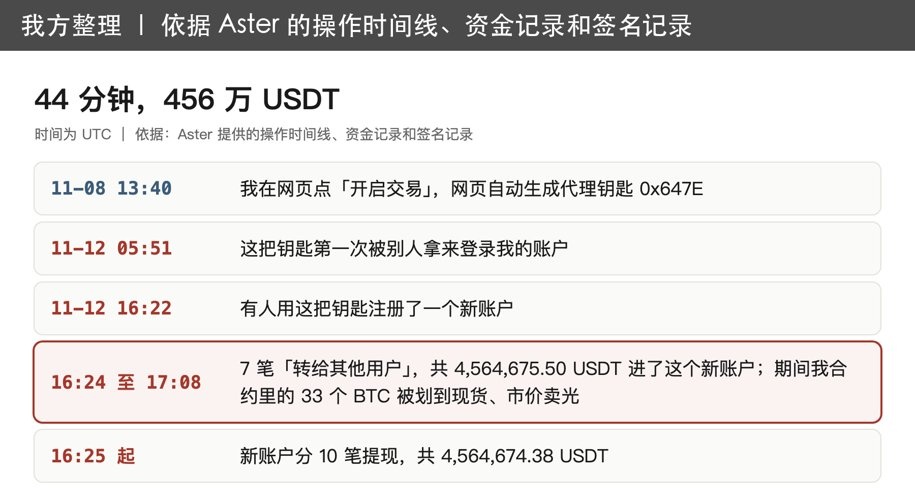
Figure caption: A timeline of events organized by the party involved, with times in UTC. This figure is an organization of records from the user's side, and does not represent that this article has independently verified all their backend records.
Main wallet did not sign, insufficient to prove transfer exceeded authority on its own
In a transactional system with proxy authorization, users can first use the main wallet to authorize another key, and then use the proxy key to submit subsequent requests. The direct utility of this approach is to reduce the frequency of wallet confirmations popping up during operations like ordering and canceling.
The Aster official proxy registration and authorization interface also reflects this arrangement: the authorization parameters include spot trading, contract trading, withdrawal permissions, as well as expiration times and IP whitelisting settings. Just because a proxy can sign does not mean the proxy should possess all funds operation permissions.
Therefore, what the party involved stated, "these seven transactions were not signed by the main wallet," primarily points to different signing entities. It alone cannot prove that there was no valid authorization; further confirmation is needed about which account the proxy key is bound to, whether the authorization is valid, and whether the scope of authorization covers the actual operations performed.
Another question from the party involved is why the request parameters in question did not include their main wallet address, yet they were still able to deduct from their balance. This issue requires an explanation from the platform, but the absence of the main wallet address in the request body is not sufficient alone to constitute evidence of exceeding authority: in a proxy model, the server may recognize accounts through existing binding relationships. What needs to be verified is whether this mapping is correct, and whether permissions were checked after the account was identified.
Conversely, even if the platform confirms that the proxy private key was obtained by another party, it only explains who might have issued the request. If the proxy was originally unauthorized to transfer to other accounts, the leak of the private key is still insufficient to explain why the system accepted this request.
Official rules provide verification basis, but execution records at the time of the incident are still missing
This article verified the Aster official GitHub repository. Aster Chain documentation lists the Transfer to Address interface as a WITHDRAW category, with the operation object being the address of another registered user. The official update logs recorded this interface and its WITHDRAW certification category as early as May 21, 2026, prior to this dispute.
At the same time, the official documentation also has other transfer paths, such as transfers between spot and contract accounts, and transfers between main and sub-accounts. Their uses, constraints, and permissions cannot be mixed. The phrase "funds transfer" does not automatically explain whether a trading key is authorized to transfer money to an unrelated account.
The party involved claimed that the platform informed them in writing that the proxy key involved had fund transfer permissions but no withdrawal permissions; however, a transfer to other users actually occurred. This is precisely the part that needs to be answered with logs: which interface were the seven requests calling, which version was used, what were the identified source and recipient accounts, which permission rules were hit, and what verification results were returned?
The current document provides a basis for rule comparison but cannot replace the configuration and execution records at the time of the incident. Just based on the interface title, it cannot be directly concluded that all seven involved transactions used this interface; simply drawing a conclusion of "private key leak" also cannot rule out the possibility of issues in authorization display, default configuration, or execution verification.
The party also claimed that the account was in privacy mode at that time. The current official documentation explicitly restricts batch cross-account transfers under PRIVATE mode, but this is not sufficient to directly prove that the seven requests applied the same path. What still needs to be compared are the applicable rules at the time of the incident, the real-time account status, and complete change records.
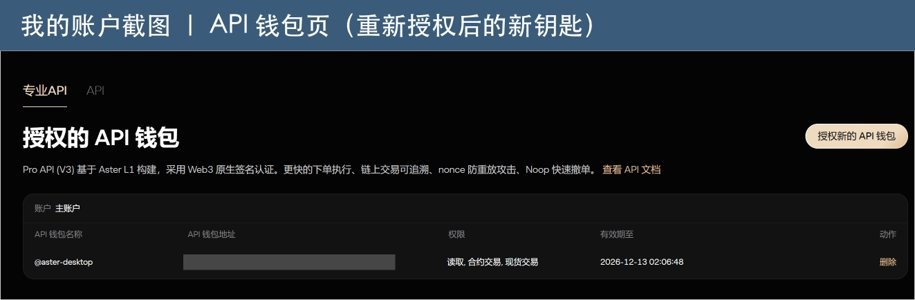
Figure caption: A screenshot of the API wallet page publicly disclosed by the party involved. The image is clearly marked as a new key after reauthorization, reflecting only their displayed subsequent interface, and cannot be used to deduce the complete permissions of the old key in question at the time of the incident.
Changing default values can reduce risk, but cannot replace the explanation for old requests
The party involved claimed that after the incident, the platform adjusted the default settings in less than 6 hours, so the relevant key could no longer transfer to other accounts. Leonard's public statement simply summarized that security mechanisms were strengthened and did not disclose specific modification projects and implementation times. The two cannot simply be equated.
Modifying default configurations alone is not sufficient to prove that there were exploitable vulnerabilities prior. The platform may have tightened originally allowed capabilities after the incident or corrected erroneous permission executions. Distinguishing between these two situations requires examining the rules, applicable objects, and audit records before and after the modification.
However, from the perspective of product design, the authorization explanation that users see when "starting a transaction" should enable them to understand the real risks their accounts face. If the backend still has defaults open for cross-account asset transfers that are not clearly displayed, then even if the server executes completely according to configuration, users would still find it difficult to make fully informed choices. This is an issue of disclosure of authorization; if actual execution exceeded the configuration, it would further involve the failure of permission verification. Two separate chains of evidence need to be established.
Risk control should also be thoroughly reviewed. The party described behaviors such as new account registration, large receipt, continuous transfers, and so on. Individual behaviors do not necessarily prove an attack, but if they appear consecutively, the platform needs to explain what rules were applicable at that time, whether they were triggered, and why they were allowed. For ordinary users, seeing a permission name on a webpage should align with the server actually restricting operations of the same range.
Tracing funds and compensation require two sets of clear answers
The party involved requested to restore the original assets, namely 33 BTC, 2,200,134.21 USDT, and related mandatory selling fees, and requested a written schedule for processing, permission explanations, and log preservation. This is the compensation approach proposed by the users and cannot be interpreted as the amount or liability that the platform has already acknowledged.
This request also indicates that the dispute is not only about the dollar amount. If BTC was sold against the party’s wishes, returning according to the USDT amount at the time of transfer versus restoring the original BTC holdings may yield different results due to price fluctuations. How to reconcile accounts and settle with what assets and time points needs to be clarified by both parties and cannot simply be replaced by a rounded “4.56 million dollars.”
Tracing funds addresses the asset flow and the possibility of recovery; determining compensation requires verifying authorization, system execution, and responsibility. Leonard has promised to continue assisting in tracing but his statement has not disclosed a compensation plan and cannot equate assisting in the investigation with a commitment to compensation, nor can it use unrecovered funds as a reason for denying compensation.
What can currently be confirmed is that the party has publicly made specific accusations, the CEO has responded, and official documentation provides comparable permission classifications. However, what is still lacking is a complete explanation of the seven transfers from signing, account identification, permission verification, to fund deduction. The next document that can advance the dispute should enumerate these verification results and the corresponding handling arrangements.
References
1. furongfei: Original long article and public attachments by the party involved, November 16, 2026
2. Leonard: Aster user loss event public response, November 17, 2026
3. Phyrex: Original comment corresponding to user screenshot, November 17, 2026
4. Aster Official Aster Chain API Documentation: Account Status and Cross-Account Transfer Interfaces
5. Aster Official Futures V3 API Documentation: Proxy Registration and Permission Parameters
6. Aster Official Update Log: May 21, 2026 transfer interface records
Editor’s note: This article verifies publicly available materials as of November 18, 2026, Beijing time. The amounts of user losses, the seven operations, the liquidation of positions, permissions of old keys, privacy status, and changes to default settings afterward are all presented according to what the parties involved have claimed and have not yet been fully verified by the platform’s complete logs or independent evidence collection item by item. This article does not conclude that there is a protocol vulnerability across the entire platform, nor has it independently completed the calculation of fund paths. The official documentation represents a visible version at the time of verification and cannot automatically replace the versions applicable at the time of the incident; the accompanying images are taken from materials publicly disclosed by the parties involved, with the cover produced by the editor.
Disclaimer: This article is solely for information reporting and analysis, and does not constitute any investment advice.
免责声明:本文章仅代表作者个人观点,不代表本平台的立场和观点。本文章仅供信息分享,不构成对任何人的任何投资建议。用户与作者之间的任何争议,与本平台无关。如网页中刊载的文章或图片涉及侵权,请提供相关的权利证明和身份证明发送邮件到[email protected],本平台相关工作人员将会进行核查。


