Nvidia's just-released financial report shows truly impressive data, but the taste of the "post-Jensen Huang era" is a bit subtle 🧐
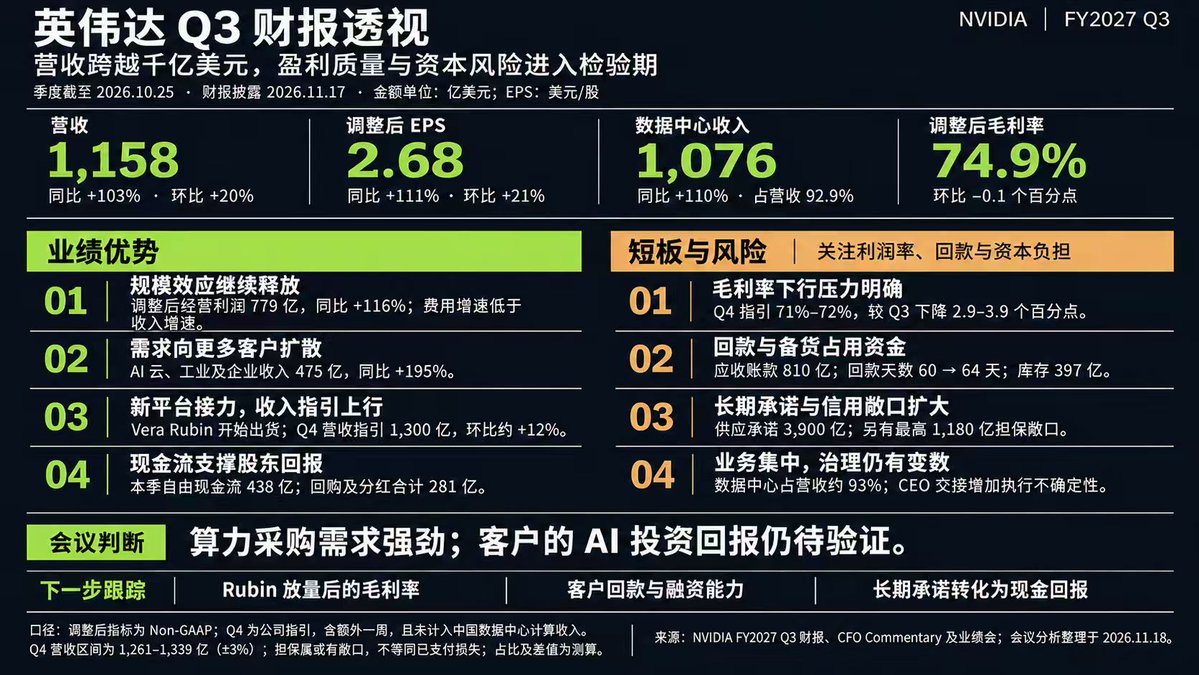
Quarterly revenue of $115.8 billion, breaking the $100 billion mark for the first time in history. Profit, EPS, and data center revenue all exceeded expectations, and the Q4 guidance directly surpassed Wall Street's highest forecast, with after-hours stock price rising by over 5% at one point!
However, this is also the first financial report conference call without Jensen Huang present. With Huang gone, is this giant still stable? Let's get into the details and take a closer look.
📊 First, let's discuss the positive aspects:
1️⃣ A quarterly revenue of over $100 billion is not a dream: Revenue skyrocketed to $115.8 billion, a year-over-year increase of 103% and a quarter-over-quarter increase of 20%. Given such a large base, many thought it was nearing its peak, but it doubled anyway. It's just astonishing.
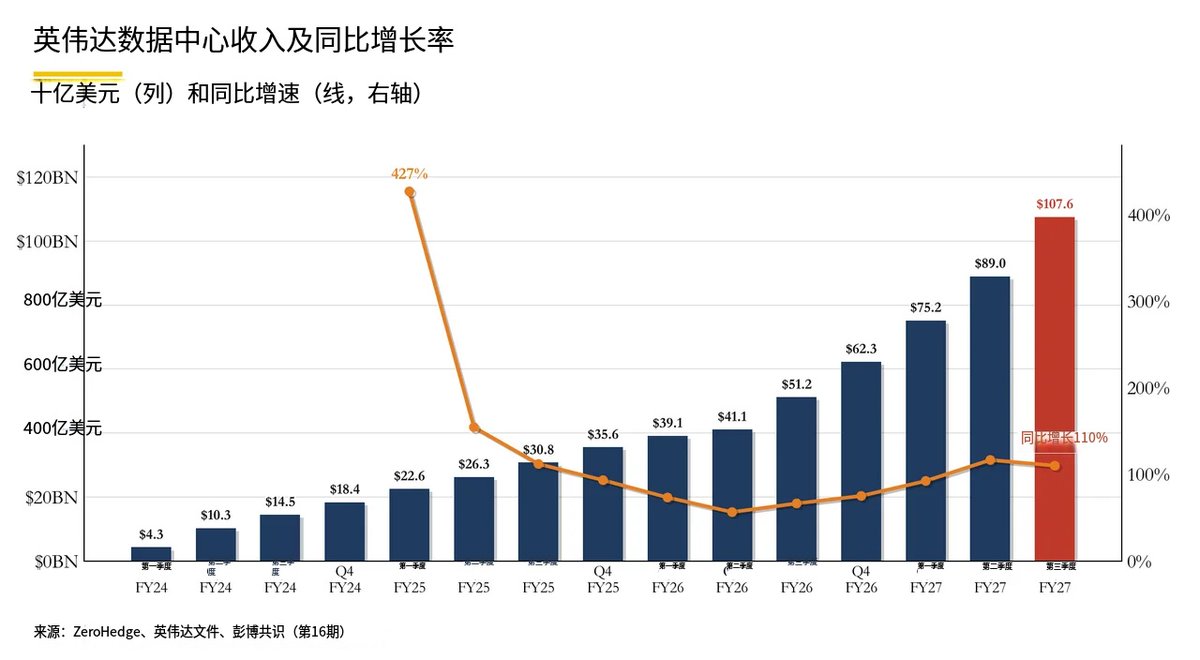
2️⃣ Data center demand hasn’t collapsed: There was previous market concern about large companies slowing down and AI investment returns reaching a peak. But with the financial report, the data center secured $107.6 billion, accounting for 90% of total revenue. Major cloud providers like Microsoft, Google, and Meta didn't hold back; AI cloud, industrial, and enterprise customers contributed $47.5 billion in solid buying.
3️⃣ Vera Rubin has emerged: The new generation of Vera Rubin NVL72, which everyone was sweating about, has now become Nvidia's "fastest-growing product in history." CoreWeave, Google, Microsoft, and Oracle's data centers have already started utilizing it.
The new Nvidia CEO Colette Kress stated in the meeting, "The core contradiction now is not that there is no one buying, but that demand far exceeds supply."
4️⃣ Earnings guidance exceeded expectations, and the 2028 target has been raised: The median revenue guidance for Q4 has been set at $130 billion, which has even stunned the most optimistic Wall Street investment bank, UBS.
Even more impressive is that management raised the revenue growth target for the 2028 fiscal year from the previously stated "over 70%" to about 75%.
This effectively reassures the market: Although Huang is no longer here, the money-printing machine is running faster than ever.
⚠️ Now let’s look at the concerns, which are critical:
While the numbers in the financial report are appealing, if we dig into the financial details, there are many sweet burdens and visible risks:
• Gross margin is declining 📉. Q3 was 74.9%, and the Q4 guidance has dropped to 71%-72%. The reason is that memory prices are rising, coupled with the initial high production costs of Rubin, making the ramp-up difficult.
• Accounts receivable are increasing 📈. Accounts receivable hit $81 billion, with the payment period extending from 60 days to 64 days, meaning customers owe more money.
• Inventory is rising 📈. Inventory reached $39.7 billion, up from $31.6 billion from the previous quarter, all for preparing stock for Rubin. If demand suddenly halts, being left with excess inventory could be troublesome.
The aforementioned points may not even be my biggest worries; it’s the more than $500 billion in contingent liability guarantees that truly cause me concern when looking at Nvidia's financial report!
Many people see Nvidia just making money selling chips, but overlook its other identity as the world's largest financier and guarantor for AI data centers.
At the end of the quarter, Nvidia's supply commitments reached $390 billion, mainly for multi-year memory purchases, plus cloud services and leasing commitments, summing up to a total of $518 billion in future commitments.
Even more astonishing is the financing guarantee exposure of up to $118 billion, such as the $105 billion guarantee for the SB Energy project helping OpenAI build data centers in Ohio.
In plain terms, Nvidia is not only selling shovels; it has also become the largest financial company in the AI field, binding the entire upstream and downstream of AI together in its war vehicle. It’s not just about selling chips; it also needs to support AI data centers, memory chips, optical modules, etc. This appetite is too big; if one Neocloud chain breaks, Nvidia will also be heavily impacted!
🎯 Major upheaval in management: Is Huang really not coming back?
This might be the most touching and dramatic part of the entire call:
First, Chairman of the Board Harvey Jones declared emphatically: Jensen Huang "resigned voluntarily," and the board has "no intention" of reinstating him.
Next, while new CEO Colette Kress has stabilized the troops, she’s also started to "hit the brakes." She explicitly stated that Nvidia will not be as generous or reckless in backing Neoclouds as before, and their stance will be "more restrained and selective." Only when the water, electricity, and land for data centers are truly ready will Nvidia's financial guarantees come into effect, with the implication being: if you want Nvidia as a reliable partner, you need to lay a solid foundation yourself, and do not expect us to fund every dirty job.
Finally, let me share my personal view: this financial report has temporarily suppressed the cloud of "AI bubble" suspicions. As long as computing power continues to be consumed at a frantic pace, Nvidia remains the absolute monopolist. From the after-hours performance, it appears good, rising 5%!
However, we may need to lower our expectations for future AI hype; it’s hard to see a repeat of the crazy trends from the first half of this year, reducing return expectations, lowering investment leverage, and overall expectations!
First, Nvidia lacks a spiritual leader; can the pace of innovation be maintained? Recently, rumors of Huang's return have resurfaced, and there are many variables, increasing uncertainty.
Second, the more than $500 billion in commitments plus the guarantee exposures is a double-edged sword. While locking down the ecosystem for downstream, it also ties its own debt risk with the entire AI infrastructure together.
Thus, when looking at Nvidia now, we cannot just focus on how much money it makes but also begin to assess the heavy burdens it carries.
Which detail do you find most surprising? Without Huang, how long can Nvidia continue to surge? Let’s discuss in the comments section 🙏
For trading US stocks, I choose the #RWA US stock tokenization platform #MSX. Let’s invest together in the US stock market: http://msx.com/?code=Vu2v44
Early US stock investment fans and partners can message me, fill out the form, and gain free entry into the US stock discussion and exploration community (currently limited to 10 people per week, reviewed by an assistant, may take a little time, thank you 🙏)!
When the market is not good, learn more and be less impulsive. DYOR 🙏
免责声明:本文章仅代表作者个人观点,不代表本平台的立场和观点。本文章仅供信息分享,不构成对任何人的任何投资建议。用户与作者之间的任何争议,与本平台无关。如网页中刊载的文章或图片涉及侵权,请提供相关的权利证明和身份证明发送邮件到[email protected],本平台相关工作人员将会进行核查。


