In the past few years, the "brains" of robots have become increasingly smart, but to truly step into the real world, they still lack an important element: a human-like sense of touch that can perceive objects and understand changes in force during contact.
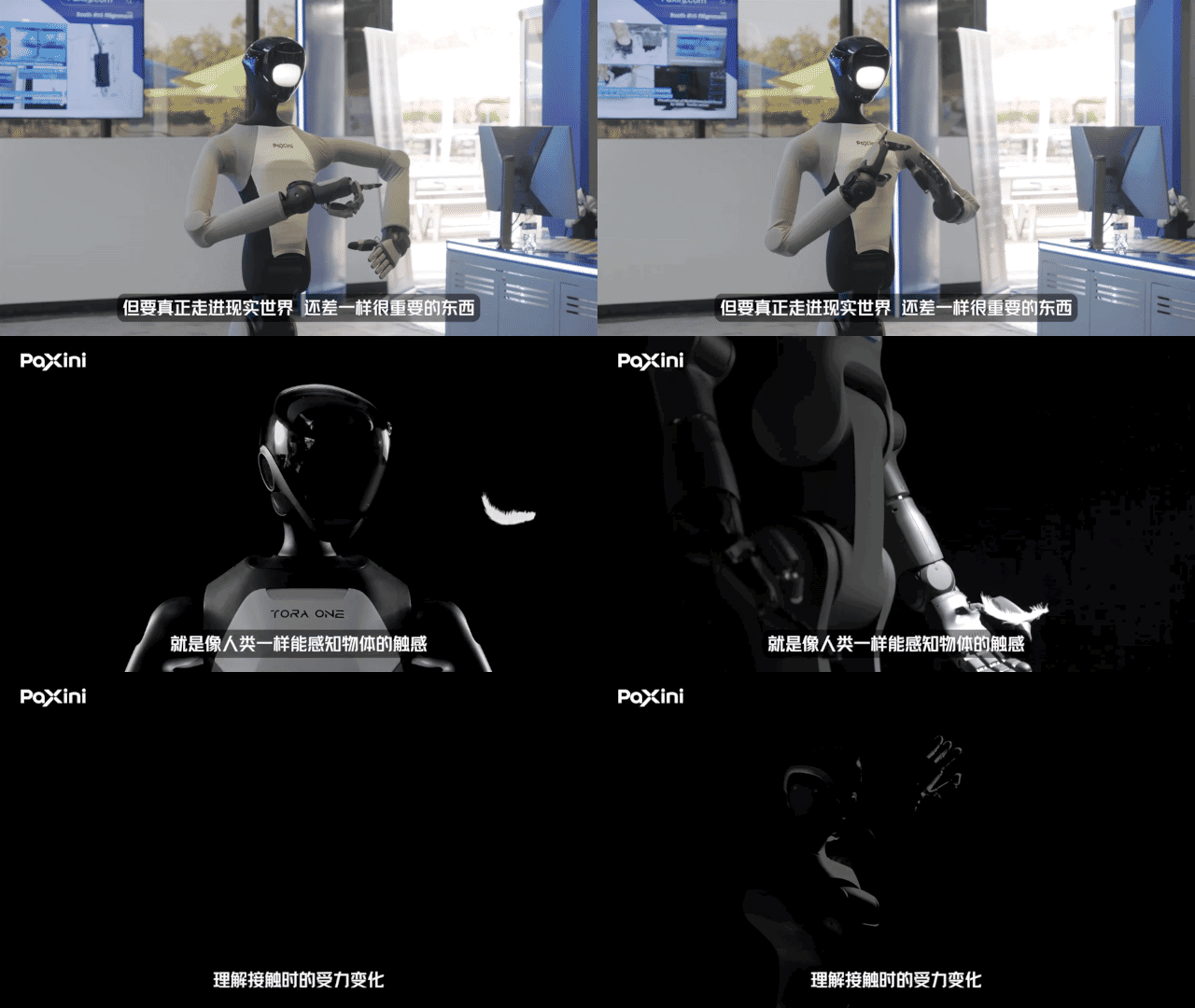
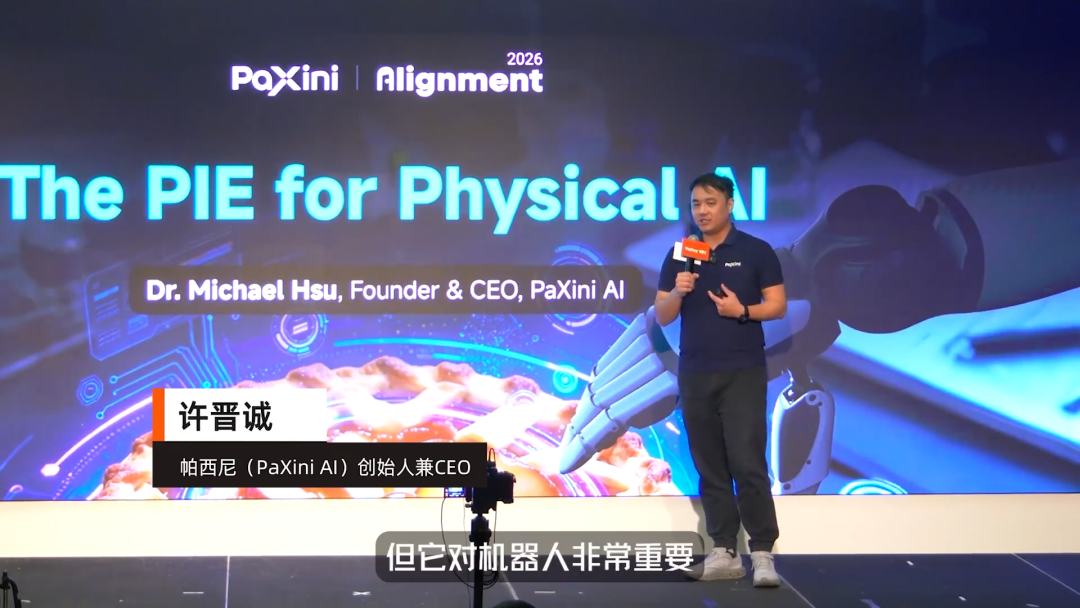
So, how can we enable robots to truly possess the ability to perceive and understand the physical world? Next, let us return to the site of the ALIGNMENT 2026 conference and see how Dr. Xu Jincheng, founder and CEO of PaXini AI, understands the development direction of Physical AI and what technical bottlenecks robots still need to overcome.
This article is a rewrite of a video; we welcome everyone to watch the video below.

Xu Jincheng:Today's theme is the PIE of Physical AI. For many, PIE may just refer to a type of food, but here it refers to several important abilities that robots need to have.
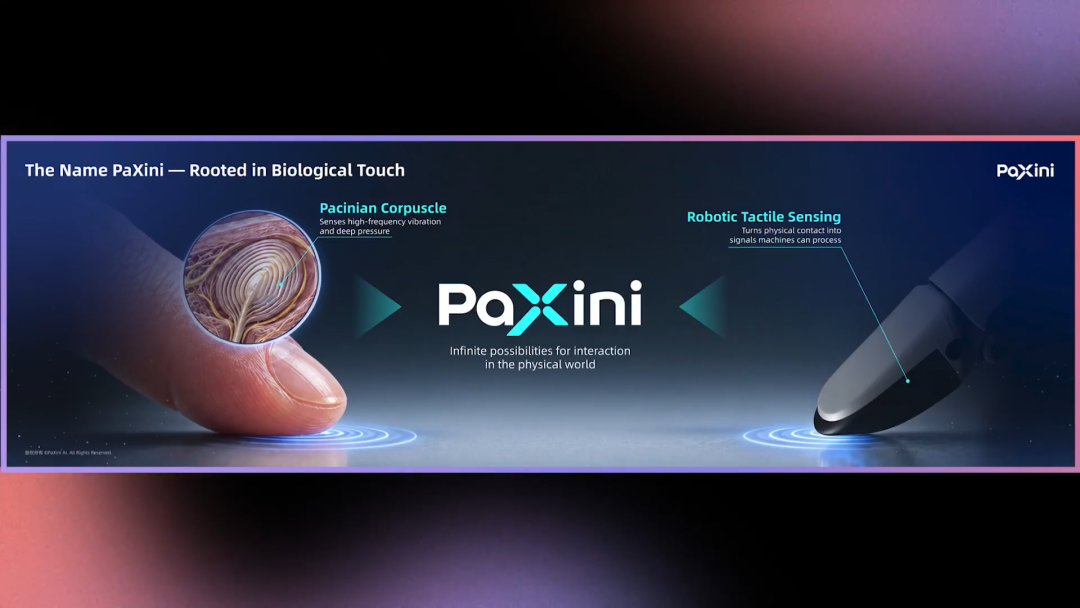
Many people find the name of our company interesting. They ask, why is it called PaXini? This is because there are four different types of tactile receptors in human skin, one of which is responsible for sensing texture and high-frequency vibrations, known as the Pacinian corpuscle. We aim to develop a sensor skin similar to the Pacinian corpuscle, which is also the reason behind our name, PaXini.
Tactile perception in the fingers is very important. When one hand holds a cup full of water and the other holds an egg, we can determine how to grasp them through touch. The brain processes a large amount of tactile information received from the fingers, helping us control the force such that the egg neither slips nor gets crushed.Therefore, tactile perception is a crucial link in the interaction between the human body and the physical world.
We are a globally leading company driven by embodied perception for general intelligence. Our products are not only used in robots but also in cars and other fields, while also helping large enterprises manufacture their own robots or automation equipment. For future robots, we have noticed that many large companies are very focused on Physical AI and also realize the extreme importance of tactile perception information for the robots themselves.

Xu Jincheng:When we think about how to interact with the physical world, we also consider how intelligence exists in the physical world. This raises more questions: If AI can think, can it understand the physical world?
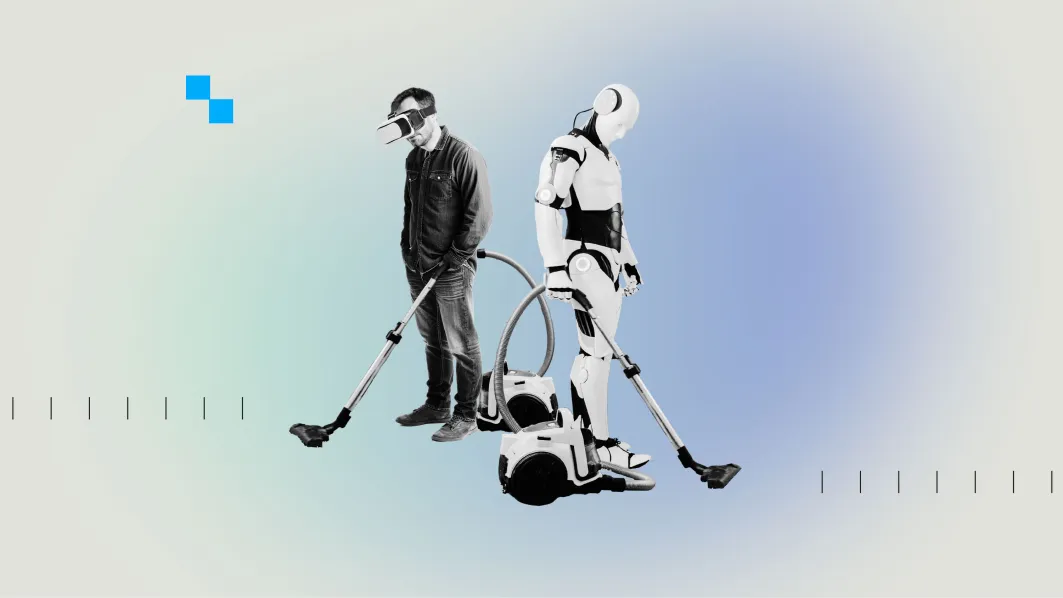
For example, in this image, a person is cleaning the floor while a robot is also cleaning the floor. When the robot performs exactly the same action, does it really understand what it is doing?? When we clean the floor, we need to use force feedback during operation to perceive whether the vacuum cleaner nozzle is in adequate contact with the floor and adjust the downward pressure in time to effectively clean the surface. Whether the robot truly understands this action is still questionable.
Thus, intelligence lacking physical understanding is incomplete.There remains a significant gap between knowing how to do something, actually doing it, and reliably accomplishing it.
So we want to ask: what should the next generation of AI look like? They should not just understand commands, nor should they merely react to prompts; they also need to interact with the world to make things happen or bring about change.
Moreover, the world is not comprised of pixels; we do not only observe everything with cameras. Therefore, reality is not just what we see; it also includes what we touch, feel, and change.What our company aims to do is further drive the development of AI, allowing it to truly understand the physical world.
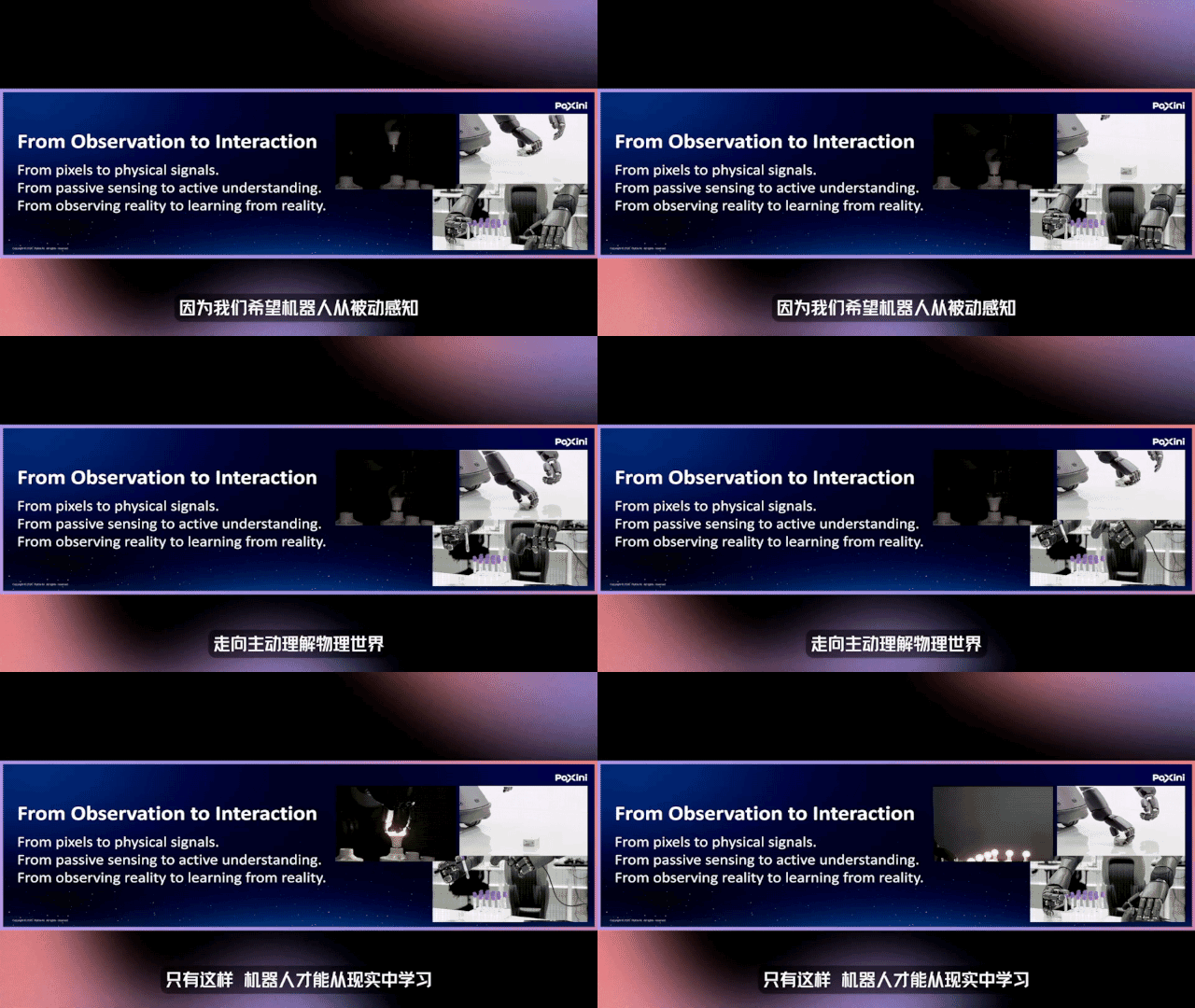
This animated graphic demonstrates how, when the robot operates using tactile sensors, it can feel how it grips the nozzle and how it picks up objects like light bulbs.
We believe that AI must go beyond observation; it should respond or interact after seeing something. To move from observation to interaction, we have conducted many such experiments, hoping that robots can transition from passive perception to active understanding of the physical world. Only then can robots learn from reality.

Xu Jincheng:Intelligence requires much more than just textual knowledge; it needs more experience. What is experience? It is essentially human data. A robot may know what a cup is and that it is a cylindrical object. But does it know how to grasp a cup or how to interact with it? Perhaps not. Experience teaches us and also teaches robots how to act and manipulate objects.
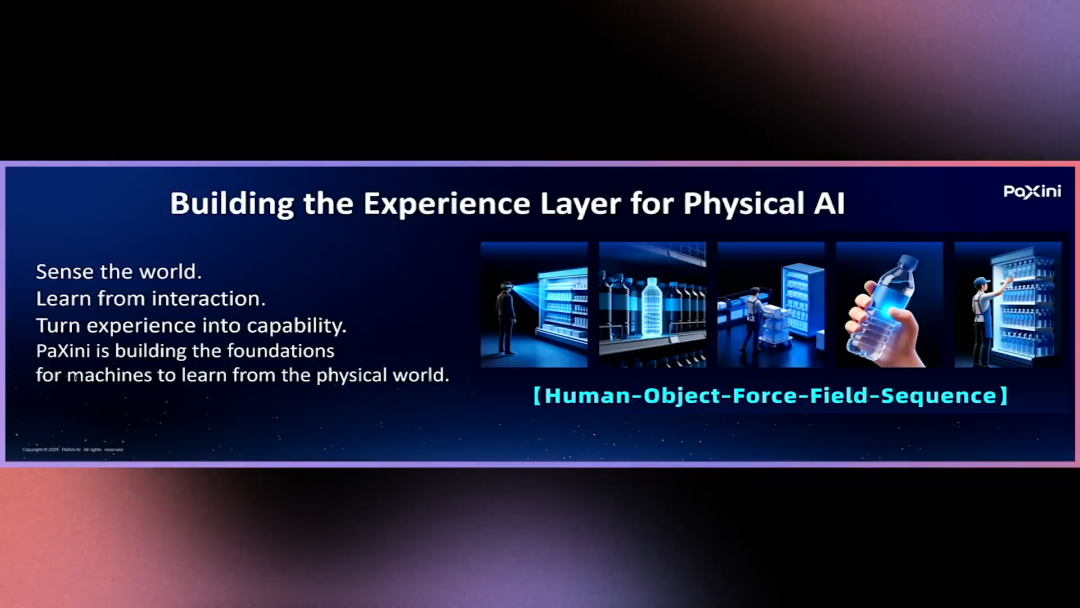
If we want to gain more experience, we need to establish an experience layer to provide experiences for robots or physical AI, as we need to perceive the world. The diagram shows a process in our data factory. Humans observe objects, interact with them, and then pick up a bottle; thus, we can gain data on interacting with such objects. It is crucial to establish such AI or robot data foundations so that machines can learn from the physical world.
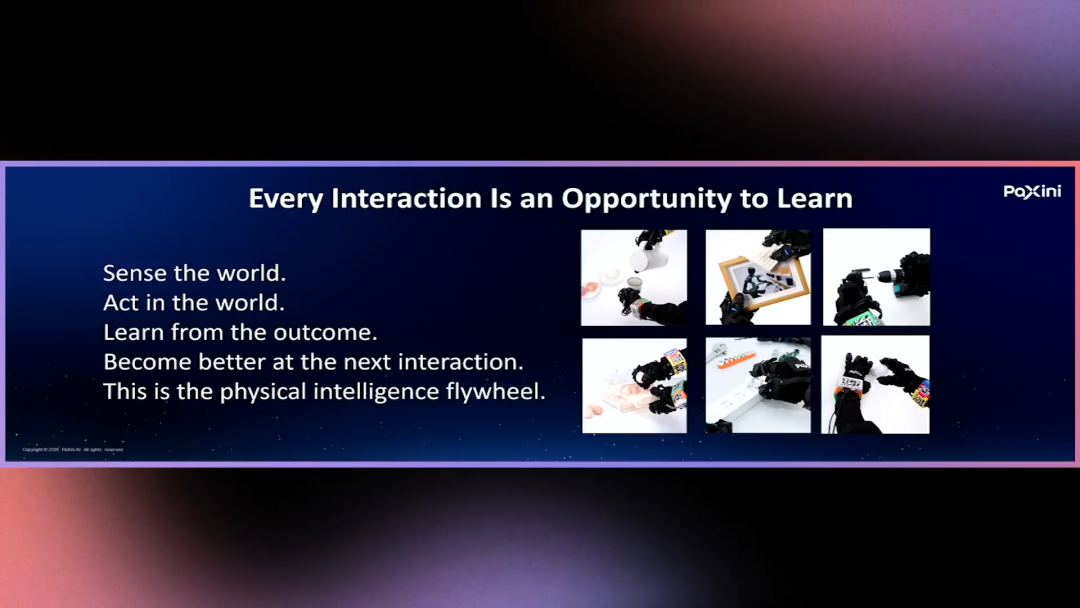
Every interaction is an opportunity to learn from the physical world.Not limited to data collection at fixed locations of data factories, we also hope robots can learn anywhere. Therefore, we have provided such devices to allow everyone to teach robots in their own homes. We hope to seize every opportunity to teach robots, forming a data-driven physical intelligence flywheel.
Transforming physical interaction into intelligence is also one of the keys.
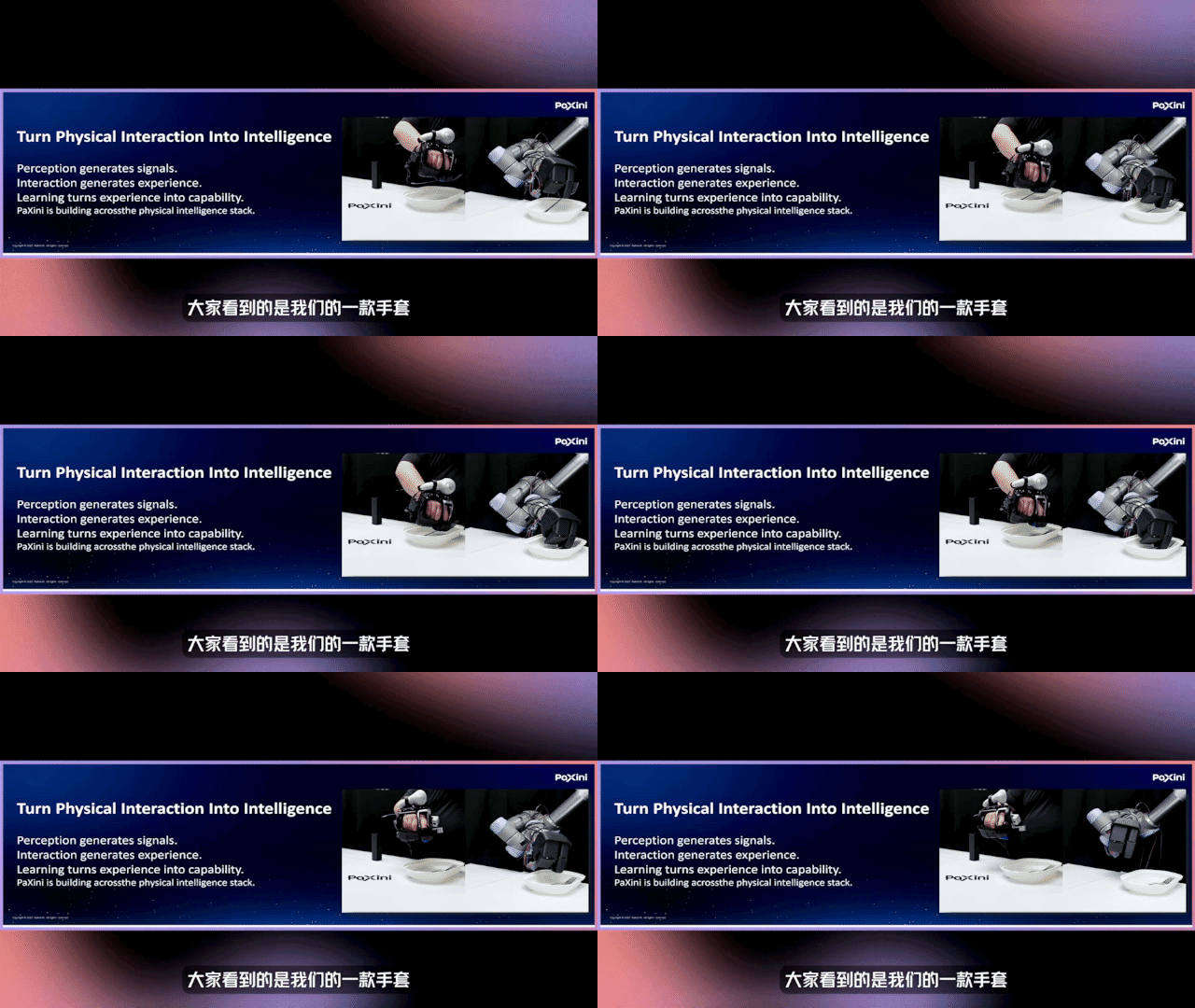
The animated graphic demonstrates one of our gloves that we use to teach robots. This is not remote control; we train a small model using this data, and it can perform actions very precisely.
Thus, the ability to perceive is very important, whether it is the perception of tactile signals themselves or interaction with various objects. Through learning, success rates can be significantly improved, applicable to various tasks performed by robots.
If we conduct such experiments and let robots learn from them, how can we establish evaluation benchmarks? Or rather, how do we assess whether the tasks completed by the robot meet human needs? A very simple method is to see if the robot can handle things it has never encountered before, such as objects it has never seen or operated on.
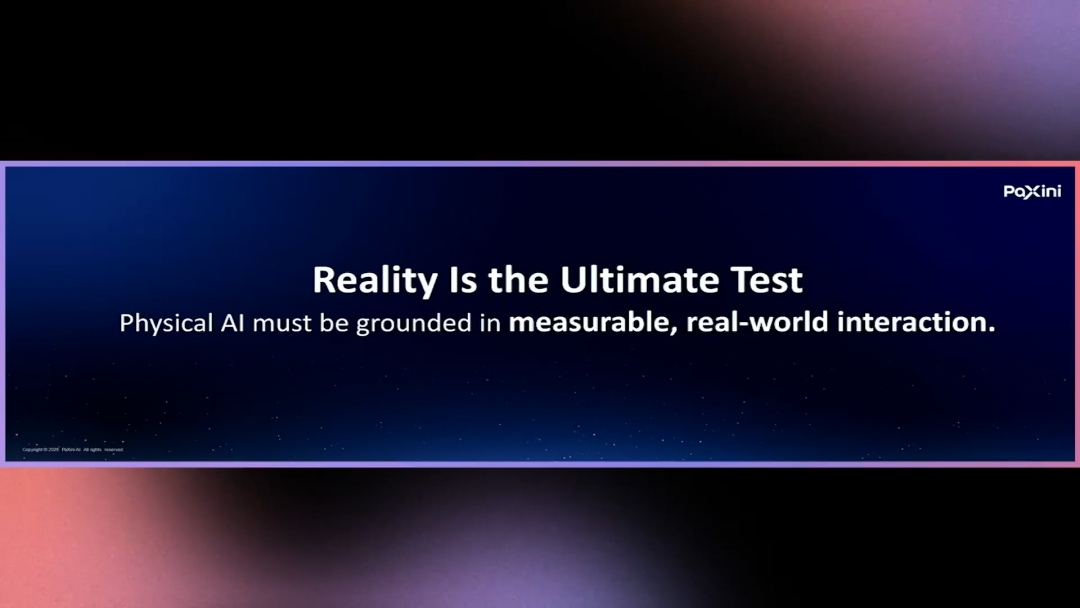
If the robot can handle these objects, it indicates that it can exhibit intelligence in the real world.The real world is the ultimate test for robots, and it is crucial to enable robots and physical AI to interact based on measurable real-world experiences.This brings us back to our PIE, which is about integrating intelligence with reality.

Xu Jincheng:Next, I would like to further introduce our PIE. Many people will ask, what is PIE? Is it apple pie or pineapple pie?
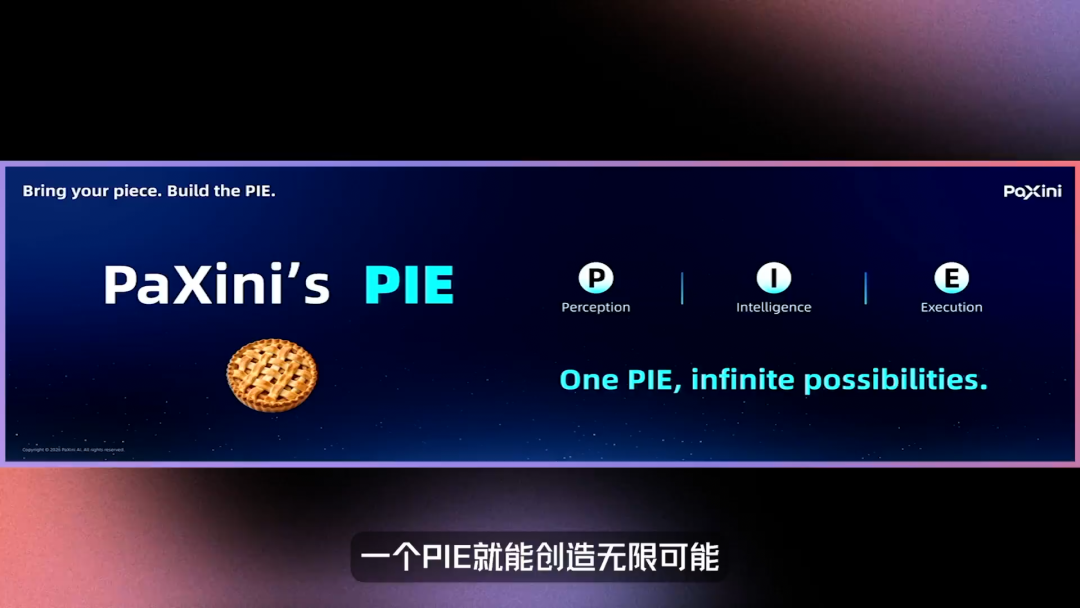
P refers to perception, I refers to intelligence, and E refers to execution. For every robot, these three abilities are essential. Through PaXini's PIE, we can create more possibilities for robots.
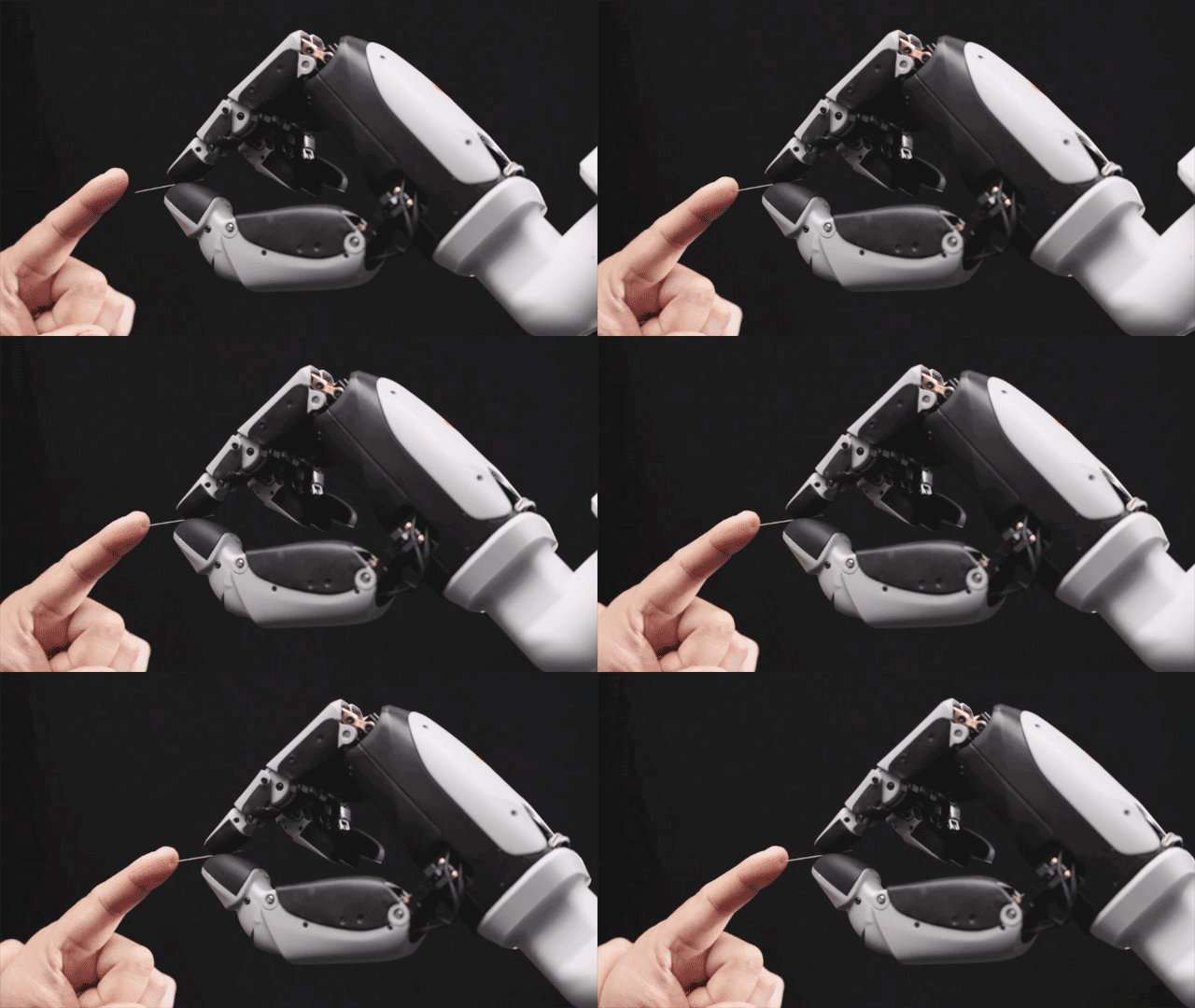
First, I would like to introduce the perception part. The diagram shows a dexterous hand equipped with tactile sensors, with its fingertip pinching a thin needle. When a person lightly touches this needle, the fingertip's tactile sensor can quickly perceive external contact and changes in force, prompting the dexterous hand to withdraw. If the robot has the ability to perceive, it will not only complete a simple pinching action but also sense external contacts and interact safely with humans.
Our perception capability is based on our self-developed sensor chips. Through the GEN FUSE sensor chip architecture, we can develop various products, such as fingertip sensors for robots, tactile sensors, and sensors for use in cars and other applications.
Currently, we have various products on robots, such as torque sensors on joints, six-dimensional force/torque sensors on end effectors, and tactile sensors for fingertips, palms, robot skins, and even the soles of feet. With these technologies, we can enable each robot to have full-body physical perception capabilities.
This technology still has great potential and is expected to meet demands we do not yet know of. Recently, many clients have approached us, hoping to install different types of sensors on their robots. Some applications are entirely new to us, and the demands from these robot companies are surprising.
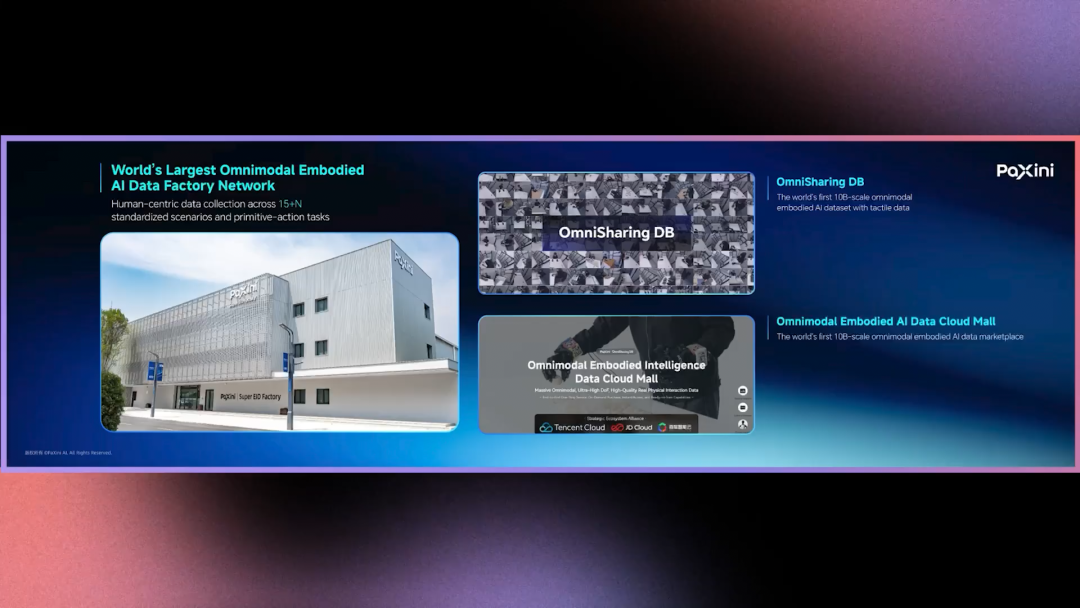
Now let's talk about the intelligence part. We have established a data factory, which is an important project for PaXini. We can now obtain over a million hours of high-precision human data, including tactile perception information. This database is called OmniSharing DB, which you can check on our official website if you are interested. Using this data, we develop applications for various scenarios, such as warehouses, homes, and factories.
Leveraging this technology, we have set up five data factories. This data can be used for pre-training, post-training, and even lifelong learning, so this type of data is extremely important for the robots themselves.
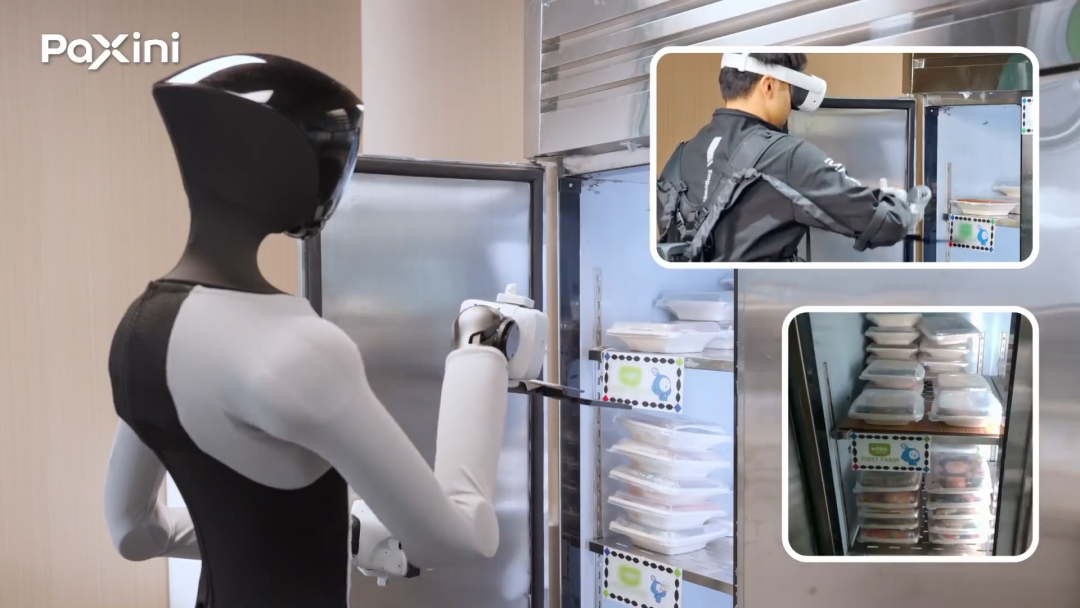
But with this data, how do we get robots to learn from it? To that end, we developed a flywheel algorithm model for robots, for verification. This model is called Omni VTLA 2.0. Through this model, we can use data produced by the data factory as well as data generated by the robots themselves. When robots generate data themselves, they can still use that data for lifelong learning.
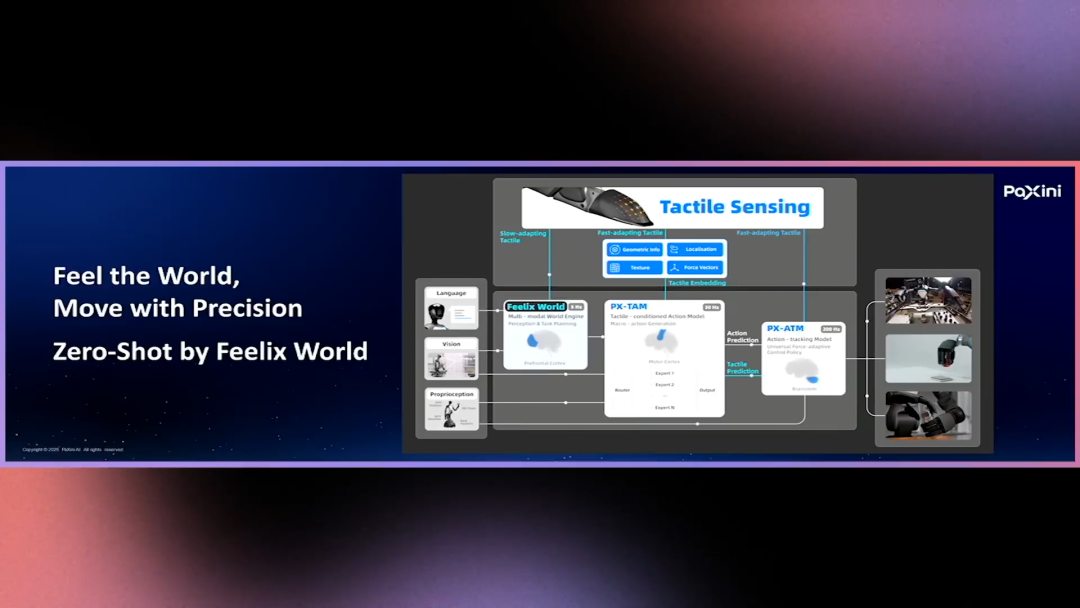
The model itself can also play a very important role, possibly helping robots achieve zero-shot generalization. Therefore, we developed Feelix World, which can encode tactile perception information for robots to perceive the world. In this way, it can enable few-shot, and even zero-shot generalization.
We will still use language information, visual information, and the robot's own interactive information. In addition, more importantly, is tactile perception. We will utilize slow-adapting and fast-adapting tactile information, allowing robots to embed this tactile information into models and algorithms. Furthermore, we will apply these models in various scenarios.
Next is the final part of PIE, execution, which is also one of the most crucial abilities of robots. Even with perfect perception and an outstanding brain, robots also need a sufficiently good execution layer, such as a complete robot body and end effectors like robotic hands. With these conditions, robots can form a closed loop and complete tasks in the real world.
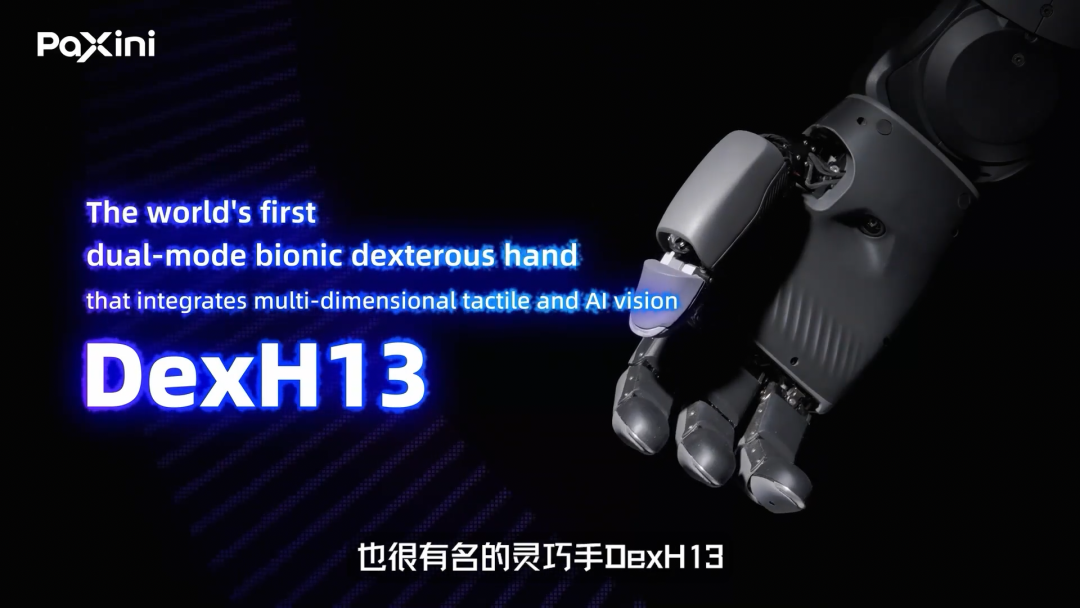
Therefore, we aim to create such an execution layer and design various types of robotic hands. For many robot companies, the design of robotic hands is extremely important. For PaXini, we can open source the design of dexterous hands to robot companies in need. On the design front, we have also made significant improvements in reliability. For example, one of our flagship products, the dexterous hand DexH13, has undergone extensive testing, with usage testing exceeding 20,000 hours. After these tests, we believe it remains a very promising dexterous hand.

Xu Jincheng:Finally, in addition to creating the PIE composed of perception, intelligence, and execution, we also hope to build a Platform, Integration, and Ecosystem.
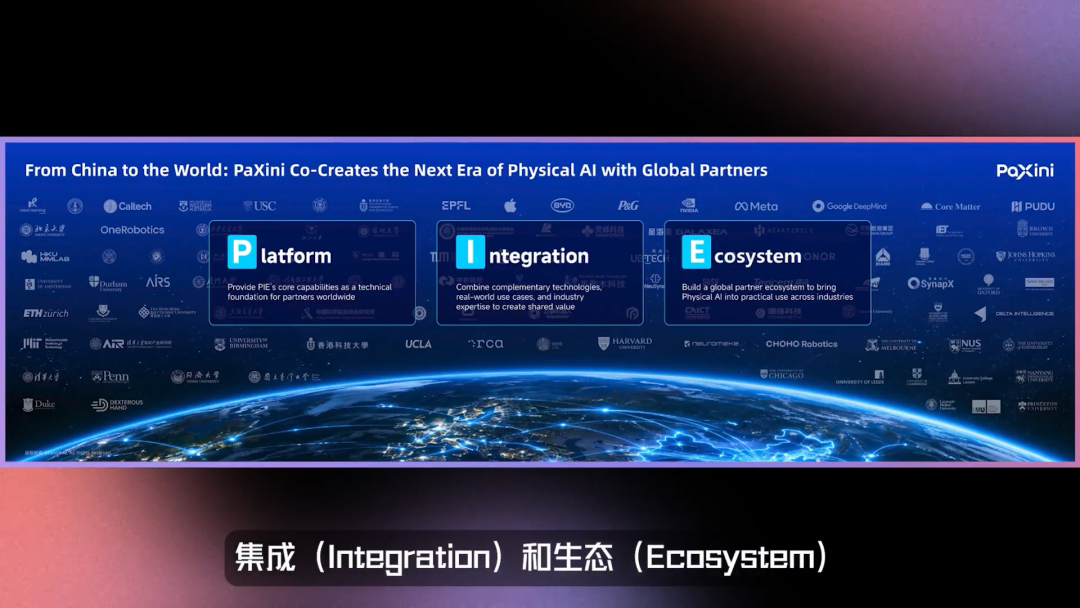
Thus, we have two different PIEs.One is to enable robots to interact with the physical world, while the other is to establish a good open ecosystem, allowing everyone to have their own robots and successfully develop robots with their own technologies.
We hope to create infinite possibilities for the future with a PIE, while also hoping everyone can contribute their share to build their own PIE or co-build our PIE. From a technological perspective, we hope everyone can have their own robots to free up labor and enjoy more fun in the physical world. Those tiring jobs and tasks can be left to robots.
We hope everyone enjoyed my speech today; thank you all very much.
That is the content of Dr. Xu Jincheng's speech at the ALIGNMENT 2026 conference.From the perception of contact and force to enabling models to learn and accurately executing actions, Dr. Xu Jincheng shared how PaXini connects these tasks, allowing robots to perceive, understand, and truly engage with the world.
When robots can perceive their environment and accumulate experience from repeated operations, how far are they from truly taking on more work?

Note: Some images are sourced from the internet.
[This episode does not constitute any investment advice]
免责声明:本文章仅代表作者个人观点,不代表本平台的立场和观点。本文章仅供信息分享,不构成对任何人的任何投资建议。用户与作者之间的任何争议,与本平台无关。如网页中刊载的文章或图片涉及侵权,请提供相关的权利证明和身份证明发送邮件到[email protected],本平台相关工作人员将会进行核查。