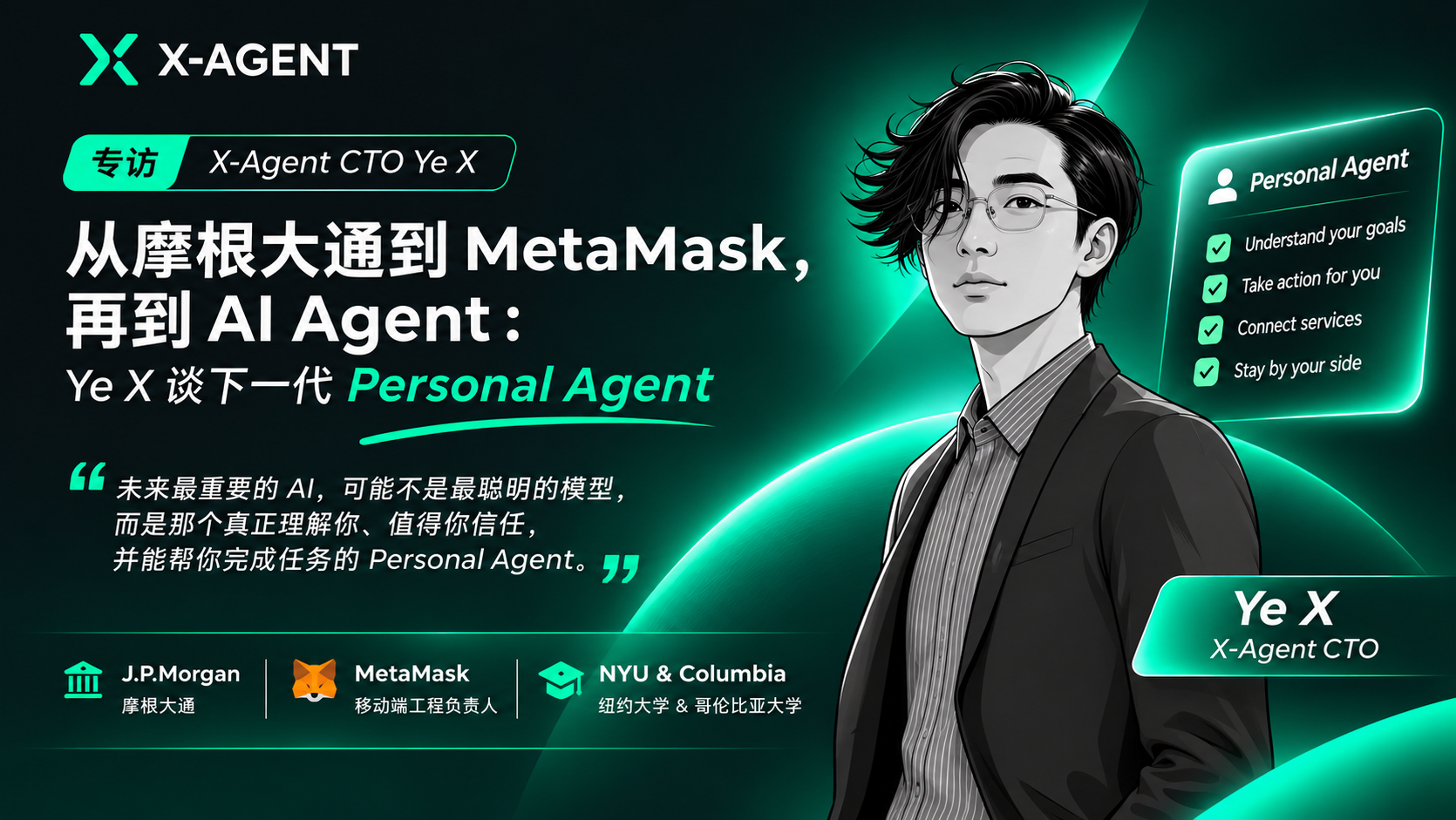
“The most important AI in the future may not be the smartest model, but the Personal Agent that truly understands you, is trustworthy, and can help you accomplish tasks.”
In the past few years, artificial intelligence has been undergoing rapid evolution. From the explosion of large models with ChatGPT, to AI Agents starting to call tools and perform tasks, AI is gradually transforming from a tool that answers questions to a digital collaborative partner capable of engaging in real work.
However, as AI begins to execute tasks on behalf of users, manage information, and even initiate payments, a new question arises: how do we ensure it is safe, reliable, and truly trustworthy?
According to X-Agent CTO Ye Xinnan, the answer lies not only in more powerful AI models but also in combining financial-grade security, Web3 infrastructure, and AI execution capabilities.
With an educational background from New York University (NYU) and Columbia University, experience at J.P. Morgan (JPMorgan Chase), and as the mobile engineering lead for MetaMask, Ye's career spans traditional finance, Web3, and artificial intelligence.
Today, he is leading the X-Agent technical team to explore a more imaginative future: empowering everyone to have their own Personal Agent.
In this exclusive interview, we talked to Ye about the technological evolution of AI Agents, the product direction of X-Agent, and how Personal Agents will change the future of digital life.
Q1: First, please introduce yourself. How have your experiences from J.P. Morgan to MetaMask and now to X-Agent influenced you?
Ye Xinnan: Hello everyone, I am Ye Xinnan, currently serving as the CTO of X-Agent, mainly responsible for the technical architecture, product development, and AI Agent infrastructure.
I studied at New York University and Columbia University, and my career experiences span traditional fintech, the internet, and the Web3 space.
During my time at J.P. Morgan, I encountered strict requirements for security, stability, and reliability in financial systems. A very important principle in fintech is that systems not only need to function but must also ensure that every transaction is accurate and controllable.
Later, I joined MetaMask as the mobile engineering lead, participating in the technical development of Web3 wallet products. This experience deepened my understanding of digital assets, wallet security, user permission, and the interaction methods of decentralized applications.
Looking back at these experiences, I realize I have always focused on the same question: how to make complex technology safe, simple, and truly serve ordinary users?
Today, AI Agents give us a new opportunity.
We hope to bring the technical concepts accumulated in financial systems and Web3 into AI, allowing Agents to not only understand user needs but also truly accomplish tasks in a safe and controllable environment.
Q2: Why do you believe AI Agents will become the next phase of artificial intelligence?
Ye Xinnan: In the past few years, the most significant breakthrough for large models has been enabling machines to understand and generate natural language.
But I believe understanding problems is just the first step; actually solving problems is the next phase.
For example, if you ask an AI to plan a trip for you. A traditional chatbot can give you a detailed guide, but a true Agent should be able to call tools, compare options, and assist in making bookings once authorized.
This signifies that AI is moving from “answering questions” to “executing tasks.”
In the future, users will not only care about how smart a model is but will be more concerned with whether it can reliably complete tasks.
This is also the starting point for us to build X-Agent.
Q3: What problem does X-Agent aim to solve? How is it different from ordinary AI Agent platforms?
Ye Xinnan: We aim to lower the barrier to creating and using AI Agents, while also addressing the execution, security, and commercialization challenges that Agents encounter when taking root.
At X-Agent, we want users to be able to create their own Agents using natural language without the need for complex programming knowledge.
But creating an Agent is just the starting point.
A truly useful Agent must also be capable of safely executing tasks, calling external services, managing necessary payments, and collaborating with other Agents.
Therefore, we connect natural language creation, Secure Runtime Environment (SRE), Agentic Wallet, x402 payments, and the Agent service ecosystem.
We summarize this direction in four words: Build → Act → Pay → Earn.
Our goal is not only to enable more people to create Agents, but to ensure that Agents generate real value.
Q4: You have mentioned Personal Agents multiple times. Why are they so important?
Ye Xinnan: I believe Personal Agents could be one of the most important application forms of AI in the future.
Today, most AI products remain passive. You ask a question, and it answers a question.
But a true Personal Agent should be able to continually understand the user's goals and preferences, providing help in different times and contexts.
For instance, if you have been following an industry for a long time, a Personal Agent can continually organize information within the scope of authorization and proactively remind you when significant changes occur.
If you are managing a project, it can help track progress, organize to-do lists, and assist in moving the subsequent work forward.
It is no longer just a chat window but an intelligent partner that accompanies users long-term and assists in handling digital affairs.
Of course, this capability requires reliable memory, tool invocation, permission control, and task execution mechanisms.
The core of Personal Agents is not to replace users in decision-making but to empower them with stronger agency.
Q5: From a technical perspective, what is the biggest challenge in realizing a true Personal Agent?
Ye Xinnan: The biggest challenge is reliability and security.
Today's AI can generate very complex answers, but when an Agent replies “task completed,” it does not necessarily mean the task has actually been completed.
If it needs to interact with external systems, access user data, or process payments, it must be able to verify execution results and halt or recover promptly in case of anomalies.
Additionally, since Personal Agents may interact with important user information over the long term, it is crucial to clearly define which data can be accessed, which tools can be called, and which actions require re-confirmation.
I believe that future competition will not only be about model capabilities but also about secure execution, task verification, and user trust.
Q6: How do your experiences at J.P. Morgan and MetaMask influence X-Agent's security design?
Ye Xinnan: In the financial sector, security and risk control are fundamental to system design; in the Web3 field, wallet and asset management make user permissions even more critical.
These experiences have led me to believe that when AI begins to have action capabilities, permission boundaries must be clearer than model capabilities.
X-Agent's Secure Runtime Environment (SRE) is built around this concept.
We aim to allow Agents to execute tasks in a controlled environment while minimizing risks associated with sensitive data and other systems.
Moreover, when it concerns wallets, payments, or significant operations, explicit authorization, budget limitations, and necessary confirmation mechanisms are required.
A trustworthy Personal Agent should not have unlimited permissions.
It should know what it can do, what it cannot do, and when to seek user consent.
Q7: Why do AI Agents need wallet and payment capabilities?
Ye Xinnan: Because future Agents won't just use information but might also become consumers and providers of services in the digital economy.
Suppose an Agent needs to call paid data interfaces, purchase computational resources, or request professional services from another Agent.
If every interaction requires manual payment processing, automation would be significantly limited.
Agentic Wallet and x402 payment technologies provide new possibilities for such interactions.
We wish to enable Agents to utilize external services more conveniently under the constraints of user authorization and budgeting while gradually forming sustainable business models.
From a broader perspective, Personal Agents will not only be intelligent assistants for users but could also become an essential entry point for users to engage in the digital economy.
However, we always emphasize that automated payments must be built on a foundation of security, transparency, and control.
Q8: How does X-Agent help developers engage in the Agent Economy?
Ye Xinnan: I believe the development of AI Agents will lead to a new application ecosystem.
In the future, a developer may not need to develop a complete app. They might only need to provide a specialized capability, such as data analysis, market research, content processing, or specific automated workflows.
These capabilities can be encapsulated into Agents or MCP services for other users and Agents to call upon.
If the service truly creates value, developers will have the opportunity to earn income through usage fees or other commercial mechanisms.
This is also the Agent Economy we hope to promote.
Users can create Agents, developers can provide services, Agents can collaborate, and value can flow within the network.
X-Agent aspires to gradually become the platform that connects these participants.
Q9: Why should users trust their Personal Agents in the future?
Ye Xinnan: I believe trust must be built on verifiable mechanisms and cannot rely solely on AI's responses.
Firstly, identity matters. Users need to know who created and maintains an Agent.
Secondly, credibility. Whether an Agent is reliable should be determined based on actual execution performance and verifiable records.
Finally, authorization. Users must clearly control the operational scope of the Agent, especially concerning data, assets, and payment behaviors.
We are also exploring technologies related to Agent identity and credibility, such as ERC-8004.
However, I believe that true trust cannot be achieved by relying on a single protocol.
It requires the joint functioning of identity, execution environment, permission management, result verification, and user control.
The most valuable Agents in the future may not be the ones with the most features, but those that users are willing to trust for the long term.
Q10: Looking ahead to the next three years, what do you hope X-Agent and Personal Agents will evolve into?
Ye Xinnan: I hope that in the future, everyone can have their own Personal Agent, as naturally as everyone has a smartphone today.
This Agent can understand your goals, help you manage daily affairs, and connect different tools and services upon receiving authorization.
For ordinary users, it will be a genuinely capable digital partner.
For developers, it will be a new application entry point and commercialization opportunity.
For enterprises, it could become an intelligent collaborative layer connecting business processes, data, and external services.
Of course, achieving this vision will require solving many technical issues, including security, privacy, reliability, and long-term memory.
But I believe the direction is becoming increasingly clear.
The future of AI is not just to make machines smarter but to empower everyone to possess their own intelligent agency.
This is precisely the future we hope to achieve with X-Agent.
Conclusion: From financial-grade security to Personal Agents, AI is entering the era of action
From the financial systems of J.P. Morgan to the Web3 wallets of MetaMask, and now to X-Agent's AI Agent infrastructure, Ye Xinnan's technical experience showcases a clear evolutionary path: secure and reliable systems → user-controlled digital assets → Personal Agents that can execute tasks on behalf of users.
As AI transitions from answering questions to taking real actions, security, identity, payments, and trust will no longer just be auxiliary features but will become the foundation of next-generation intelligent applications.
X-Agent is exploring how to connect these capabilities, enabling more users and developers to participate in the Agent Economy and gradually move towards the era of Personal Agents.
In the future, everyone may have their own AI Agent. And the real transformation will begin when AI reliably completes tasks for you for the first time.
About X-Agent
X-Agent is a platform focused on AI Agent applications and economic ecosystems, dedicated to connecting natural language creation, secure execution, Agentic Wallet, payment capabilities, and developer services, promoting AI Agents from conversational tools to real applications.
Website: https://xagt.ai
X: https://x.com/XAgent_official
Medium: https://xagentai.medium.com
免责声明:本文章仅代表作者个人观点,不代表本平台的立场和观点。本文章仅供信息分享,不构成对任何人的任何投资建议。用户与作者之间的任何争议,与本平台无关。如网页中刊载的文章或图片涉及侵权,请提供相关的权利证明和身份证明发送邮件到[email protected],本平台相关工作人员将会进行核查。


