Written by: Sam, Techub News
Introduction
On November 15, the U.S. State Department announced that the United States signed the "San Francisco Declaration on the Secure Foundations of Enduring Prosperity" in San Francisco with nine participants of "Pax Silica." The news quickly turned into another version on Chinese social media: "The United States signed a declaration with Japan, South Korea, the UK and other eight countries to comprehensively encircle China's technology industry chain," with Southeast Asian "backdoors" such as Singapore, Malaysia, and Indonesia explicitly excluded, while India, Qatar, and the UAE acted as "fence sitters" blocking the Middle East backdoor.
Compared with the full text of the declaration published by the State Department, this widely circulated post misidentified the signatory countries, stating that Singapore was excluded while miswriting comments as the original text. However, it pointed out one thing correctly: the declaration extended the "things that need protection" from chips and devices to ports, docks, logistics networks, and energy facilities. This is more noteworthy than the numeric representation of a single country.
Core Summary
- On November 15, the U.S. State Department announced that the United States, along with Australia, India, Israel, Japan, South Korea, Qatar, Singapore, the UAE, and the UK, signed the "San Francisco Declaration." The meeting was convened by Deputy Secretary of State Jacob Helberg, responsible for economic affairs, for a forum of the founding members of Pax Silica.
- The declaration provided a common definition for "sensitive technology" and "critical infrastructure," with the latter explicitly including ports, docks, transportation, communication, and logistics networks, along with their dependent information and communication as well as energy facilities; the declaration also plans to establish five working groups.
- The full text of the declaration did not name China, nor did it contain funding commitments or binding obligations; it only mentioned preventing sensitive technology from being stolen, illegally transferred, or acquired by "hostile actors," as well as addressing "economic coercion" and "non-market policies and practices."
- No European countries were on this signing list. Reports indicated that EU member states previously had concerns about the scope defined in the draft; Helberg stated to the Financial Times that Germany, Sweden, the Netherlands, and the European Commission were expected to sign next week.
- On November 16, the Chinese Foreign Ministry responded by stating that artificial intelligence is a common wealth of humanity and should not be ideologically divided or create closed and exclusive "small circles"; three days later, the leaders of the U.S. and China will meet during the APEC summit in Shenzhen.
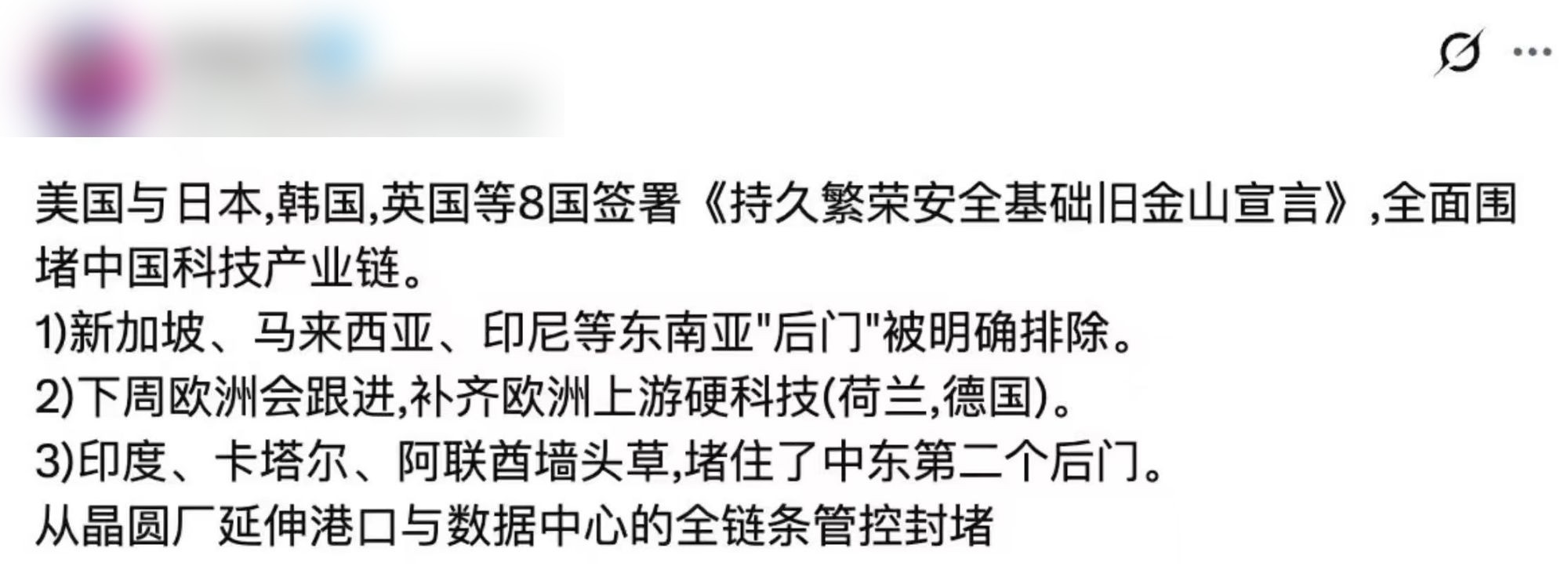
Comparison of Internet Claims and Original Text
The above image is a post that recently circulated on Chinese social media. A point-by-point comparison follows with the declaration and press release published by the State Department:
- "The United States signed with Japan, South Korea, the UK and other eight countries": Incorrect. The State Department press release stated, "The United States and nine other participants of Pax Silica," and the declaration text was jointly published by ten governments.
- "Southeast Asian backdoors such as Singapore, Malaysia, and Indonesia are explicitly excluded": Contrary to the facts. Singapore is one of the ten signatories. Malaysia and Indonesia are not on the signing list, but the declaration does not mention any country being "excluded."
- "Comprehensively encircling China's technology industry chain": This is an interpretation, not the original text. The term "China" does not appear in the declaration; the wording is to prevent sensitive technology from being obtained by "hostile actors."
- "Extending from semiconductor fabs to ports and data centers": Partially true. The declaration's definition of critical infrastructure does include ports, docks, and logistics networks, but the original text does not specifically name "semiconductor fabs" or "data centers," which can only fall under broader terms like "means of production" and "information communication infrastructure."
- "India, Qatar, and the UAE as fence sitters have blocked the second backdoor in the Middle East": The three countries did indeed sign, while "fence sitters" and "backdoor" were comments made by the poster.
- "Europe will follow up next week to fulfill the upstream hard technology (Netherlands, Germany)": There are reports to support this, but it is not yet a fact. According to Anadolu, citing the Financial Times, Helberg indicated that Germany, Sweden, the Netherlands, and the European Commission are expected to sign next week, but they have not yet signed.
What the Declaration States: Two Definitions, Five Working Groups
The body of the declaration is not long, focusing on two definitions.
The first is "sensitive technology," referring to goods, software, materials, knowledge, components, production inputs, and means of production critical to the superintelligence (SI) supply chain. There are two criteria for judgment: if stolen, illegally transferred, or acquired by hostile actors, it will provide the opposing side with "significant military or intelligence advantages," or create "improper economic leverage" over the signatories; or unauthorized transfers and misuse would bring significant risks to the economic and national security of the signatories.
The second is "critical infrastructure," which refers to physical and digital systems that support the superintelligence supply chain and relate to the security, economic operations, and basic services of the signatories. It explicitly includes ports, docks, transportation, telecommunications, and logistics networks, as well as the information and communication and energy infrastructure relied upon by these networks and the digital platforms used to coordinate and manage them. The criteria for judgment are: if interrupted, degraded, controlled by hostile entities, or if the data flowing through them is unauthorizedly exposed, it would cause significant harm.
The significance of these two definitions lies in their scope. Over the past few years, U.S. technology controls on China have primarily focused on chips and manufacturing equipment; this declaration has also included port operations, logistics platforms, and the data flowing through them as objects "needing joint protection." The declaration also states that the signatories will establish working groups, with the State Department press release listing five directions: a policy framework to promote innovation, applications of superintelligence in critical industries, supply chain cooperation across the entire superintelligence technology stack, secure harbors and supply chain security hubs, and superintelligence safety and resilience.
The term "superintelligence" is a recent usage by the U.S. State Department, with a footnote in the declaration clarifying: for some signatories, "superintelligence" refers specifically to "artificial intelligence."
Why These 10 Countries: From 7 Country Initiative to 10 Country Core Group
Pax Silica is an initiative launched by the U.S. State Department in December 2025, aimed at securing the supply chain dependent on artificial intelligence, covering critical minerals, energy, semiconductors, advanced manufacturing, and AI infrastructure. According to the U.S. think tank Information Technology and Innovation Foundation (ITIF), when the initiative was launched, the "Pax Silica Declaration" was signed by seven countries: the U.S., the UK, Japan, South Korea, Singapore, Australia, and Israel; subsequently, the UAE signed in January this year, and India in February, bringing the total signatories to 26 as of November this year.
The ten signatories of the "San Francisco Declaration" are part of these 26: in addition to the seven founding signatories, there are the UAE, India, and Qatar. Geographically, this list covers chip and storage capacity in East Asia (Japan, South Korea), transshipment and testing hubs in Southeast Asia (Singapore), capital and data center investments in the Gulf region (UAE, Qatar), and India, which is competing for semiconductor manufacturing. This also explains why the post interprets it as "blocking backdoors": nodes in the AI supply chain that can be bypassed are being drawn into the same security definition one by one.
Europe's Absence: Not Excluded, But Yet to Reach Agreement
No European countries are on this signing list, but Germany, the Netherlands, and the EU joined an earlier "Silicon Peace Declaration" in June this year. According to reports from Euronews on November 12 after seeing the draft, EU member states had concerns about the broad definitions in the declaration, regulatory autonomy, and the term "superintelligence," with some members wanting to set objective standards for sensitive technology and critical infrastructure. The European Commission has been authorized to participate in the negotiations, but it is uncertain whether it can obtain signing authorization before the signing ceremony.
Helberg stated to the Financial Times that Germany, Sweden, the Netherlands, and the European Commission are expected to sign next week. If realized, the Netherlands' lithography equipment and Germany's industrial and chemical materials will also fall under the same framework. However, acceptance levels among European countries regarding "ports" and "digital platforms" being listed as critical infrastructure may differ from those of Asian partners: several ports in Europe have Chinese companies holding shares or participating in operations.
Neither Naming China Nor Obscure Direction
The term "China" does not appear anywhere in the declaration, and when Pax Silica was initiated by the State Department last December, it also claimed that this partnership "is not aimed at isolating other countries." However, several keywords in the declaration, including "economic coercion," "non-market policies and practices," "reducing excessive dependence," and preventing "hostile actors," are consistent with the terminology in U.S. policies towards China in recent years.
On November 16, when asked about this at a regular press conference, Chinese Foreign Ministry spokesperson Mao Ning stated that China has always believed that artificial intelligence is a common wealth of humanity and should not be ideologically divided, creating closed and exclusive "small circles," and that all parties should work together to promote the development and governance of artificial intelligence.
The timing is also worth noting. Four days after the signing of the declaration, U.S. President Trump is scheduled to meet with Chinese President Xi Jinping during the APEC summit in Shenzhen on November 19. According to VOA reports, U.S. Treasury Secretary Benson stated last week that the U.S. has initiated superintelligence dialogue with China, aiming to prevent shared risks and avoid misjudgments. Signing a supply chain security declaration with allies while engaging in dialogue with China precisely positions this declaration: it is a common baseline among allies, not a set of specific blocking measures.
Unanswered Questions
The declaration contains no funding commitments or binding authority; its weight depends on a few subsequent matters: whether the five working groups can produce specific standards and lists; whether ports and logistics platforms controlled by hostile actors will trigger investment reviews or operational restrictions within the signatory countries; whether Europe can sign on schedule and what reservations may be attached to the signing; and how superintelligence and supply chain security will be presented at the Shenzhen meeting. Until these are settled, the concept of "comprehensively encircling" is neither the original text of the declaration nor reality.
Reference Material
3. ITIF: Tracking Pax Silica's Evolution: A Timeline (2026-11-16)
5. U.S. State Department: United States and India Sign Pax Silica Declaration (2026-02)
8. Brownstein: State Department Expands Pax Silica Initiative at 2026 Summit
Editor’s Note: The content of the declaration is based on the English original text published by the U.S. State Department on November 15 and its official Chinese translation; screenshots of social media posts have anonymized the posting accounts. The statement that European countries "are expected to sign next week" is based on Helberg's comments to the Financial Times, as reported by Anadolu, and has not yet been actualized; the EU's concerns about the draft come from Euronews reports; the Chinese Foreign Ministry's response is quoted from VOA Chinese reports. The number of Pax Silica signatories is based on ITIF's count as of November 16.
Disclaimer: This article is for information reporting and analysis only and does not constitute any investment advice.
免责声明:本文章仅代表作者个人观点,不代表本平台的立场和观点。本文章仅供信息分享,不构成对任何人的任何投资建议。用户与作者之间的任何争议,与本平台无关。如网页中刊载的文章或图片涉及侵权,请提供相关的权利证明和身份证明发送邮件到[email protected],本平台相关工作人员将会进行核查。


