Original author: Bu Shuqing
Original source: Wall Street Watch
The investment boom in AI infrastructure shows new signs of cooling.
The semiconductor research organization SemiAnalysis released its latest model update on November 13, significantly lowering its forecasts for AI accelerator shipments, capital expenditures, HBM demand, and power demand over the next few years. Notably, the adjustments for 2028 to 2030 are particularly substantial: the global capital expenditure forecast for AI accelerators in 2028 has been cut by 28%, while those for 2029 and 2030 have been cut by 41% and 40%, respectively.
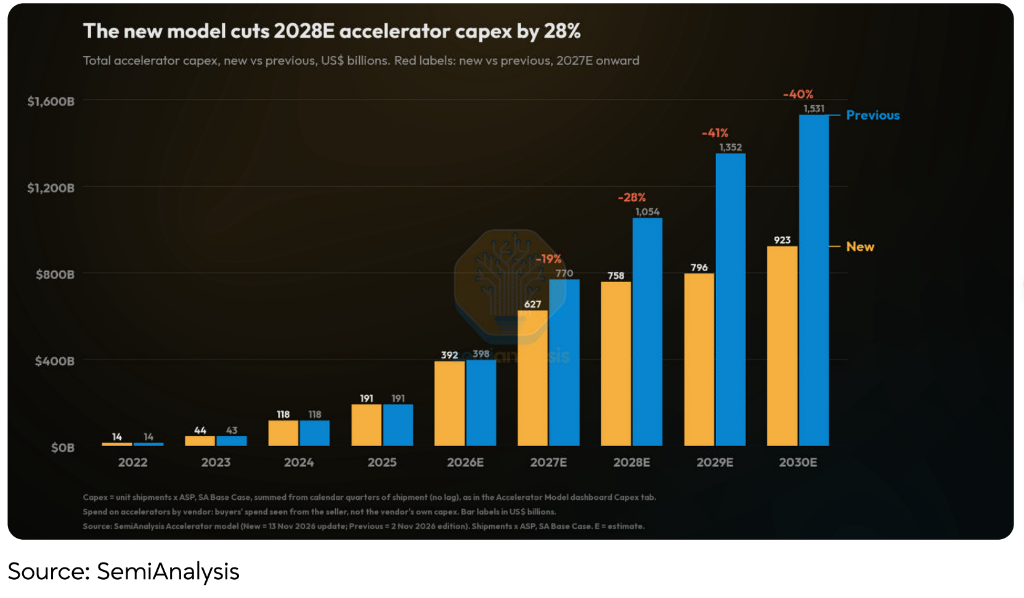
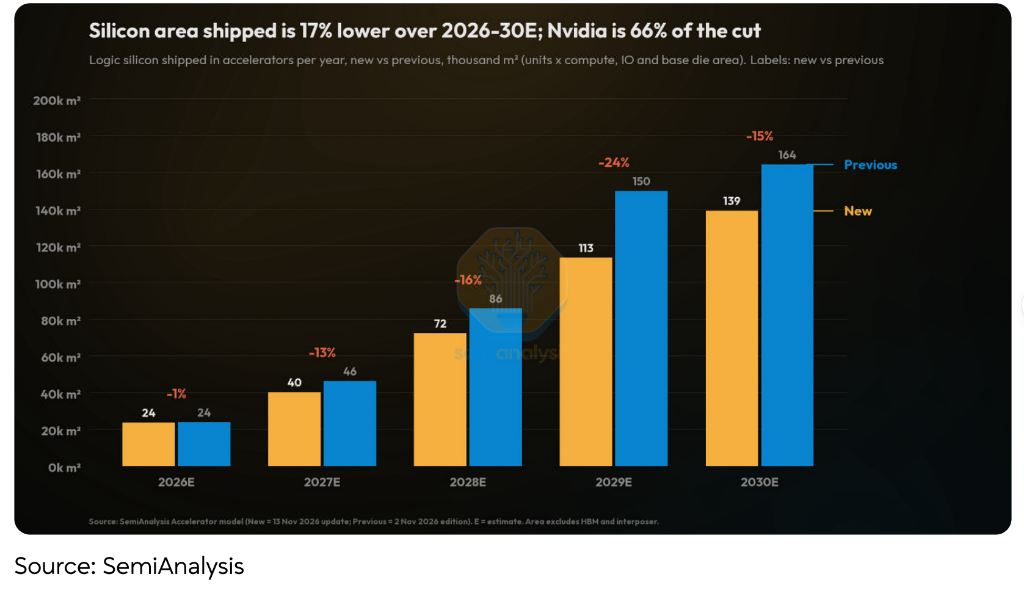
According to the latest model, global capital expenditure for AI accelerators is expected to drop from a previously predicted $1.531 trillion in 2030 to $923 billion, a reduction of $608 billion. At the same time, the cumulative forecast for the shipment area of accelerator logic chips from 2026 to 2030 has been lowered by 17%, with Nvidia accounting for 66% of this reduction.
Nvidia is the most affected by this round of forecast adjustments. SemiAnalysis not only significantly lowered Nvidia's shipment forecasts for the coming years but also further reduced assumptions about the average selling price of its next-generation products, believing that as competition in the AI hardware market intensifies, Nvidia will need to accept lower profit margins to maintain competitiveness.
Capital expenditure expectations for AI plummet, with a $608 billion downward adjustment for 2030
The most direct signal from SemiAnalysis's adjustment is a reevaluation of the scale of global capital expenditure for AI accelerators.
According to its latest model, capital expenditure forecasts for global AI accelerators in 2026 remain largely unchanged, still around $392 billion. However, starting from 2027, the previously high growth expectations have clearly been revised down.
The 2027 capital expenditure forecast has been cut from $770 billion to $627 billion, a reduction of 19%; from $1.054 trillion in 2028 to $758 billion, a reduction of 28%; from $1.352 trillion in 2029 to $796 billion, a reduction of 41%; and from $1.531 trillion in 2030 to $923 billion, a reduction of 40%.
This means that the previously expected high-speed expansion path for AI accelerator capital expenditures is being significantly corrected. Especially for 2029 and 2030, the originally anticipated annual investment scale of over $1 trillion has now been revised down to the range of $800 billion to $900 billion.
This does not mean that investment in AI infrastructure will stop growing. According to the new forecast, global capital expenditure for AI accelerators is still expected to rise from $392 billion in 2026 to $923 billion in 2030, but the growth scale is significantly lower than previously expected.
The downward revision of capital expenditures is driven by the dual changes in the revenue growth of the AI industry and the financing environment.
SemiAnalysis pointed out that the annual recurring revenue (ARR) growth rate of leading AI laboratories slowed in the third quarter, prompting a reevaluation of the token revenue scale that the entire ecosystem can generate. In order for AI business revenue to more sustainably cover computing costs, the organization has accordingly lowered the future expansion expectations for computing power supply.
At the same time, the willingness of debt and equity investors to invest in capital expenditures for AI infrastructure is weakening, especially for projects lacking commitments from large cloud service providers (Hyperscalers). This will directly affect the development of data center land, power, and building shells, leading to a reduction in the future power supply available for deploying AI computing systems.
The results of the U.S. midterm elections further exacerbate this pressure. SemiAnalysis predicts that of the U.S. data center supply originally scheduled to go into operation in the second half of 2027 to the first half of 2028, 5.8GW will be delayed, and regulatory factors will further compress the data center capacity in 2028.
However, the agency emphasizes that the delays in data center construction caused by the midterm elections are merely additional factors in the forecast revision; the slowdown in AI revenue growth and tightening financing environment are the more significant driving forces.
Chip shipment area cumulative down 17%, HBM demand also sees significant correction
In addition to the downward revision of capital expenditure forecasts, SemiAnalysis has also become more cautious in its judgment of actual hardware demand.
According to the latest model, the cumulative forecast for the shipment area of global AI accelerator logic chips from 2026 to 2030 has been lowered by 17%. The forecasts for 2027, 2028, 2029, and 2030 have been cut by 13%, 16%, 24%, and 15% respectively.
Notably, Nvidia accounted for 66% of the reduction in chip shipment area, indicating that this adjustment of AI hardware demand expectations is not equally shared among all suppliers, and Nvidia is the main affected party.
HBM demand forecasts have also seen significant downward revisions. The forecast for global HBM shipments in 2028 has been cut from 9.0EB to 6.4EB, a reduction of 30%; from 10.3EB to 7.9EB in 2029, a reduction of 23%; and from 10.9EB to 9.6EB in 2030, a reduction of 12%.
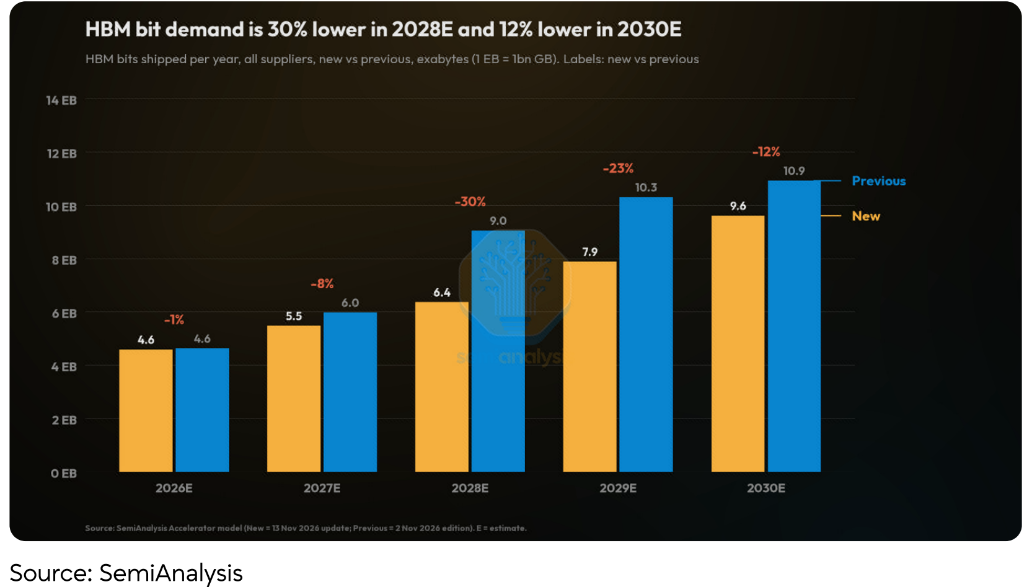
SemiAnalysis believes that the supply-demand balance of HBM is improving, which is why it has lowered assumptions about future HBM prices and transmitted price changes to the material costs (BOM) of various AI chips.
Previously, a considerable portion of the growth in AI infrastructure spending in 2027 was driven by price increases, especially for memory. The recent price forecast adjustments indicate, from the agency's perspective, that the supply chain is returning to a more normal state.
Moreover, the power demand for AI accelerators has also been significantly revised down. According to the latest forecast, the power demand for AI accelerators in 2030 will decline from the previous 122.8GW to 80.7GW, a reduction of 34%; the 2029 forecast drops from 108.7GW to 72.5GW, a reduction of 33%.
This change is due both to the decrease in chip shipments and to adjustments in future assumptions about the power consumption of individual chips. SemiAnalysis points out that power continues to be a limiting factor, and the highest chip power consumption in future accelerator product roadmaps may also trend toward moderation.
Nvidia faces the greatest pressure, future chip shipment forecasts have been significantly lowered
Among the major AI chip suppliers, Nvidia is the most affected company in this forecast adjustment.
SemiAnalysis has lowered Nvidia's shipment forecasts for 2027 to 2030 by 22%, 39%, 56%, and 66%, respectively, according to compute revenue; based on the total power consumption which includes the entire system, the reductions are 14%, 35%, 50%, and 59%.
In terms of price, SemiAnalysis has considered not only the impact of decreasing HBM costs but also believes that Nvidia will need to reduce markup levels on products like Feynman and its subsequent products to cope with increasingly fierce competition.
Specifically, the average selling price forecast for Feynman has been lowered from approximately $110,000 to about $78,000, Feynman Ultra from approximately $175,000 to about $98,000, and Feynman Next from approximately $191,000 to about $118,000.
The simultaneous downward revisions in both shipments and prices will put greater pressure on Nvidia's future revenue forecasts. This adjustment involves not only GPUs but also Groq LPUs and standalone CPU products.
SemiAnalysis explains that Nvidia has been hit harder primarily because its chips have lost attractiveness compared to other platforms in the power procurement mixes of some large AI laboratories.
For example, Anthropic's main computation platforms include TPU, Trainium, AMD GPU, and Nvidia GPU. SemiAnalysis believes that in terms of performance-cost ratio, Nvidia GPUs are at the marginal position among these four platforms, and Anthropic is leaning toward other platforms.
In the case of OpenAI, although GPUs still hold a significant position in its infrastructure, AMD GPUs have become a considerably attractive option. Furthermore, OpenAI will prioritize deploying self-developed ASIC projects like Jalapeno and the next generation Serrano.
The emergence of new cloud service providers (Neocloud) poses another risk for Nvidia. SemiAnalysis points out that Nvidia has the highest exposure to Neocloud customers, especially smaller long-tail customers, who are currently facing greater project execution and financing risks.
Notably, SemiAnalysis emphasizes that this model adjustment does not take into account the potential impact of Jensen Huang resigning as CEO of Nvidia; even if Huang continues as CEO, the agency would still make the same forecast revision. However, the agency believes that leadership changes may further increase the downside risk of Nvidia's market share loss.
Broadcom shows relative resilience, while AMD and MediaTek face varying degrees of adjustment
In stark contrast to Nvidia, Broadcom has demonstrated greater resilience in this forecast adjustment.
SemiAnalysis has lowered Broadcom's cumulative revenue forecast for ASIC business from 2026 to 2030 by 11%, primarily due to average selling price adjustments stemming from the decline in HBM costs rather than large-scale reductions in shipment volumes.
The agency believes that Broadcom's major ASIC projects, including Google TPU, OpenAI, and Anthropic-related projects, have advantages in performance-cost ratio and energy efficiency, while Broadcom is also able to provide financing support for data center land, power, building shells, and system deployment through collaborations with creditors.
AMD also shows some resilience but still faces significant downward revisions. According to the total power consumption metric, SemiAnalysis has lowered AMD's forecasts for 2028 to 2030 by 23%, 55%, and 57%, respectively; and by 29%, 35%, and 32% according to the expenditure metric. The 2027 forecast remains relatively stable, with power consumption metrics remaining basically flat and expenditure metrics revised down by 11%.
AMD has been less affected than Nvidia, mainly due to its positioning with major clients like Meta, OpenAI, and Anthropic. SemiAnalysis believes that the warrant trading arrangements between Meta and OpenAI and AMD make procuring AMD systems very attractive; Anthropic also views AMD as the second-best choice in performance-cost ratio in the inference computing field, following TPU.
Additionally, AMD's recent product deployment has actually accelerated. SemiAnalysis has advanced the shipment timelines for approximately 25,000 MI400 chips and about 30,000 Meta-customized MI450-MC chips from the fourth quarter of 2027 to the fourth quarter of 2026, reflecting a stronger production ramp-up.
MediaTek, on the other hand, faces more apparent adjustments in shipment volumes. SemiAnalysis has lowered the lifecycle shipment forecast for Humufish by 470,000 units for 2028 to 2029, and has reduced the lifecycle shipment forecast for the Triggerfish project targeting Anthropic by 42%.
Amazon's Trainium is one of the few platforms in this adjustment where near-term forecasts have not been revised down. SemiAnalysis has not cut the shipment forecasts for Trainium in 2027 and 2028, as Amazon has sufficient data center project reserves and Trainium has lower manufacturing costs; Amazon is also willing to support its key customers through strategic subsidies.
Overall, this adjustment from SemiAnalysis does not mean that the demand for AI computing power will completely disappear; rather, it indicates that the previously established growth expectations based on continuous financing, rapid data center expansion, and high-priced hardware are being recalibrated.
As the revenue growth of AI laboratories slows and the capital market financing tightens, competition among chip suppliers will shift from purely performance comparisons to a more comprehensive competition encompassing performance-cost ratios, energy efficiency, and financing capabilities.
Nvidia still holds a strong position in the AI chip market, but in the view of SemiAnalysis, its future growth will face greater pressure compared to some ASIC suppliers.
免责声明:本文章仅代表作者个人观点,不代表本平台的立场和观点。本文章仅供信息分享,不构成对任何人的任何投资建议。用户与作者之间的任何争议,与本平台无关。如网页中刊载的文章或图片涉及侵权,请提供相关的权利证明和身份证明发送邮件到[email protected],本平台相关工作人员将会进行核查。


