Original | Odaily Planet Daily (@OdailyChina)
Author | Azuma (@azuma_eth)

This summer, Leopold Aschenbrenner, the “AI Stock God” once hailed by Wall Street as the new investment myth along with his fund Situational Awareness LP, experienced a rise and fall that is worthy of being written into investment history.
In the 13F tracking reports for Q1 and Q2, we witnessed how he pushed the fund's public holdings to over $20 billion peak through extreme bets on AI infrastructure (storage, electricity, computing power). However, shortly after the end of the Q2 reporting period, the severe correction in the AI sector in July combined with high leverage severely impacted Situational Awareness, leading Leopold to ultimately be forced to sell off most of the public market stock portfolio at a discount to Ken Griffin's Citadel.
The story didn't end there. In September this year, insiders revealed that Leopold has returned to the investment battlefield. Amid the recent severe correction in the US stock market, rumors even surfaced about Leopold's "second liquidation" — rumors that remain unverified, with many details based on the now-reference-less Q2 holdings report — but due to the delayed disclosure window for Q3's 13F, the outside world has been unable to peek into the true bottom line of this former myth after experiencing the calamity in July.
On November 17, Beijing time, Situational Awareness finally submitted its 13F holdings report to the U.S. Securities and Exchange Commission (SEC) as of September 30, 2026. This belated report finally unveils his current positioning.
Who is the “AI Stock God”? (Skip if familiar)
In March this year, we first introduced Leopold in the article "SBF’s little brother turned $225 million into $5.5 billion in just one year."
Leopold previously worked at FTX's Future Fund in 2022 and stayed with the team until FTX collapsed. In 2024, Leopold wrote a 165-page super paper titled “Situational Awareness: The Decade Ahead” and founded the fund of the same name, Situational Awareness, serving as chief investment officer.
Situational Awareness focuses on investment opportunities in the AI supply chain. By Q4 2024, the fund's public holdings had “only” reached $225 million; however, by the disclosure in February this year for Q4 2025, this figure had rapidly grown to $5.5 billion; and by May this year for Q1 disclosure, it had soared to $13.7 billion; in the Q2 disclosure, it even peaked at $20.2 billion... but now these numbers have lost all significance.
- Odaily Note: It should be noted that in U.S. stock 13F filings, the reported market value of options assets usually reflects the “Notional Value” of the underlying stocks rather than the actual premium costs paid by the fund.
With explosive investment returns, Leopold and Situational Awareness gained significant fame and became one of the most followed AI investment trends online, with Leopold also being dubbed the “AI Stock God” by a market eager to create idols.
Position Shrunk by 92%: From $20.2 billion to $1.58 billion
From the fund's scale, after experiencing the “discount fire sale” in July, Situational Awareness' holdings have significantly decreased.
According to the latest disclosed Q3 13F document, as of September 30, 2026, the reported value of Situational Awareness's 13F holdings dropped sharply from approximately $20.24 billion at the end of Q2 to about $1.58 billion, a staggering decline of 92.2% in a single quarter.
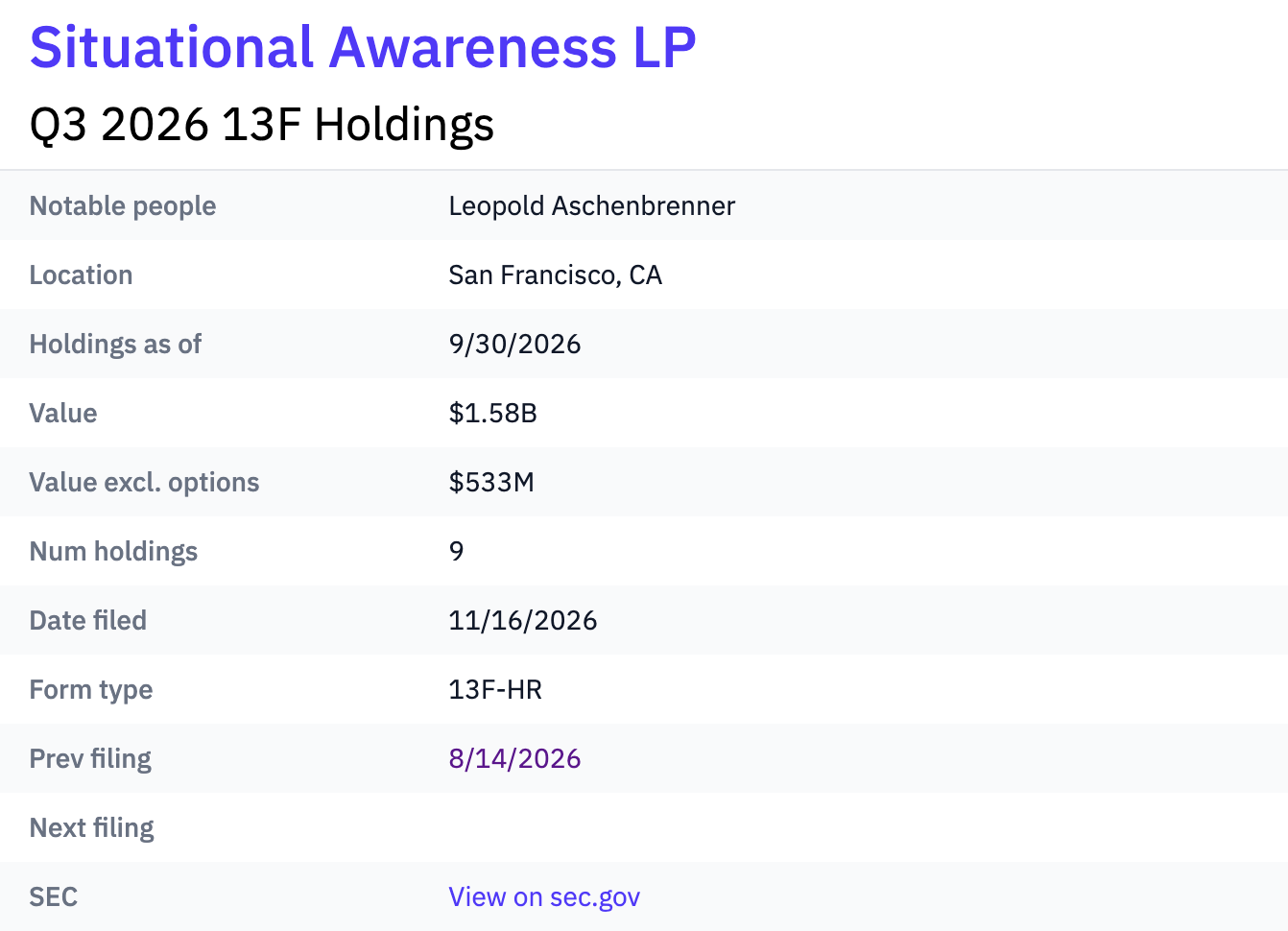
If we break down the holding structure further, this change becomes even more evident:
- Excluding options positions, the value of stocks has drastically decreased: At the end of Q2, the fund held stocks worth as much as $20.17 billion; by the end of Q3, the total value of stock holdings was merely $533 million, a 97.4% reduction in stock scale.
- Severely reduced number of positions: The number of holdings plummeted from 42 in Q1 and 26 in Q2 to just 9 in Q3.
- The top five positions account for a concentration as high as 94.2%: Out of the nominal total exposure of $1.58 billion, the top five positions contributed approximately $1.485 billion, accounting for 94.2% of the entire investment portfolio.
In summary, after surviving the liquidation crisis in July, Situational Awareness is no longer a giant ship relying on a huge scale to cover multiple tracks and dozens of targets in the secondary market, but has significantly reduced the fund size and highly concentrated the remaining chips on a few core targets.
Core Holdings Breakdown: Fully Shifted to Options, SHAZ Becomes the Only Major Stock
In the $1.58 billion nominal total holdings, what did Leopold buy back?
The answer is still his most familiar formula — AI computing cloud, data center electricity, and AI storage; meanwhile, Leopold’s specific trading model has undergone a clear change — from “heavily stockpiling equities” to fully shifting towards “positioning call options.”
In the Q2 report, 99.6% ($20.17 billion) of Situational Awareness’s $20.24 billion holdings were actual stock spot, with SanDisk (SNDK, 28.0%) and Micron (MU, 27.5%) two storage giants occupying half. However, in the Q3 report, the proportion of stocks was compressed to only 33.7% (approximately $533 million), and the remaining 66.3% (approximately $1.047 billion) of nominal exposure was entirely composed of call options.
The following is the core holdings details of Situational Awareness as of the end of Q3 2026.
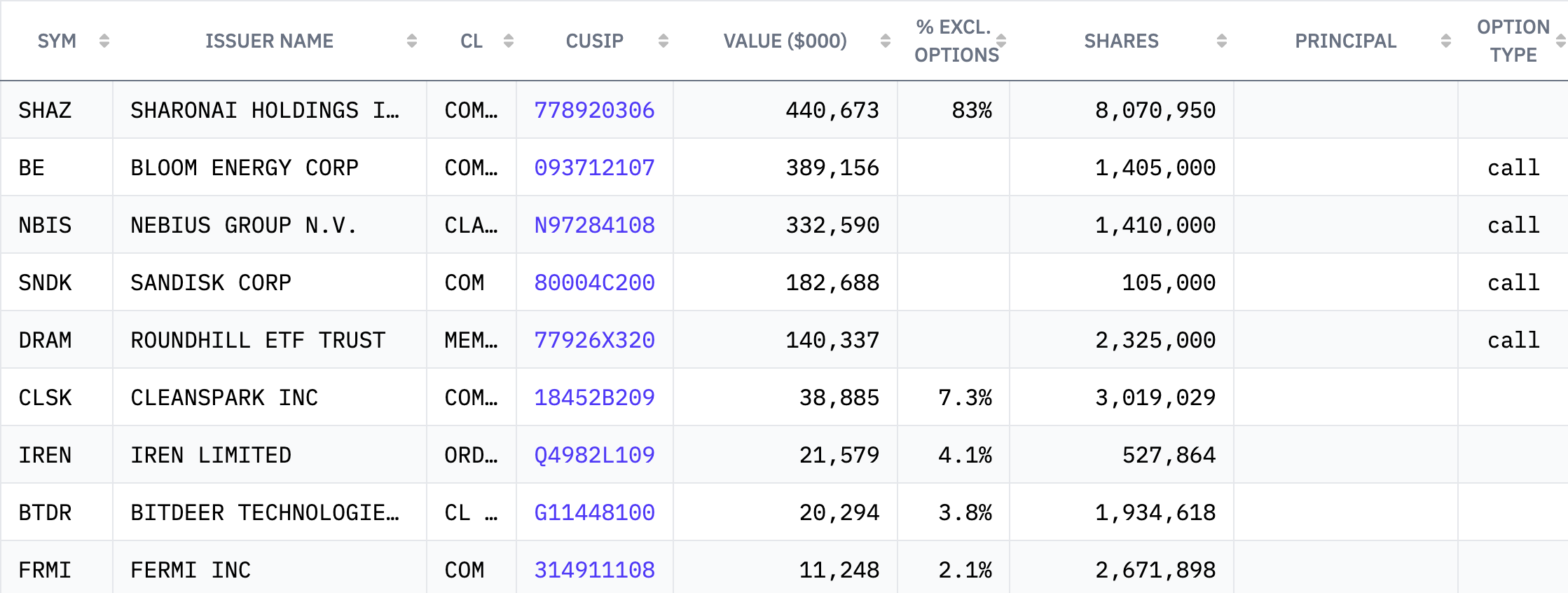
Specifically, the top five major holdings in Q3 (accounting for a total of 94.2%):
- Largest holding: SharonAI (SHAZ) stock, with a holding value of about $441 million, accounting for 27.9%. This is currently the only major stock held by the fund, and now, Situational Awareness holds over 21% of the circulating shares of this Australian AI computing cloud service provider.
- Second-largest position: Bloom Energy (BE) call options, with a nominal value of approximately $389 million, accounting for 24.7%. The logic betting on the power supply bottleneck for data centers continues, but the holding method has changed from Q2’s stock to call options.
- Third-largest position: Nebius Group (NBIS) call options, with a nominal value of approximately $333 million, accounting for 21.1%. Another long-term favorite of Leopold, an emerging computing cloud (Neocloud), maintained high exposure in Q3 using call options.
- Fourth and fifth largest positions: SanDisk (SNDK) call options, with a nominal value of approximately $183 million, accounting for 11.6%; Roundhill Memory ETF (DRAM) call options, with a nominal value of approximately $140 million, accounting for 8.9%. In the most core storage sector, Leopold cleared out Q2's Micron (MU) and SanDisk (SNDK) stocks, instead opting for call options on SNDK paired with call options on the memory industry ETF (DRAM) to continue betting on the storage cycle's rise.
Apart from the top five, Situational Awareness also holds a small amount of common stocks in CleanSpark (CLSK), Iren (IREN), Bitdeer (BTDR), and Fermi (FRMI). Among these, the first three have suffered significant reductions, while FRMI is a newly established position this quarter.
Has the Leverage Decreased?
After the massive losses in July, did Leopold reduce leverage?
Although the 13F document does not directly disclose the fund's margin debts borrowed from the main broker, we can still clearly see the change in leverage structure through the shift in holding tools — leveraging implicit leverage inherently provided by options, instead of explicit financing leverage that triggers forced liquidations.
In other words, while the 13F does not disclose Situational Awareness's actual leverage ratio, the market at least sees that the fund’s holding risk structure has changed.
After suffering huge losses in July, Leopold stated in a letter to investors that the fund had removed leverage from the portfolio. When re-entering the market in September, insiders also revealed that he had switched to a fully paid premium option trading method to avoid the previous risk structure reliant on financing, which easily triggers margin calls.
Referring to Q3 13F, the four call options disclosed in the report (BE, NBIS, SNDK, and DRAM) correspond to a total nominal value of about $1.045 billion, which forms about two-thirds of the total holding value. It is important to note that this $1.045 billion is not the actual premium paid but corresponds to the nominal value of the underlying stocks (since the 13F does not disclose the specific strike prices, expiration dates, or acquisition costs of the options, we cannot accurately calculate how much principal the fund paid for these positions). If these positions were purchased using available funds for the full premium, the declines in the underlying would not directly trigger additional margin calls as purchasing financed stocks would; the maximum loss is generally limited to the premiums paid.
This does not mean that risks have vanished. Call options still face the drop in the underlying price, decay of time value, and changes in implied volatility, but at least it won't push Leopold back into the predicament of July. Situational Awareness was previously forced to sell at a discount to Citadel due to the reliance on borrowing to buy stocks and triggering broker margin notifications and a series of forced liquidations during the crash. By switching to directly buying call options afterward, this structure does not have a forced liquidation mechanism for additional margin calls, and the maximum loss limit is locked at the time of purchase as the invested premium — considering the market has recently dropped significantly again, this may help Leopold dodge another bullet.
Leopold is Still Bullish on AI — Just Changed His Approach
Overall, this Q3 13F shows that Leopold's faith remains unchanged, but his investment style has significantly changed — Leopold is still the same steadfast bull on AI, but after experiencing the tragic defeat in July, he is trying to add a safety net to his aggressive investment style.
However, this 13F only records the holdings as of September 30 and cannot reflect trading changes over the past month and a half. After the recent market downturn, whether Leopold has reduced his positions, stopped losses, or even faced new liquidity pressures still needs validation from subsequent information.
In July, Leopold lost to leverage; now, he attempts to regain control with options. But this time, whether he can survive until the AI investment logic is realized remains unknown.
免责声明:本文章仅代表作者个人观点,不代表本平台的立场和观点。本文章仅供信息分享,不构成对任何人的任何投资建议。用户与作者之间的任何争议,与本平台无关。如网页中刊载的文章或图片涉及侵权,请提供相关的权利证明和身份证明发送邮件到[email protected],本平台相关工作人员将会进行核查。


