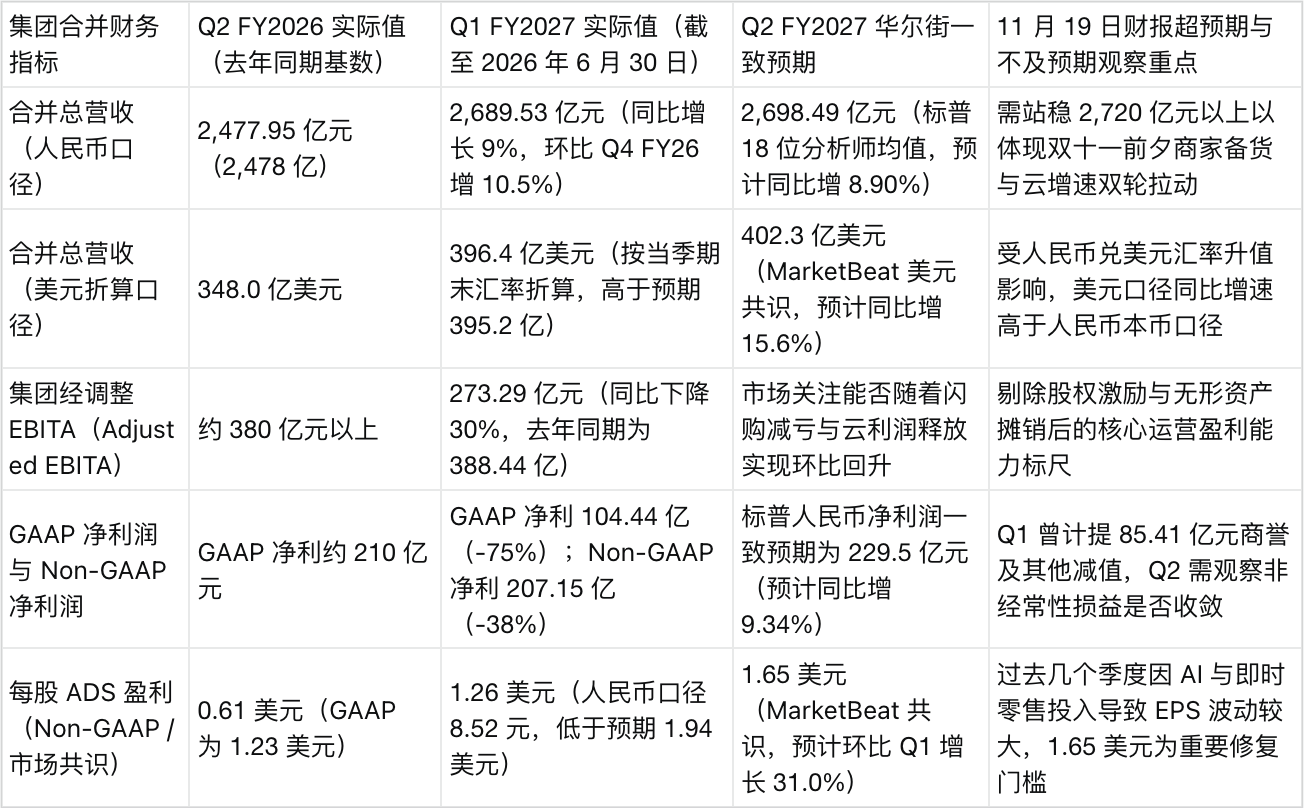
Alibaba Group (NYSE code BABA, HKEX code 9988) is scheduled to announce its unaudited results for the second quarter of fiscal year 2027 (the third calendar quarter of 2026) before the U.S. stock market opens on Thursday, November 19, 2026, Eastern Standard Time. A conference call will be held at 20:00 Singapore time (07:00 EST) on the same day. The market expects its total quarterly revenue to increase by approximately 8.9% year-over-year to 269.85 billion yuan (equivalent to 40.23 billion USD), and earnings per ADS is expected to be 1.65 USD. Following a first quarter external revenue growth of 45% in cloud computing (with AI-related product revenue achieving triple-digit growth for the 12th consecutive quarter, reaching 12.4 billion yuan), but with quarterly capital expenditure surging 75% year-over-year to 67.68 billion yuan resulting in a free cash flow outflow of 44.67 billion yuan, the key focus of this second quarter report will be whether Alibaba Cloud Intelligence Group can maintain a high growth rate of over 45% while increasing its adjusted EBITA margin from 12%, along with whether the reduction in losses from instant retail can alleviate the significant pressure on free cash flow caused by substantial investments in AI infrastructure.
Key Points
The key to understanding Alibaba's fiscal year 2027 second quarter financial report lies in grasping the dual main lines of "acceleration of AI cloud profitability" and "parallel investments in e-commerce and computing power." Reflecting on the analysis of Alibaba's first quarter earnings report published on August 20, 2026, the group's total revenue increased by 9% year-over-year to 268.953 billion yuan, with Alibaba Cloud's external revenue and total revenue growth rates both accelerating to 45%, and AI-related products accounting for 35% of external cloud revenue (annualized revenue reaching 49.5 billion yuan), driving cloud business adjusted EBITA up 133% year-over-year to 5.628 billion yuan. However, due to the AI lab and application (Qwen inference and model development) recording an adjusted EBITA loss of 13.861 billion yuan and the initial investment in Taobao Instant Commerce affecting overall group adjusted EBITA, which fell 30% year-over-year to 27.329 billion yuan, GAAP net profit decreased 75% year-over-year to 10.444 billion yuan. Then, from August 24 to 26, the company completed the 800 million Hong Kong Dollar (approximately 100 million USD) new stock placement analyzed in Alibaba’s 10 billion USD share placement analysis, specifically for expanding the global AI computing power base. With the BABA share price trading at 94.30 USD (which corresponds to a forward price-to-earnings ratio of approximately 11.6 to 16 times, Wall Street's consensus target price being 186.86 USD), the pre-market trends in customer management revenue (CMR), cloud business margins, and capital expenditure intensity will be the core catalysts determining stock price revaluation.
Fiscal Year Standards, Winter Time Conversion, and Consistent Expectations for the Second Quarter Report
According to the official notice released on November 6, 2026, by Alibaba's investor relations website and Business Wire schedule announcement, the company will publish its quarterly financial results as of September 30, 2026, before the U.S. stock market opens on Thursday, November 19, 2026 (before 09:30 EST / 22:30 Singapore Time), with a management conference call at 07:00 EST (20:00 Hong Kong and Singapore Time on the same day).
For cross-time-zone investors tracking both U.S. and Hong Kong markets, two basic standards need to be clarified: First, Alibaba’s fiscal year runs from April 1 to March 31 of the following year, so the three months ending on September 30, 2026, is strictly labeled as Q2 FY2027 in official fiscal year terms, which corresponds to September Quarter 2026 in calendar quarter terms; second, since the U.S. ended daylight saving time on November 1, 2026, and reverted to standard time (EST, UTC-5), 07:00 EST corresponds to 12:00 Coordinated Universal Time (UTC) and 20:00 Singapore and Beijing time (UTC+8), which has been delayed by one hour compared to the conference call during daylight saving time.
Combining the SEC first quarter official report, the historical benchmarks disclosed in the June Quarter 2026 full report, and the Moomoo S&P consensus expectations (average of 18 analysts in RMB terms) with MarketBeat earnings forecast statistics (average in USD ADS terms), the table below provides a complete comparison of the expected core financial indicators for the same period last year (Q2 FY2026), the previous quarter (Q1 FY2027), and this second quarter report (Q2 FY2027).
Cloud Intelligence Group and AI Product Demand: Can the Growth of 45%, 49.5 Billion ARR, and 12% Profit Margin Continue to Rise?
In Alibaba's current valuation system, the Cloud Intelligence Group is the primary engine determining whether the price-to-earnings multiple can be revised upwards. According to data disclosed in the TradingKey first quarter earnings call transcript and Tiger Securities' second quarter outlook, Alibaba Cloud delivered a report card of simultaneous volume and price increase in the first quarter: the cloud segment's total revenue and external customer revenue growth rates both accelerated to 45% (an 11 percentage point increase over the 34% growth in the third calendar quarter of 2025), while AI-related products accounted for 35% of external cloud revenue, corresponding to AI product revenue of 12.4 billion yuan (approximately 1.8 billion USD), achieving triple-digit year-over-year growth for the 12th consecutive quarter.
Based on the first quarter AI product revenue of 12.4 billion yuan, Alibaba's AI-related products' annualized recurring revenue (ARR) has reached 49.5 billion yuan (approximately 7.3 billion USD), a quarter-over-quarter increase of 38.3% compared to the 35.8 billion ARR of the fourth quarter of fiscal year 2026. In the conference call of the first quarter, CEO Wu Yongming and the management reiterated two clear medium- to long-term quantitative targets: first, to achieve an ARR exceeding 30 billion yuan for Model as a Service (MaaS, based on the open-source and commercial models of Qwen and QwenWork enterprise-level intelligent agents) by the end of 2026; second, to achieve external cloud annual revenue exceeding 100 billion yuan and a gross margin level of 20% by 2030.
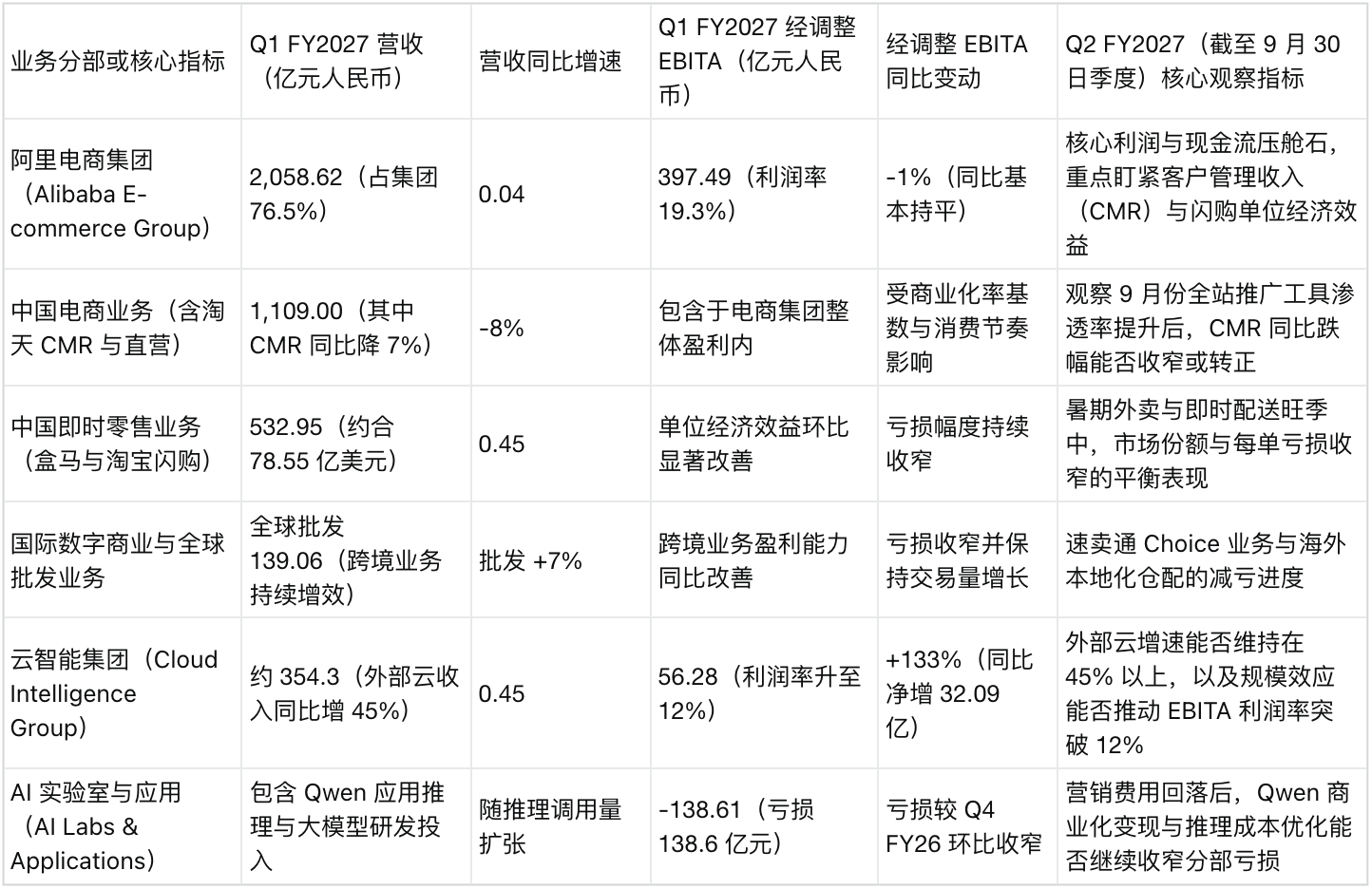
Analyzing the matrix in the above table, investors should focus on verifying three quantitative details of Alibaba Cloud before Thursday's pre-market report: first, under the high base of the previous year's growth of 34% in the third calendar quarter (2025), can this season's cloud business external revenue growth maintain in the 40% to 45% range; second, can the proportion of AI-related products in external cloud revenue increase from 35% in the first quarter to further progress towards 40%, driving AI product ARR to exceed 55 billion to 60 billion yuan; third, as the proportion of high-margin public cloud and MaaS usage expands, can the adjusted EBITA margin of the Cloud Intelligence Group continue to expand from 12% in the first quarter (with adjusted EBITA of 5.628 billion yuan, up 133% year-over-year).
E-commerce Business Profit Resilience and Instant Retail Loss Reduction: Can CMR Stabilize and Rebound?
If Alibaba Cloud determines Alibaba's valuation ceiling, then the Alibaba E-commerce Group, which accounts for 76.5% of the group's total revenue, is the cash flow foundation supporting the capital expenditures of the entire group.
In the first quarter, the Alibaba E-commerce Group achieved total revenue of 205.862 billion yuan (up 4% year-over-year), with adjusted EBITA reaching 39.749 billion yuan, virtually unchanged compared to the same period last year (a slight decrease of 1%). However, analyzing the internal structure of the e-commerce group reveals a notable shift from old to new momentum: on one hand, the instant retail business in China, including Hema and Taobao Instant Commerce, saw revenue soaring 45% year-over-year to 53.295 billion yuan, and with an increase in order density and optimized delivery efficiency, management confirmed that the unit economics of Taobao Instant Commerce continued to improve with significant reduction in losses; on the other hand, traditional Chinese e-commerce business revenue decreased 8% year-over-year to 110.90 billion yuan, with the customer management revenue (CMR, mainly from advertising and commissions) falling 7% year-over-year.
Entering the second quarter ending September 30, the e-commerce sector faces two critical tests: first, the period from July to September, which includes summer consumption and back-to-school season, is also the most intense phase for instant retail delivery subsidy competition, investors need to verify whether Taobao Instant Commerce can lower the average fulfillment cost while maintaining market share; second, as merchants gradually adapt to the full-site promotion (Quanzhantui) advertising tools and basic service fees, can the year-over-year growth rate of traditional Chinese e-commerce CMR show significant marginal improvement from -7% in the first quarter. As long as the e-commerce group can consistently contribute adjusted EBITA above 38 billion to 40 billion yuan each quarter, the group will have sufficient internal profits to absorb the R&D investments of the AI lab.
677 Billion Single-Quarter Capital Expenditure and Negative Free Cash Flow: Analyzing Investment Cycles and 3.5-Year Payback Arithmetic
The most controversial indicator among institutional investors in this financial report preview is Alibaba's shift from positive to negative free cash flow. According to U.S. cash flow statement analysis and U.S. financial statements and valuation accounting framework, free cash flow equals the net cash flow from operating activities minus capital expenditures.
In the first quarter, Alibaba's cash flow from operating activities remained robust, growing 11% year-over-year to 22.945 billion yuan (from 20.672 billion yuan in the same period last year); however, due to a capital expenditure of as much as 67.678 billion yuan (approximately 9.975 billion USD, a 75% year-over-year increase) made to meet the surge in AI computing power orders (mainly for purchasing servers, networking equipment, and data center construction), the cash outflow for equipment purchase of 67.660 billion yuan far exceeded the cash inflow of 22.945 billion yuan from operations, resulting in a net outflow of free cash flow of 44.670 billion yuan for the season (compared to a net outflow of 18.815 billion yuan in the same period last year).
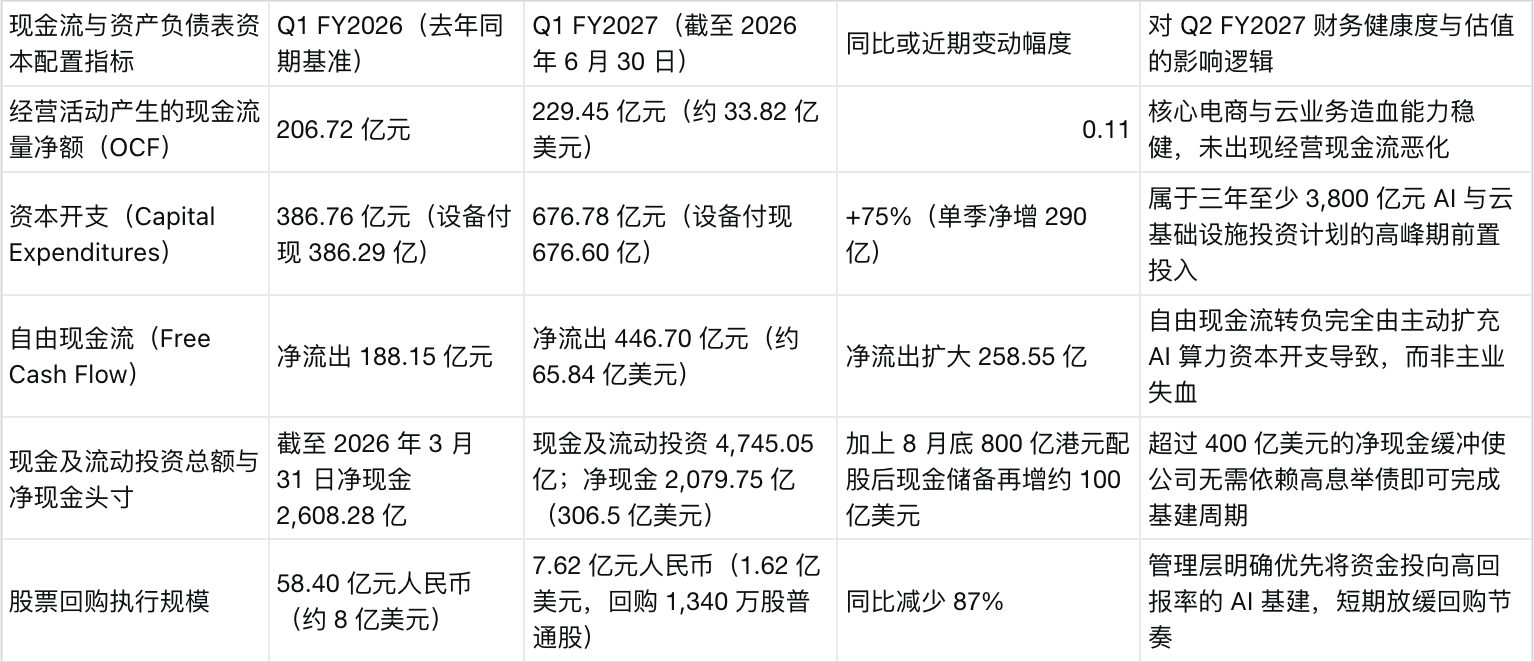
Facing market concerns over the negative free cash flow, CFO Xu Hong provided a highly persuasive capital return arithmetic model in the first quarter call: based on the current gross margin level of AI products and a static capital expenditure payback period of about 3 years, as long as Alibaba Cloud controls revenue growth below 33%, the existing operating cash flow is already sufficient to cover capital expenditures and achieve positive free cash flow; however, management voluntarily chose not to slow down growth to achieve positive free cash flow in the current period, but to aggressively seize market share during the AI demand explosion window. Xu further pointed out that with the continuous improvement of AI product gross margins and efficiency of self-developed chips and underlying architectures, the investment payback period for capital expenditures is expected to shorten from 3 years to 2.5 years or even less, at which point Alibaba will be able to restore positive free cash flow while maintaining high growth above 40%.
Repurchase Pace, Funding Arrangements After 10 Billion USD Share Placement, and Management's Outlook Highlights
In terms of balance sheet and shareholder returns, as of June 30, 2026, Alibaba held cash and other liquid investments totaling 474.505 billion yuan (approximately 69.933 billion USD). After deducting interest-bearing liabilities of 266.530 billion yuan, the net cash position reaches 207.975 billion yuan (approximately 30.652 billion USD). Meanwhile, in the first quarter, the company intentionally slowed the pace of open market stock buybacks, spending only 162 million USD (7.62 billion yuan) to repurchase 13.4 million ordinary shares (approximately 1.7 million ADS), then completed an 80 billion Hong Kong Dollar (approximately 10 billion USD) new share placement in Hong Kong from August 24 to 26 to enhance its AI infrastructure funding.
During the financial report release before the U.S. market opens on November 19 and in the conference call at 20:00 (Singapore time), investors should focus on verifying the management's latest outlook on the following four directions: first, whether Alibaba Cloud’s external revenue year-over-year growth can maintain in the 40% to 45% range after the base effect increase, and the progress of reaching the 30 billion RMB target for MaaS ARR by year-end; second, whether the adjusted EBITA loss of the AI lab and applications (which was 13.861 billion in the first quarter) can further narrow in the second quarter as expected; third, whether the full-year capital expenditure budget will remain at the current quarterly investment pace of 60 billion to 70 billion, and after completing the 80 billion Hong Kong Dollar share placement, whether management will increase stock buyback efforts at the current stock price of about 94 USD; fourth, the latest positioning on the recovery in consumer spending and turning point for customer management revenue (CMR) during this year's "Double Eleven" shopping festival. According to TipRanks analyst consensus, as of mid-November, 14 Wall Street analysts covering Alibaba have set an average 12-month target price of 186.86 USD, suggesting significant recovery potential compared to the current share price of 94.30 USD. Before and after the release of the quarterly report on Thursday, investors can visit MEXC stock section to browse the stock market and related companies, tracking the cross-market reaction to the report's release with real-time quotes and valuation metrics.
MEXC Editorial Team Exclusive Viewpoint
Examining Alibaba's upcoming fiscal year 2027 second quarter financial report, the core question the market really needs to clarify is: why is a tech giant with a cloud computing revenue year-over-year increase of 45%, AI products achieving triple-digit growth for 12 consecutive quarters, and holding over 30 billion USD in net cash, seeing its stock price linger around 94 USD, with a forward price-to-earnings ratio of less than 16 times?
The answer lies in the secondary market’s discounted pricing of the "misalignment in the profit and loss statement structure" and "short-term transition to negative free cash flow." In the first quarter's report, investors saw two entirely different pictures: one is the Cloud Intelligence Group’s revenue soaring 45% and adjusted EBITA jumping 133% to 5.628 billion yuan (with a margin rising to 12%), proving that full-stack AI commercialization has entered the harvest period; the other is the R&D losses of the AI lab and applications amounting to 13.861 billion yuan combined with a massive capital expenditure of 67.68 billion yuan that lowered the overall group’s adjusted EBITA by 30% and created a net outflow of 44.67 billion yuan in free cash flow. In a macro environment where funds pursue predictable cash flow, the market temporarily prices BABA at a discounted multiple reflective of the heavy asset investment phase.
This determines that the three validation anchors that can most influence valuation in the conference call at 20:00 (Singapore time) on Thursday evening are as follows: The first anchor is the convergence of the cloud business and the significant losses from the AI model: in the first quarter, the cloud segment earned 5.628 billion EBITA, and the AI lab lost 13.861 billion, resulting in a net investment gap of 8.233 billion; if the second quarter cloud segment EBITA expands to above 6.5 billion to 7 billion, while the AI lab losses narrow to under 11 billion, the market will see a clear timeline toward overall AI business breakeven. The second anchor is whether the capital expenditure payback period can shorten from 3 years to 2.5 years as the CFO stated, which directly relates to when free cash flow becomes positive in 2027. The third anchor is whether the traditional e-commerce customer management revenue (CMR) can stop declining and begin to recover. As long as the AI cloud continues to deliver over 40% growth and the e-commerce fundamentals stabilize, the current forward price-to-earnings ratio of less than 16 already fully accounts for the pains of the investment period.
Frequently Asked Questions
When will Alibaba's fiscal year 2027 second quarter financial report and conference call take place, and what are the three months corresponding to the report period?
Alibaba Group will announce its unaudited financial results for the second quarter of fiscal year 2027 before the U.S. stock market opens on Thursday, November 19, 2026 (before 09:30 EST / 22:30 Singapore time) and hold a conference call at 07:00 EST (corresponding to 20:00 on November 19 for Hong Kong and Singapore time). Since Alibaba operates on an accounting year from April 1 to March 31 of the following year, the second quarter of fiscal year 2027 (Q2 FY2027) corresponds to the actual calendar report period of July 1 to September 30, 2026 (September Quarter 2026).
What is the market consensus for Alibaba's revenue and earnings per share for the second quarter of fiscal year 2027?
According to the consensus estimates compiled by S&P Global from 18 analysts in RMB terms, Alibaba's total consolidated revenue for the second quarter of fiscal year 2027 is expected to be 269.849 billion yuan, representing an 8.90% year-over-year increase from 247.795 billion yuan in the same period last year (Q2 FY2026) and a slight increase of 0.3% from 268.953 billion yuan in the previous quarter (Q1 FY2027); the net profit attributable to parent in RMB terms is expected to be 22.95 billion (representing an expected year-over-year growth of 9.34%). According to MarketBeat’s USD ADS estimates, total revenue for the quarter is expected to be 40.23 billion USD (a year-over-year increase of 15.6%), with earnings per ADS expected to be 1.65 USD (higher than the actual 1.26 USD in the previous quarter).
How did Alibaba Cloud Intelligence Group and AI-related products perform in terms of growth and profitability in the last quarter?
In the first quarter of fiscal year 2027 ending June 30, 2026, Alibaba Cloud Intelligence Group's total revenue and external customer revenue both increased by 45% year-over-year, with AI-related product revenue reaching 12.4 billion yuan (approximately 1.8 billion USD), achieving triple-digit year-over-year growth for the 12th consecutive quarter and accounting for 35% of external cloud revenue, leading to an annualized recurring revenue (ARR) of 49.5 billion yuan (approximately 7.3 billion USD). Thanks to economies of scale, the cloud segment's adjusted EBITA increased significantly by 133% year-over-year to 5.628 billion yuan, with the adjusted EBITA margin improving to 12%.
Why does Alibaba have positive operating cash flow but a negative free cash flow of 44.67 billion yuan?
Free cash flow equals the net cash flow from operating activities minus capital expenditures. In the first quarter of fiscal year 2027, Alibaba's net cash flow from operating activities increased by 11% year-over-year to 22.945 billion yuan (approximately 3.382 billion USD), remaining healthy; however, to advance its investment plan of at least 380 billion yuan for AI and cloud infrastructure over three years, the company saw its capital expenditures surge 75% year-over-year to 67.678 billion yuan (with equipment purchase cash outflows of 67.660 billion yuan), and the substantial upfront capital investment led to a net outflow of 44.670 billion yuan in free cash flow for the season.
How did Alibaba's E-commerce Group and instant retail business perform in terms of profitability in the last quarter?
In the first quarter of fiscal year 2027, the Alibaba E-commerce Group achieved total revenue of 205.862 billion yuan (up 4% year-over-year), with adjusted EBITA maintained at 39.749 billion yuan (virtually unchanged, a slight decrease of 1% year-over-year). Internally, traditional Chinese e-commerce business revenue decreased 8% year-over-year to 111.09 billion yuan (CMR declining by 7% year-over-year), whereas the instant retail business in China, including Hema and Taobao Instant Commerce, saw a significant year-over-year increase in revenue of 45% to 53.295 billion yuan. With improvements in unit economics, instant retail losses have significantly narrowed on a sequential basis.
What is the current cash reserve, share placement financing, and stock repurchase progress for Alibaba?
As of June 30, 2026, Alibaba held cash and other liquid investments totaling 474.505 billion yuan (approximately 69.933 billion USD), with a net cash position of 207.975 billion yuan (approximately 30.652 billion USD) after deducting interest-bearing liabilities. Additionally, from August 24 to 26, 2026, the company completed an 80 billion Hong Kong Dollar (approximately 10 billion USD) new share placement in Hong Kong to enhance AI infrastructure funding. Regarding stock buybacks, as the company prioritized allocating capital to high-growth AI infrastructure, it slowed its repurchase pace in the first quarter, spending 162 million USD (7.62 billion yuan) to repurchase 13.4 million ordinary shares (approximately 1.7 million ADS).
Disclaimer
This article is for general informational purposes only and does not constitute investment advice, financial advice, legal advice, tax advice, or any trading recommendations. The prices of cryptocurrencies, stocks, and other related financial assets may experience significant volatility, and the historical data, company disclosures, and third-party expectations cited in this article do not guarantee future results, and the market expectations and third-party estimates may not represent actual outcomes, with related figures subject to change in subsequent disclosures and revisions. Readers should conduct their own research and make independent judgments based on their financial situation, investment objectives, and risk tolerance, consulting qualified professionals when necessary. MEXC operates in compliance with legal requirements and does not provide services to residents of restricted areas, and the MEXC Crypto Pulse team does not accept any liability for any direct or indirect losses arising from the use of this information.
免责声明:本文章仅代表作者个人观点,不代表本平台的立场和观点。本文章仅供信息分享,不构成对任何人的任何投资建议。用户与作者之间的任何争议,与本平台无关。如网页中刊载的文章或图片涉及侵权,请提供相关的权利证明和身份证明发送邮件到[email protected],本平台相关工作人员将会进行核查。


