Original | Odaily Planet Daily (@OdailyChina)
Author | Asher(@Asher_0210)

On November 15, the DEX project Metric, led by former Uniswap engineering director as CTO, disclosed that its trading volume exceeded 8 billion dollars in the first month of the platform's official launch, with a single-day trading volume exceeding 600 million dollars, while the TVL was only a little over 25 million dollars. With a TVL of over 25 million dollars supporting a monthly trading volume of over 8 billion dollars, this caught my attention.
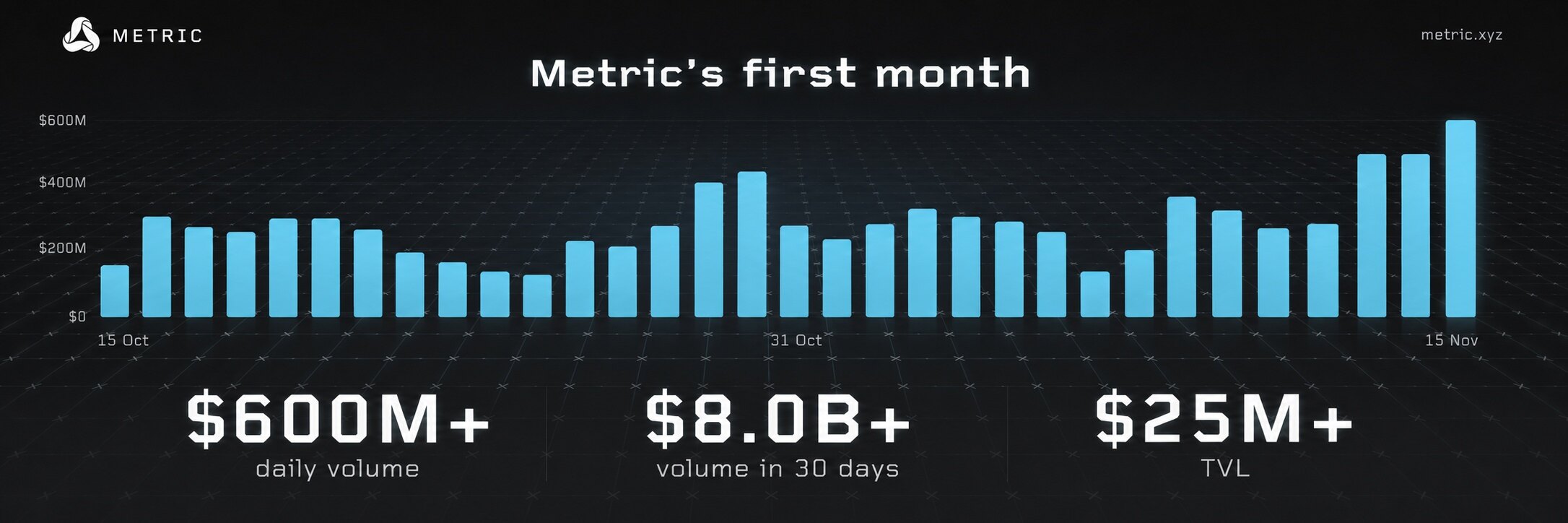
Moreover, Metric announced the launch of a points program, distributing 1 million points weekly to participants, which also attracted the attention of many "farming" enthusiasts. So, where does Metric's trading volume come from? What are the unique aspects of its mechanism? After the points activity is launched, how can ordinary users participate?
Former Uniswap Engineering Director Enters, Metric Focuses on Tokenized Asset Trading
Metric is a decentralized spot exchange centered around Active Pools, catering to trading needs for tokenized stocks, mainstream crypto assets, and stablecoins. Unlike common AMMs that form prices based on the proportions of assets in the pool, Metric separates pricing from liquidity allocation, allowing funds to reference external markets for updated quotes, enabling liquidity to move with the reference price.
Tokenized stocks provide a perspective for understanding its positioning. Once stocks are issued as on-chain tokens, the corresponding company's stock price continues to fluctuate in the external market. If the on-chain liquidity pool is not updated in time and sells already appreciated assets at old prices, arbitrageurs can buy the undervalued tokens, incurring losses that are ultimately borne by the LP. After assets are tokenized, how to ensure that quotes keep up with market conditions and provide sufficient trading depth around reasonable prices is precisely the issue Metric aims to solve.
To achieve this, Metric allows liquidity pools to connect to oracles, on-chain data, or custom pricing strategies through price providers. Its open-source code already includes implementations for data access from Chainlink and Pyth. This also extends its applicability to assets such as gold, foreign exchange, and BTC, ETH, which have external reference prices. For professional market makers, Metric supports the use of proprietary funds to operate private pools; for ordinary LPs, it provides public pools that can accept external funds.
Metric's technical lead comes from Uniswap Labs. Current CTO Christos Gkolias (@CGkol) worked at Uniswap Labs for three and a half years as engineering director, having previously worked at Google. Transitioning from a leading DEX to a new project, he hopes to enable market makers to independently set pricing strategies, allowing LPs to avoid frequently adjusting price ranges, and provide more market-congruent quotes for tokenized stocks, foreign exchange, and mainstream crypto assets.
With over 25 million dollars in TVL, how does it support 8 billion dollars in trades?
In Metric, LPs can place funds within different ranges near the reference price, these ranges are known as Bins. They move with the reference price. For example, if the reference price of ETH is 3000 dollars, and LP chooses a range of 1% above and below, the corresponding range would be from 2970 to 3030 dollars. When the reference price rises to 3300 dollars, the range will automatically shift to 3267 to 3333 dollars, without LP needing to withdraw funds and redeploy. This process simply updates the quote range without automatically buying or selling tokens in the position.
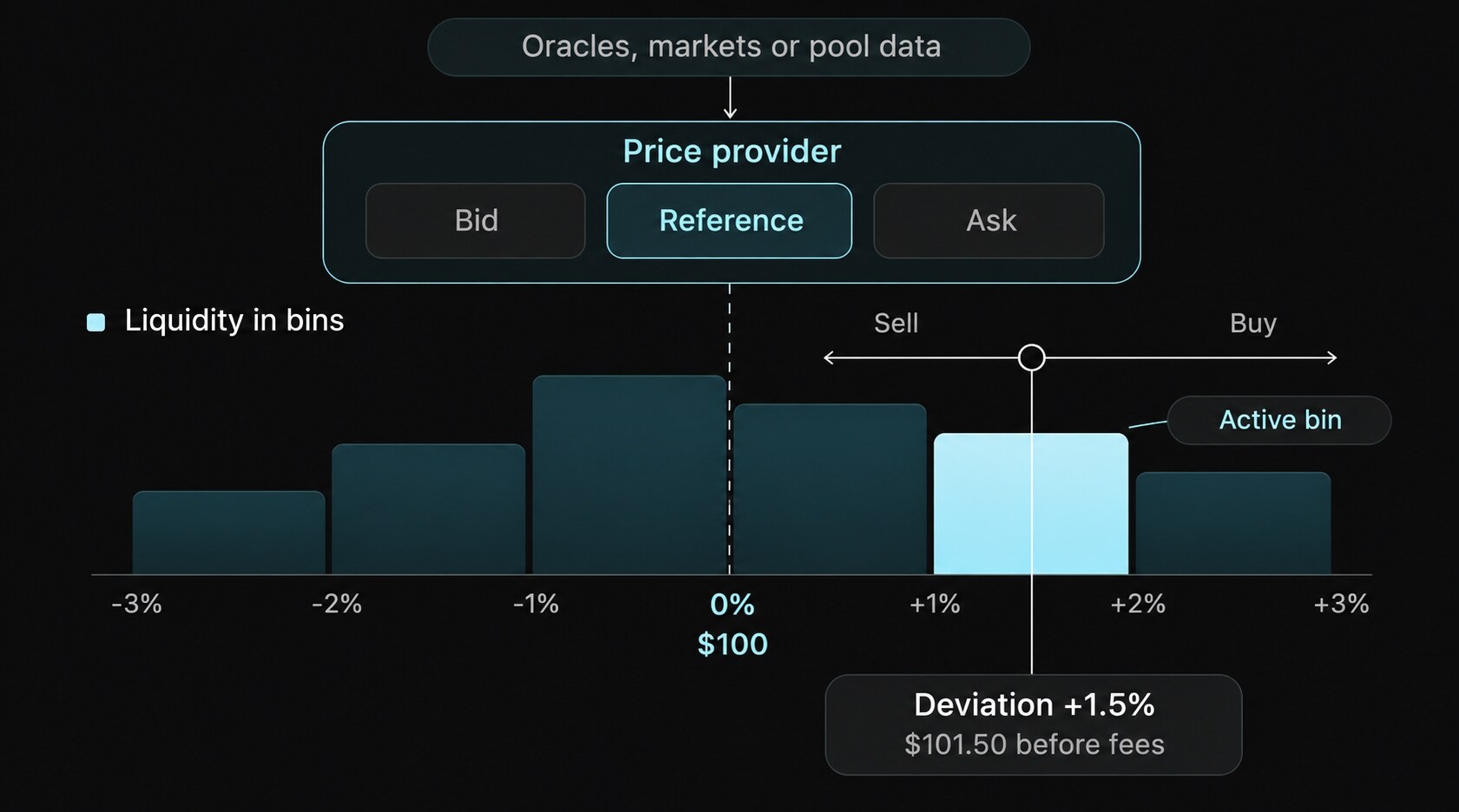
In common concentrated liquidity AMMs, if the funds remain fixed in the 2970 to 3030 dollars range, once ETH rises to 3300 dollars, those funds will temporarily "not receive orders," requiring LPs to adjust the range to re-enter trading. Metric lets the quote range follow the market, reducing the situation where funds are idled due to price changes. The same funds continuously participate in buying and selling, rotating repeatedly, thus creating opportunities for a smaller TVL to support a larger cumulative trading volume.
Once trades enter the liquidity pool, they will first utilize the liquidity within the current range. After it is exhausted, trades will then enter the next range. It is similar to buy orders gradually consuming sell orders, where larger trades will require funding from multiple ranges, resulting in an average transaction price that may deteriorate, thus price impact still exists. As trades occur, the proportion of assets held by LPs will also change—the ETH and USDC deposited may become less ETH and more USDC upon withdrawal, or vice versa.
Of course, the range following the price does not mean LPs can make guaranteed profits. The price difference earned through trading by LPs may still be offset by losses from asset declines and delayed quoting. To address this, Metric has launched Markout APR, which compares the transaction price with the reference price after a certain period, checking whether these trades are beneficial to the liquidity pool. This number can be negative, also reminding participants that the more trades, the not necessarily the more profit, and it ultimately depends on the actual returns of the entire position.
The points program launched on October 15, distributing 1 million weekly
On November 13, Metric announced the launch of a points program, distributing 1 million points weekly to participants who trade, provide liquidity, manage liquidity pools, and invite users. Points have been calculated since October 15, and interactions from the past four weeks are also included in rewards; early users can connect their wallets to see their accrued points. The weekly statistics period ends at 8 PM Beijing time on Wednesday, and points will be automatically distributed on Thursday without needing to be manually claimed.
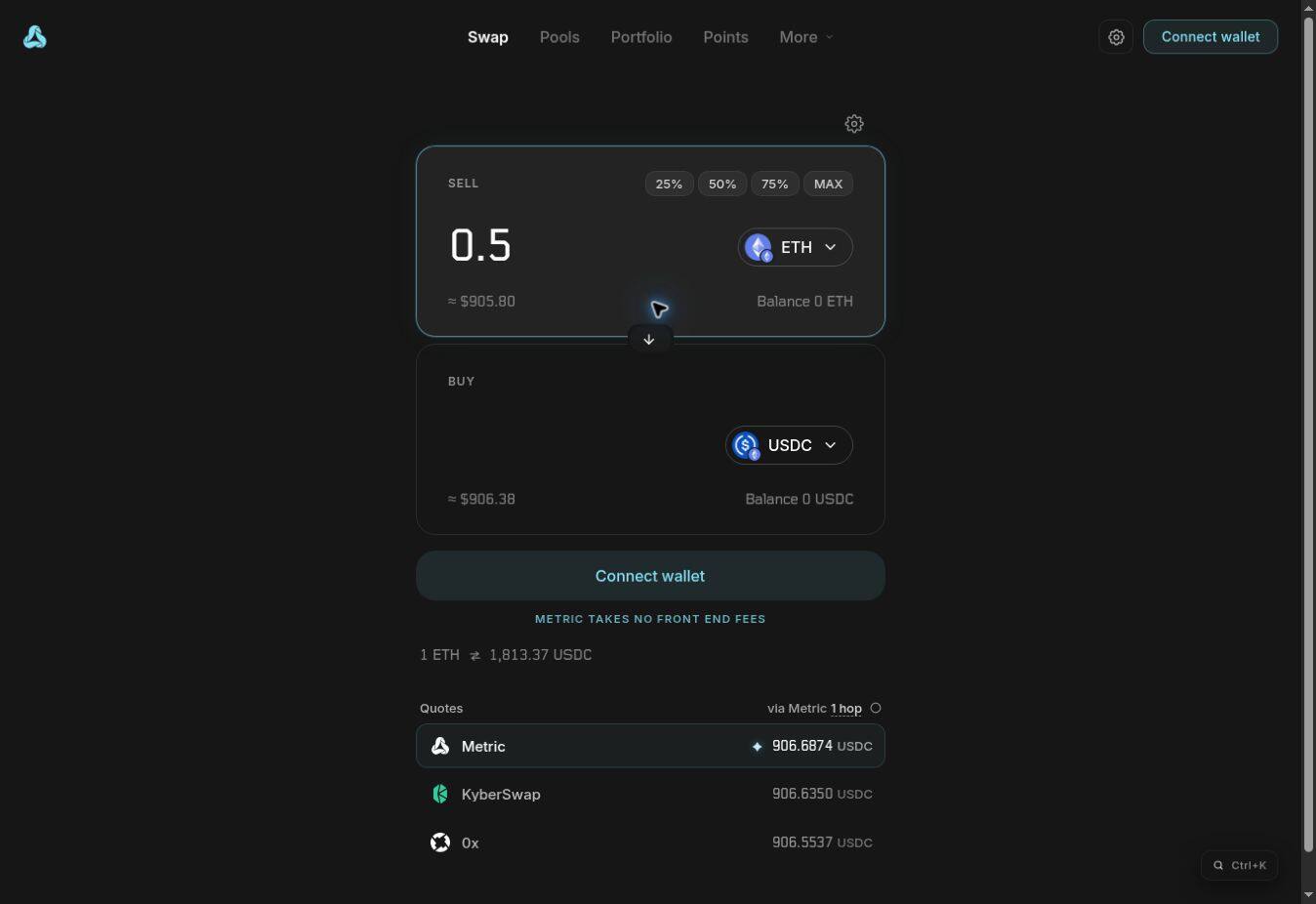
For early "farming" enthusiasts, the main way to earn points currently is by participating in spot trading and providing liquidity. Additionally, redeeming assets on the Metric page does not necessarily mean using Metric’s liquidity pool. To earn points through trading, users need to pay attention and select paths that carry the points label. As shown in the following image, the Metric quote on the right side has a light blue star label, indicating that points can be earned, while below are quotes from other routes.
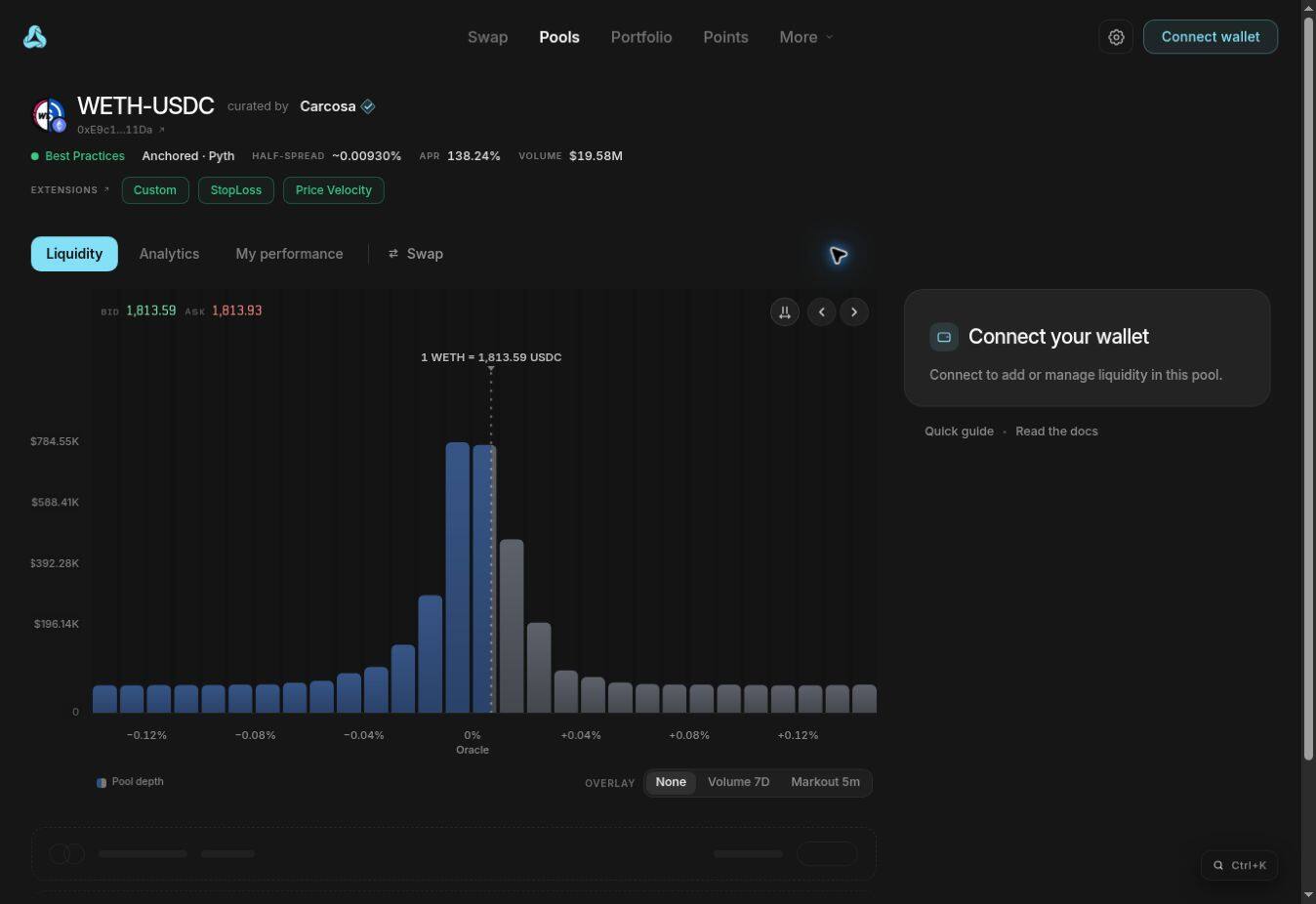
Providing liquidity can involve entering specific liquidity pools via the Pools page, connecting a wallet, selecting the price range, and depositing the corresponding assets while accumulating points and earning from trading spreads. For example, the details page of the WETH/USDC pool will display the manager, pricing source, APR, and trading volume, with switches below to check the trading volume and Markout performance of various ranges. Whether a high APR can convert into actual returns still relies on trading losses and asset price changes, and cannot merely pursue high annualized returns for points.
Furthermore, inviting users can yield up to a 10% points bonus, but it cannot be changed once bound.
免责声明:本文章仅代表作者个人观点,不代表本平台的立场和观点。本文章仅供信息分享,不构成对任何人的任何投资建议。用户与作者之间的任何争议,与本平台无关。如网页中刊载的文章或图片涉及侵权,请提供相关的权利证明和身份证明发送邮件到[email protected],本平台相关工作人员将会进行核查。


