

There are several tea cups on the table. The collector wears a headset device, picks up each cup one by one, moves it away, and then puts it back in its original position. The device recorded continuous video and inertial measurement unit (IMU) data. It seems that the actions have been completely saved. However, once the task is over, this experience usually ends as well. It does not naturally turn into a capability that can be invoked for the next time.
But in Yang Zhexuan’s view, the problem lies precisely here: recording the actions is just the beginning. The video tells us what happened, but it does not tell the model what to do next. It lacks dynamics, intent, spatial relationships, and also lacks the experience of how to recover after failures. To turn the action of organizing the tea cups into reusable intelligence, the system also needs to break down the task into steps, align it with structured language, and then fill back in hand postures, motion trajectories, and action intents.
Yang Zhexuan's judgment is clear: "My judgment is that language, specifically structured language, is the only thing that can be aligned." In his view, only by first writing the task in a structure that the model can understand, retrieve, and reuse can the actions in the physical world possibly transform from one-time experiences into intelligences that can be invoked for the next time.

△There are several tea cups on the table. The action being recorded is just the beginning.
From an industry perspective, once embodied intelligence enters the stage of data scale, the amount collected grows rapidly, but the gap for high-quality data remains significant. In May this year, 36Kr quoted industry consensus stating that training embodied models with generalization capabilities requires at least tens of millions of hours of data, whereas by early 2026, the total amount of high-quality real physical interaction data worldwide was only about 500,000 hours, less than two ten-thousandths of the training data for large language models.
Yang Zhexuan gave a more direct on-site analogy: if 1,000 hours of data is purchased, after screening, only about 100 hours may remain usable. There is a gap that needs engineering capabilities to fill between the scale of collection and effective supply.
What Zhiyu Foundation aims to do is to fill this structural gap. The company positions itself between data collection and model training, using Physical AI DBMS and physical causal models to compile multimodal observations from real tasks into trainable, evaluable, queryable, and reusable operational data assets. The larger goal is to make every action in the physical world become reusable intelligence, allowing embodied intelligence to re-enter factories, shopping malls, homes, and other real-life scenarios as a labor force capable of taking on specific tasks.

Threefold misalignment of data and model learning needs
In Yang Zhexuan's view, data does not lose its value simply because it has been "collected enough." As the model progresses, new shortcomings will emerge, and data needs will change accordingly. Just like exams will continuously present new questions, once the model enters real working cycles, it will also continually pose new challenges.
The real problem is that there remain significant misalignments between existing data and models.
The most direct misalignment lies in the learning targets. The video records where the objects are and what the hands did, but it might not include the object state changes, action consequences, operation sequences, failure recovery, and contact relationships that the model needs to understand. Internally, Zhiyu Foundation summarizes the capabilities that models need to master at the operational level into ten categories. Yang Zhexuan believes that models generally lack in these areas, and simply recording the visuals in a video will not automatically provide answers.

△The same segment of experience is split into visuals, trajectories, and contact relationships, yet the three records often do not align.
The second misalignment occurs in task distribution. Standardized data collection sites are easiest to scale: a 2,000 square meter site, calculated at about 10 square meters per workstation, can accommodate about 200 people. However, when the model learns "how to pick up an object" in this setting, it may still be clueless when transferred to a shopping mall, kitchen, or factory. Yang Zhexuan says that such sites are easy to scale but very hard to provide scene generalization.
The third misalignment comes from differences in entities. Humans and robots, as well as different robots, differ in body structure, action spaces, and control methods; human data applied to robots needs to undergo camera calibration, task schema definition, action mapping, and entity adaptation. A study by Physical Intelligence last December also found that only when pre-training data is sufficiently diverse in scenes, tasks, and entities can the transferability of human videos to robots be manifested.

△For the same cup, what humans and machines see is not the same position.
This is also a focus area of Zhiyu Foundation's ongoing research and exploration: how to shorten the embodiment gap from human to robot, allowing the accumulated action experiences of humans to be understood, mapped, and reused by different robots. If this gap can be shortened, the impact will not be limited to a single task or a particular type of robot; it will also change the efficiency at which embodied intelligence turns data scales into actual capabilities.
Yang Zhexuan's judgment is that, to this day, one relatively certain thing is that scaling will continue to happen. When further refined, the key is about finding a steeper scaling slope, allowing model capabilities to grow at a lower cost.
Thus, the division of labor between the two types of data is not the same. Human first-person perspective data is easy to scale, primarily serving the generalization in the pre-training phase; real machine data is closer to the specific entity and execution feedback, suitable for post-training of specific tasks. Yang Zhexuan gives an example: if you want to keep improving the success rate of a specific task, you must collect real machine data for post-training.
The subsequent changes in OpenAI's second robot model research team, and news such as Anthropic's release of Fable 5.2 have not yet been made public. What Yang Zhexuan discussed at that time was not just about a specific model or release, but about how language and data structure can become the foundation of embodied intelligence. Later industry public actions have followed, looking back, it seemed more like an industry forecast that happened ahead of time.
From the industry perspective, a report released in August by institutions such as the China Academy of Information and Communications Technology indicated that as of the end of June this year, the number of embodied intelligent training venues established and operational in the country had exceeded 70; however, a report on the development of embodied intelligence released by the China Academy and Tsinghua University's Department of Electronic Engineering in October also pointed out that embodied intelligence still remains in the transitional stage toward pilot applications.
Determining whether data is effective depends on whether it can cover the capabilities the model needs to learn; the duration of collection itself does not constitute the criteria. The competition in the industry has shifted from collecting more data to retaining the parts with greater training value.

Data compilation: from observational records to operational-level assets
In Yang Zhexuan's view, the core difference between observational-level data and operational-level data lies in whether there is a structured system to align the data. What is lacking is not more labels, but a language that can place different signals into the same coordinate system. In his words: "My judgment is that language, specifically structured language, is the only thing that can be aligned." Thus, Zhiyu Foundation chooses to organize tasks using structured language while also supplementing information such as dynamics, spatial positions, and motion intents, and has built and applied a five-step data compilation pipeline based on this.
Still taking the example of organizing tea cups. Once the video enters the pipeline, it undergoes quality inspection; frames with dropped data, IMU drift, key actions obscured, or non-compliant operations will be filtered out; data produced by external service providers must also pass this test. It then moves into data base reconstruction, where the system converts record data that is easy to write into a self-researched intermediate format (IR) that balances read and write access and standardizes the time reference and spatial coordinates of multimodal data.
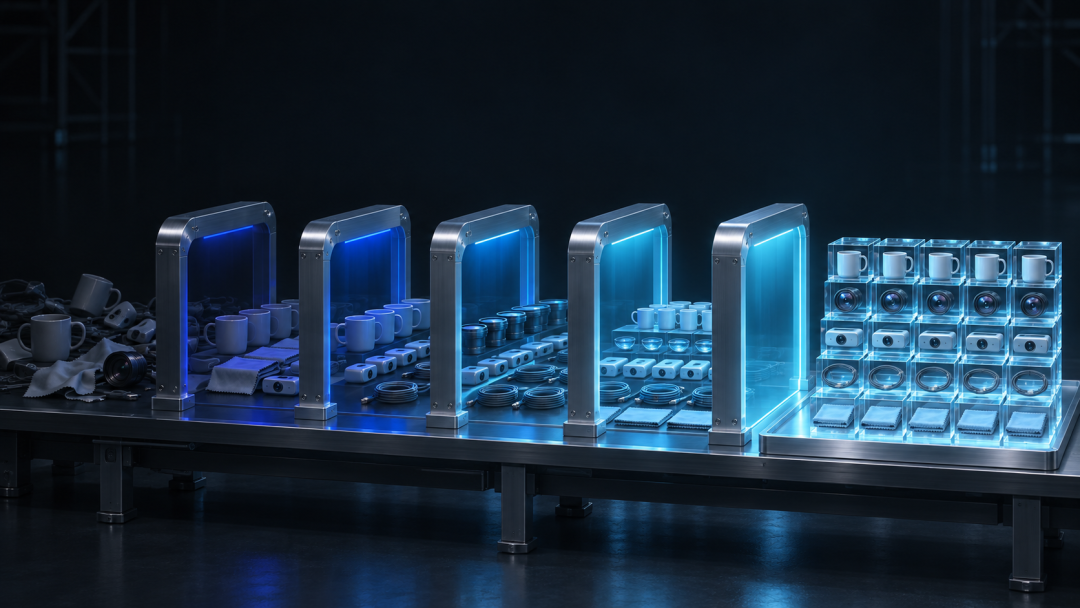
△Compilation pipeline: The left end is unprocessed observations, while the right end is retrievable, deliverable data assets.
On the other side of manufacturing is quality inspection. Products must undergo quality checks before leaving the factory, and data must equally pass scrutiny before delivery. Yang Zhexuan says: "Automation cannot achieve a fully unmanned complete process." Therefore, Zhiyu Foundation places model-based automation, human-in-the-loop multi-level quality checking, and statistical sampling on the same production line.
Next is the core data compilation stage. Tasks will be broken down into multiple steps and aligned with language, hand postures, 6DoF poses, spatial trajectories, depth, and motion intents will be restored and injected into the data. According to Zhiyu Foundation, the compiled data can be intelligently retrieved and matched according to criteria such as scene, object, and skill, and finally standardized and packaged for delivery in the format required by the client.
The four-layer architecture supporting this pipeline consists of observational-level data input, Physical AI DBMS, physical causal models, and operational-level data output.
Physical AI DBMS is the internal data foundation of the company, responsible for organizing, indexing, and version tracking heterogeneous data. From the perspective of Yang Zhexuan, who comes from a database background, the operation of automatic quality checking, labeling algorithms, and physical causal models all rely on this foundation; otherwise, the system would not withstand the workload. The physical causal model is responsible for understanding the task itself, including phase division, state changes, physical contacts, reasons for failures, and recovery paths, ultimately outputting training data sets, benchmarks, scene data packages, evaluation assets, and reusable task templates.
The outside world often views the data business as a labor-intensive industry, but Yang Zhexuan's judgment is: "Data is actually a high-tech manufacturing industry." In his view, labor-intensive is a feature of this business, but it does not mean there are no barriers. The high-tech characteristics can be manifested in the generation of hand postures and trajectory extraction. When hands obscure important areas of operation, information extraction becomes hindered, and the model must rely on restoration, which requires a large amount of unobstructed data for training, and then use ground truth for validation. "This work cannot be solved just by organizing a large number of people; it requires you to have cards, data, and algorithm talents."
The manufacturing aspect is reflected in quality inspection. Products must pass inspections before leaving the factory, and the same goes for data prior to delivery; automation cannot achieve a completely closed loop. "Many peers claim 100% automated labeling and quality inspection—this is not feasible. If you can do so, it means the model no longer needs your data," Yang Zhexuan says. Therefore, Zhiyu Foundation combines automation with multi-level quality checking and statistical sampling.
Thus, it can be seen that data compilation is essentially a manufacturing process with technological barriers. It is not merely cleaning or labeling; rather, it utilizes database engineering, physical causal understanding, algorithms, and quality control to stabilize the once-off observational records into data assets usable by the model.

Boundaries of data compilation capabilities
After compilation, original observational data is processed into trainable and evaluable operational-level data assets, but this does not mean the data can directly drive robots to perform tasks. Yang Zhexuan emphasizes that the compiled data "has not reached the robot level" and cannot be directly issued as control instructions to any robot. Different robots have certain differences in body structure, action spaces, and control systems, and for data to enter the specific training and application phases of robots, entity adaptation is still required.
This also means that cross-entity reuse is not just copying the same data or action instructions to different robots. What can truly be reused are more methods and experiences such as task definitions, failure classifications, observation rules, quality gates, and recovery modes. They can provide references for data production and training for different entities, but specific data processing and action mapping still need to be completed considering the characteristics of the robots themselves.
Besides entity differences, the source of data itself also determines its applicable range. Human first-person perspective data records the human operation process, possessing advantages in scene and task diversity, primarily supporting generalization capability in the pre-training phase; real machine data is closer to specific robot entities and their actual execution feedback, suitable for conducting post-training around specific tasks. The two types of data correspond to different training needs and cannot simply substitute for one another.
These technical boundaries also delineate the business boundaries of Zhiyu Foundation. The company does not focus on the development of robot entities and general foundational models, but it does engage in model training to some extent. The team will conduct small-scale pre-training to evaluate the effectiveness of self-produced data while utilizing models with relatively small parameter scales to maintain an understanding of model demands and validate new technical ideas.
"I believe our company, including my career and my genetic background, is unlikely to engage in large-scale pre-training," Yang Zhexuan says. In contrast, he hopes the company will focus on large-scale post-training in the future to help robots enter specific scenarios and complete real tasks.
For Zhiyu Foundation, the core work of data compilation is to transform operational experiences from the physical world into data assets that models can use; how to enable models to master these experiences and further transform them into actual capabilities for robots will still require the collaboration of model development and entity adaptation.

From one-time collection to continuous supply of real tasks
For data compilation to run continuously, there is a need to constantly receive real tasks. Zhiyu Foundation proposed the idea of a "Real Task Network" on its official website, hoping to connect industrial parks, robot companies, model teams, and research institutions to integrate task inputs, operational environments, robot entities, and model needs into a unified data system.
At this stage, the company is simultaneously collecting real machine data and human first-person perspective data, with external service providers participating in production, while the internal team is responsible for task definition, processing, and acceptance. Yang Zhexuan believes that the difficulty in doing data does not lie in how many people are hired, but in whether tasks can be well defined from the perspective of model training, which is also why the company insists on collecting authentic tasks and actions in real scenarios.
Hardware is another investment. Zhiyu Foundation has developed the ArcheGo series of wearable collection devices, available in binocular and six-eye versions, covering head-mounted primary views and dual wrists. Yang Zhexuan admits that the purpose of making hardware is to send information about physical laws, object contacts, and other data more completely into the digital world.
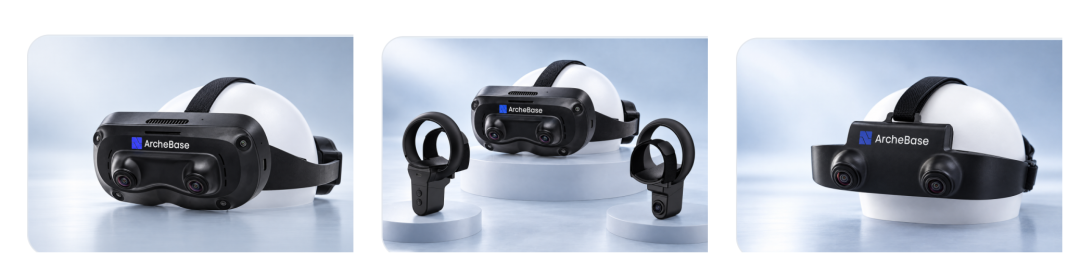
△Zhiyu Foundation's self-developed ArcheGo series wearable collection devices (binocular/six-eye).

Who pays for operational-level data
Zhiyu Foundation's current clients mainly fall into three categories: foundational model companies focusing on pre-training from both domestic and international backgrounds, leading embodied intelligent enterprises, and robot entity manufacturers with pre-training needs. These clients do not focus on collection time but place more importance on data assets that come from real scenes and can enter training and evaluation processes.
This is also changing the pricing logic of data. Yang Zhexuan believes that the repeated suppression of data prices is largely due to inefficiencies. "If I buy 1,000 hours from you, and I ultimately need people to quality-check and process it, and perhaps only find 10 usable hours, then you can only continuously press the price down." Meanwhile, the ability of model companies to check for duplicates is also growing stronger, with redundant data offering little to no enhancements.
Why do model teams need third parties? Building internal teams is not unfeasible, but the continuous production across tasks and entities requires long-term investment; what’s more challenging is determining what data is needed next.
"Data is particularly akin to the clothing industry. Everyone sells clothes, but some clothes flow into large supermarkets while some go to upscale malls, and to achieve the latter, you need to anticipate what will be in style next season," Yang Zhexuan shares, indicating that this necessitates teams to have a sound understanding of models, clearly seeing the boundaries of model capabilities and their future directions.
The value of third parties lies in being able to condense these truly important capabilities into services that can be sustainably delivered. Based on industry observations, large industry players with vertical scenes and sensitive data may not be willing to open themselves up externally; Yang Zhexuan predicts that they may prefer to complete the data loop within their own systems.
Based on thorough observations of clients, Zhiyu Foundation currently plans to enter projects: defining tasks around clients' training needs, organizing collections, and packaging the compiled task data sets and evaluation assets according to client requirements for direct delivery to the client's computational capacity. Yang Zhexuan summarizes this relationship as "data following the flow of computing power."
However, the company’s long-term direction extends beyond mere data delivery. With the continuous accumulation of tasks and data, Zhiyu Foundation aims to further participate in model deployments, conducting large-scale post-training around real scenes and extending data compilation capabilities into model training, deployment, and execution feedback, assisting robots in completing more complex and stable tasks in specific environments.
Ultimately, all of this work points to a single goal: enabling the action experiences from the physical world to be inherited by models and driving embodied intelligence to reenter the real world as a labor force capable of taking on specific tasks.

The next stage of data competition
The data race of embodied intelligence has just experienced a rapid expansion, and the upcoming changes may occur on several levels.
The first changes may come in procurement methods. As model teams mature in their judgment of data effectiveness, data procurement will gradually shift from being priced by collection hours to valuing task coverage, data quality, and training value.
Once the procurement logic changes, the supply structure will also adjust accordingly. Human first-person perspective, real machine, and simulation data will form complements around different training stages, and the data supply will shift from relying on a single collection method to multi-source collaboration.
Furthermore, industry divisions of labor may also be redefined. Professional third-party data compilation services and the internal data loops of large scene players are likely to run in parallel for the long term, while data infrastructure is gradually becoming a key link connecting real tasks with model training.

△The next stage of competition is not about collecting more but having a steeper slope.
These judgments still require time to test. What Zhiyu Foundation is currently doing is to transform each operation in the physical world into assets that can be learned, evaluated, and continuously reused by models. When the data competition of embodied intelligence has entered the next stage, the contest may no longer be about who collects more, but rather who can truly compile data into intelligence.
Image source|Provided by the enterprise
免责声明:本文章仅代表作者个人观点,不代表本平台的立场和观点。本文章仅供信息分享,不构成对任何人的任何投资建议。用户与作者之间的任何争议,与本平台无关。如网页中刊载的文章或图片涉及侵权,请提供相关的权利证明和身份证明发送邮件到[email protected],本平台相关工作人员将会进行核查。