
CEX Popular Coins
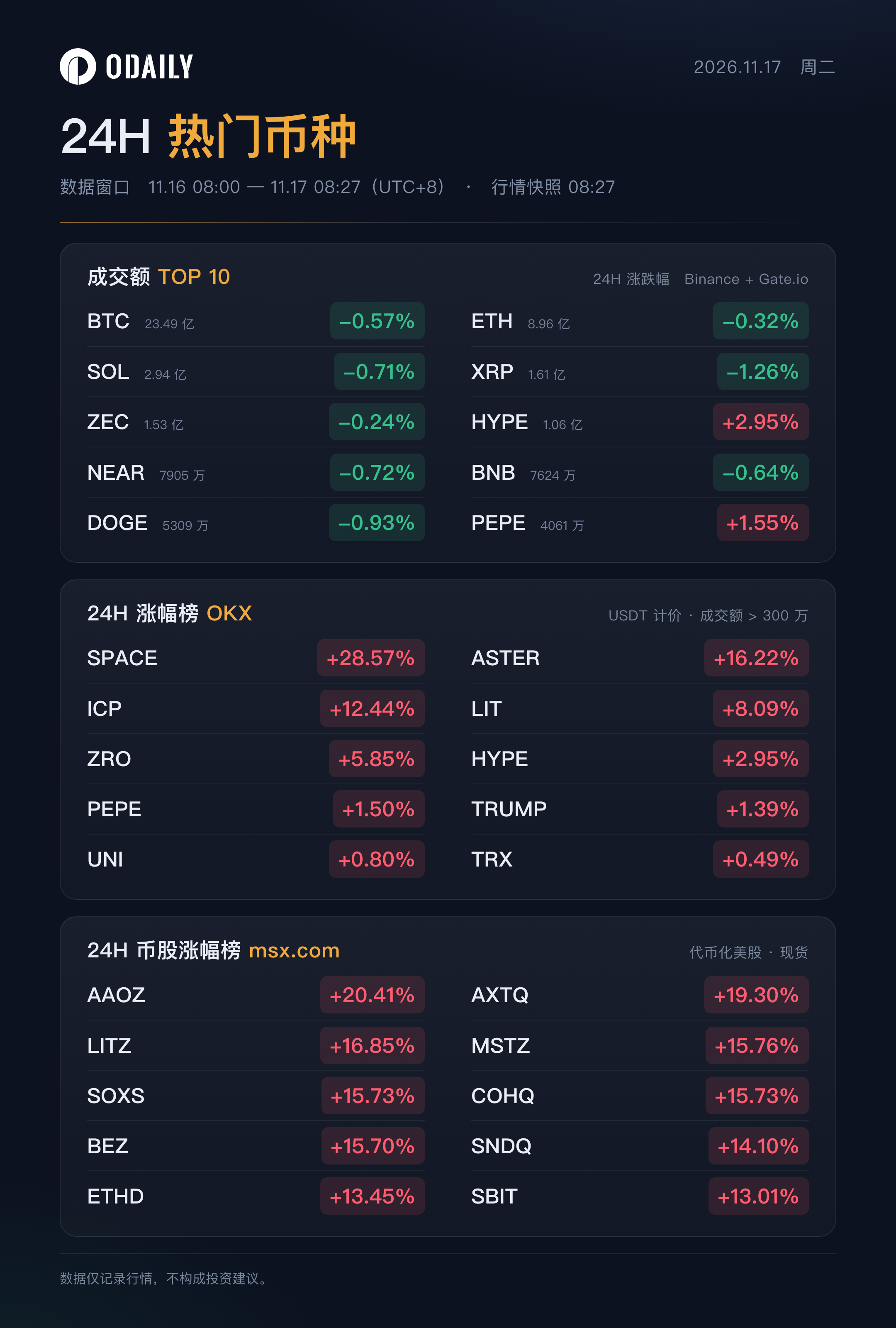
CEX Transaction Volume Top 10 and 24-Hour Price Changes:
- BTC: -0.57%
- ETH: -0.32%
- SOL: -0.71%
- XRP: -1.26%
- ZEC: -0.24%
- HYPE: +2.95%
- NEAR: -0.72%
- BNB: -0.64%
- DOGE: -0.93%
- PEPE: +1.55%
24-Hour Price Increase Rankings (Data source: OKX):
- SPACE: +28.57%
- ASTER: +16.22%
- ICP: +12.44%
- LIT: +8.09%
- ZRO: +5.85%
- HYPE: +2.95%
- PEPE: +1.50%
- TRUMP: +1.39%
- UNI: +0.80%
- TRX: +0.49%
24-Hour Coin Stock Price Increase Rankings (Data source: msx.com):
- AAOZ: +20.41%
- AXTQ: +19.30%
- LITZ: +16.85%
- MSTZ: +15.76%
- SOXS: +15.73%
- COHQ: +15.73%
- BEZ: +15.70%
- SNDQ: +14.10%
- ETHD: +13.45%
- SBIT: +13.01%
Headlines
Over 160,000 People Sign Petition for Jensen Huang's Return to NVIDIA
The petition requesting the NVIDIA board to restore Jensen Huang's CEO position has garnered over 160,000 signatures, with Elon Musk stating he would also sign it. Y Combinator CEO Garry Tan also signed the petition; over 7,500 signers claim to be NVIDIA employees, although this identity has not been verified, representing about 18% of the company's total workforce. NVIDIA's two major shareholders, Brad Gerstner and Gavin Baker, have written to the board, suggesting all options be kept open including Jensen Huang's return. U.S. Treasury Secretary Scott Bessent advocates for NVIDIA to look externally for a new CEO and hopes the board and external legal advisors will respond within the next 10 days. The NVIDIA board has reached out to Arm CEO Rene Haas as a potential successor. A NVIDIA spokesperson stated the company is selecting a CEO search firm and has not yet formally contacted any potential candidates. (Decrypt)
About 5 Million USDC Returned, Lighter Resumes Withdrawals and Explains Security Incident
According to monitoring by Lighter, on November 16, Lighter issued a security incident explanation stating that at 11:00 UTC on November 16, a trader's API key was compromised by an attacker, resulting in funds being withdrawn. The Lighter protocol, smart contracts, and infrastructure were unaffected. The affected account did not use the official Lighter SDK but instead used unsafe signed code; this code reused the signature nonce, allowing the attacker to deduce the private key based on public data. After the incident, the Guardian mechanism of Lighter's smart contract was triggered abnormally, and withdrawals were temporarily suspended. The Lighter Security Committee used this opportunity to return about 5 million USDC to the affected trader, and withdrawals have now resumed.
Industry News
On-chain analyst Yu Jin published an analysis on the recent crypto market downturn, stating that this round of decline was not caused by a single negative event, but due to Treasury companies and institutions increasing spot selling, continuous outflow of BTC spot ETF funds, and multiple factors including high open interest (OI) in market contracts and low trading activity. Yu Jin pointed out that MARA has sold 40,581 BTC this year, valued at approximately $3.02 billion; over the past two weeks, net outflows from BTC spot ETFs have reached about $3 billion, resulting in approximately $300 million in selling pressure on average every business day. With insufficient market trading volume and liquidity and high OI, spot selling further triggered contract liquidations, exacerbating price declines. This downturn was further accelerated after a whale with over $500 million in long positions on Hyperliquid was liquidated on November 12, causing BTC to drop from $80,000 to $62,000 within 10 days. Yu Jin believes this decline primarily results from the interaction of insufficient market liquidity and institutional selling pressure, with no single market participant capable of independently driving BTC price trends.
The AI infrastructure investment boom has shown new signs of cooling; semiconductor research institution SemiAnalysis has significantly downgraded future forecasts for AI accelerator shipments, capital expenditures, HBM demand, and power requirements in its latest model update. Notably, adjustments for 2028 to 2030 are particularly significant: global AI accelerator capital expenditure forecasts for 2028 have been lowered by 28%, with reductions of 41% and 40% for 2029 and 2030, respectively. According to the latest model, global AI accelerator capital expenditures are expected to drop from the previously forecasted $1.531 trillion to $923 billion by 2030, a decrease of $608 billion. Meanwhile, cumulative forecasts for accelerator logic chip shipment area from 2026 to 2030 have been downgraded by 17%.
As Bitcoin has recently declined, the options market on Deribit has seen the highest value open interest shift from $100,000 call options to $60,000 put options, with the latter's open interest now representing about $900 million, slightly higher than the $867 million for the $100,000 call options. The 30-day implied volatility index (BVIV) for Bitcoin peaked at 57.13 on Sunday, the highest level since June, before retreating to 44, indicating a slight easing of market tension. (CoinDesk)
Project News
Backpack Approved by US CFTC to Establish First Blockchain Derivatives Exchange in the US
Backpack has announced that it has received approval from the U.S. Commodity Futures Trading Commission (CFTC) to obtain the necessary qualifications for a designated contract market (DCM) and derivatives clearing organization (DCO), planning to establish the first blockchain-based derivatives exchange in the U.S. According to the announcement, the approved operations include cryptocurrency perpetual contracts, support for leverage trading, crypto asset and fiat collateral, cross-margining, and 24/7 trading, allowing U.S. users to access global liquidity through a unified order book. Backpack US President Mark Wetjen stated that this approval will promote the inclusion of blockchain financial infrastructure into the U.S. regulatory framework and help move price discovery from offshore non-regulatory platforms to the U.S. Backpack CEO Armani Ferrante emphasized that the company has adhered to local regulatory requirements from the outset when entering Asian, EU, UAE, and U.S. markets.
Solana Network Bids Farewell to Mainnet Beta, Uniformly Activates Solana 1.0 Protocol Version
The Solana Foundation announced that the Solana network will transition from Mainnet Beta to Mainnet and uniformly activate the Solana 1.0 protocol version. This adjustment is being advanced by the Solana Foundation in collaboration with the Anza and Firedancer teams, without involving a replacement of the underlying network; ordinary users do not need to take action, and SOL, accounts, assets, applications, and transaction history will remain unaffected. The foundation stated that Alpenglow has been activated on the mainnet, reducing transaction final confirmation time to about 150 milliseconds; the gradual deployment of Firedancer helps enhance client diversity. The release of the protocol version does not imply that related functions will be activated immediately, as developers, validators, and RPC operators still need to adhere to compatibility versions and upgrade guidelines of each client.
Kava Chain officials disclosed that a security incident occurred on HARD Lend on November 14, where about 53.9 million KAVA were stolen. The attacker exploited a lending account calculation vulnerability, artificially inflating the value of BUSD collateral, and withdrew KAVA from the lending pool through repeated borrowing and liquidation. Approximately 49.2 million of the stolen KAVA have crossed to the BNB Chain via LayerZero. Kava stated that this incident only affected the decentralized lending application HARD Lend on the Kava Chain and did not impact the underlying security of the Kava Chain nor did it create new KAVA tokens, with user deposits largely unaffected overall.
Kamino announced three product launches at Solana Breakpoint 2026: a completely rebuilt Kamino application, the trading execution algorithm Kamino ONE, and the automated investment platform Kamino Omni for institutions. The new applications are now live with over 200 performance improvements; a new Assets Hub has been added to discover and purchase over 100 real-world assets.
Investments and Financing
AI CRM Company Dreamteam Secures $53 Million Financing, Led by Accel
AI startup Dreamteam AI Inc. has completed $53 million in financing, led by Accel, with participation from Premji Invest and Together Fund among other institutions. The company plans to utilize this funding to expand its AI client relationship management (CRM) platform business, challenging traditional CRM vendors such as Salesforce, SAP, and HubSpot. Dreamteam was founded in 2025 and is headquartered in San Francisco, with its core product using AI agents to analyze customer dialogues, emails, and meeting contents, identifying customer purchasing intentions, competitor dynamics, and potential transaction risks, while automatically advancing the sales process. The platform is equipped with four different functional AI agents responsible for meeting preparation, following up on commitments, identifying risks, and pushing transactions. Currently, the company has several hundred business clients in sectors such as healthcare, manufacturing, and consulting three months after launching its product beta.
AMD announced it has completed the acquisition of World Labs. World Labs was co-founded by researcher Fei-Fei Li in the field of artificial intelligence, focusing on developing AI models capable of creating and simulating interactive 3D environments, as well as robotics learning and simulation technologies. Fei-Fei Li will join AMD as Executive Vice President and Chief Scientist, reporting directly to AMD Chair and CEO Lisa Su. AMD stated that the World Labs team will continue to advance foundational model research and collaborate with AMD engineers to apply model capability research outcomes to the development of future AI infrastructure to support customers and developers in the open AI ecosystem.
Tether Capital Invests $15 Million in Nomad to Expand Dollar Financial Services in Brazil
Tether Capital announced on November 16 that it is making a strategic investment of $15 million in Brazilian fintech company Nomad. Nomad provides USD accounts, international payment, and global investment services. (Tether News)
Regulatory Trends
Four U.S. Democratic Senators Question SEC's Tokenized Securities Exemption Regulation
U.S. Democratic Senators Angela Alsobrooks, Ruben Gallego, Mark Warner, and Catherine Cortez Masto wrote to SEC Chair Paul Atkins, highlighting regulatory loopholes in anti-money laundering regarding the five-year tokenized securities innovation exemption introduced by the SEC in September this year. This exemption allows eligible tokenized securities trading venues to operate without registering as exchanges but fails to clarify how customer identity verification and anti-money laundering requirements apply to such transactions or whether platforms need to restrict token recipients. The four senators warned that certified investors purchasing tokenized stocks might transfer them to unverified wallets, including those held by foreign individuals or participants in illegal activities.
U.S. Strategic Bitcoin Reserve Cannot Purchase Bitcoin in Open Market Without Congressional Approval
Bitcoin News reported on X platform that former White House crypto advisor Patrick Witt stated that without congressional approval, the U.S. strategic Bitcoin reserve cannot purchase Bitcoin in the open market. An additional clause in the National Defense Authorization Act requires that such purchases must receive explicit approval from Congress. This reserve was established in March 2025 under Executive Order No. 14233, holding seized Bitcoin, estimated to number between 200,000 and 328,000, without having made purchases yet. H.R. 8957 was considered by the House Financial Services Committee in September, but it was related to custody and a 20-year holding period, not purchases; without relevant legislation, the next president could potentially revoke the reserve by signing an executive order.
Hong Kong plans to submit a bill by the end of the year that will include digital asset trading, investment advice, asset management, and custody services under licensing regulations. Regarding stablecoins, two out of the initial 36 applicants already received licenses in April and launched Hong Kong Dollar stablecoins. The scale of tokenized funds publicly issued in Hong Kong has increased by approximately 7 times in a year; additionally, two tokenized money market funds have been providing round-the-clock trading on licensed platforms since last month. Finance Secretary Paul Chan stated that decentralization does not equate to avoiding responsibility.
California voters have passed Proposition 42, prohibiting new taxes on personal property such as 401(k) retirement accounts, business equities, digital assets, intellectual property, and personal belongings, excluding real estate. The Associated Press announced Friday that this proposition passed, with approximately 96% of ballots counted, showing slightly over 51% in favor and nearly 49% against. The proposition also prohibits retroactive tax levies, except in situations where the state government declares an emergency. Proposition 42 was originally listed alongside Proposition 40 as a "poison pill" clause aimed at blocking the proposed one-time wealth tax for billionaires in Proposition 40. Ultimately, Proposition 40 was rejected by voters, while Proposition 42 passed. This means that any future taxation on personal assets would need voters' approval to overturn Proposition 42. (Los Angeles Times)
Voices of Figures
Vitalik Buterin explained the design reasons for Ethereum proposal EIP-8037 and its implications for application developers in a recent post. He stated that scaling Ethereum's execution computation capabilities is relatively easy, but scaling the state size is more challenging; increasing the Gas limit alone could lead to significant state size inflation, increasing the burden of node storage, synchronization, and execution. EIP-8037 aligns resource pricing with the network's actual burden by increasing the Gas cost for operations like creating new accounts, storage slots, and contracts, making it a more realistic option balancing scalability and decentralized security. Vitalik pointed out that this proposal may still affect some existing applications, especially contracts that rely on hard-coded Gas limits or specific calling parameters. Rather than making additional modifications to the protocol layer that may introduce new risks, collaborating with application developers to identify and resolve compatibility issues before deployment of the Glamsterdam upgrade is currently more important. He also urged developers to not regard the Gas mechanism as a fixed rule and called for core developers to clearly outline protocol characteristics that may change in the future to reduce unexpected impacts from subsequent upgrades.
Jiang Zhuoer updated his short-term market outlook, stating that short covering has now ended, and futures positions are no longer decreasing. However, since BTC peaked at $66,000, the cumulative transaction volume difference (CVD) between spot and futures has shown continued active selling, and the market remains in a weak downtrend. The only relatively positive sign is that the funding rate is now close to 0, indicating weak market bullish sentiment. If new capital enters, the market may see an upturn. He noted that attention should be paid to market performance after the U.S. stock market opens, to observe whether any new capital variables emerge; if not, the market is expected to continue its downward and volatile trend.
On the afternoon of November 16, renowned investor Duan Yongping expressed via social media, "I am very interested to see if this company can ultimately emerge from this crisis, so I do not want to rush to escape." In commenting on another user's article about whether he would sell, Duan Yongping believed that there is not enough evidence to make a conclusion at this time. He stated that NVIDIA's "moat" remains very strong with high demand, and he does not want to simply give up. Regarding the potential return of Huang Renxun to NVIDIA, Duan Yongping expressed on the same day: "I am not certain about this matter, but I think it is not zero probability." (China Fund News)
免责声明:本文章仅代表作者个人观点,不代表本平台的立场和观点。本文章仅供信息分享,不构成对任何人的任何投资建议。用户与作者之间的任何争议,与本平台无关。如网页中刊载的文章或图片涉及侵权,请提供相关的权利证明和身份证明发送邮件到[email protected],本平台相关工作人员将会进行核查。