The Week that the AI Market Truly Enters "Price Verification"
In the past few months, the logic that has most easily gained market recognition for AI trading is "demand is still there." As long as cloud vendors continue to expand capital expenditures, GPU orders keep growing, and AI applications seek commercialization paths, the market is willing to assign higher valuations for long-term growth.
However, after entering November, the trading environment began to change.
NVIDIA dropped 12.75% last week, retracting 31.9% from the peak on October 6, with a market capitalization shrinkage of about $1.84 trillion; Bitcoin fell below $64,000, retreating more than 20% from the late October high; gold fell below $3,900; the dollar index rose to around 103.28, and the 10-year U.S. Treasury yield briefly surpassed 5.1% (NVIDIA's one-year performance is shown in Figure 1).
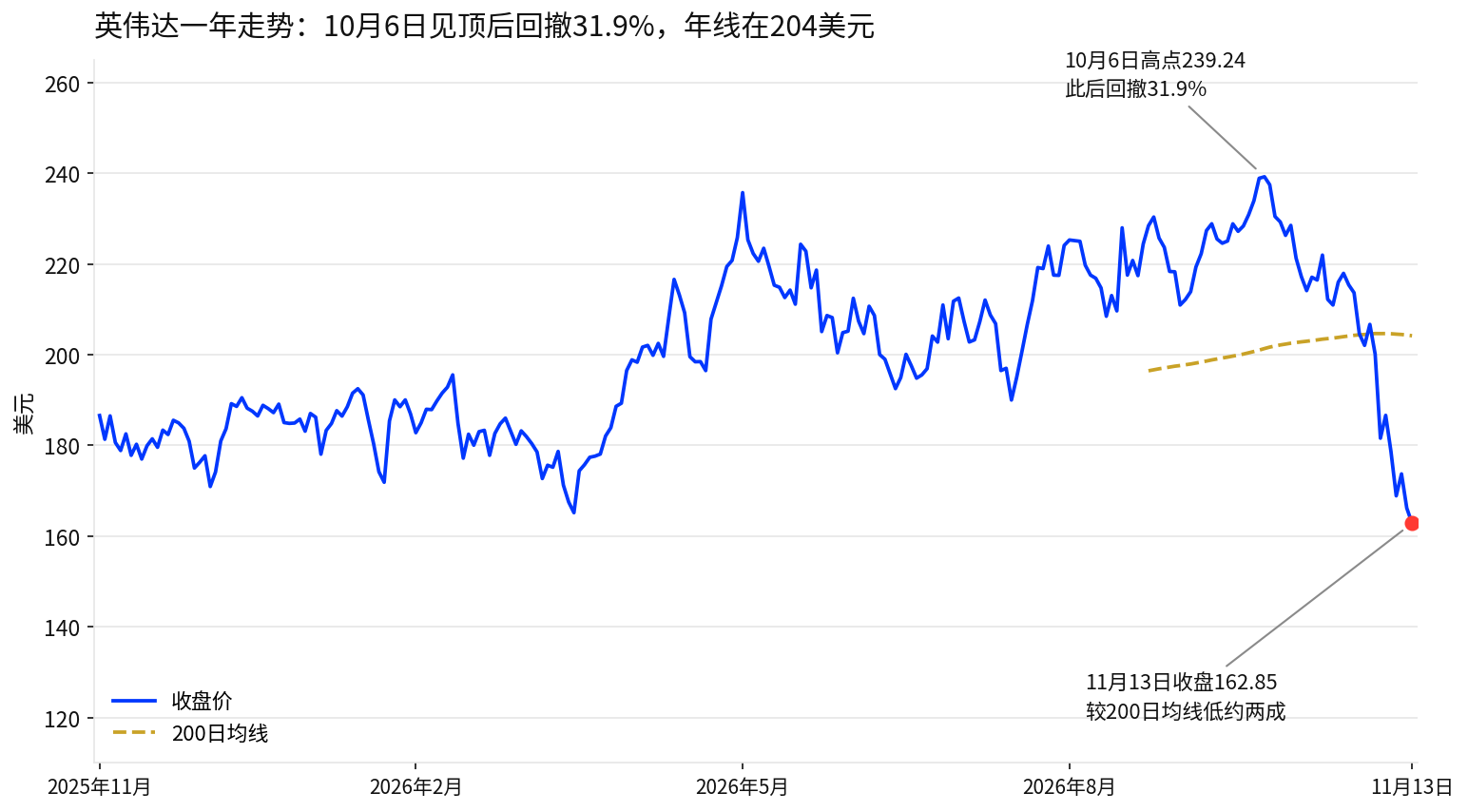
These price changes cannot simply be understood as "AI demand suddenly disappearing" or "safe-haven assets failing." More importantly, the market is recalculating a certain equation: when interest rates become the cost of capital again, how quickly do AI assets need to realize profits to sustain their previous valuations?
Therefore, this week's NVIDIA earnings report, Anthropic IPO, and the Federal Reserve minutes correspond precisely to the three parts of this equation: NVIDIA looks at the numerator, Anthropic looks at valuation, and the Federal Reserve looks at the denominator (the calendar for these three events is shown in Figure 2).
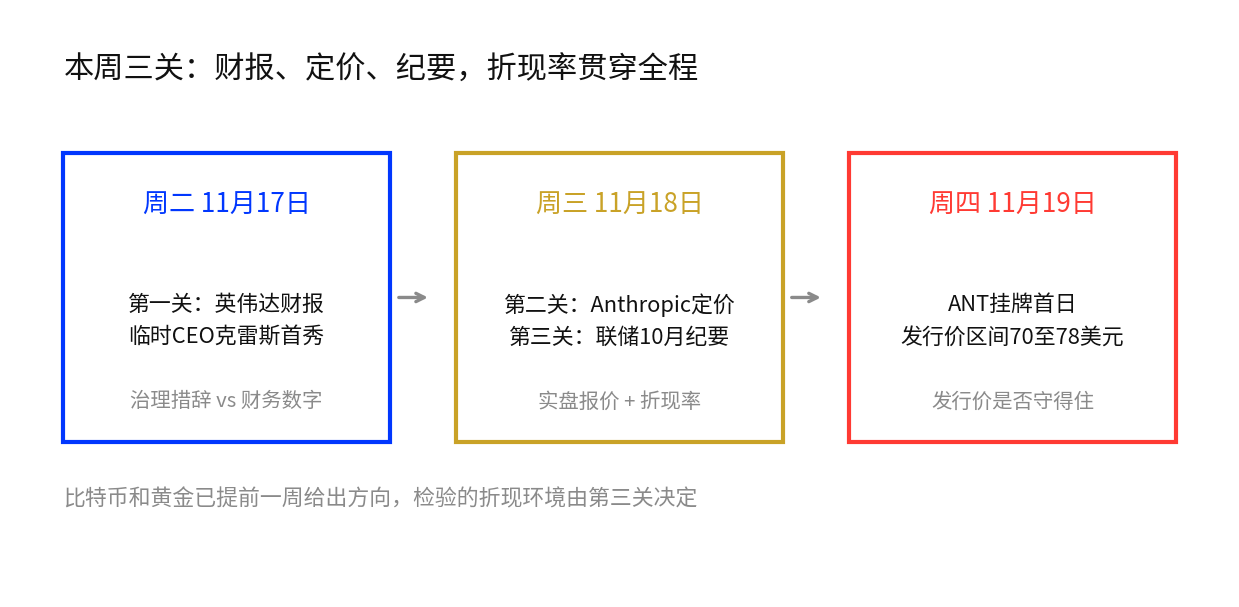
If all three develop favorably, AI assets may welcome a round of valuation repair; if only performance grows, but the interest rate and valuation environment continues to deteriorate, then "good performance but stagnant stock price" may become a more common trading scenario.
1. NVIDIA Earnings Report: The Market is No Longer Satisfied with "AI Demand is Still There"
On Tuesday after the U.S. stock market closes, NVIDIA will release its third-quarter earnings report for fiscal year 2027. After a rapid decline in the past week, the importance of this earnings report has exceeded that of an ordinary quarterly performance disclosure.
The market expects revenues of about $109 billion, a year-on-year increase of about 90%. According to media reports, Goldman Sachs' forecast of NVIDIA's earnings per share for the 2027 calendar year corresponds to a forward price-to-earnings ratio of about 9.6 times at the current stock price, significantly lower than its forward valuation central tendency over the past five years (see Figure 3).
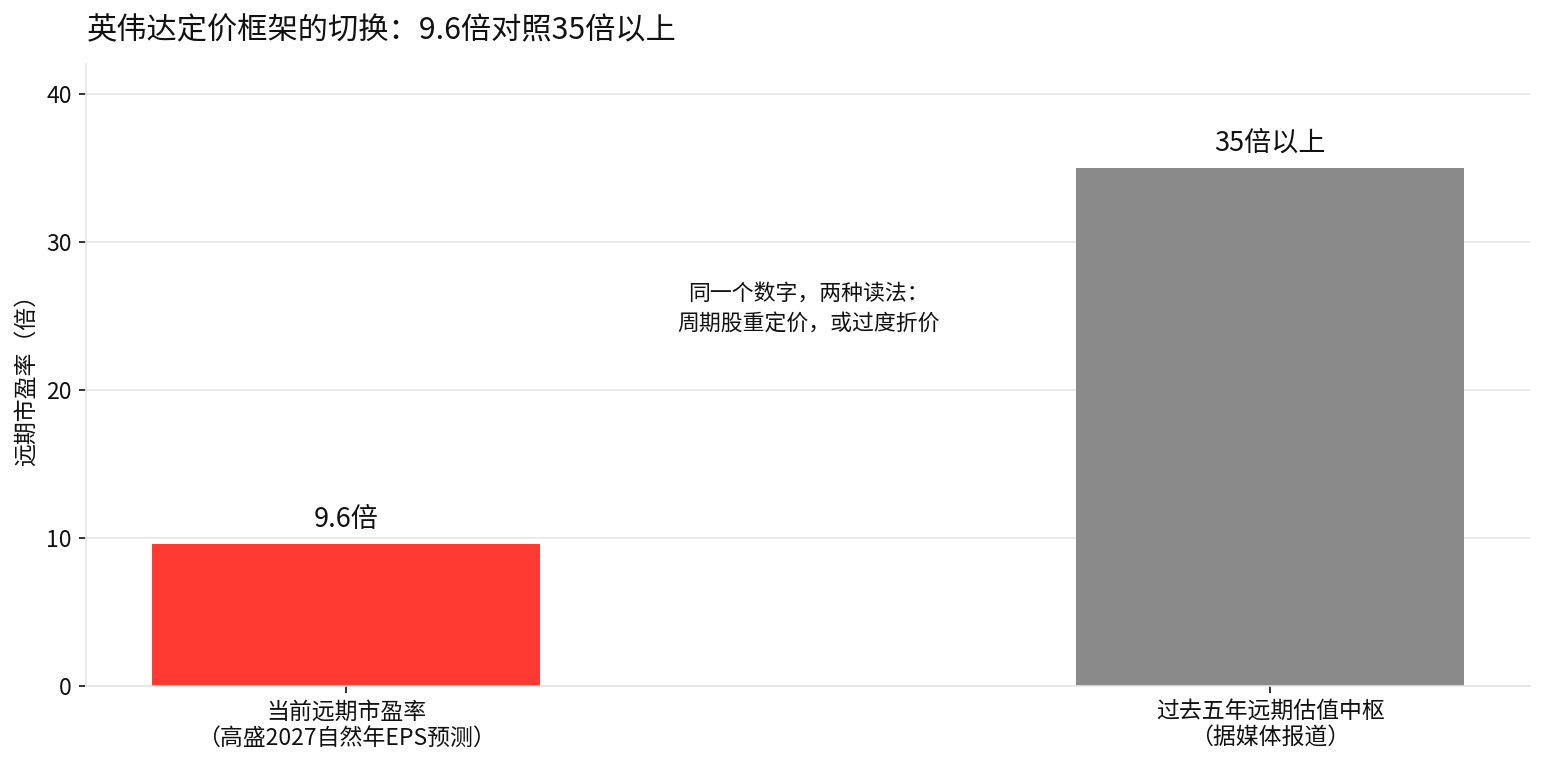
This means that the market's pricing logic for NVIDIA is changing: the issue is no longer just "Is there demand for AI?", but rather how long this demand can sustain the current profit levels.
Some believe that if profit growth continues to remain high, a 9.6 times forward price-to-earnings ratio means that the market may have preemptively accounted for a considerable portion of cyclical risks; however, if the market begins to worry that AI capital expenditures are entering a high base phase, then even if profits continue to grow, the valuation center may continue to shift downwards. Goldman Sachs has also offered another interpretation of the same 9.6 times: in their report, they likened it to Apple after Jobs's passing, suggesting that the current risk-return profile is "quite attractive." The two interpretations will collide head-on on Tuesday night.
Therefore, what is most worth watching in this earnings report is not a single revenue figure, but whether the orders, customer capital expenditures, product roadmap, and management's statements about the upcoming quarters mutually reinforce each other. If financial data continues to be strong, while management confirms that customer demand and computing power expansion still have high visibility, then the prior valuation compression may see a repair; conversely, if performance meets expectations, but there is a slowdown in order growth, increased customer concentration risk, or cautious future guidance, the market may continue to price it as a "cyclical stock" rather than a "high-growth tech stock."
Why have governance factors suddenly become important? In previous AI market trends, NVIDIA enjoyed not only profit growth but also a long-term credit premium from its founder and management team regarding technology direction, product iteration, and customer ecosystem. A governance change does not inherently signify business deterioration, but it raises the market's demands for strategic continuity.
Thus, what is truly worth monitoring during the conference call is: succession planning, computing power expansion strategy, customer commitments, and whether there are any changes in product direction that would necessitate a repricing. More notable is that a new catalyst for governance variables has suddenly emerged over the weekend. According to a Financial Times report on November 15, Jensen Huang is discussing the possibility of returning to the CEO position with confidants, and his Silicon Valley allies are pushing the board to consider his comeback; figures like Elon Musk have publicly supported the related petition. However, this is not a certainty, as U.S. Treasury Secretary Janet Yellen has publicly advocated for NVIDIA to seek a new CEO externally, and the board's investigation and succession process regarding the issue is still underway.
This has added an unexpected variable that the market did not anticipate for Tuesday's earnings report: If performance continues to be strong and the likelihood of Huang's return increases, the market may trade both "AI demand has not cooled" and "governance discount may recover"; conversely, if the earnings report falls short of expectations, or the return gamble further exacerbates governance uncertainty, a low valuation may not immediately translate into stock price support. Therefore, what is truly worth watching on Tuesday is not just how much NVIDIA made but whether performance, management expressions, and governance progress all provide positive signals simultaneously.
2. Anthropic IPO: AI's Trillion-Dollar Valuation Must Face Secondary Market Testing for the First Time
If NVIDIA's earnings report tests the "profit end" of the AI industry chain, Anthropic's IPO tests the furthest "valuation end" of AI assets. According to disclosures, Anthropic's issuing price range is $70 to $78, proposing to issue 825 million shares, which, based on the upper limit of the range, corresponds to a fully diluted valuation of approximately $1.405 trillion, listing on the NASDAQ on November 19.
The truly noteworthy aspect of this number is not just the words "trillion dollars," but that a cutting-edge AI laboratory will directly hand over the high valuation formed in the primary market to the public market for daily repricing for the first time.
Prior to this, AI companies' valuations were mainly determined by primary market investors. Investors could accept longer commercialization cycles and could justify high valuations through strategic value, technological barriers, or future market potential; after the IPO, this pricing system must face daily trading public prices.
This will generate a very important market signal: If Anthropic can successfully complete its issuance at a price close to the upper range and maintain the price after listing, it indicates that the public market is still willing to pay a high premium for AI's long-term growth; if the final pricing is significantly conservative or quickly falls below the issuing price post-listing, it may mean that the valuation gap between the primary and secondary markets is being reopened.
It is particularly noteworthy that Anthropic is not facing a low-interest environment. When the 10-year U.S. Treasury yield approaches or surpasses 5%, investors are effectively betting on two things when they pay $1.4 trillion for an AI company still in a high-investment phase: that future revenue growth will be sufficiently rapid, and that interest rates will not remain high enough to compress future valuations for the long term.
This is why Anthropic's IPO cannot be viewed in isolation. It is both a company going public and a public vote on the entire valuation system of the primary AI market.
3. Federal Reserve Minutes: AI Assets Face More Expensive Capital
If NVIDIA represents the "profit numerator," and Anthropic represents "valuation," then the Federal Reserve minutes determine the "denominator" that both face.
As of November 13, market pricing indicated an approximately 85% probability for a 25 basis point rate hike in December and about 15% for a 50 basis point hike; by November 14, CME tools showed that the 25 basis point probability briefly exceeded 95%. Meanwhile, the core CPI for October increased by 0.3% month-on-month, the PPI rose by 6.5% year-on-year, the dollar index touched 103.28, and the 10-year U.S. Treasury yield briefly rose to around 5.1% (rate hike pricing is seen in Figure 4).
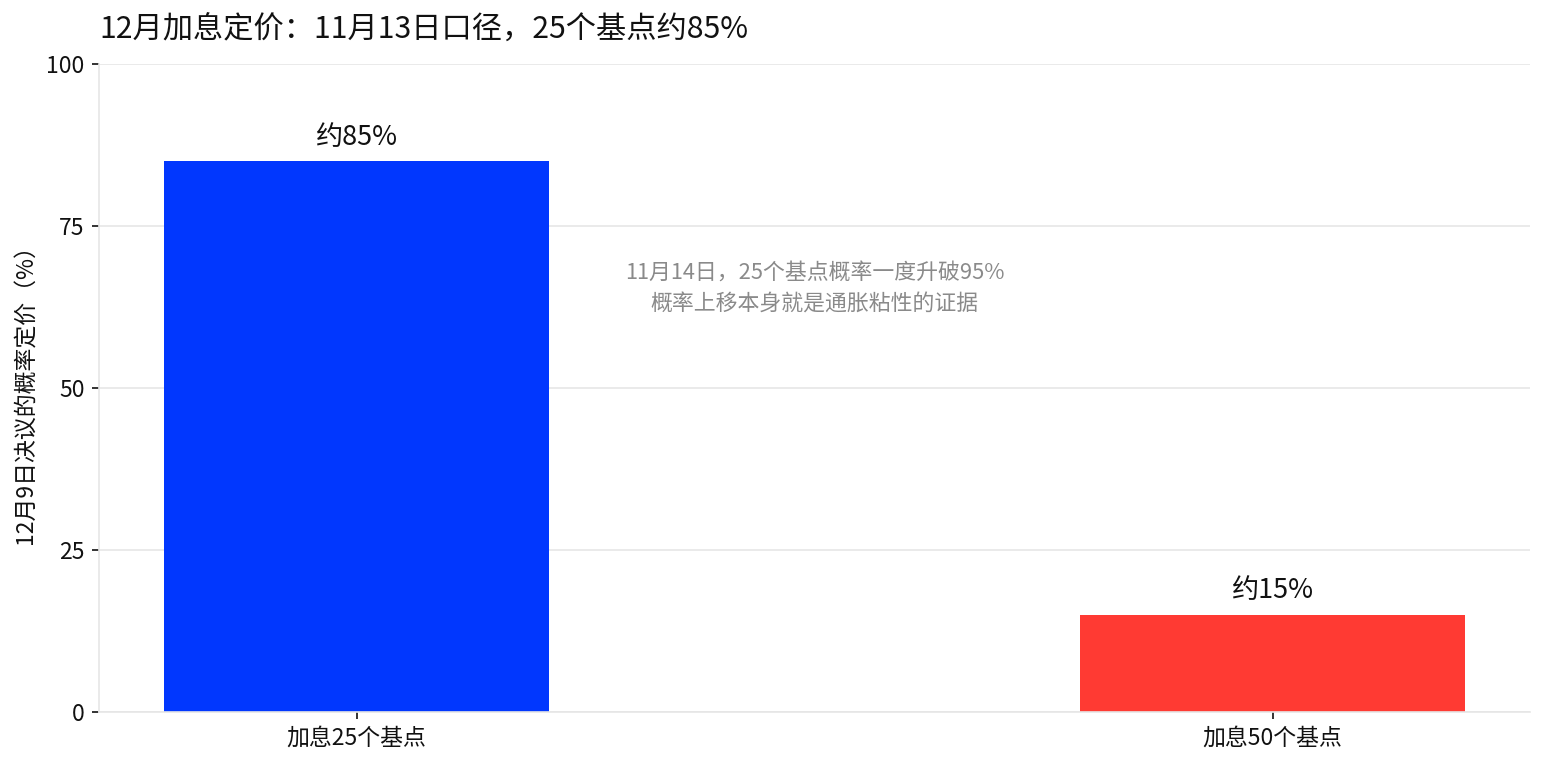
Therefore, what the market genuinely needs to seek from this week’s minutes is not a simple “to hike or not to hike.” More importantly, does the Federal Reserve believe that the current inflation environment requires rates to remain high for a longer time, and how tolerant is the committee towards further tightening of policy?
This is particularly crucial for AI assets. Much of the value of AI companies derives from revenue and profits expected in the coming years. If the risk-free rate continues to rise, the present value of future cash flows will naturally decrease. Hence, a seemingly anomalous but actually very typical market phenomenon can occur: a company's performance continues to grow, but the stock price may not rise. The reason is not that the market is denying the company's business, but rather that investors are demanding higher returns.
This is the key to the current AI trading switch from "looking at growth" to "growth multiplied by interest rates." If NVIDIA delivers strong results this week, while the Federal Reserve simultaneously releases hawkish signals, the market will face a typical divergence: strong AI demand, but high capital costs. What will truly determine the stock price is which of the two changes faster.
4. BTC and Gold Have Already Dropped: The Market is Repricing High Rates
Prior to the emergence of the three major events this week, Bitcoin and gold provided answers to the market ahead of time.
Bitcoin fell below $64,000, retreating more than 20% from the late October high; gold fell below $3,900; and the dollar index rose to around 103.28. Meanwhile, the yield on the 10-year U.S. Treasury stood above 5% (the weekly performance of these three markets is shown in Figure 5).
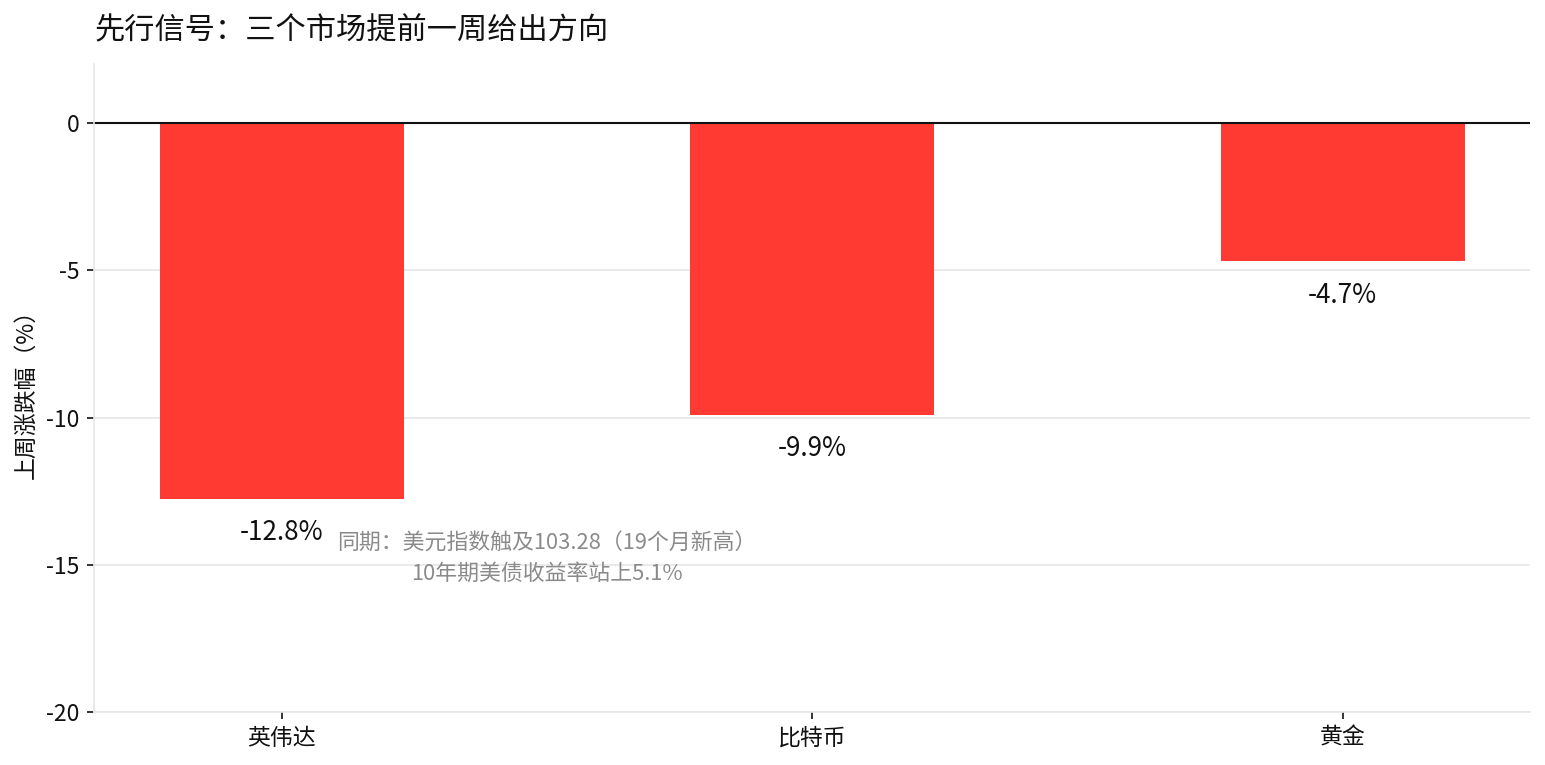
Looking at the movements of these asset classes together is more meaningful than examining any single price. Bitcoin, as a high-beta risk asset, often faces the earliest impacts during liquidity tightening and deleveraging phases; although gold has safe-haven properties, when both real interest rates and the dollar strengthen at the same time, the holding costs of a non-yielding asset will also rise.
Thus, the drop in gold does not mean the market has suddenly lost its safe-haven demand, nor does Bitcoin's drop necessarily indicate that the long-term logic of crypto assets has changed. A more direct explanation is that as capital begins to reassign importance to risk-free returns, the prices the market is willing to pay for high-risk, long-duration assets will naturally decrease.
This is also the context that AI trading needs to pay special attention to this week. If U.S. Treasury yields remain high while BTC and gold continue to be under pressure, then even if NVIDIA's earnings report exceeds expectations, the valuation repair space for AI assets may still be limited. Conversely, if interest rate expectations ease, the dollar retreats, and both NVIDIA and Anthropic provide strong fundamental signals, AI assets may welcome a more comprehensive "numerator improvement with denominator easing."
5. Retail, Chinese Concepts, and Second-tier Chips: Don’t Just Focus on NVIDIA
This week, several groups of earnings reports are also worth observing on the same map. Retail companies such as Walmart, Home Depot, Target, Ross Stores, and Disney will successively disclose their performances. They provide another macro evidence: can American consumers continue to withstand a high-rate environment? If consumption remains strong, inflation and economic resilience will be more difficult to rapidly cool, providing more justification for the Federal Reserve to maintain high rates; if consumption clearly cools, the market may reconsider rate cut expectations. For AI assets, this line is not direct, but it will influence valuations through interest rates and the dollar.
For Chinese concept stocks, the earnings reports from Alibaba, Baidu, Pinduoduo, Tencent Music, and others should focus on profit margins and future guidance rather than just chasing revenue growth. After previous valuation repairs, the market now needs to see whether growth can convert into profits and whether profits can further convert into cash flow.
Second-tier AI chips are likewise worth attention. Cerebras reported a 272% year-over-year growth in cloud business revenue for the third quarter, with an upward revision for the full year guidance, but hardware revenue fell nearly 30% year-on-year. This combination is very interesting: on one hand, cloud AI demand remains strong; on the other hand, the spread of demand across different computing power suppliers is not balanced. Therefore, the earnings reports from companies like Cerebras should not simply be interpreted as "NVIDIA competitors rising," but better suited as auxiliary indicators: whether AI computing demand continues to spread and whether growth is beginning to transfer from a single GPU supplier to a broader infrastructure ecosystem.
6. This Week, What's Really Worth Watching is Not a Single Number, But Whether Three Groups of Signals Resonate
At this stage, the market is no longer lacking the story of "AI demand is large," nor is it short of discussions on "AI valuations are high." What truly holds market value is whether several key variables are changing in the same direction simultaneously.
The NVIDIA earnings report looks at demand and profit. If revenues, orders, customer capital expenditures, product roadmap, and guidance for the next quarter remain strong, it indicates that the AI investment cycle has not significantly stalled; if performance grows but future guidance weakens, then caution should be exercised as the market may shift from "insufficient growth" further towards "growth peaking."
The Anthropic IPO assesses valuation tolerance. Pricing close to the upper limit and maintaining strength post-listing is a signal of public market recognition of high AI valuation; a significant discount or drop below the issue price post-listing means that primary market valuations need to realign with secondary market valuations.
The Federal Reserve minutes and the 10-year U.S. Treasury yield look at discount rates. If inflation and interest hike expectations keep pushing long-end yields higher, then even if the fundamentals of AI assets do not deteriorate, they could still face valuation compression; if long-end yields retreat, there is space for the previously compressed growth stock valuations to recover.
Thus, what truly deserves attention is not a single event but the combination of the three: strong performance, strong IPO, and relaxing yields form a relatively favorable combination for AI assets; strong performance but rising yields are more likely to evolve into a structural market; if weak performance, weak IPO, and rising yields occur simultaneously, then the pressure faced by high-valuation AI assets will truly escalate. If any variable contradicts the aforementioned direction, the corresponding judgments need to be revised.
In Conclusion: AI Has Not Restarted; the Market Has Just Begun to Require It to Prove Itself
This week, what is truly important is not whether NVIDIA can continue to tell a bigger AI story, nor whether Anthropic can go public at a $1.4 trillion valuation.
The market is entering a more realistic phase: AI demand must be realized through profits, AI valuation must accept public market quotes, and future profits must be discounted at higher interest rates.
NVIDIA needs to prove that computing power demand can still support high growth; Anthropic needs to prove that trillion-dollar-level AI valuations can be accepted by the secondary market; the Federal Reserve decides how high the capital cost that this growth story needs to face.
BTC and gold have already told the market that capital is re-emphasizing interest rates and the dollar.
Therefore, what is truly worth observing this week is not "Is the AI bull market over?" but rather a more specific question: in an environment where the 10-year U.S. Treasury yield stands above 5%, how fast can AI companies realize profit growth to offset the higher valuation discount rate?
The answer to this question could be more important than any single company's quarterly revenue figure.
Disclaimer:
This content is for general information and market commentary only, compiled from publicly available data as of the time referenced in the text. Related market data, expectations, and probabilities may change with market conditions. The views and investment strategies cited from third-party institutions, analysts, or other individuals represent the opinions of the relevant parties at a specific time and do not represent BIT's views or recommendations. This document does not constitute investment advice, investment research, solicitation, or endorsement of any security, investment product, or trading strategy, nor should it be the basis for any investment decision. Financial markets involve risk; the prices of securities and market performances may fluctuate, and past performance and historical market trends do not represent or guarantee future results. Investors should independently assess relevant risks based on their own situations and seek professional advice when needed.
免责声明:本文章仅代表作者个人观点,不代表本平台的立场和观点。本文章仅供信息分享,不构成对任何人的任何投资建议。用户与作者之间的任何争议,与本平台无关。如网页中刊载的文章或图片涉及侵权,请提供相关的权利证明和身份证明发送邮件到[email protected],本平台相关工作人员将会进行核查。


