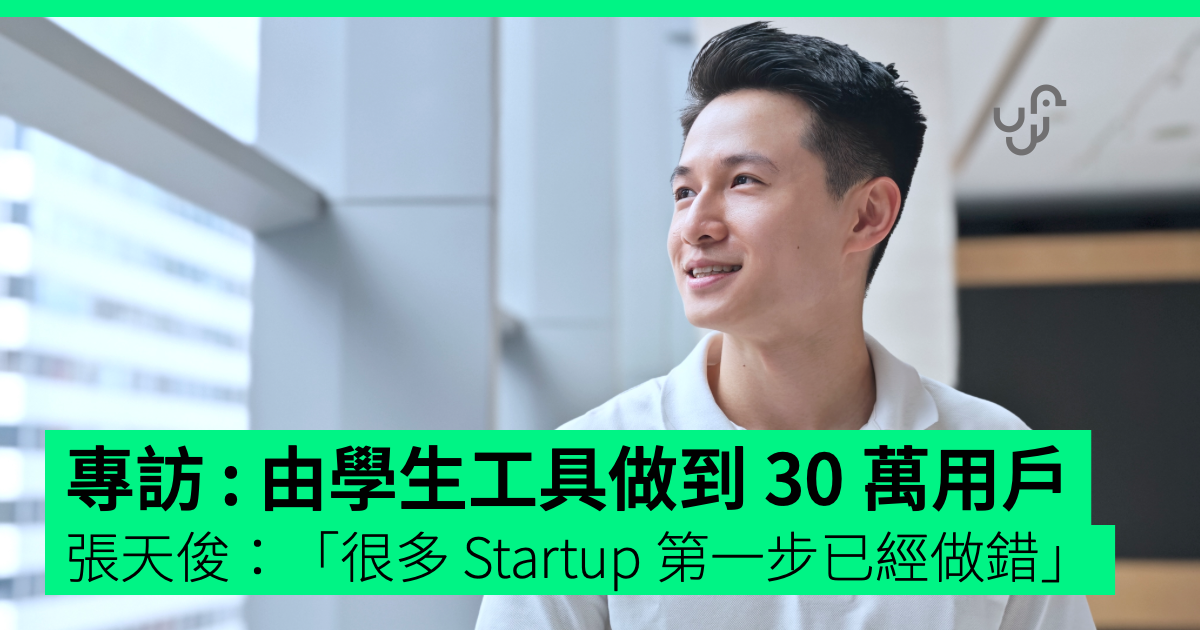

Hong Kong University medical school final year medical student Calvin Cheung, who is also a co-founder of Memo AI. Memo, formerly known as PDF2Anki, can organize PDFs, videos, websites, and notes into flashcards, notes, and quizzes. The official claim is that there are over 300,000 users. On August 16 this year, Calvin Cheung attended Today at Apple "Focus: Cracking the Code of Efficient Learning with Calvin Cheung" at Apple Causeway Bay.
In an interview with unwire, he talked most about how a startup should first find the demand. After Memo became popular, server and token costs increased immediately, forcing the team to start considering charging fees.
Before Memo, there was already IG content channels
After entering medical school, Calvin Cheung began creating content to share his medical school life and study experiences. Before school, he relied on content from seniors to understand medical studies; after enrolling, he passed on his experiences. After doing content for a while, he also frequently communicated with students and parents, which helped him learn where everyone was stuck during their studies.
He faced the same difficulties himself. At that time, manually making flashcards could take two to three hours a day, "and still not study." After the launch of ChatGPT, he and his partner Jason Chan wondered: could this step be handed over to AI?
He described himself as "more marketer instead of technical founder." Many people first ask, "What idea can we create?" and then directly build a product; his approach is to first manage social media and personal branding, understand "what problems 90% of people have," and then go back to creating products.

Creating MVP in two to three weekends proves there is demand
According to Calvin Cheung, the team created the early MVP over two to three weekends and then demonstrated it on the existing channel. The first two videos garnered three to four million views within two weeks, attracting a large influx of users, overwhelming even the servers.
The team could not continuously subsidize token and server expenses, so they introduced free and paid plans. It was not until the first customer actually paid that he felt this endeavor began to transition from a tool to a business.
How many tokens should the free version have? "Actually, we don't know."
Calvin Cheung studied freemium products like Duolingo, but AI products incur computational costs every time content is generated, making it impossible to directly copy the free ratio of other apps.
The team could only keep trying different pricing points, observing how many free users converted to paid, how many left after charging, and then weighing this against AI costs.
Startups must move fast; focus on Apple for mobile version initially
When talking about mobile version development, Calvin Cheung directly stated that startups must "move fast." He believes Apple has more concentrated development documentation, APIs, and device environments; Android has more device sizes and system versions, which would increase workload if tried to accommodate all at once.
The team focused on the Apple platform first. Memo now has a native iOS app, while Android offers a web app.
An email from a visually impaired user reveals issues the team could not see
A visually impaired learner once wrote to express difficulty in creating flashcards one by one. Memo could streamline this part of the process, but the product's assistive features at that time were not well-developed.
After several rounds of communication with the individual, the team understood Apple's screen reading function "VoiceOver," and Calvin Cheung stated they followed up to make improvements. This email also allowed the team to encounter usage scenarios they would not typically experience.
AI is a double-edged sword; average output increases, but disparities may widen
Calvin Cheung described AI as a "double-edged sword": if used well, it can improve learning efficiency; if one merely relies on AI to complete all homework without truly understanding the content, the effect may paradoxically be worse.
He mentioned a study that observed "higher homework scores when using AI for assignments, but lower exam scores." A 2026 CEPR Discussion Paper tracked 26,811 Chinese high school students for 30 months and found that after the adoption of generative AI, homework scores increased by 18%, but closed-book monthly test scores dropped by 20% within six months. The learning loss was mainly concentrated among roughly 80% of users who matched the pattern of letting AI complete their homework, with two authors coming from HKU.
When discussing capability gaps, Calvin Cheung analogized it to Lin Dan receiving better rackets than someone who doesn’t know how to play badminton. He believes that while tools may raise the average level, the existing gaps may actually widen.
He also cited the example of the Hospital Authority's electronic medical records: after documentation was digitized, processing medical records became faster, with the assumption that doctors would have more time to communicate with patients; in reality, demand increased, and doctors remained busy, with "time with patients" not differing much from before.
Regarding what young people should learn, he believes the value of hard skills like coding is being transformed by AI. Instead of just chasing the latest hot skill, it is better to first consider what the future market needs, and then decide what one should learn.
Latest videos
This article is reproduced from unwire.hk, with copyright belonging to the original author and media.
免责声明:本文章仅代表作者个人观点,不代表本平台的立场和观点。本文章仅供信息分享,不构成对任何人的任何投资建议。用户与作者之间的任何争议,与本平台无关。如网页中刊载的文章或图片涉及侵权,请提供相关的权利证明和身份证明发送邮件到[email protected],本平台相关工作人员将会进行核查。


