This article comes from: 3 (@3i)
Compiled by|Odaily Planet Daily (@OdailyChina); Translator|Azuma (@azuma_eth)

First, thanks to CBB (@Cbb0fe) for the inspiration. I learned a lot after reading about his experience in discovering asymmetric opportunities.
- Odaily note: CBB's articles can be referenced in "HyperEVM “Top 1” Arbitrage Team Public Strategy: How to Move Out 5 Million USD in Six Months"; "10 Months Earned 10 Million USD, Arbitrage Master Public New Strategy".
Recently, I received a lot of private messages asking how to find opportunities on-chain. Every time I answered, it was the same content, so I decided to simply write an article that I could send to them in the future.
For most of you, 95% of your earnings may only come from 5% of the time spent on-chain. You should spend the vast majority of the remaining time exploring and nurturing your curiosity. This is a common trait of many top scientists and traders I have encountered.
In the AI era, most advantages in writing code and other underlying details will gradually disappear, while your ability to think abstractly at the system level will yield exponential returns. Once you discover potential asymmetric opportunities, you must show extreme execution ability and resource integration skills, tackling the problems at hand from different angles.
This resource integration ability is largely reflected in the tedious and dirty work. I have been increasing the wallets and infrastructure that need to be tracked, continuously improving my tools, and refining every aspect of the trading process. Over time, these small improvements create a cumulative effect—you can gain an information advantage far beyond that of ordinary people, and a clearer understanding of what is happening in the market, ultimately executing trading signals more efficiently than other market participants.
In the case of cashcat, weeks of preparation gave us enough information advantage, allowing us to complete our layout even before Robinhood's own employees.
cashcat: How to Ambush Before Robinhood's Listing
About a month before Robinhood Chain went live, I saw a coin listing notification, and out of pure curiosity, I wanted to know if anyone had transferred tokens into Robinhood's hot wallet in advance. I found out that the market maker Wintermute had transferred tokens about an hour before the announcement was made. I checked earlier coin listing records and found that it was always the same routine. At that time, I hadn't yet figured out how to exploit this pattern for trading, but it stayed in my mind.
When Vlad (Robinhood CEO) followed cashcat's Twitter, I, like most of you, bought quite a bit. My position was sizeable, and the unrealized profit was also considerable, but it was far from meeting my own expectations. I had bought several percentage points of every coin that Ansem called, hoping for a big result from him, but it all went wrong. However, cashcat seemed to have the potential to become a "generational golden dog," and I wanted to use this to make up for my mistakes on Ansem's called tokens.
The Robinhood listing was obviously the biggest turning point, so I spent several weeks preparing, eager to get ahead of the market. I first studied the coin listing schedule and the public API interface, looking for trading pairs that had appeared before the official launch. However, most of the signals I discovered had very limited lead times. After all, many traders specialized in on-chain sniping (trenching) had already been tracking those coin listing information accounts, which would inherently provide related notifications.
Therefore, I needed to further dissect the information acquisition process behind them. The overall idea was to figure out which institutions Robinhood partnered with for custody and infrastructure. This information is actually publicly available.
This made me pay attention to Wintermute again. On Ethereum, Wintermute provides market making services for various clients, so seeing it prepare to trade a certain token doesn't indicate much; there could be various reasons behind it. However, when Wintermute began deploying infrastructure on Robinhood Chain, there was a clearer direction. So, I created a tracking tool specifically for Robinhood Chain to monitor whether the Wintermute wallet clusters I had previously pinpointed started to become active.
I then discovered that BitGo was also an official partner of Robinhood Chain, responsible for providing custody services. So, I started to track a lot of BitGo's infrastructure and GitHub activity. My partner then prepared a set of bots that would enable us to buy immediately when relevant signals appeared.
By July 16, cashcat had started to drop significantly. But for us, the lower the price, the more we could potentially earn in the future, as we estimated that if cashcat successfully listed on Robinhood, the K-line increase on the day of listing could very well reach 200% to 300%.
At that time, Blockscout was almost the only available blockchain explorer for Robinhood Chain, and the user experience was quite poor. So I rechecked Wintermute's historical wallet activities and used a custom EVM explorer. It could read data on both Robinhood Chain and other EVM chains, making it easier for me to track Wintermute's activities across different networks.
To ensure I hadn't missed any wallets, I did an additional round of comprehensive checks. This step helped me discover a Wintermute wallet that I had never noticed before—this was the first wallet Wintermute had funded since Robinhood Chain went live. It's worth noting that two weeks had already passed since the launch of Robinhood Chain.
This made me more and more convinced that I had to further increase my investment. Because I now had a genuine opportunity to lay out ahead of the formal coin listing. I further dug into Wintermute's wallet clusters on Robinhood, discovering that several of them had deployed smart contracts. Four of these were controlled by the same Wintermute multisig wallet, and the recent transaction records of that multisig indicated that it had just authorized the operator to conduct transactions through two of those contracts.
I further checked the contract code and found that three of the contracts included a function named getAllApprovedTokens(). Realizing that these were all trading contracts, I began to monitor the relevant changes continuously, as they were completely empty in their whitelist at that time. Several days later, these contracts added WETH and USDG to the whitelist and began trading this pair the next day.
On July 27, our BitGo monitoring bot caught the information of hoodeth:cashcat—just five seconds after it appeared in a public Pull Request. This was the first concrete signal we obtained regarding cashcat. However, the biggest problem at the time was that there were far too many exchanges and institutions served by BitGo, and this single piece of information was not enough for me to invest millions of dollars.
However, as both Wintermute and BitGo started to deploy infrastructure for Robinhood Chain, the entire puzzle gradually became clear.
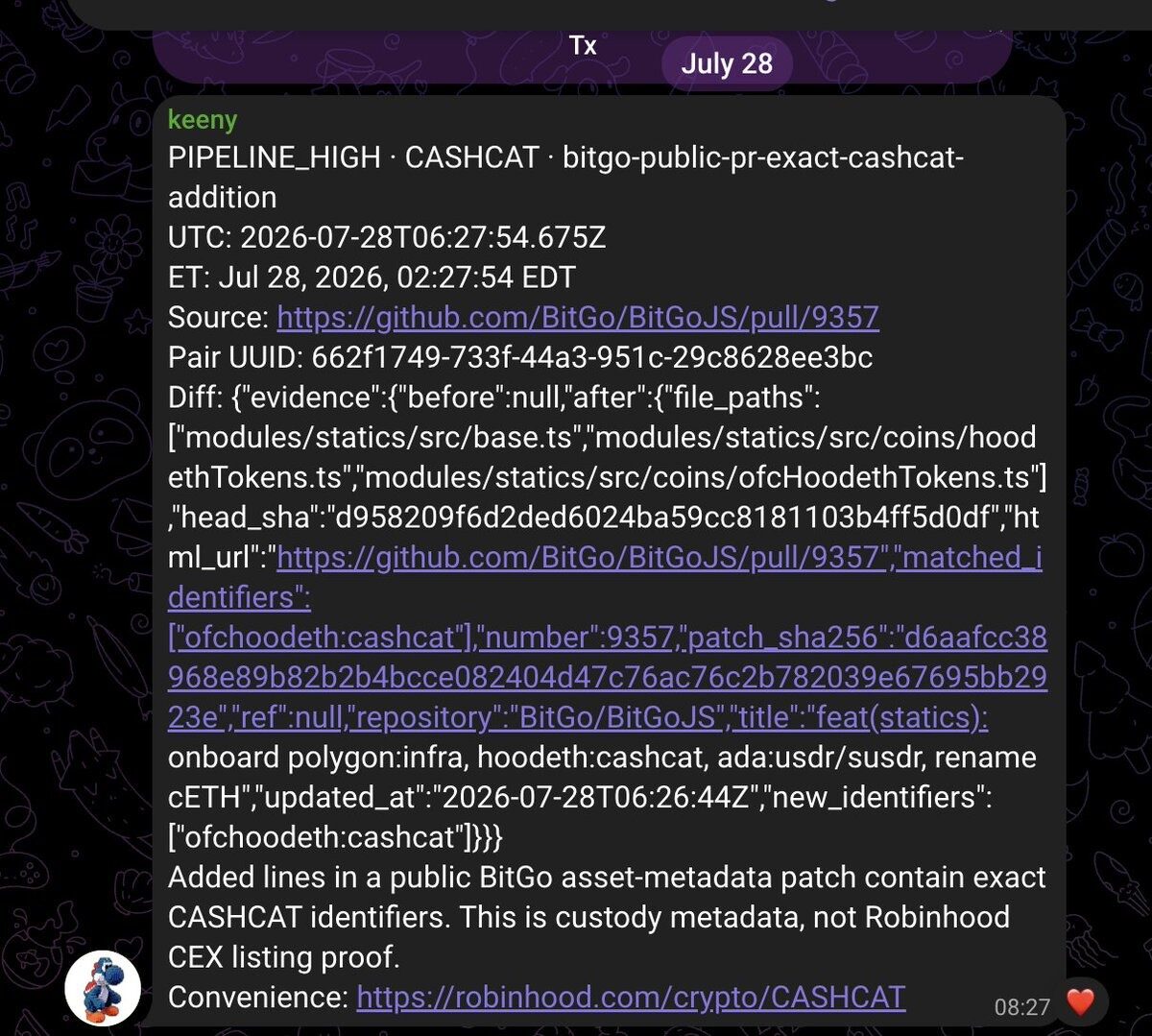
On July 28, one day after we first triggered our alert, BitGo made a follow-up update to the related Pull Request. On July 29, BitGo released a relevant update that included cashcat and added 99 types of Robinhood Chain stock tokens. The significance of this was immense because it confirmed my suspicion—that the people behind this demand were Robinhood. Otherwise, why would cashcat appear in this update along with Robinhood's native stock tokens?
As evidence continued to emerge, my partner and I were consistently increasing our holdings. By July 29, the two of us had collectively held 1.5% of cashcat's total supply. The next day, I told my partner what kind of signals would prompt me to significantly increase our holdings—I wanted to see Wintermute whitelist cashcat or catch cashcat transferring between Wintermute and Robinhood. At that time, our monitoring system was fully operational, and the funds were already prepared.
On August 3 at 17:48 (UTC), our tracking tool detected Wintermute authorizing operations for the cashcat/WETH liquidity pool. This was the signal we had been waiting for. The market maker had selected a trading venue, and the token they were preparing to trade was precisely the one we held.
We were ready to invest a seven-figure dollar amount, but if we bought everything all at once, it would clearly leave a significant trace on the K-line chart and alert everyone to investigate our wallets. So, I had my partner slowly start buying half of the planned position in batches to see if anyone would notice our actions.

Half an hour later, at 18:19, a wallet we suspected belonged to an internal person at Robinhood placed a limit buy order for cashcat worth $11,000. We had been tracking this wallet because it always appeared before the token officially launched. I also knew that other traders were aware of this address as well. Although this order had not yet been filled, anyone monitoring this address could tell what token it intended to buy. I judged that others might start to rush in before we completed our positioning.
So, we abandoned the slow DCA strategy and together bought over $1 million worth of cashcat, directly pulling up the K-line. By the time we completed our positioning, we held more than 4% of the total supply of tokens.
On-chain analysis accounts immediately began exposing our wallet addresses on Twitter, which was exactly what we wanted to avoid—this would spark market speculation and lead many to rush in to front-run the official listing, severely diluting our information advantage. That internal person’s lack of on-chain trading experience likely cost us several million dollars.
Three days later, Robinhood officially launched cashcat. At the time, I was taking a nap and missed the initial spike in the K-line. My selling operations could have been done even better, but despite that, my partner and I still earned over $4 million altogether.
PONS: When the Market Begins to Figure Out Our Pattern
By the time PONS appeared, I had anticipated that most sharp traders would have already noticed Wintermute's contract pattern. Therefore, if we were still waiting for the previous kind of monitoring signals, it was obviously no longer enough. We had to dig deeper into the entire information acquisition chain to regain the initiative.
We continued to dig along the clues left by cashcat and eventually discovered enough signals to begin buying PONS on August 28. I can't conveniently disclose the details of this information acquisition process.
Three days later, BitGo added PONS to the related support list, and Wintermute subsequently began providing market making services for it. Then, on September 2, PONS welcomed its so-called "listing." But in the end, it seemed more like a bait set by Robinhood to flush out insiders who had grasped the news in advance.
Since then, most of the information advantages I introduced in this article have gradually been digested and diluted by the market. My friends and I ultimately made a total of $2 million through PONS.
Most of the details mentioned here may be more valuable references for those trading with bots, but I believe that many of the principles also apply to other trading methods.
Overall, my trading goal has always been to find a balance between pure narrative trading and maximizing technical advantages, thus achieving better trading execution.
In the future, if given the opportunity, I might also share some of my experiences in narrative trading.
免责声明:本文章仅代表作者个人观点,不代表本平台的立场和观点。本文章仅供信息分享,不构成对任何人的任何投资建议。用户与作者之间的任何争议,与本平台无关。如网页中刊载的文章或图片涉及侵权,请提供相关的权利证明和身份证明发送邮件到[email protected],本平台相关工作人员将会进行核查。


