Original authors: Bao Yilong, Ye Zhen
Original source: Wall Street News
The continuously rising US dollar is tightening global liquidity and has transformed into a "wrecking ball" for financial markets, suppressing global risk assets and commodities, making it difficult for risk assets to enter the market.
This is the view of Michael Hartnett, Chief Investment Strategist at Bank of America, in his latest report, "Flow Show." He believes that the current market is facing three contradictory issues - the Federal Reserve's tightening cycle is far from over, government support is building a bearish barrier, and the wealth effect of high-net-worth consumers is supporting the economy. This means that risk assets are neither worth chasing nor easy to short at the moment.
Hartnett has postponed his optimistic "finish line" for the year-end. Initially, he expected the market to enter an end-of-year rally after the midterm elections and before Thanksgiving, but the much better-than-expected employment data, inflation heating up for three consecutive months, and Federal Reserve officials hinting at a 50 basis point rate hike have completely disrupted the rhythm. The only signal to increase positions would be when oil prices, US Treasury yields, and the dollar all fall in sync - and this wait could extend until next spring.
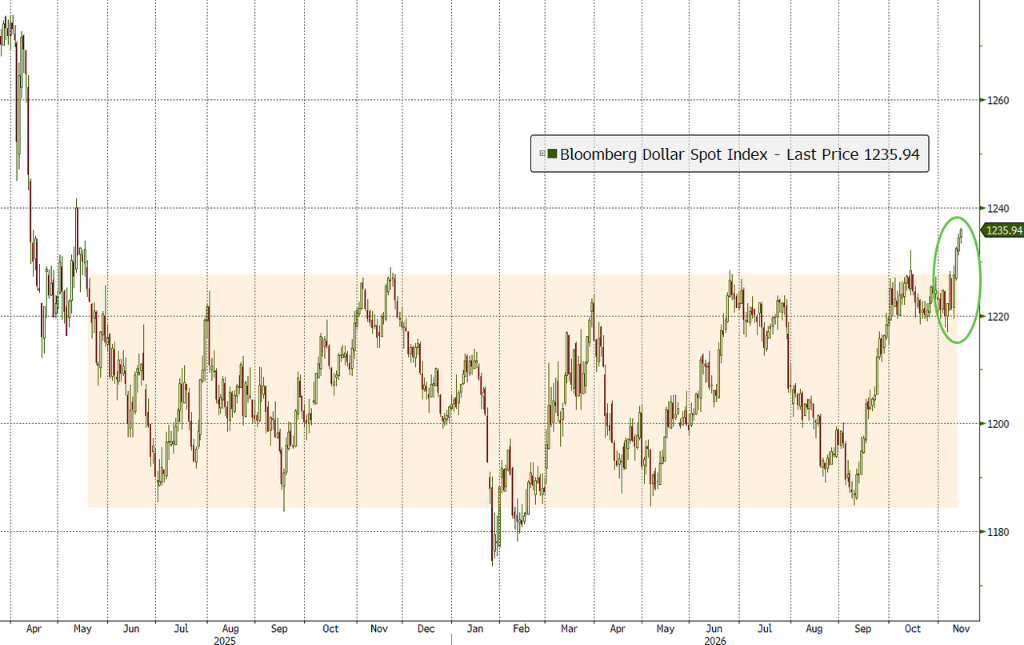
Last Friday, the dollar index closed at 103.42, reaching a new high for the year. Hartnett characterized it as the "wrecking ball" of global liquidity - the continuous strengthening of the dollar along with gold falling below 4000 dollars indicates that global liquidity is contracting within his analytical framework.
Against this backdrop, he has pushed back the endpoint of the global rate hike cycle to the Federal Reserve's meeting in April next year and will maintain a bearish stance on risk assets until after the dollar peaks next spring.
In terms of market impact, this round of a strong dollar has caused significant shocks to various assets: gold has fallen 10.4% this year, bitcoin has dropped 18.9%, government bonds have decreased by 3.6% in the year, and emerging market bonds saw a weekly outflow of 1.5 billion dollars.
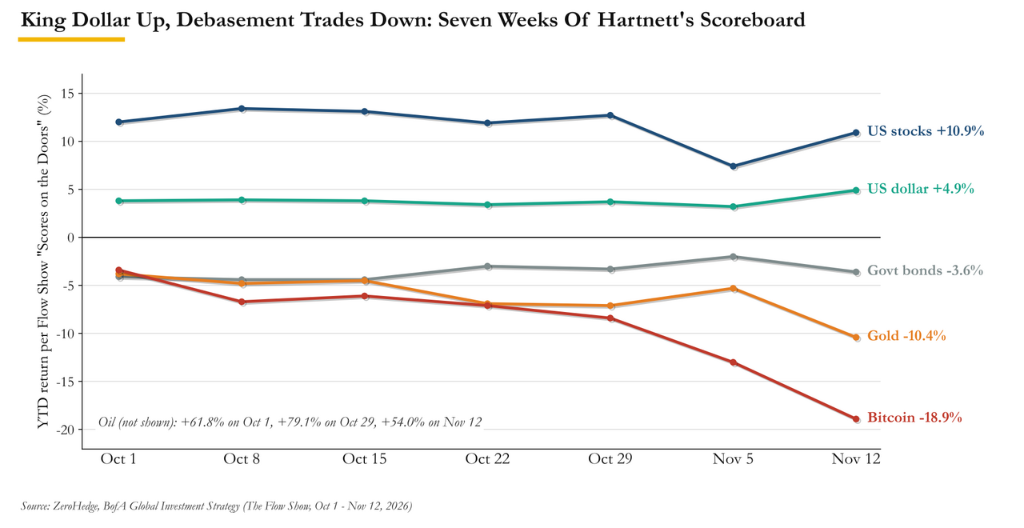
The dollar as a "wrecking ball" leads to overall contraction of global liquidity
The strength of the dollar is the core market variable this week.
After the dollar index rose for four consecutive trading days, it closed at 103.42, a new high for the year. The yen touched the 160 mark which triggered verbal intervention from Tokyo authorities, and gold fell 4.7% in a single week to about 3874 dollars, closing below the 4000 dollar mark for the first time in months; bitcoin slid below 70,000 dollars.
Hartnett's logic is clear and straightforward: the rising dollar combined with gold falling below 4000 dollars equals a signal of the withdrawal of global liquidity.
He had suggested clients begin increasing their bond holdings as early as October 3, using this as a judgment benchmark, clearly stating to maintain a risk-averse stance until the dollar peaks. Six weeks later, the dollar has not fallen but instead has risen, prompting him to now delay his expectations for the dollar peak until February to March next year.
This judgment is highly consistent with predictions from Goldman Sachs' foreign exchange team. According to Bloomberg, Goldman strategists Kamakshya Trivedi and Michael Cahill predict that the euro will fall to 1.08 against the dollar within three months, subsequently rising to 1.15 by the end of 2027, with the trade-weighted dollar currently overvalued by about 13% compared to its average.
Both institutions believe that the destructive trend of the dollar will precede any easing.
All three entry conditions fail, pivot point pushed to next spring
Hartnett has set three preconditions for shifting back to risk appetite: oil prices (WTI) falling below 70 dollars, 10-year US Treasury yields dropping below 4.5%, and the dollar beginning to decline. By Friday's close, none of these conditions were met.
Regarding oil prices, WTI needs to drop about 21% to reach the 70 dollar threshold, and this threshold has already been revised down from 80 dollars a week ago. Brent crude fell below 90 dollars earlier this week but subsequently rebounded due to geopolitical rhetoric, closing around 89 dollars over the weekend.
In terms of Treasury yields, the yield on the 10-year US Treasury closed at 5.15% last Friday, rising about 28 basis points in a week, just a step away from multi-year highs, with yield tail differentials observed in the auctions of three-year, ten-year, and thirty-year government bonds. Achieving a 65 basis-point drop in yields while the Federal Reserve discusses whether to raise rates by 25 or 50 basis points in December presents a significant challenge.
Regarding the dollar, the current trend is entirely opposite to the entry conditions, marking a new high for the year, with peak expectations postponed to February to March next year.
Meanwhile, inflation continues to exert pressure. Federal Reserve Governor Waller has hinted at a 50 basis point rate hike in December, and Goldman has included a rate hike in its benchmark forecast for March next year. The NFIB October survey indicates that the proportion of small businesses planning to raise prices has jumped to its highest level since July 2022, historical data shows this is closely tied to an inflation rate of at least 3% to 4%.
Hartnett also specifically pointed out that the last time the Federal Reserve met its 2% inflation target was in February 2021, which was 67 months ago.
Why is the stock market resilient: wealth effect and policy support
Despite the challenging macro environment, the S&P 500 index continues to maintain its upward trend.
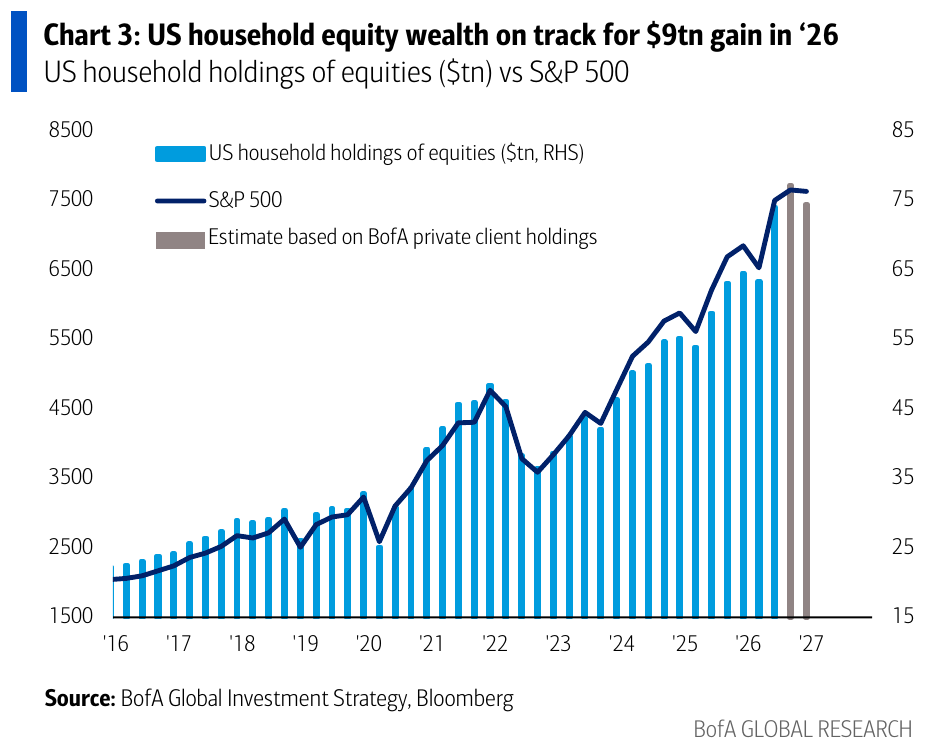
Hartnett explained two dimensions for the market's refusal to decline. The first is "why not save money." According to data from Bank of America, since January 2025, American households' stock wealth has increased by 19 trillion dollars, reaching a total of 74 trillion dollars. With consumption accounting for 70% of US GDP, the wealthy class, holding a large amount of stock assets, tends to spend more, making it difficult for the economy to fall into a deep recession.
The second is "why not short the market."
The recent turbulence in Asian markets has prompted several governments to take substantial intervention measures. According to reports, relevant regulatory agencies have implemented restrictions on short selling, paused margin rules, and established a 15 billion dollar stabilization fund, while stock funds in the Chinese market have recently set a record for five consecutive weeks of inflow totaling 88 billion dollars. Decision-makers view the stock market as "too big to fail," supporting retail purchases of tech stocks.
The "prosperity" expectation is the last line of defense
Hartnett pointed out that in May of this year, market consensus had collectively bet on "no landing, no rate hikes, AI capital expenditures not being reduced, and Democrats not sweeping," with almost all four bets failing. The last remaining bullish belief in the current market is the expectation of "prosperity" - specifically, a nominal GDP growth of 5% to 6% in 2027 and S&P 500 earnings growth exceeding 15% to 18%.
He believes this expectation carries a risk of downward revision. Goldman Sachs chief equity strategist Peter Oppenheimer, in the 2027 outlook, predicted that S&P 500 earnings growth next year would be 11%, far below the market consensus of 18%. At the current price-to-earnings ratio of about 19.5 times, this gap corresponds to an index level of around 7100 points, just falling within the bear market trigger range set by Hartnett at 7000 points.
Goldman itself still maintains a target price of 8700 points, but this requires earnings realization and further valuation expansion, while the current 5.15% yield on the 10-year Treasury places significant constraints on this.
Hartnett sees the Bank of America November Global Fund Manager Survey, to be released on November 17, as a key observation window:
- If the "prosperity" expectation declines significantly and the cash ratio rises above 4.2%, then sentiment will no longer pose a barrier to buying;
- If the "prosperity" expectation remains high while the cash ratio falls below 3.7%, then the market has not yet formed enough panic and still lacks entry conditions.
Hartnett has defined a clear dual-scenario framework for the S&P 500. The current S&P 500 is at 7562 points, precisely positioned in the middle of the two trigger points.
If the index breaks through 8000 points, the driving force will lie in a continued influx of buying funds on dips, the "stocks over bonds" signal transmitted by the equal-weighted S&P 500 returning to historical highs, and the technical support provided by junk bonds, S&P 500 index, broker stocks, and TSMC all holding above their 200-day moving averages.
He also considers the APEC summit in Shenzhen on November 18 as a potential catalyst, suggesting that the meetings of leaders from the US, China, and Russia may confirm that oil prices have peaked.
If the index falls below 7000 points, the core risk comes from a liquidity shortage triggered by the dollar's rapid rise, and policy mistakes by central banks continuing to raise rates amid economic slowdown. The most vulnerable assets include high-yield bonds, US and emerging market stocks, energy and healthcare sectors, as well as large-cap consumer stocks.
If his risk-averse judgement is proven wrong, the assets most likely to rise sharply in the next eight weeks will include gold, investment-grade tech bonds, Japanese and European stocks benefiting from a strong dollar and low oil prices, Chinese tech stocks, small and mid-cap stocks, semiconductors, discretionary consumer goods, and residential builders.
免责声明:本文章仅代表作者个人观点,不代表本平台的立场和观点。本文章仅供信息分享,不构成对任何人的任何投资建议。用户与作者之间的任何争议,与本平台无关。如网页中刊载的文章或图片涉及侵权,请提供相关的权利证明和身份证明发送邮件到[email protected],本平台相关工作人员将会进行核查。


