Written by: Sam, Techub News
Introduction
On November 14, Bitcoin's overall network difficulty decreased by 9.13%. On the same day, the price fell to around $64,000, halving from its peak 13 months ago. In terms of the median price in the second-hand mining machine market, the network's total hash rate of approximately 965 EH/s corresponds to a hardware book value of only about $10 billion; based on the prices of mainstream models, it is even less than $5 billion. The security of Bitcoin relies on the principle that "the cost of attack is prohibitively high." When this cost in terms of hardware can be matched by just one large fund, the question becomes serious: Has Bitcoin's hash rate security really become cheaper? To what extent? Who can fix it?
Key Summary
- Bitcoin has dropped nearly half from its peak of about $126,000 on October 6, 2025, closing around $64,000 on November 14; on the same day, the overall network difficulty was reduced by 9.13% to 134.8T, which is about 14% lower than its peak at the end of October 2025.
- Bitcoin miners, given the current difficulty and coin price, earn about $30 per PH/s of hash rate daily, with the total network daily income around $29 million, of which transaction fees account for about 0.6%.
- The Endless Mining mining machine price index shows that the median price of second-hand mining machines is about $10.35 per TH, multiplying by the total network hash rate brings it to approximately $10 billion; based on the mainstream model price of $4.95 per TH announced by Luxor in August, it’s less than $5 billion.
- The "billion-dollar double-spending" exists on the hardware books, but in reality, it is stuck on power: duplicating the network-scale hash rate requires about 15–17 GW of electricity, equivalent to more than a dozen large nuclear power units; money can buy the machines, but not that much power and time.
- Listed mining companies are redirecting power and capital towards AI data centers, and hardware manufacturers are no longer self-mining like in previous bear markets. The 2028 halving will also cut block subsidies in half; Bitcoin's security budget is systematically shrinking, which is more concerning than a "billion dollars."
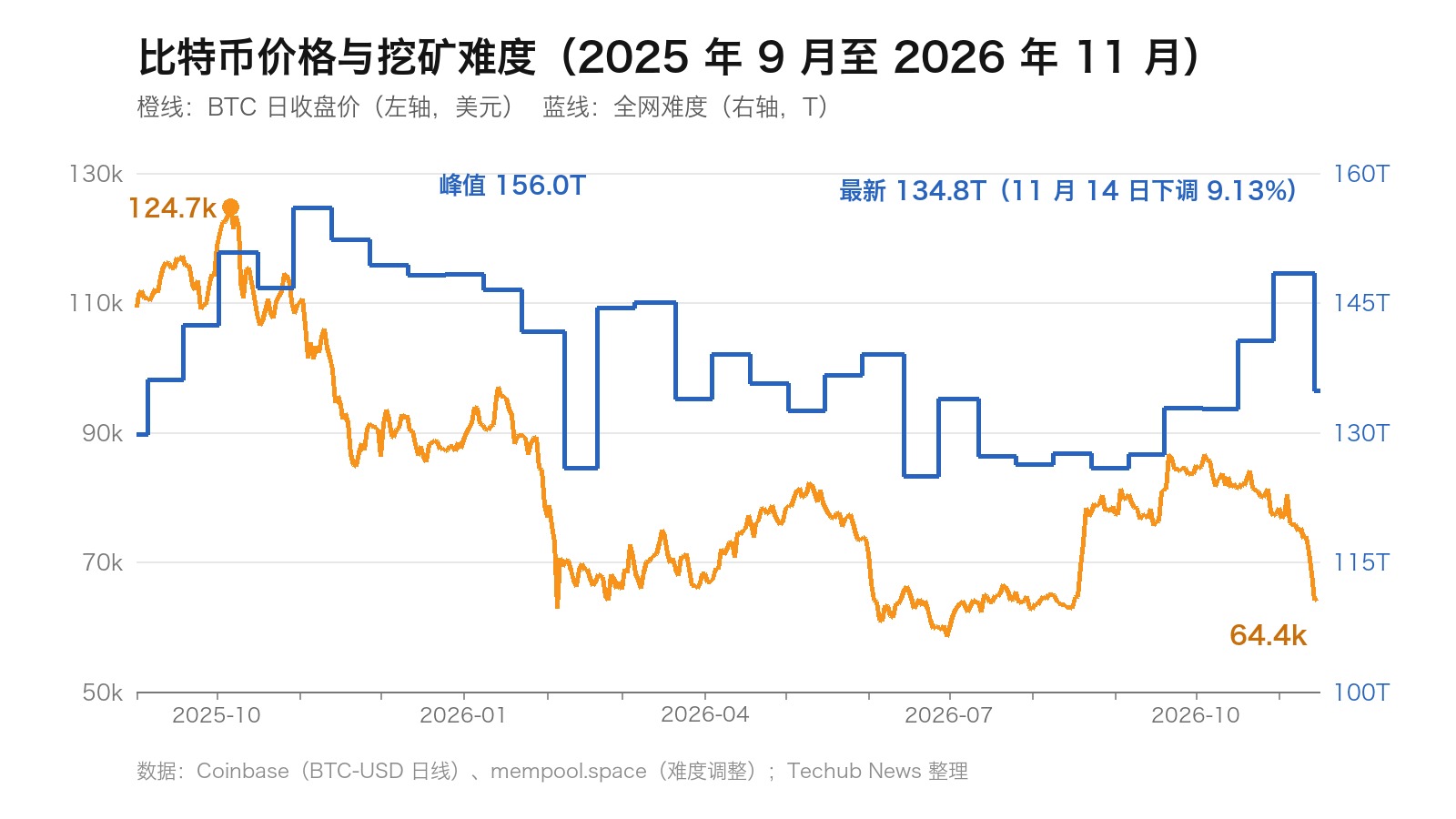
Miner income has returned to historical lows
Let’s examine how difficult it is for miners. Bitcoin reached approximately $126,300 on October 6, 2025, and then fell sharply, dipping around $60,000 in February this year, before briefly rising back to above $86,000 in late September, and has fallen about 20% again in the past 30 days, trading around $64,000 on November 14.
The change in difficulty lags behind the price of the coin. The overall network difficulty peaked at 155.97T on October 29, 2025. Following a rebound in coin prices in October this year, it was adjusted up twice, but on November 14 (block height 975,744), it was lowered by 9.13% to 134.8T, marking the largest decrease since June this year. According to mempool.space's estimates, the next adjustment may decrease by about 5% more. The decline in difficulty indicates that some miners are shutting down, with existing hash power exiting.
By converting earnings into per unit hash power, the pressure becomes clear. Based on a difficulty of 134.8T, the total network hash rate is about 965 EH/s; using the most recent 144 blocks from November 14, miners earned approximately 452.5 Bitcoins daily, which is approximately $29.2 million at the price of $64,000, averaging about $30 per PH/s per day. Real-time data from Endless Mining shows the corresponding hash power price during the same period was $31.91 per PH per day. This is close to the historically lowest range, comparable to when the coin price dropped to around $60,000 in February this year.
On the cost side, the efficiency of mining machines and electricity prices determine survival. Based on daily electricity costs per PH/s:
- For new models with an efficiency of 15 J/TH, about $18 at an electricity price of $0.05 per kWh, and about $29 at $0.08 per kWh;
- For mainstream models with an efficiency of 17.5 J/TH (S21 generation), approximately $21 and $34 respectively;
- For previous generation models with an efficiency of 21.5 J/TH, approximately $26 and $41 respectively;
- For older S19 generation models with an efficiency of 30 J/TH, approximately $36 and $58 respectively.
In other words, at a hash power price of $30, older S19 generation models would incur electricity costs as long as the price exceeds about $0.04 per kWh, while the breakeven point for S21 models is around $0.07 per kWh. Another glaring number: in these 144 blocks, the total transaction fees amount to approximately 2.5 Bitcoins, accounting for about 0.6% of miner income, meaning miners rely almost entirely on block subsidies to survive.
"$10 billion" is not an exaggeration: mining machines have dropped by 70% in a year
"The network hash rate is settled in dollars," refers to calculating the overall network hash rate into hardware value at current market prices for mining machines. Mining machines are priced per TH/s, so the calculation is straightforward: the total network hash rate multiplied by the price per TH.
Two sets of publicly available data yield results around or below $10 billion. Endless Mining's mining machine price index takes the median price from the second-hand market listings and transactions, which was $10.35 per TH on November 15, multiplied by around 965 million TH/s, totaling about $10 billion. The Luxor Hashrate Index calculates prices based on efficiency brackets; according to data cited by Bull Miners from August 9, the price for the 14–19 J/TH bracket (S21, M60S generation) is $4.95 per TH, falling by 72% in a year; the 19–25 J/TH bracket is $2.11 per TH, and the 25–38 J/TH bracket is only $1.02 per TH. Using the $4.95 per TH price, the total network hash rate corresponds to hardware worth less than $5 billion.
The plummeting prices of mining machines have outpaced that of Bitcoin, due to a simultaneous deterioration in supply and demand: a falling coin price pushes down the output per TH, elongating the breakeven cycle, while the number of buyers decreases; at the same time, mining companies transitioning to AI are offloading old mining machines, increasing the supply in the second-hand market.
$5 billion can buy machines, but not electricity
So, can $5 billion launch a double-spending attack?
On hardware terms, it is basically feasible. The so-called double-spending attack involves the attacker controlling more hash power than honest miners, secretly extending a chain that does not include their own transaction. After exchanges confirm the incoming transactions and assets are withdrawn, they then publish this longer chain to "revoke" the original transaction. To achieve this, the attacker needs hash power at least equivalent to the current total network, approximately 965 EH/s. At a price of $4.95 per TH for mainstream models, this batch of machines costs around $4.8 billion.
But hardware is only the first threshold, several more hurdles lie ahead.
The first is electricity. 965 EH/s requires about 15–17 GW of continuous power based on 15–17.5 J/TH, equivalent to the output of more than a dozen million-kilowatt nuclear power units. The largest publicly listed mining company currently has a single power scale only in the gigawatt range, and AI companies are competing with mining companies for the same electricity and space. Holding $5 billion in cash, it would take years to gather that much usable electricity.
The second is supply. The mining machines listed in the second-hand market represent only a small fraction of the total network; large-scale acquisitions would quickly drive up prices; new machines from manufacturers also require production schedules.
The third is monetization. A double-spending attack requires a counterparty willing to accept a large amount of Bitcoin incoming and to release it for withdrawal after just a few confirmations; mainstream exchanges have risk controls and longer confirmation requirements for large deposits. Even if the attack succeeded, it is highly likely that Bitcoin's price would plummet, devaluing both the mining machines and remaining Bitcoins in the attacker’s possession.
Therefore, the $5 billion is not the price for attacking Bitcoin; it is the price for the hardware required for such an attack. This distinction is crucial: Bitcoin's true moat has now shifted from "machines are costly" to "finding electricity is challenging." If one day a state-level entity has access to idle electricity, or if a large number of shut-down mining machines flow into the hands of a single buyer, this moat will appear narrower than the book value suggests.
Where the machines have gone: mining companies are shifting to AI, manufacturers are no longer self-mining
The supply side has also changed compared to previous bear markets. When mining machines became unsalable in the past, manufacturers often took their inventory machines to self-operate in mining farms, without significant loss of hash power. In this round, new machines are not selling, and manufacturers are also struggling to find enough electricity to digest their inventory themselves. After the United States imposed tariffs in 2025, manufacturers like Bitmain and Canaan began assembling in the U.S.; Canaan’s monthly operational update this year shows the company positioning itself as an "energy infrastructure platform." Its self-operated hash power in September was maintained at around 10 EH/s, about 1% of the overall network. For manufacturers to self-mine on the scale of previous years, they first need electricity, which is currently being taken by AI.
The situation is even more pronounced on the mining company side. CoinShares estimated this March that about 30% of the revenue from listed mining companies came from AI business and might rise to 70% by the end of 2026. IREN signed a $9.7 billion AI cloud service contract with Microsoft in November 2025, with Cipher, TeraWulf, and others also signing multi-billion dollar hosting agreements with cloud providers. For mining companies, the same megawatt of electricity used to run GPUs brings far higher income than mining Bitcoin, so shutting down mining machines and freeing up electricity is a rational choice. This is good news for mining company shareholders, but for the Bitcoin network, it means that the "reserve army" of hash power is dwindling: when the coin price rebounds, the electricity that can be quickly reactivated has been locked away by long-term contracts.
The "iron law" of breakeven period: where does it fall today
There is a long-standing saying in the mining industry: When the breakeven period for mining machines is 16 to 18 months, it is often a peak and one should not invest further; when it extends beyond 24 months, it is often a bottom, and buying is advisable. The logic is counter-cyclical: when the breakeven is quick, everyone rushes to buy machines, and difficulty rises rapidly, diluting returns; when the breakeven is slow and no one is willing to buy, it's usually close to the bottom.
Applying today's numbers to this experience: With the S21 model (17.5 J/TH), Luxor’s August price of $4.95 per TH, and a hash power price of $30 per PH/day, assuming stable difficulty: at an electricity price of $0.04 per kWh, the breakeven period is about 12 months; at $0.05 per kWh, about 18 months; at $0.06 per kWh, about 34 months. If buying machines at Endless Mining's median price of $10.35 per TH, the breakeven period would double again. For most miners with electricity prices above $0.06 per kWh, the breakeven period has already exceeded 24 months, fitting perfectly into the range of "should buy;" only large mining farms with access to cheap electricity can achieve a year and a half to breakeven.
The same logic applies to today's AI computing power, as the two are almost isomorphic: the income from a GPU or mining machine depends on how many similar devices across the entire industry are competing for the same demand. According to rental price indices from AIMultiple, Silicon Data, and others, the hourly rental price of an NVIDIA H100 has fallen from over $7 at the beginning of 2024 to below $3 by October 2026. The more devices there are, the lower the unit income, and the longer the breakeven period; the highs and lows of the cycle can also be measured in terms of breakeven months.
Can $150,000 solve the problem?
So, who can fix Bitcoin's security budget? Current sentiment in the mining community suggests that Bitcoin must rise above $150,000 for the profitability of miners to truly resolve.
Based on current difficulty, if Bitcoin were to rise to $150,000, the hash power price would be about $70 per PH/s per day, and older S19 generation models could also earn profit at an electricity price of $0.08 per kWh, prompting inactive machines to reactivate. However, difficulty would follow the increase in hash power, and unit income would be diluted again, meaning the price can at best temporarily repair miner profits.
The timeline is even harder to evade. Bitcoin will face its next halving at block height 1,050,000, expected around April 2028 based on the current block generation speed, where the block subsidy will drop from 3.125 Bitcoins to 1.5625 Bitcoins. At that time, if transaction fees still account for only about 1% of miner income, the Bitcoin price will need to double to maintain today's security budget. Currently, the overall miner income across the network is about $10.6 billion per year, less than 1% of its market value of approximately $1.3 trillion.
Bitcoin also lacks a central authority that can intervene to support the market. Difficulty adjustments are the protocol's only automatic stabilizer; it can help the remaining miners continue to profit but cannot prevent the total hash power from declining. Whether the fee market can grow into a sufficient revenue source to replace subsidies and whether the electricity taken by AI will return to the market in the next bull run are questions for which there is currently no data to provide answers.
References
1. mempool.space: Difficulty adjustment records
2. mempool.space: Estimated next difficulty adjustment
3. Coinbase Exchange: BTC-USD Daily Market Data
4. Endless Mining: ASIC Miner Price Index (2026-11-15)
5. Bull Miners: Why ASIC Miner Prices Fell in 2026 (citing Luxor ASIC Price Index, 2026-08-09)
6. Luxor: Hashprice Indicator Explanation
8. S&P Global: Bitcoin miners pivot to AI and HPC as cryptocurrency market slumps (2026-02)
9. Canaan Technology 6-K Monthly Operations Update (2026)
10. SCMP: Trump's tariffs see makers of Chinese bitcoin-mining machines eye US production
11. Uvik: GPU Price Index 2026 (citing Silicon Data, AIMultiple H100 Rental Price Index)
Editorial Note: Bitcoin prices are sourced from Coinbase, while difficulty and block revenue are sourced from mempool.space, both as of November 14 (UTC); total network hash rate is calculated from difficulty (difficulty × 2³² ÷ 600 seconds), hash power prices, electricity costs, and breakeven periods are self-estimated based on the assumptions in this article, excluding pool fees, operation management, and depreciation, ultimately subject to the conditions of each mining farm. Luxor's tiered mining machine prices are based on August data, as referenced by Bull Miners; H100 rental prices are from third-party indices, which vary in scope.
Disclaimer: This article is for informational reporting and analysis only and does not constitute any investment advice.
免责声明:本文章仅代表作者个人观点,不代表本平台的立场和观点。本文章仅供信息分享,不构成对任何人的任何投资建议。用户与作者之间的任何争议,与本平台无关。如网页中刊载的文章或图片涉及侵权,请提供相关的权利证明和身份证明发送邮件到[email protected],本平台相关工作人员将会进行核查。


