After the midterm elections in the US stock market, the AI narrative changed, leading to a stock market crash.
After the Democratic Party won control of both chambers of Congress, the market became concerned that the regulation of data center construction and AI safety would tighten further. On November 5, the Nasdaq 100 index and the Philadelphia semiconductor index both recorded the largest single-day declines since March 2020.
What worries people even more is, could this be a formal shift in the AI narrative?
In the past, whether data centers could be completed on time mainly depended on whether there was enough electricity and if equipment could be delivered. Now, businesses must answer another set of questions: Who will pay for the grid upgrades, who will bear the increased utility costs for residents, and how much long-term employment will the community receive? In some regions, if conditions are not met, a project could be vetoed unanimously. In this dialogue, our guests estimate that, in the worst-case scenario, costs for data centers could increase by 10% to 20%.
However, construction delays do not equate to a disappearance of computing power demand. If demand remains strong, companies that already have computing power may actually gain stronger pricing power. Is Wall Street really concerned about the inability to build data centers, or is it that companies are no longer willing to spend on AI? These two assessments could lead to completely different outcomes.
Meanwhile, many local residents in the US are concerned about more tangible aspects of life: Can they afford rent, will electricity bills increase, and how many jobs will remain after the construction ends? As Bruce, CEO and CIO of Jiyong Investment, repeatedly reminded during the conversation: “Do not underestimate voters' opposition to this issue.”

In this article, we talked with professionals in energy strategy and data center construction, as well as Wall Street investors who have been tracking the US AI hardware sector, about how policy changes will impact construction, costs, financing, and computing power demand. We also interviewed three local residents in the US to hear their demands regarding voting, housing, and community life.
This article is a video rewrite, and you are welcome to watch the following video

Due to the AI industry's demand for computing power, data centers have become a crucial part of capital investment. Upstream and downstream companies related to GPUs, CPUs, optical communications, storage, and electricity have all been hotly pursued by capital in recent times.
If AI regulations first block the approval of data centers or require contractors to bear more costs and tax burdens, or even revoke construction permits, it will strike a blow to the AI industry's supply chain. Let's first discuss the costs behind AI regulation.
Ethan Xu: The risks of delays in data center construction that we were worried about for the past few months have essentially materialized following the midterm elections, perhaps even worse than previously anticipated.

Previously, we anticipated that the greatest risk for data centers would come from electrical supply and equipment delivery, with policy suppression or public opposition being a secondary concern. However, after the midterm elections, the clear positions of several elected Democratic governors have turned prior secondary factors into potentially more significant primary concerns than electricity delivery and supply.
It is almost certain that, in the next one to two years, significant delays in data center construction are as good as confirmed. The scale of these delays will depend on the specific policy-making situations in each locality.
So far, it is clear that risks are increasing, but by how much is unknown. I believe that even the elected Democratic governors themselves do not know. They understand that regulations must be stricter than before, but to what extent? This requires deeper discussions with local council members, including those in the Texas House and Senate, as well as with local residents.
For example, Texas' newly elected governor mentioned that local residents must sit at the negotiating table with data centers and the government to decide whether data centers can be built in their community, and they possess veto power. This means a considerable portion of data center planning may be vetoed due to the dissatisfaction of local residents.
This is also a concern we have previously raised: it’s not just about delays, but a portion of data centers may be completely canceled, which is more serious than before. Earlier, we thought that if supply chain and electrical supply issues could be resolved, even delays could be relatively controlled within certain limits. But now, more must be done, which includes ensuring that local residents are completely satisfied with the presence of data centers. This means data centers need to engage in very deep and comprehensive negotiations with local residents.
Is it the case that, beyond completely covering the costs of electrical upgrades and rising electricity prices, ensuring residents' electricity bills are unaffected, data center companies also need to bear the costs of upgrading the entire municipal water supply system to guarantee that residents' water supply is problem-free, and possibly even better than before?
Aside from these costs, must they also help improve local public infrastructure, such as roads, hospitals, schools, training centers, and unions? Should all these costs be borne by data center companies? I believe these issues will certainly come to the table for systematic discussion, and there will definitely be regions requiring very high standards; if unmet, it could result in a veto.
Even if data centers are willing to bear higher costs than before to keep the projects alive while alleviating residents' concerns, some concerns are indeed very legitimate, such as protecting residents from the impact of rising electricity prices.
However, with this opportunity emerging, will many local residents want even more? This is also a considerable concern. The increase in costs is one aspect; to meet many demands requires more time, so delays will undoubtedly be more severe than before.
In summary, one inevitable result of the midterm elections is that many regions, led by Texas, will experience longer delays and the complete cancellation of some projects.
Texas is perhaps the most representative state. Right now, there are two particularly large data centers in the entire United States: one in Virginia, which is currently the largest data center hub; the next future hub is widely acknowledged to be Texas, so Texas is essentially the future of data centers.
However, if this future becomes very uncertain, with severe delays and cancellations of construction, other states like Ohio and Georgia also face significant policy changes; they are watching how Texas negotiates with residents, how policies are formulated, and how the best balance can be achieved. What happens in Texas is highly instructive for the measures other states may take later.
Thus, I anticipate that in the next six months, Texas will likely be the focus of the entire industry. Why six months? According to Texas' legislative schedule, many bills related to data centers can be submitted to the legislature starting now. From January to May next year, it will be the main phase for legal negotiations, voting, and confirmations; in September next year, new laws will start to take effect.
This timeline is quite lengthy; it is not an issue that can be resolved in a month or two, and it is very possible that solutions may not begin to form until September next year. Before May next year, there will likely be very intense negotiation and voting processes. During this process, I believe significant market fluctuations are likely to occur.
For elected legislators, they need to show loyalty to voters and fulfill their commitments made during the campaign. Very likely, at the beginning, we will see many very radical proposals aimed at suppressing data centers and AI development being put on the table for discussion, which will create a certain degree of market panic.
For example, some proposals put forth by Bernie Sanders have an audience everywhere. Some proposals are very extreme, including a complete ban on constructing data centers and even banning AI research, with severe penalties for individuals involved in AI research.
However, we do not believe that Texas, a state that has been very business-friendly for decades, will ultimately adopt such extreme proposals. During this process, it is possible that some more extreme proposals will be put forth, and after a few months of debate and contention, everyone may cool down, reassess the pros and cons of data centers, and find a relatively calm middle ground.
We personally believe that there will be quite significant fluctuations in the coming months, but the final outcome may not be as terrifying as what everyone fears; it may become a relatively moderate solution.
However, the duration of this time is very unfavorable for the entire data center industry, as the legislative cycle is too long and may only be implemented by September 1. Even before September 1, we might see some temporary bans on data centers in Texas and some other places until new laws emerge. These risks are considerable, which is why we see that stocks throughout the data center industry chain are experiencing a dramatic decline.
In the coming months, it is very likely that we will continue to see significant volatility. The emergence of worse and more extreme proposals being introduced, which receive a lot of public support, could lead to even more panic.
If some elected Democratic lawmakers propose that as long as data centers meet certain conditions, such as assuming all risks related to grid upgrades, increases in electricity prices, and ensuring resident satisfaction, they can connect to the grid, I believe that is very reasonable, and data centers should bear those costs.
If the proposed conditions are controllable and feasible, the market might feel that it is not so extreme. Therefore, it is possible that the market may continue to fluctuate like this for several months until a relatively moderate plan is formed that gains consensus.

Chen Qian:Ethan, regarding the additional costs that data centers might incur, could they be divided into different bills? From the most unfavorable to data centers to relatively milder bills, what is the range of additional costs that data centers might incur under different conditions?
Ethan Xu: Right now, there is a rough range, but it is quite broad. If it’s just the electricity costs, that can be relatively easily resolved, as all data center companies have already committed to bearing all the risks and additional costs associated with electrical facilities, generation, and increases in electricity costs for future data center construction. This part is completely acceptable and is not a concern for the data centers. Added costs such as water rates may increase costs by 5% to 10%, which is entirely acceptable.
However, some greater burdens may not be as easily accepted. For instance, taxes; previously, we discussed in one segment that a 1GW data center could cost $50 billion. If there are ordinary sales taxes and property taxes paid to the locality, these costs could be substantial. In many areas in the US, sales tax rates can range from 6% to 10%. If taxed this way, costs could rise even more. We have evaluated that, in a worse-case scenario, costs could increase by 10% to 20%.
Chen Qian: Christina, do you have anything to add?

Christina Xu: On policy issues, Ethan has expressed very well. It breaks down into three levels: state, federal, and local. The governor can take the fastest restrictive measures on licenses that have not yet been issued. Texas halted the connection procedure on August 3 and paused environmental permits on September 21; that’s how it came about.
Taxes and benefits, as we mentioned earlier, are a significant part that needs to go through legislative bodies. Equipment tax exemptions are the largest leverage; there may be a difference of tens of billions of dollars per GW. Electric rates and connection terms are managed by utility commissions.
I have worked on a data center project in Texas, and it involved numerous approvals; state, local, and federal are separated. From the federal perspective, Texas is tightening onsite power generation permits, while the federal government is drafting rules to allow some natural gas power generation permits to be relaxed. The state is tightening, the federal is loosening.
I think the most important adjustment still relates to production timelines, which has the largest impact. What aspects might data centers affect?
Currently, the biggest opposition people express is the rise in electricity costs, which is indeed a valid concern. Regarding electricity costs, we previously observed that data centers typically cause an increase of about 10%. Therefore, if data centers bear these costs, that is approximately the scale.
The second concern is water; there are concerns about rising water costs and water scarcity, which may not hold as much weight. For instance, in a project we invested in that is building a data center in Texas, which is also helping OpenAI with construction, the 140-megawatt data center uses loop cooling water, and its water consumption is equivalent to that of ten households, resulting in very little water loss.
The next potential source of more public opposition I believe comes from the pressure on employment. Currently, we see some AI technologies replacing white-collar work, but blue-collar jobs have significantly increased. In one of our investment projects, a 1GW data center in Texas needs nearly 7,000 employees, mostly blue-collar. To meet their demands, it will also undertake a lot of surrounding infrastructure development, such as highways and schools. This project contributes about one-third of the local tax revenue and does provide some benefits.
The vast majority of opposition, in my view, may be more about voters’ sentiments during elections. Politically speaking, I feel there isn’t a genuine drive to massively halt these projects. When we look at GDP, the year-on-year growth rate in Q2 was 2.2%, of which AI investment contributed 1%, high-income groups contributed another 1%, and all other elements together contributed only 0.2%.
Therefore, whether from the three levels of policy, through the actual construction of data centers, or from macro data perspectives, I feel this may just be short-term sentiment rather than a long-term decision to completely halt data center construction.
Ethan Xu: Regarding what Christina mentioned, many tech companies have already begun to bear the costs of upgrading public infrastructure in some American towns. The electric grids are something that is definitely going to be addressed, including our company and several others. I believe they have already begun to take on the costs of upgrading the entire city's water supply system.
This is also quite interesting; it is equivalent to a private enterprise covering all the city’s expenses for upgrading the electrical grid and water supply system. They cover all costs for upgrades and, after completion, provide part of the capacity for free to local residents while supplying the remaining capacity to the data center.
For instance, suppose a tech company spends $30 million to upgrade the water system for a small town, helping the town gain an additional 5 million gallons of water per day. Half of this 5 million gallons may be provided for free to the town, while the other half is utilized for cooling by the data center. This way, the town doesn’t need to spend a cent to get a better water system. Such arrangements can also aid in securing local recognition for the data center's operations.
The infrastructure in the US has seen almost no significant changes over the past two decades, and now it presents an opportunity: tech companies take on this burden, prompting systematic upgrades to infrastructure, while both the tech companies and local residents benefit.

Bruce Liu: I have a question regarding employment. Just now Christina mentioned that the project created 7,000 jobs, but there is a debate: are these jobs merely generated due to the construction cycle? Many blue-collar jobs arise during the construction of data centers, but once the construction cycle ends, these jobs will disappear; they are temporary.

In contrast, operating a data center is largely automated and does not require a significant workforce. I would like to hear your frontline experiences from working on these projects: what is the long-term sustainable impact on local employment?
If you are a local resident, and it can create long-term jobs, people will welcome it. But if it is temporary employment, and once you finish building, you leave, and then it becomes a ghost town, there will be opposition.
Ethan Xu: What Bruce describes is largely correct, and it needs to be acknowledged. The construction of a large data center might take two to three years, during which thousands of workers are hired, with an average on-site number possibly reaching 2,000. However, once the data center is built, operation may only require dozens of people, and indeed does not need that many on-site workers.
This is fundamentally different from a 2,000-person automotive factory. It’s entirely understandable that local residents would welcome a 2,000-person automotive factory rather than welcoming a data center that requires 2,000 to 7,000 people only during the three-year construction period and just a few dozen afterward.
However, one aspect that may not yet be realized is that data center construction is not just limited to those few years. At least from what we now see, large-scale data center construction in the US over the next five years looks very certain. Even beyond 2030, construction may continue, indicating a long construction cycle.
If these 2,000 workers finish building one data center within two to three years, they might then move to build another in another county or city in the same state, extending the cycle another two to three years. There is indeed a process of labor migration, but the construction cycle of this industry could easily span five to ten years and remains relatively stable.
This is similar to real estate and major highways, where there is indeed a construction cycle. Yet, if the cycle is long enough, the workforce in the industry will have a high degree of certainty over the next ten years, and these will be high-income groups. While it may not be as favorable as a 2,000-person automotive factory, it is still quite good.
These industrial workers receive good wages, and there are many public data to support this. A high school graduate trained as an electrician working in the data center industry can easily earn an annual income of $100,000 to $200,000. Overall, this is very advantageous for the local community and the entire labor market, particularly for blue-collar workers.
Christina Xu: That's right. We hire relatively senior electricians and can offer them up to $300,000 a year, which could be up to five times their previous income.
What we may need to consider is their employment fifteen years down the line, or at least five years later. However, to be honest, after five years, everyone in every position might worry about their employment.
Richard: Christina, you have practically worked on data centers; have you encountered real cases of community consultations? What are the core desires of residents now? What promises from politicians would be most useful to them? In which direction may this evolve in the future?
Christina Xu: Every time, it requires going through processes similar to public hearings, which involve several rounds, and each time there are different issues. The most common ones tend to be pollution, rising electricity costs, resource availability, noise, and traffic impacts on the community, which need to be addressed item by item by the construction party.
For instance, addressing local traffic congestion, Crusoe built many highways in Abilene, Texas, and additional supporting facilities. As Ethan mentioned earlier, they must bear many local costs. Even after implementing behind-the-meter (self-sustaining electricity supply), the electricity must also be managed to guarantee local power availability in emergencies. Thus, public hearings must resolve these issues step by step, and, of course, many lobbying efforts are involved. Is that also your experience?
Ethan Xu: Absolutely. We have dedicated teams; each project must engage with local residents, hold many meetings, provide extensive outreach, and negotiate: what they want and what we can offer.
Christina Xu: Generally, there will be several rounds of voting, maybe two to three rounds, and pushing things forward is very challenging.
Richard: For those building data centers, what might constitute significant costs?
Christina Xu:The biggest factor in data center construction costs is still computing power. For instance, we see that assuming a data center costs $50 to $60 billion per GW, computing power can account for around half to 60% of that.
This is also why all major model companies now need to develop their chips since they can eliminate a significant portion of costs. Even though people have previously criticized Amazon's Trainium for being less useful, it’s now more being used along with TPUs.
Richard: I want to ask about communication with residents or any additional costs in construction, such as water, electricity, and traffic congestion; which ones are the largest?
Christina Xu: These are probably already included in the infrastructure construction costs. For example, the cost of building highways is still not small; at the same time, the construction party must also bear local electricity costs rising by 10%.
But compared to the costs of computing power, these construction costs are only one-time expenses. A single park, like the one we have in Texas with 5GW, may have one-time costs. Chip costs must be calculated per GW.
Richard: Every state is different; each cost should be based on specific projects, right?
Christina Xu: Yes, that’s exactly it.
Ethan Xu: Not to mention, every community has its unique negotiation points. To summarize, there may be costs for grid upgrades, increases in electricity costs, upgrades of local water supply systems, and infrastructure expenses for roads, etc.
Another major factor could be local sales and property taxes. Besides that, there may also be costs for upgrading local hospitals, schools, training facilities, and unions, which can also add up significantly.
Bruce Liu: In Texas, one complaint voters have against Tesla is the substantial ten-year property tax reductions granted by the previous governor, while simultaneously cutting many school district expenditures. Now voters are using these issues to highlight their concerns, which are problems to be faced afterward.
Christina Xu: But at the same time, although costs may be higher by 10% to 20%, because the available capacity decreases, the pricing power will correspondingly rise.
This round of market sentiment's downturn is largely due to the state government transition.
In the Texas gubernatorial election on November 3, 2026, Democratic Representative Gina Hinojosa defeated Republican incumbent Governor Greg Abbott, marking the first victory for a Democrat in over 30 years, placing Texas in the spotlight of capital and political rivalry.
Abbott had instructed to suspend certain environmental permits for data centers in September; Gina proposed to continue suspending new approvals until legislative protections for the community are established.
Besides the state government, there have also been actions at the federal level. In March of this year, Bernie Sanders proposed Senate Bill S.4214, advocating a suspension of new AI data center construction until more comprehensive protective rules are established. In September, he introduced S.5493, the "Ban on Artificial Superintelligence Act," advocating for restrictions on superintelligence, halting some advanced AI research, and imposing penalties for violations of the act, including potential twenty-year prison sentences for individuals.
These are still proposals, and their degree of radicalism makes it unlikely they will be ultimately passed; they may more serve to indicate political stances and attract votes. However, it demonstrates that there are significant forces in Congress looking to control the pace of AI development.

The federal government is involved in environmental laws, interstate trade, and AI safety; state governments can influence utilities rates, tax incentives, and multiple administrative approvals; local governments affect whether a project can be truly realized through land planning, hearings, and community conditions. The pressures of policies on these three levels have made the AI computing power market face greater uncertainty.
Rob Li: I would like to offer a few observations from perspectives of policy, politicians, and the market.

Looking back at futures market movements on election night, while it was all but assured that the Democrats were to take both chambers, the market reaction was not particularly intense. The predictive market had already factored in the Democrats taking both chambers as a given event prior to the election, which is why there was not much response.
What triggered the sharp downturn, especially in futures for AI and infrastructure-related stocks, was when Gina secured the governorship of Texas. Before the election, her chances of winning were under 40%, which was quite low. Thus, from a regulatory policy perspective, she has now become a benchmark.
Christina also mentioned that from the federal government’s perspective, because Trump retains veto power as president, there won’t be significant changes in federal policy over the next two years. However, governors hold considerable power, and Texas just happens to be the largest transfer point for data centers; thus, her stance has become the most watched issue.
The severe drop experienced last week has been dubbed the Gina Risk release. However, upon a closer look at her background and previous remarks, including her first interview with CNN the day after her election, it reveals an interesting narrative.
Firstly, her family background is worth noting. She does not come from a common household; her father was a former Texas Democratic Party chair who served for nearly ten years starting in 2015. If you look at her father's career, he does not resemble Bernie Sanders and is rather part of the mainstream party. In past elections, he firmly aligned with Hillary Clinton, thus opposing Bernie Sanders’ initiatives. His style is not exceedingly left but more centered, closely aligning with Hillary's approach.
Of course, the father's political views do not dictate his daughter's perspective. However, she has been groomed in the political sphere since childhood, and now that she has become governor, I believe her father's influence is substantial.
Secondly, looking back at her policy agenda, she clearly articulates two core demands: first, funding; and second, job preservation. This is something every politician will emphasize. Regarding funding, as Ethan and Christina have clearly explained.
About job preservation, her main voting base comes from local labor unions. If you observe her transition committee's formation and the first press conference post-election, a significant figure beside her is the leader of a local union, who has an electrical background.
The electrician position is evidently closely related to data centers. If I want to preserve jobs, predominantly from local union members, being right next to an electrician, it is hard to believe she intends to dismantle the entire AI industry and disallow any data centers from being constructed in Texas; even if she harbors such intentions, her staunch supporters, especially the unions, would likely not allow it. After all, they need to preserve the economy and their livelihoods.
The mainstream Democratic party is also acutely aware that the key to their recent victory lies with Trump having mishandled the economy. If they further drag down the economy by halting AI development, what will happen to GDP growth in 2028? That’s a very tricky situation.
In the meantime, Bernie Sanders was quite elated, immediately declaring that it was now the time to ban all AI data centers. Gina could have stated the same, but she did not. Instead, she adopted a somewhat ambiguous stance, returning to her policy agenda: she did not say she opposes data centers, but she demands more regulations to ensure they truly benefit the public rather than just making wealthy individuals in Silicon Valley rich.
This stance is quite thought-provoking. She could have declared, "I won; now I will fulfill my promise to eliminate all data centers," but she said something different, indicating another side of her perspective.
From my personal standpoint, I don't see Gina as a Bernie Sanders. Her style may lean more to the center, resembling Hillary, and she wouldn’t wreck Texas’s economy.
Returning to market observations, I entirely agree with Ethan and Christina's statement: delays in data center construction, and even the cancellation of some projects, may be quite likely.
However, the recent plummet in the market is no longer a discussion about how long the delays will be, but rather the belief that the AI narrative has concluded, the bubble has burst, and that no data centers can be built anymore, leaving everyone in jeopardy.
From a valuation perspective, the entire semiconductor sector might revert to trading at around low teens, below 15 times earnings, which is relatively low. In contrast, many consumer durable goods are currently trading at valuations that exceed those of 2022, marking new historical highs over the past decade.
In 2022, software companies' prices fell sharply, leading people to think technology was struggling, prompting a switch to consumer durables. Today, valuations of such companies have surpassed those from 2022, validating the idea that the market feels the AI story is over, and it's no longer merely a delay issue.
Consequently, the market currently holds no expectation that data centers or AI endeavors can continue. Earlier, Ethan mentioned an interesting point: if ultimately Gina declares that she will perform better than expected, as long as the industry is not completely eradicated, it would be a boon to the market, as from our angle, it seems the market has sufficiently digested negative pressures.

Bruce Liu: I’d like to add a few points. Firstly, the fact that voters have concerns about data centers and voice opposition is not just an issue for the Democrats; it’s something both parties face and must deal with. Grassroots Republicans are opposing the idea as well, so it’s a matter of alignment with voter sentiments shared by both parties.
Before the midterm election results came out, I felt the market harbored a certain sense of illusion: after all, the White House still belongs to Trump, and as long as the lower-level elections aren’t too severely lost, they will continue following his policies, leading this issue to remain unruffled.
However, the Democratic victory was historic, suddenly highlighting these conflicts, prompting everyone to reprice the extensions and their impacts more deeply. Delays in data centers are not new; they’ve been a concern, but the election results have made the situation feel more extreme.
Secondly, I hope people do not underestimate voter opposition to this issue. This election has concretely informed everyone that voters can change policy directions through the ballot. The new generation of elected politicians must adapt to voters and respond to their demands.
I feel that both parties have not adequately educated voters or have been too deficient in their campaigning. Long-term, there are examples to draw from, such as the Richmond area. In reviewing economic interpretations from the Federal Reserve, it has consistently been one of the best-developed areas in the US, largely because of job opportunities and economic development attributed to data centers. These benefits certainly exist, and there’s data to display them as well.
Yet, throughout the election process, these positives have not been well promoted; instead, the negative impacts and sentiments have been amplified. Concerns over water, environment, and electricity pricing carry very tangible impacts.
Last Sunday night, I had dinner with XXX (the guest's name was requested to be hidden). During the election period, she visits various precincts to observe conditions and has repeatedly reminded me not to underestimate voter opposition to data centers. She is aware of grassroots elections and sentiments, which are indeed quite negative.
I also tend to agree with Rob’s point that people won’t act irrationally. The Democrats are undergoing changes; the recent victory is largely because Trump has mishandled the economy; a significant reason is the high cost of living. Besides Iran and tariffs, voters attribute a third reason for the problems to data centers.
Of the approximately 47 voting options pertaining to data centers, only one was approved, which reflects the voters' opposition very clearly.
The Democratic Party also hosts two emergent factions. One is the so-called Democratic Socialists of America (DSA) group, represented by Michigan's Sayyed, which is relatively more radical, yet not as extreme as AOC and Bernie Sanders, remaining relatively rational with socialistic tendencies.
The centrist representatives include John Ossoff, Texas’ James Talarico, and Gina, of whom I feel they belong to a growing centrist faction. In contrast, established figures, be it Nancy Pelosi, Obama, or Chuck Schumer's supported candidates, have performed poorly.
I believe this new centrist faction will, as Rob said, make relatively rational policy choices. However, this requires time. They must figure out how to convey confidence to voters and ensure they actually perceive benefits through this process, which will take time.
As an example, data centers are somewhat aggrieved: I have contributed so much in taxes; shouldn’t the government provide some rebates back to the voters? There’s extensive bargaining here.
I remain hopeful. However, we need to also consider the medium-term risks. Semiconductor companies have expressed confidence in their earnings projections for the coming year or two, including AMD's Lisa Su. When making projections, we need to communicate with clients, and even the clients' clients, to confirm if their growth is actual.
If extreme situations arise, wherein previously anticipated data centers cannot be built, it will weaken short- or medium-term profitability; we must acknowledge this.
At this point, discussing whether the market has fully digested risks is a complex issue. At least for me, I lack confidence in making that assertion, especially for those segments being negatively impacted, as they will need time for healing. From a market standpoint, how to manage risks is becoming a more critical issue for me right now.
Long-term, I am quite optimistic, believing it will have a very effective stimulating effect on the economy. However, the medium- to short-term changes, particularly with the Democratic Party gaining such influence, with data centers being a local issue, will require significant effort in communicating and persuading local voters.
At the federal level, during a private dinner we sponsored, I met with XXX (the guest's name was requested to be hidden), who is one of the leaders of the AI working group in the US House of Representatives. I think the party's leadership is quite aware of voter sentiments and equally wary of the advantages that AI offers.
He stated that they're now promoting an AI safety bill. His demand is: development should proceed accordingly, construction should happen, research and development should continue, but there must be a kill switch in place. If AI runs amok, there must be a guarantee that there is a mechanism to shut it down immediately.
This is a bill being pushed by both parties. I think more regulatory responsibilities will be localized, while the federal level will focus more on security. That’s my largest takeaway from recent research over the past couple of months.

Richard: Ethan, you previously said many data centers have not secured all the necessary permits. Categorically speaking, which permits tend to be the most troublesome? In terms of timeframes and financial investment, which ones are the hardest? Are there any indications of what new permits might emerge in the future?
Ethan Xu: This is what local residents, data centers, and politicians will be discussing incessantly over the next six months: what regulations and permits should be used to restrict data center companies?
The top three challenges currently are interconnection permits, air pollution permits, and land approvals. Beyond those, I believe there are other issues, such as noise, visual pollution, or local residents feeling that tax contributions are insufficient and tax rates too low, which all need ongoing negotiation.
Richard: I recall that when SpaceX launched rockets, Musk once complained about regulatory concerns regarding noise affecting seal breeding and other issues. Are there any similar dramatic, yet real examples occurring in the data center field currently?
Ethan Xu: There are numerous such instances. I have heard time and again that establishing data centers requires deforestation and land occupation, and local environmental groups believe that changes in these trees and land severely disrupt the migration paths of certain local species, possibly a turtle. Such cases exist all over the US. If a trend of strict regulation begins to manifest, these occurrences will only increase.
Some residents’ concerns are very reasonable, and must be resolved before data centers are allowed to operate. For example, grid upgrades, electricity pricing, and so on, are all very valid.
However, looking back at history, why do we generally not want excessive regulations? It is often because once regulations are allowed, the regulatory bodies tend to grow larger and become overly regulatory. It's not easy to keep regulations at a suitable level, as they often grow into excessive ones.
There is a possibility of future extreme over-regulation. It could occur in similar ways as previously mentioned: if rockets were to fall into the sea, may they hit sharks and seals? Much research needs to be done to eliminate these possibilities, and that is labor and time-intensive, severely delaying engineering progress.
I hope the government can manage regulations appropriately to avoid excessive constraints, because the ultimate goal of industry development should be to benefit society as a whole. Many Americans' retirement savings are in 401(k) accounts, including shares of many tech companies. A decline in these companies' stock prices can greatly impact their retirement savings.
Finding the right regulatory balance can achieve a win-win outcome. However, overly stringent regulations could first harm tech companies, ultimately leading to significant negative impacts on the broader stock market, the economy, and ordinary people. This is something I hope politicians will approach with more rationality in the future.

The changes in data center regulation, why they ultimately reach Wall Street, is because this entire industry chain is priced based on the construction and demand for computing power in the coming years: upstream companies deliver chips, optical modules, storage, and electrical equipment according to data center production plans; large cloud providers exchange capital expenditures for future revenues, while emerging cloud providers depend on customer long-term contracts, equipment collateral, and external credit financing.
However, restricting construction does not automatically equate to a collapse in the entire industry’s demand. If users still require computing power, then as short-term supply diminishes, existing data centers may become rarer and holders of pricing power; if future cloud revenues must depend on new data centers for realization, delays will depress the speed of growth realization.
From the perspective of upstream hardware, the risks may be more direct: Orders initially expected for delivery may be delayed, and profit forecasts may be revised down. For the credit market, the key issue is that the cash flows of projects appear later; creditors demand higher risk premiums, and different companies possess varying capacities to secure financing.
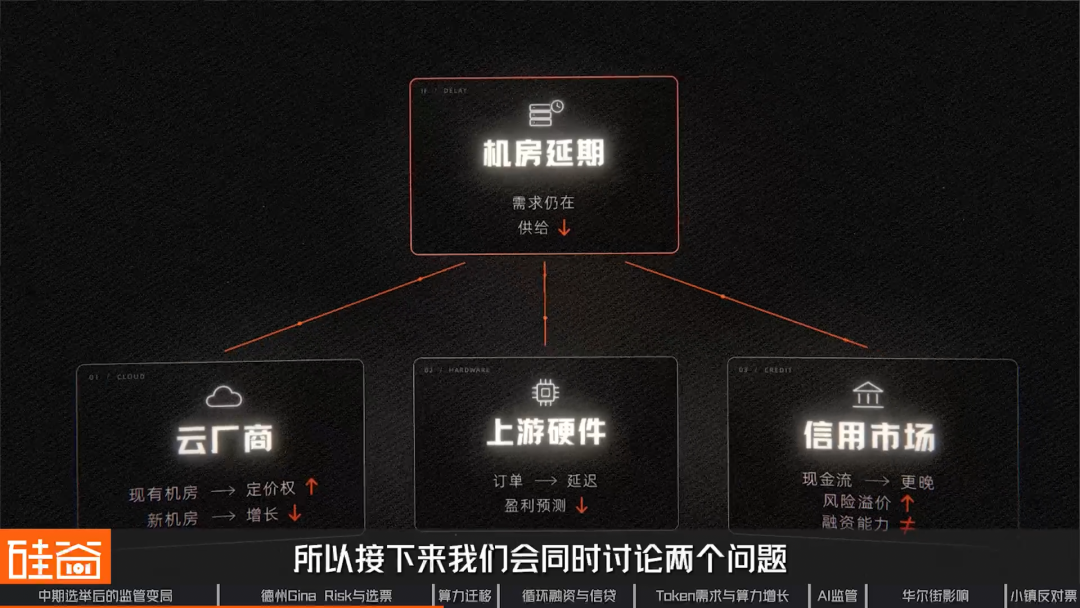
Is the market currently repricing supply delays, or are they doubting the true demand for AI? For tech giants, emerging cloud providers, as well as companies in chips, optical communications, and storage, the answers may differ.
Richard: There is now a most pessimistic narrative stating that the US may transform from a token-exporting nation into an import one. For instance, starting in 2028, many newly constructed data center capacities will transition to Southeast Asia due to ongoing wars in the Middle East, among other issues.
If before 2027 there are no significant impacts, what about after 2028? What predictions do you have, or what early signs have you observed?
Rob Li: Firstly, from the perspective of ongoing projects, it is undoubtedly clear that by 2027 they won’t be completed; it will at least be summer or the third quarter of 2028 before we need to consider the subsequent phase. Thus, any new construction projects still pending approval or in planning stages truly face challenges after 2029.
Secondly, everything discussed now regarding Southeast Asia or, as Musk suggested, spending more to directly establish projects in space, where nobody can regulate, boils down to chips in the negotiating process.
During the trade wars, there was uncertainty about how long their duration might last, half a year or a decade. If it extends for ten years, then how will China’s factories manage? Should they be fully shut down first and moved to Southeast Asia or other places, or even back to the US? Over a year ago, when trade war discussions began, many were predicting such outcomes.
Since April 2025 until now, over a year has passed, and only a small proportion of capacity has genuinely returned to the US, transitioned to Southeast Asia, or another location. I believe this contrast offers a valuable perspective.
From the corporate decision-making standpoint, this is a long-term cycle. Moving to Southeast Asia also involves issues regarding electricity, land, water, and local governments. Indonesia is currently in an unstable political situation; how many would dare to decide to halt all constructions in America and redirect all resources to Southeast Asia? Very few CEOs would make such decisions.
This is quite similar to corporate decision-making from a year and a half ago. Few have the audacity to declare a complete halt to Chinese factories, claiming no further constructions in China, moving everything to Southeast Asia or America. As of today, not many are doing that either.

Christina Xu: I agree with this perspective. I’d like to add that due to restrictions in the US, we’ve seen some companies, such as Nebius, make significant moves in Europe and begin exploring more power supply resources in Israel, places where electricity is relatively non-scarce. If they act as a larger neocloud company, ensuring they secure chips, even with restrictions in the US, they can leverage advantages from both sides simultaneously.
But in terms of Southeast Asia, I have observed that some startups in Silicon Valley are discussing utilizing more Southeast Asian chips, due to lesser restrictions. However, larger model training companies and major inference companies will certainly continue to consider local options more heavily.
So while facing some restrictions, there is no clear indication of migration occurring. I completely align with Rob’s earlier notion that while there has been a lot of discussion, actual migration to Southeast Asia remains very challenging.
Richard: The AI data center has always been a core component of the AI cyclic financing model. If the midterm elections alter expectations and lead to a decline in valuations and IPO delays for core companies like Sorby, what chain reactions might emerge? This could be a poor change for neoclouds. Which segments could tighten credit, possibly leading to greater domino effects or even a collapse?
Rob Li: Regarding the terminal collapse of the entire industry, we consulted some clients last week. The core is in demand, not supply.
Assuming that the demand curve remains unchanged, current policies regarding data centers, whether cancellations or delays, merely slow the rate of supply growth. If demand hasn’t changed but supply growth slows, intermediaries that already possess computing power will instead benefit. Demand remains robust, yet supply lags further behind, giving them stronger pricing power to increase prices. The essence of this narrative is demand.
If demand outright collapses, both NVIDIA and the Hyperscalers will encounter problems.
On the first day of last week, it piqued everyone's curiosity as to why AI-related infrastructure was falling sharply while companies like Amazon, among the Hyperscalers, saw a marked rise. The explanation at the time was that data centers could not be constructed; thus, they wouldn’t sell shovels and should decline. However, Amazon already possesses some data centers that can earn income and potentially charge higher prices, providing a foundation for their rise.
Looking further ahead, Amazon recently released earnings just before the midterm elections; CEO Andy Jassy provided long-term guidance for the first time. Previously, they provided guidance quarterly, and this time he stated that while this quarter's growth rate was 39%, which you might not find satisfactory, growth would accelerate to at least 40% in 2027 and remain the same for 2028.
This serves as his two-year strategic outlook. In other words, he believes that cloud demand will double in two years. This confidence derives from AI, not from general corporate demand transitioning from local to cloud.
If data centers cannot be constructed starting now, they can indeed raise prices in the short term since demand is still present and supply is limited. But looking further ahead, the data centers and computing infrastructure that Amazon currently has are far from adequate to support a doubling of demand in two years.
If they cannot build new ones in the US henceforward, they will be unable to meet the target of doubling demand in two years; it’s clearly unfeasible. Should their growth rate drop from 40% per year to possibly as low as 12% in subsequent years, a CEO who just outlined a 40% growth forecast would see that unable to be realized. You would have to question whether the company’s stock price and valuation should rise or fall.
This illustrates that the market itself does not possess a clear understanding of this issue and is often thinking in terms of the short term. Ultimately, the core remains demand; as long as demand holds steady, whether supply growth is slow or fast can be resolved in the end.
If, however, the demand is a false proposition, where companies discontinue investing because they fail to see returns, leading to the realization that they no longer need to spend on these tokens, if demand is discredited, the whole narrative concludes. I believe that is the most critical issue.

Bruce Liu: What are your thoughts? Will the midterm elections alter the original cyclic financing model of data centers?
Bruce Liu: I don’t necessarily buy into the concept of "cyclic financing." There’s a significant concept in economics known as "the velocity of money," which must circulate. My expenditure is your income, and after rotating among ten people, the same dollar, from an economic perspective, could generate ten dollars of GDP. However, the connections within the AI circle are remarkably short.
I believe that as long as there is tangible revenue growth, investing in these companies poses no issue. During the internet bubble period, why was it considered a bubble? Profits were declining while the stock market continued to rise, without substantial revenue backing. Now, when looking back at these figures, the situation is completely reversed, thus I won’t view it from that angle.
Nevertheless, AI construction is capital-intensive, and it undeniably requires support from capital markets; this is a consensus.
Over the past two months, significant changes have taken place in capital markets, especially in the credit market, experiencing a revaluation of credit bond risks. It’s a fairly complex chain.
In my understanding, the root cause is July 7, when Trump tore up an MOU (memorandum of understanding), leading to upheaval in the treasury market, a sharp rise in interest rates, and a spike in the MOVE (Treasury market volatility index). When the treasury and interest rate markets began to move, it naturally began to impact the credit market; this is the transmission chain of financial markets.
Initially, the credit market had no issues, but by September, when volatility arose in the treasury market, the credit market started worrying. Your costs have risen; previously, considering all else equal, if I lent you at an 8% interest, I would; but now, I may demand a higher rate.
This is from the perspective of the lenders. There are also supply-side problems; in May and June, there were significant bond issuances, and when everyone quickly wanted to issue bonds in September, the market needed time to digest this influx.
For instance, that week when CoreWeave received impacted financing, I forgot whether it was in September or early October. Everyone was focused on AI financing, but at that time, media company Skydance issued $80 billion in bonds, completely clogging the credit market.
These situations combined create credit market issues; it’s not that bonds cannot be issued, but at what price.
After that week, Musk remarked that all debts had become impossible to issue due to a short-term blockage. Yet that weekend, BlackRock and other institutions were still tirelessly signing new transactions, as they coincidentally found themselves in a position to negotiate better conditions.
Companies that recently raised funds managed to secure financing as long as their credit was solid; there were no issues with getting bonds issued. This will vary with changing financing conditions and inherently depends on the basic situation of each company.
For example, if Meta issues bonds now, they might have a slightly higher interest rate, but they can definitely pass. Amazon can too. However, for CoreWeave or smaller neoclouds, post the midterm elections, the uncertainty regarding future constructions and their timeline will lead bond buyers to demand higher risk premiums.
For instance, if I previously provided a loan at a 16% interest rate, now I may only lend at 20%. At this juncture, if CoreWeave believes their internal rate of return is at 40%, will they still proceed with the issuance? Possibly yes. But if they determine the expected returns are only 20%, they definitely will not.
The ultimate decision rests on whether the difference between investment returns and financing costs is appropriate. The investment community will invariably adjust pricing based on your future certainties. The supply side may also need to align accordingly.
Overall, AI development necessitates financing, entirely relying on cashflows, I believe, is unrealistic. If it could be accomplished, that would be ideal, indicating that the industry and model capabilities are exceptionally strong. Yet, there will certainly be periods requiring expenditure, where capital expenditures significantly exceed revenue growth, necessitating backing from capital markets.
The capital markets can provide support, but it depends on the price.

Richard: I want to ask Ethan a detail. SemiAnalysis stated that by the end of 2028, there could be a surplus of over a dozen GW in data centers relative to chip supply, implying that chip output does not meet the expectations of data center construction. What do you think about this gap? Now that data center construction is experiencing delays, could this gap be somewhat alleviated?
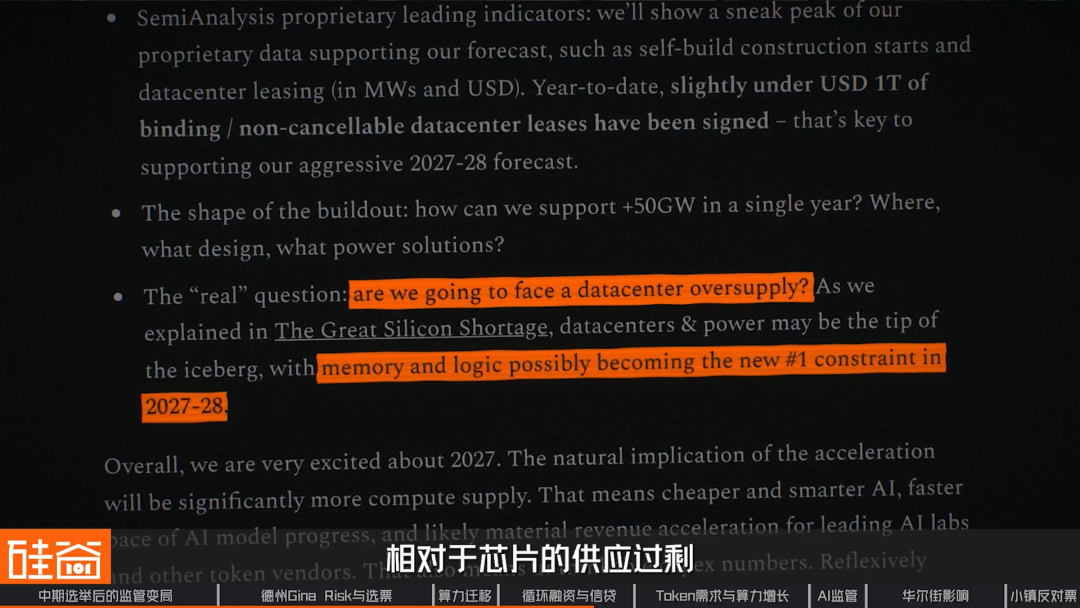
Ethan Xu: I agree with much of the semiconductor research conducted by SemiAnalysis, yet I explicitly disagree with its recent articles regarding computing power growth situations for 2027 and 2028. It claims that by 2027, the US will have 38GW of data centers rolling out, which far exceeds my personal judgment. Additionally, I do not concur with the conclusion that there may be a surplus of data center capacity relative to insufficient chips in 2028.
I believe that in both 2027 and 2028, the US will face a severe shortage of data centers. From a worldwide perspective, while some localized instances of having facilities but lacking chips could occur, it is more likely due to restrictions on exporting advanced chips rather than excessive data centers being constructed with inadequate chip growth.
When solely looking at the US, I disagree with the notion of having such capacity launching next year. Especially after the midterm elections, numerous unpredictable risks and impediments have emerged; many of which remain difficult to quantify. For example, measuring the extent of local residents' opposition is very challenging. Given such circumstances, I find it hard to believe that we could reach those scales, or that there will be more in the following year.
I expect that in the coming years, there will likely be a shortage of data centers while chips remain sufficient, and potentially even surplus. Under such circumstances, computing power will transform into a very scarce resource.I differ with Rob on one point: I believe that most data centers, including those in Texas, have yet to secure all necessary approvals. There are not as many fully approved data centers ready to be constructed immediately.
Many initial approvals for several GW in Texas were halted. To obtain grid approvals, exhaustive reassessments are needed. Since the new governor took office, the approval process has only become more complex and will entail added costs, regulations, and public acceptance requirements. All of these factors will sharply increase the risks that data centers without full approvals face in terms of timeliness.
Therefore, at least in the US, I do not foresee a surplus in data center supplies by 2027 or 2028. Globally, the same trend should hold; localized imbalances may occur, but they will likely represent isolated cases, not widespread trends.
Additionally, I am also pondering whether, for those with computing power, such as Amazon, will invariably perform exceptionally? It may not be as straightforward.
Many computing orders were signed a year or two ago, stipulating availability for next year or the year after, with pricing and contracts already determined. In such cases, would Amazon be willing to renegotiate, tear up contracts, or choose to breach agreements to enter into pricier, more lucrative contracts? This touches on matters of business credibility and long-term considerations.
Concerning profitability, I agree with Rob's assertion that the market has yet to ascertain how to price this, resulting in volatile stock movements. Regulatory and public sentiment risks may persist for a duration potentially spanning up to half a year, and fluctuations will likely continue.

Richard: Recently, there was a heated discussion on X, where a user named DEX estimated, based on traffic of DeepSeek on OpenRouter on a specific day, that one GB300 rack could almost meet these needs. If this estimation holds true, does that imply token growth will not yield significant hardware demand growth? What is your perception of this estimate?
Rob Li: I’m not fully familiar with the assumptions behind this estimate, hence cannot whimsically assess its correctness. However, that logic has been a topic of engagement since the day DeepSeek appeared in public.
If the efficiency of a model's computing power significantly increases, what could previously be achieved with a dollar's worth of computing today can be done tenfold, does that mean that less hardware is required?
The core lies in whether the demand can expand tenfold due to a 90% reduction in computing prices, or is more accurately a simple index. If computing prices decline by 90%, but demand only rises fivefold, hardware demand will inevitably decrease by half; yet if demand overshoots tenfold, hardware demand inherently continues to grow.
Therefore, the heart of the issue resides in the elasticity of demand upon price reduction: does a 90% cut lead to a tenfold multiplication, or is that figure higher or lower?
Bruce Liu: I’d like to pose a probing question: given the current landscape, what are your thoughts on demand over the next two years?
Rob Li: To be frank, we ourselves don’t have the answers either. I am uncertain how Andy Jassy arrived at such an aggressive forecast wherein he expects demand to double in two years.
Of course, it’s not just him; Jensen Huang has also stated that there will be at least a 40% demand increase each year. The forecasts from the three major memory manufacturers also predict demand growth of at least 35% to 40% over the next few years. While their growth rates might align, it’s uncertain whether real-world outcomes will match that.
From what we understand, the core driver of this scenario lies not in consumer demand, but rather in whether corporations are willing to invest money. Spending $100 today means at least $140 next year, and at least $200 the following year for tokens, in order to validate the industry’s projected demand trajectory. Currently, many corporate CFOs and IT decision-makers might not even know how much they’re willing to spend next year, necessitating continued observation.
I could provide several references. One could track companies handling data infrastructure like Snowflake and Databricks since they can gauge corporate demand accurately and in real-time.
Most companies currently utilizing tokens do not directly purchase from OpenAI and Anthropic; rather, they utilize platforms like Databricks and Snowflake to relay their demand to Amazon, Microsoft, and Google to consume their computing power.
Thus, who can observe the real-time token demand that enterprises have? Databricks and Snowflake can see the figures; Amazon, Microsoft, and Google can also observe them. But what they are seeing reflects real-time activities — they cannot predict what these corporate clients will be willing to spend in two years. I believe no one knows; continual observation is required.
Bruce Liu: I think the market’s pressure during this period stems from more than just supply issues. You can certainly argue that as the market declines, more ghost stories will emerge, but currently, confidence regarding demand is indeed not as strong as it was when AI Agents first appeared earlier this year. This is part of the market pressure.
I concur that quantifying this figure is impossible; it simply cannot be calculated — calculations along these lines are essentially guesses.
Rob Li: I completely agree with Bruce's viewpoint. Andy Jassy’s assertions concerning doubling demand and yearly growth rate of 40% have evidently not convinced the market. The market is saying, “You need to provide evidence before I believe Amazon’s growth expectations can be realized.” Currently, the market does not believe this matter.
Ethan Xu: Pertaining to Bruce and Rob's conversation on demand, based on what we have observed, I’m less concerned about demand and actually feel we can estimate it based on some evidence. For example, how many orders does each enterprise have on hand and how long might it take to complete the expected growth at the current rates? So far, these major cloud providers already possess orders they cannot fully deploy within three years.
Amazon and other companies have significant optimism about future demand, likely stemming from contracts already signed. Even with annual increases of 40%, those cannot be satisfied within the next three years. This provides the conclusion that they possess high confidence in achieving that annual growth rate, largely based on stable signals from the supply side.
From this angle, could we argue that there’s no need for particular concern regarding supply and demand? Bruce earlier mentioned the market's concerns over demand; I also want to understand where these anxieties originate.
Bruce Liu: Previously mentioned by Rob, it's about the growth rates. AWS assesses such estimations to indicate they have witnessed substantial orders. Collectively, the orders amongst them amount to $15 trillion, a massive figure; however, these contracts can be rescinded.
Should demand falter for whatever reason, clients may gradually withdraw from their orders. From this perspective, AWS is not a frontrunner; it’s not the first to observe changes, but instead may realize adjustments might be too late. The market seeks to anticipate changes even before AWS does.
This explains why there is particular concern regarding the ARR (Annual Recurring Revenue) figures of OpenAI and Anthropic. They are first to observe user growth—if ARR surges, the market doesn't fret. I believe this encapsulates the underlying logic.
Christina Xu: I would like to add something. While in Silicon Valley, I often converse with startups. Previously, we used to discuss that one cannot solely focus on OpenAI and Anthropic’s ARR.
First, those figures lag; second, the actual power they utilize for inference remains limited; and third, the entire token usage growth should be the primary focus, not just those Frontier Labs.
If one monitors the overall growth in token utilization, one may notice the share of Frontier Labs declining to some extent. How to track that? As Rob mentioned earlier, it's insightful to observe Databricks. A simpler method would be to observe Fireworks or Baseten, which directly furnish token services.
We observe that many startups, including numerous companies I’ve invested in, have seen their token usage increase ten to thirty-fold this year compared to last year. Of course, a vast majority (more than 80%) still primarily rely on Frontier Labs models. However, more are venturing into post-training and hosting their open-source models to control costs more effectively. Nevertheless, irrespective of whether models are open-source or proprietary, as long as token usage surges, the demand for computing power persists. This logic holds true.
Richard: Christina, is there any evidence of RSI (Recursive Self-Improvement) in token growth, or is most demand still derived from past usage patterns?
Christina Xu: There is indeed evidence for RSI. Currently, we’re observing several avenues emerging: one in security, another in drug development, and many are employing it for GPU compute kernel writing. In the short term, this is driven by a desire to generate revenue quickly; however, monitoring these RSI companies reveals that their primary complaint remains the insufficiency of computing power.
It is known that the leading firms have already secured $400 million in computing power contracts with Amazon, yet they are still actively seeking larger-scale power agreements. This is because ultimately, they recognize competition hinges on who is able to acquire more clientele to generate increasing data flywheels, as well as securing adequate computing power.
Bruce Liu: I will pose a contrarian question: if there is such fierce competition in computing resources, and demand is so strong, why are OpenAI and Anthropic engaging in price wars?
Christina Xu: I believe Anthropic does not necessarily need a price break. They could continue to fare quite well without it.
Our speculation suggests that there may be some public pressure to pursue such paths, so both entities have opted to go this route to enhance the presented quarterly outputs. OpenAI recently secured significant funding in this round, as you likely know, aiming for a valuation of $1.5 trillion but actually completing at $1.2 trillion, while still falling short of their expectations, having also been affected by market sentiments cooling off.
Under these circumstances, they have engaged in such activities, but the end results don’t appear to be as optimistic as anticipated. I feel this might be a strategic move, though not necessarily the most beneficial or correct approach.
Bruce Liu: At least from a market perspective, initiating a price war at this time, while not seeing equivalent usage spikes from that price war, generates worries: does a 90% price reduction not correspondingly generate similar demand growth? Overall, there remains an apprehension about a slowdown in growth. This partially explains the plethora of “ghost stories” circulating that negatively impact perceptions surrounding AI.
Christina Xu: I wrote a perspective in my public account, "Silicon Valley Non-Consensus." Gavin Baker mentioned this notion: these two companies can capture the majority of the economic value but may not command a large portion of the token usage.
Thus, engaging in price wars becomes quite inefficient; the vast majority of users do not choose these firms based on price sensitivity. Therefore, I feel that while this may not be strategically correct, it does not indicate a slowdown in demand.
Richard: Contextually, there are other underlying factors, like how DeepSeek and Kimi offer lower prices; if price wars aren’t wagered, demand will shift toward less costly open-source models.
Christina Xu: My viewpoint is that many who use open-source models likely consider factors beyond just cost, like data security, privacy, and so forth.
Thus, companies currently focusing on post-training are experiencing growth, such as Thinking Machines Lab; they initially aimed for frontier models but later recognized that these weren't sufficiently advanced and have now switched to post-training, which is another revenue-generating approach. Most of their clients prioritize data security in their considerations. Therefore, I feel it won't be as simple as pricing being lower to swiftly snatch those users away.
Bruce Liu: Aside from these states, how feasible are alternative options like Louisiana and North Dakota? Can a swift transition occur, or is it not that simple?
Ethan Xu: I believe every company in the computing sector is contemplating this question. The majority are already eyeing opportunities in those areas. However, casually moving data centers initially planned in Texas to other locations isn’t straightforward.
Data centers require not just electricity but also sufficient labor. Construction could require thousands of workers, and these cannot solely be inexperienced workers lacking data center backgrounds. They could come from surrounding economically developed regions, but are they willing to migrate to North Dakota or South Dakota and remain for two to three years for construction? Labor migration indeed presents a challenge.
The majority of the US fiber optic systems are also primarily laid around major cities and economically developed areas. Extending slightly from existing networks poses no issues, but constructing entirely new mainlines to sparsely populated, power-abundant states takes years and is no easy feat.
Furthermore, whether local laws and regulations are robust, and whether the attitudes of residents and government remain stable are all factors to consider. No one wants to relocate to a new place, have a solid first year of construction, yet have residents and government opinions completely change in the second year; that represents political risk.
It's certainly not as simple as many might conceive. Nonetheless, every company is drafting contingency plans, contemplating shifts to nearby regions with less regulatory risk, and those initiatives are already in motion.
Christina Xu: What Ethan mentioned holds true; we are indeed operationalizing that view, and the relocation challenges exceed expectations, particularly since electrical permits cannot be obtained immediately. You might build the shell of the data center, but if you can’t procure the power supply, it’s necessary to self-generate electricity.
Currently, many say each data center should self-generate power. However, among the planned capacity across the US, only 25%, or one-quarter, is self-generating. The number of currently operational behind-the-meter power projects might amount to only 2GW; I’m uncertain how this figure compares with Ethan’s view.
If expansive capacity scaling to 40GW is intended, power generation presents its own set of challenges. SpaceX has also mentioned the need to create its gas turbines and Tesla's battery support, as well as grid connections and various other plans, before addressing behind-the-meter power issues even to a certain extent. Thus, this poses a considerable problem.
SemiAnalysis tracks a wealth of data from numerous channels, and has satellite images. However, based on my past operational experience, I believe the time gap between completing construction and powering on could grow indefinitely, constrained by current policies. For instance, the previously initiated New Jersey project faced extensive delays for certain neocloud initiatives as well. Hence, delays will undoubtedly remain prominent; from that perspective, I believe this will greatly benefit existing computing power.
Looking at neoclouds, many companies' financing costs remain reasonable, possibly only around 7% to 8%, and their cash ratios are high. Neoclouds also present various scenarios; in fact, many are likely to find new opportunities emerging now. For neoclouds, arrangements involve NVIDIA quotas, client long-term contracts, and data centers. Data centers generally relate to powered shells (with integrated power supply and other infrastructure), whereby many companies opt to rent rather than build their own; if not renting, they may separately secure loans due to depreciation periods possibly extending to twenty years.
Previously, acquiring loans through NVIDIA quotas allowed swift access, but now that’s no longer feasible; securing long-term client contracts is essential for that. Even if a premium revenue rate is offered, with pricing potentially three to four times that of long-term contracts, those loan routes wouldn’t be acceptable; they’d certainly need long contracts.
Thus, neoclouds are confronted with a re-examination: should they continue signing relatively low-priced long-term contracts to secure financing? For instance, CoreWeave previously opted for maximum long-term contracts but is now seeking short-term agreements for higher rates while lacking substantial negotiation power to enter pay-per-use models. This could prove to be its most significant challenge, leading to a relatively unfavorable cycle.
Conversely, some neoclouds might actually benefit from the current situation. These are my observations.

Chen Qian:I want to follow up with Bruce and Ethan. Previously mentioned government regulation, the regulation of data centers might be more stringent, but the regulation of AI safety matters is likely to affect the R&D speed of Frontier Labs. Do you perceive that the market currently factors in risks regarding safety within the pricing mechanisms, or does it remain solely at the data center level without accounting for safety, AI, and R&D components?
Bruce Liu: To be frank, I don’t believe the market can neatly delineate which aspects have been counted and which have not.
From the perspective of AI safety, at least two bipartisan bills are about to be pushed out. The general direction still supports development, but there must be safety measures and emergency shutdown mechanisms in place. I believe what the market accounts for includes these aspects without feeling that regulatory measures are set to impede AI advancement.
If individuals like Bernie Sanders and certain legislators pursue extremely stringent measures, the market certainly hasn’t factored that into the prices. I recall that when AI safety emerged as a topic, Zuckerberg noted that safety measures had already been considered during model development; it's not an isolated concern.
This kind of discussion will only continue to grow, and regulatory pressures will inevitably exist. Moreover, from the perspective of federal and House legislation, this will certainly have priority due to its immediacy and importance.
Ethan Xu: My view aligns closely with Bruce’s. Currently, the market mainly expresses concerns regarding data center regulations and the risks of over-regulation.
Concerning safety regulations, every Frontier Lab, including Google, is taking them into account. For example, Google recently released its latest model but did not swiftly open it to the public; instead, it limited access to select individuals for initial usage, aiming to consider potential safety issues. They needed assurance that risks were manageable and wouldn't present substantial safety challenges before fully releasing it to the public.
This is a fairly resolvable internal issue within the AI industry: when developing models, corresponding safety regulations can also be established, which are relatively easy to handle. However, the development of data centers involves numerous factors beyond the control of tech companies, amplifying the risks involved.
Bruce Liu: I’d like to add one more point. The financial and automotive industries have developed over many years, establishing corresponding safety regulatory bodies. I believe that at some juncture, AI will also have its own institutions responsible for overarching industry safety.
Chen Qian:Recently, Trump signed an agreement with leaders from major AI companies, requiring firms to shoulder corporate responsibility.
This is a path to constrain enterprises through market mechanisms: if AI generates problems, its corporate image diminishes, consumers vanish, and the enterprise may suffer severe repercussions as well. In order to avoid such outcomes, companies will reinforce AI safety and ensure their products are problem-free.
Will there be changes in this mechanism once the Democrats gain power? Will it transform into heavy government regulation? If the approach shifts, what implications might it hold for AI research speeds?
Bruce Liu: Based on my last engagement, I wouldn’t describe this stance as the prevailing attitude among the
免责声明:本文章仅代表作者个人观点,不代表本平台的立场和观点。本文章仅供信息分享,不构成对任何人的任何投资建议。用户与作者之间的任何争议,与本平台无关。如网页中刊载的文章或图片涉及侵权,请提供相关的权利证明和身份证明发送邮件到[email protected],本平台相关工作人员将会进行核查。