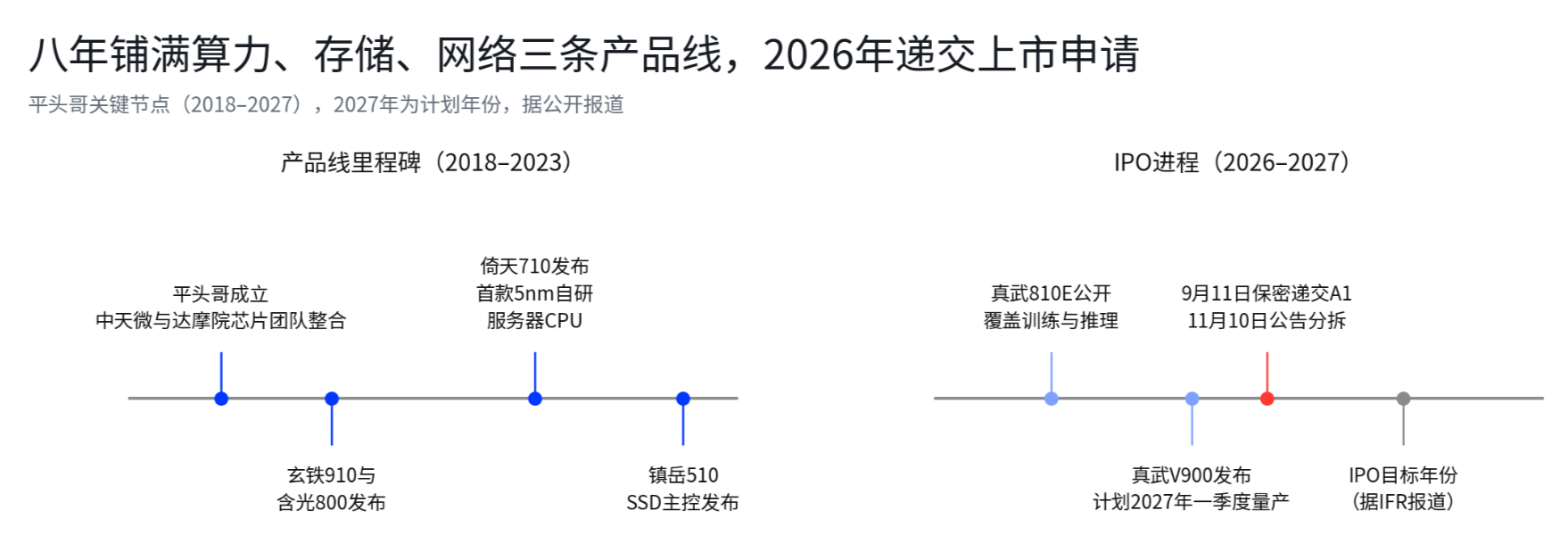
On the evening of November 10, Alibaba-W (09988.HK) announced that it plans to spin off its wholly-owned subsidiary Pingtouge (Shanghai) Technology Co., Ltd. for independent listing on the main board of the Hong Kong Stock Exchange. The Exchange has confirmed that the spin-off can proceed; Pingtouge had previously submitted the A1 listing application form confidentially on September 11. It took Pingtouge about 8 years from its establishment to prepare for the IPO.
This company is named after the honey badger, initially positioned for chip design, and now its products cover AI computing, server CPUs, SSD controllers, intelligent network cards, interconnect chips, and RISC-V processor IP. The company's annualized revenue exceeds 10 billion yuan, and the Zhenwu series AI chips have already transitioned from product validation to large-scale commercialization. The key points of Pingtouge's IPO now revolve around "how much the products can sell for, how independent the customers are, how much profit can be retained, and what valuation the capital market is willing to assign."
For the Hong Kong stock market, this is also an event worth adding to the observation list in advance: if it ultimately lists, the Hong Kong domestic computing power sector will gain a new chip company covering computing power, storage, and networking, which will provide the market with a more direct price reference for domestic AI chips.
1. The Exchange Confirms Spin-off, Pingtouge IPO Enters Substantial Advancement Stage
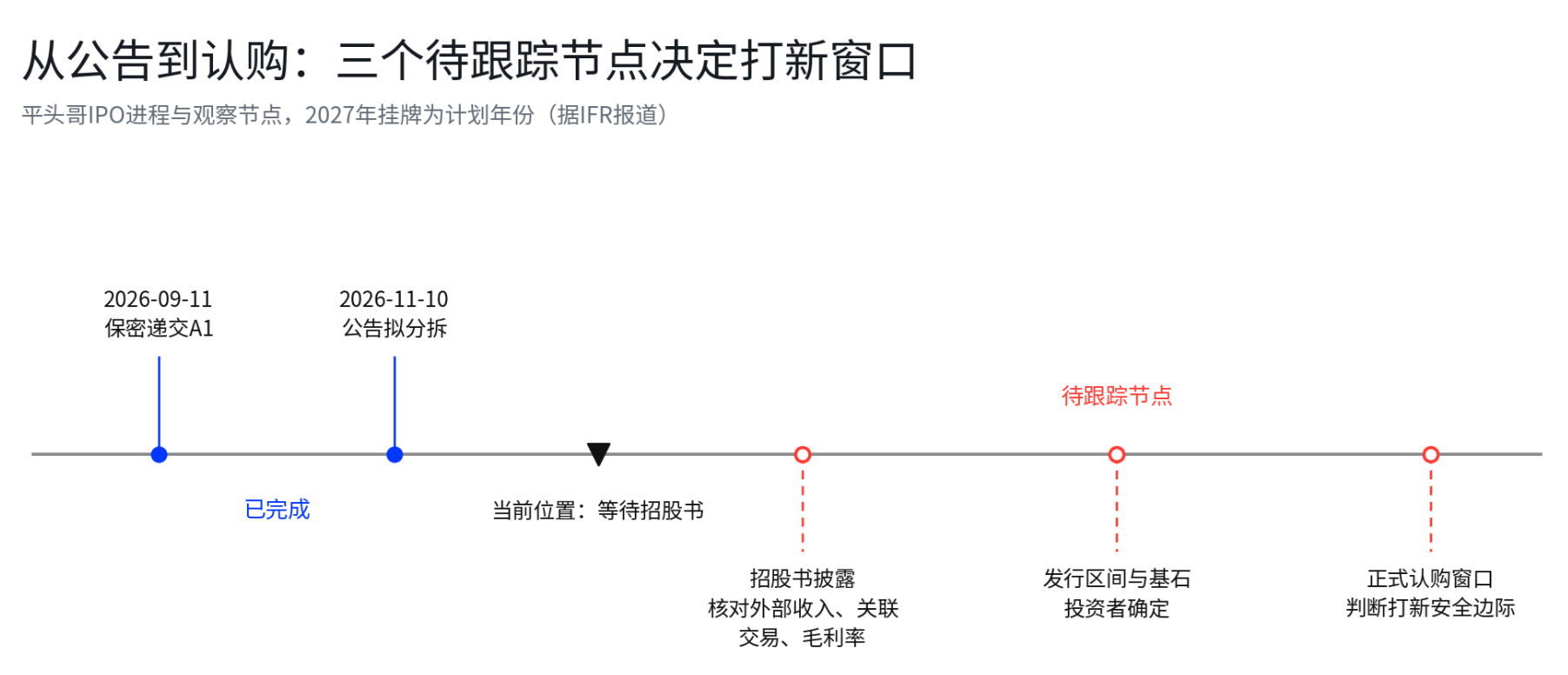
The currently available information is quite clear. Alibaba submitted the spin-off proposal based on item 15 of the Hong Kong Stock Exchange listing rules, and the Exchange has confirmed that the spin-off can proceed. Pingtouge submitted the A1 application form confidentially on September 11, 2026, planning to apply for H shares listing and trading on the main board of the Hong Kong Stock Exchange, with a global offering of H shares, which includes a public offering in Hong Kong as well as a placement to institutional and professional investors.
This spin-off does not involve "selling" Pingtouge; after independent listing, Alibaba will continue to maintain its control relationship, and Pingtouge will still be a subsidiary of Alibaba. This has two direct implications for the company: on one hand, after independent listing, the revenue, customers, R&D investment, and profitability of the chip business will gain clearer capital market pricing; on the other hand, Alibaba Cloud, Qianwen, and other internal ecosystems will still be able to provide application scenarios and computing power demand, meaning Pingtouge is not completely detached from its original ecosystem to start anew.
As for the fundraising scale and listing timeline, current market information remains in the expectation stage. According to IFR reports, this issuance aims to raise $2 billion to $3 billion, targeting a listing in 2027. What can now be confirmed is that "the IPO process has started", while the issuance scale, issuance price, and listing valuation are not yet final results; the next document that will truly determine the new share value will be the prospectus.
2. Over 10 Billion Revenue is Not Just a Story: Zhenwu Chips Have Entered Large-Scale Commercialization
Pingtouge's most valuable change at present is that its business has transitioned from "chip R&D" to "chip sales". According to disclosures from the company's earnings report conference, Pingtouge's annualized revenue exceeds 10 billion yuan, and cumulative shipments of the Zhenwu series AI chips have exceeded 470,000 units; media statistics show that as of April 2026, cumulative shipments of the Zhenwu series were about 560,000 units, and by June 2026, it has served over 650 enterprise customers, with external commercial customers accounting for over 60%.
If this commercialization trend can be further validated in the prospectus, then Pingtouge will be markedly different from early chip companies that rely solely on a technology story to support their valuation: it already has revenue, shipments, and customers, and has entered a real procurement cycle.
Product-wise, there is ongoing iteration. Public data shows that the Zhenwu 810E features 96GB HBM2e memory and 700GB/s inter-chip interconnect bandwidth, which has been used in some Alibaba Cloud Wan Card clusters for Qianwen large model training and inference. The next generation Zhenwu V900, scheduled for release in September 2026, will upgrade the memory to 216GB and inter-chip interconnect bandwidth to 1200GB/s, with official claims that its computing power is three times that of the previous generation, planning to begin mass production in Q1 2027.
For the IPO valuation, the significance of V900 lies in its growth logic: if V900 can be mass-produced as planned and generate revenue, Pingtouge will have the opportunity to prove that its growth is not entirely dependent on existing products but can continuously elevate revenue ceilings through the new generation of chips. This will directly affect the central valuation that the market assigns to it.
3. From AI Chips to RISC-V, Pingtouge Offers a Product System
Another advantage for Pingtouge is that its business is not limited to AI acceleration chips. Currently, the company's data center products cover the Zhenwu series AI chips, Yitian 710 server CPUs, Zhenyue 510 enterprise-grade SSD controllers, Panmai intelligent network cards, and ICN interconnect chips; at the terminal side, there are the Xuantian series RISC-V processor IPs, with cumulative shipments exceeding 6 billion units and over 400 ecosystem partners.
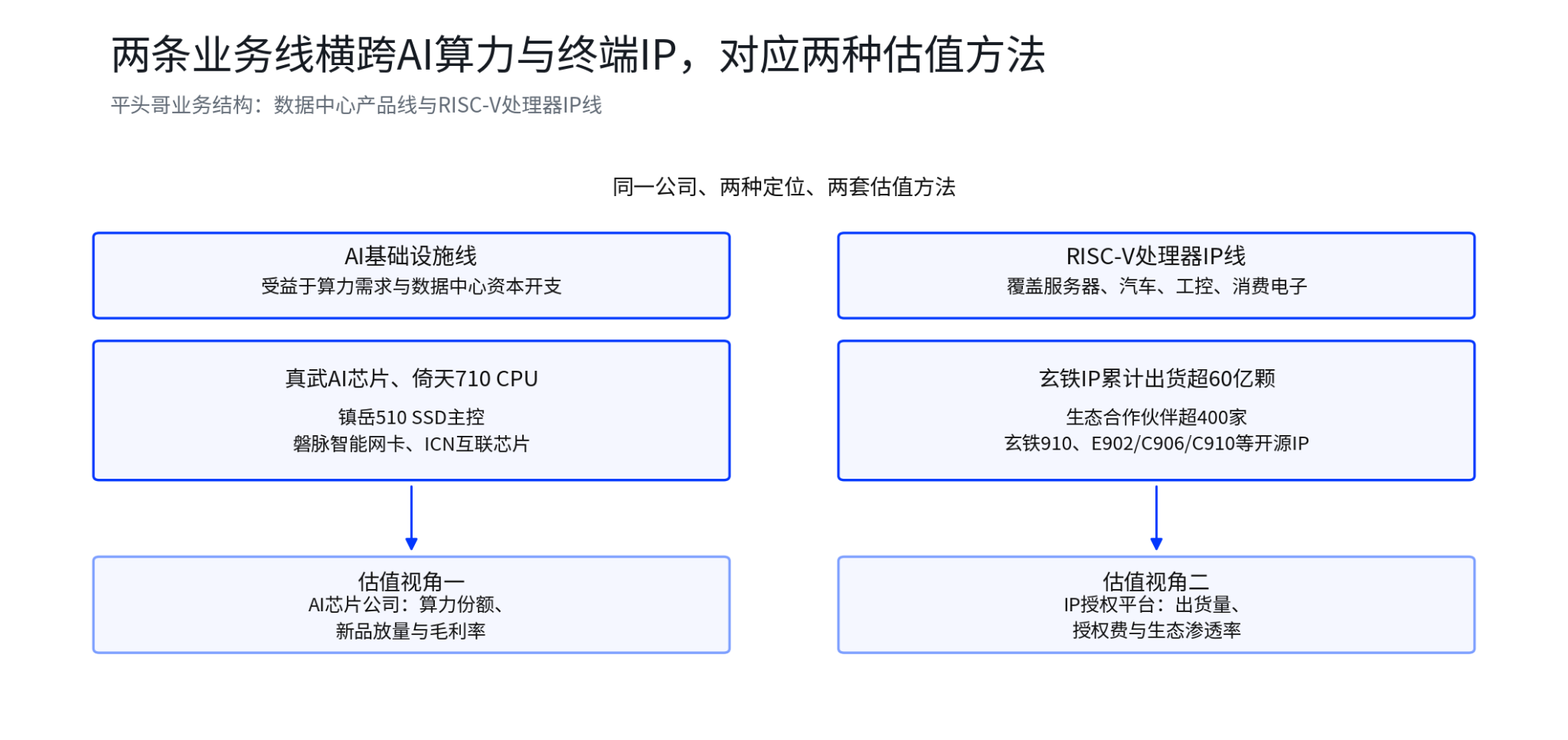
This means that Pingtouge's business model spans across two lines: one is AI infrastructure, directly benefiting from computing power demand and data center capital expenditures; the other is RISC-V processor IP, covering a broader terminal market including servers, automotive electronics, industrial control, and consumer electronics.
For Hong Kong stock investors, this business structure is worth noting as it determines whether Pingtouge will ultimately be viewed by the market as an AI chip company, a comprehensive chip platform, or a computing power infrastructure asset within the Alibaba ecosystem. Different positioning will correspond to different valuation methods.
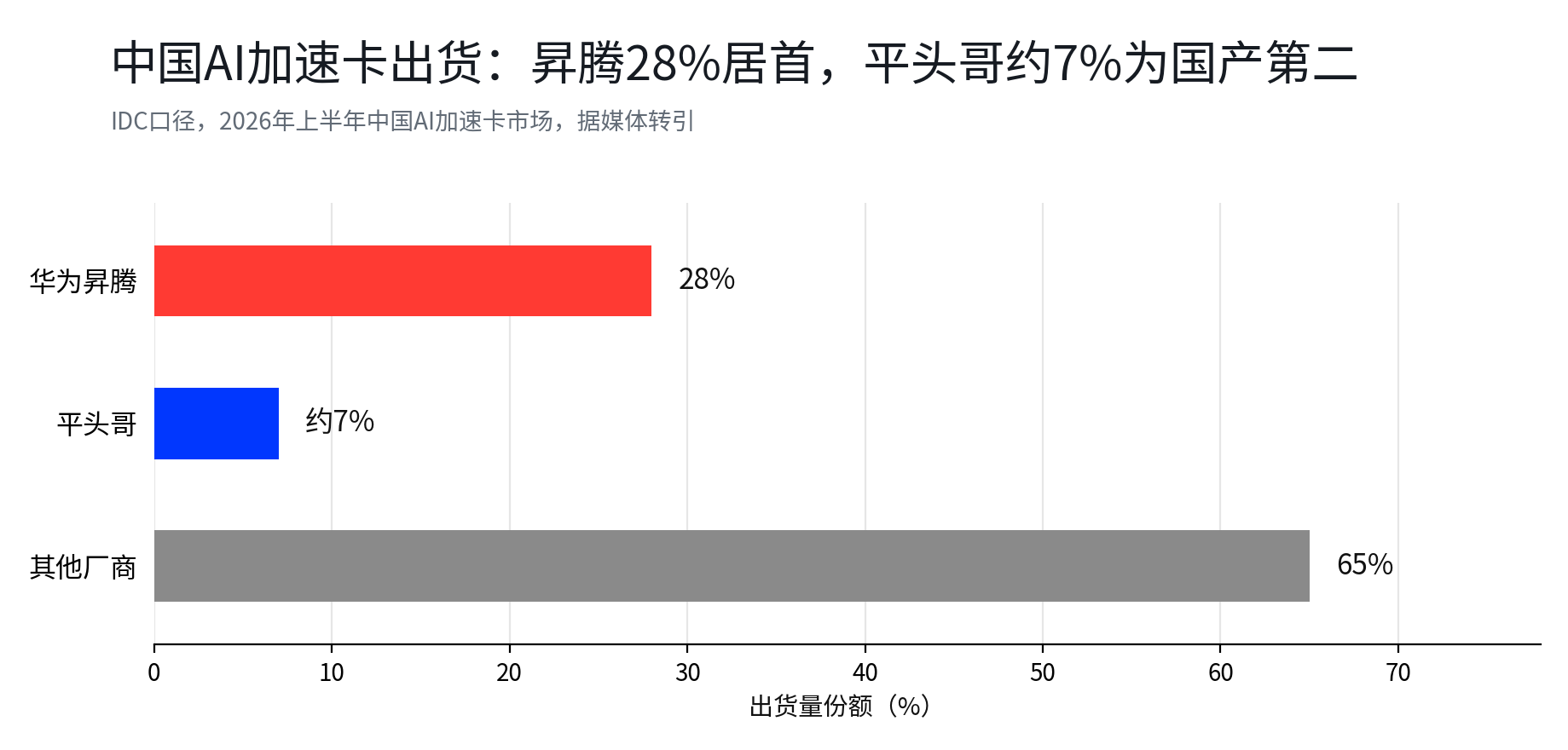
In terms of AI infrastructure, third-party data already provides a reference for market position. According to IDC data (cited by media), in the first half of 2026, Pingtouge's market share in China's AI accelerator card market was approximately 7%, ranking second among domestic players, just behind Huawei's Ascend at 28%.
4. The Real Valuation Mystery: $20 Billion to $86 Billion, Why the Difference of $66 Billion?
Currently, the market's valuation expectations for Pingtouge vary significantly. According to the 21st Century Business Herald, professional institutions have given a valuation range of about $20 billion to $30 billion; JPMorgan's estimates from January of this year range from $25 billion to $62 billion; other media reports indicate that Morgan Stanley's valuation range is approximately $28 billion to $86 billion. The difference between the highest and lowest is $66 billion.
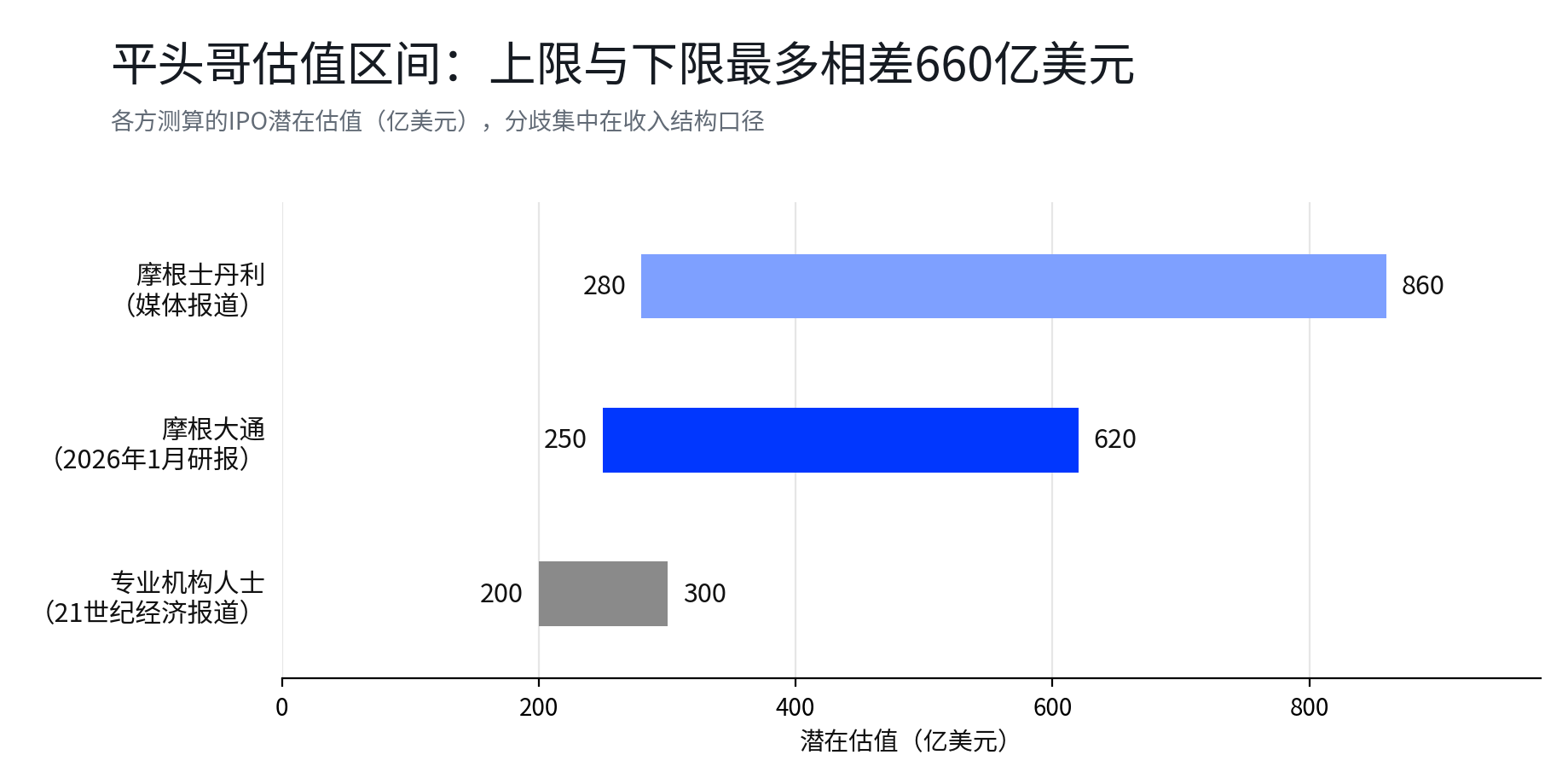
For a company, this already exceeds the normal estimation error of a few hundred million dollars and indicates a significant divergence in the capital market’s understanding of the business model. This divergence does not mean that the market is unaware of how much Pingtouge is worth; the real issue is that several key accounts are still missing.
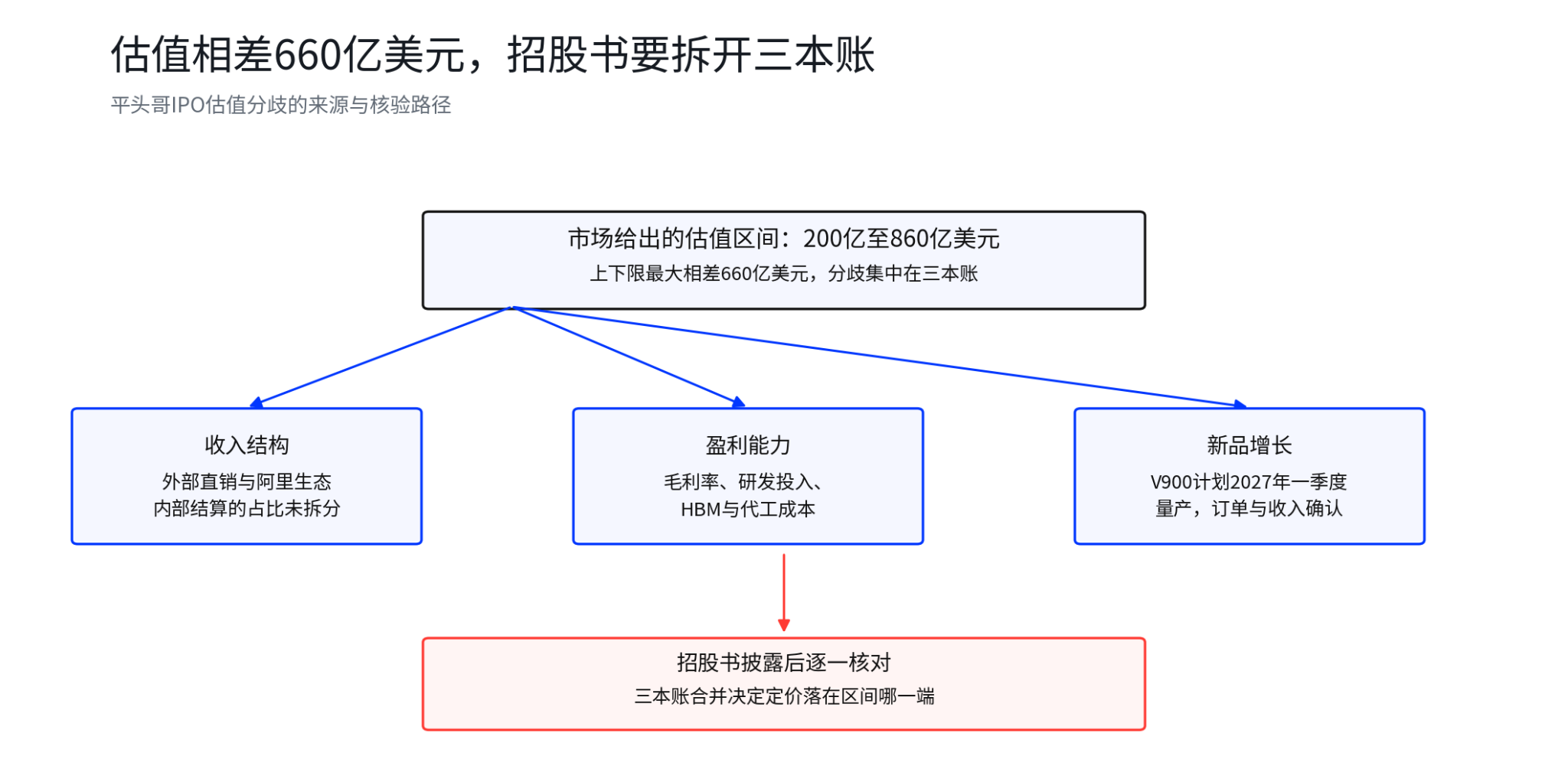
First is the income structure. Pingtouge's annualized revenue has already exceeded 10 billion yuan, but how much of that comes from real external customers, and how much comes from the internal orders of the Alibaba ecosystem is still lacking complete public data.
Second is profitability. Revenue growth in a chip company does not automatically equate to high profits; R&D investments, wafer manufacturing, advanced packaging, HBM, and other supply chain costs will affect final gross margin and net profit. The market's willingness to assign high valuations presupposes that high revenue can gradually transform into sustainable profits.
Third is new product growth. If the V900 smoothly enters mass production in Q1 2027 and quickly generates orders and revenue, what the market will see is a product curve that continues to expand upward, with the potential for revenue to exceed the current 10 billion income.
Therefore, what is truly worth watching in the prospectus is the financials and customer structure that can push the valuation from $20 billion to $86 billion.
5. Watch These 5 Numbers Before the Prospectus is Disclosed: They May Determine Pingtouge's Worth
After the prospectus is formally disclosed, investors should pay special attention to the following five items.
1. Proportion of External Customer Revenue. Current publicly available information shows that external commercial customers account for over 60%. If this number continues to rise, it means Pingtouge's reliance on internal orders from the Alibaba ecosystem is decreasing, enhancing its ability for independent commercialization; if it remains at a low level long-term, there will be a need to pay more attention to related transactions and revenue quality.
2. Growth Rate of External Revenue. Total revenue growth is important, but external revenue growth is even more critical. If the growth rate of revenues from external customers continues to exceed that of the overall business, it indicates that Pingtouge is transitioning from being a chip company within the Alibaba ecosystem to a market-facing chip supplier.
3. Mass Production Progress of the Zhenwu V900. The current official plan is for mass production in Q1 2027. For new share valuation, V900 is more than just a product launch event; it is an important validation point for whether the next round of revenue growth can be fulfilled. Mass production, shipments, customer onboarding, and revenue recognition form a complete chain that is truly worth tracking thereafter.
4. Gross Margin and R&D Investment. The chip industry cannot just look at revenue. If revenue is growing rapidly while gross margins improve and the proportion of R&D investment gradually declines, profit elasticity will significantly enhance; conversely, if revenue growth mainly relies on high R&D investment and high supply chain costs, it will be more difficult for the market to assign high valuations.
5. Issuance Valuation and Issuance Price. This is the most direct question for the Hong Kong IPO market. No matter how good the company is, if the issuance price is too high, it will compress the margin of safety for new shares; continuous improvement in fundamentals and a relatively restrained issuance valuation will make it easier to form positive expectations.
As a result, once the subscription phase truly begins, the issuance market cap, fundraising scale, issuance ratio, peer valuations, and company profit forecasts should all be considered together; looking solely at market rumored valuation numbers is not sufficient.
6. The IPO Has Not Yet Reached the Subscription Window; What Should Hong Kong Investors Look at Now?
Pingtouge is still in the process of advancing the IPO, and the formal offering and final issuance conditions need to await subsequent documentation. Therefore, the most appropriate action now is to establish an observation list in advance; the issuance price has not yet been determined, and no pre-transaction can be discussed.
The most direct observation direction is the domestic computing power sector in Hong Kong stocks. If the market begins to trade on the expectations of Pingtouge's IPO in advance, related directions such as domestic AI chips, servers, semiconductor manufacturing, packaging testing, storage, and data center infrastructure may experience emotional linkage.
However, this linkage needs to distinguish between two types of signals: if it involves increased trading volume, leading stocks strengthening together, and basic orders or price changes in the industry chain, it typically indicates a more quality sector trend; if it is merely a one-off stimulus under the IPO news, it is more suitable for observation rather than simply chasing higher prices.
For newcomers in the Hong Kong IPO sector, what is truly worth waiting for are the following three milestones: disclosure of the prospectus, determination of the issuance range and valuation, and formal subscription. At the stage of formal offerings, combining issuance valuations, cornerstone investors, the public offering ratio, company profitability, and peer valuation to judge whether participation is worthwhile will be much more meaningful than guessing the issuance price in advance.
7. Why This IPO is Worth Continuous Monitoring
Pingtouge's significance goes beyond just being another subsidiary of Alibaba going public. If it ultimately succeeds in debuting on the Hong Kong stock market, the market will gain a domestic chip platform company that covers AI computing power, server CPUs, storage control, network interconnects, and RISC-V IP.
More importantly, as revenue, customers, shipments, and R&D investments gradually become public, the market will be able to start comparing the commercialization capabilities of domestic computing companies using the same capital market language. For investors, this comparability itself constitutes value.
In the past, the market focused more on trends and thematic expectations related to domestic computing power; after listing, investors can further compare who has faster revenue growth, who has more external customers, who has higher gross margins, and who can convert R&D investment into sustained orders. This is also the most concerning aspect of Pingtouge's IPO: it may shift the focus of domestic computing power from thematic trading to fundamentally driven pricing.
In Conclusion: First Assess Company Quality, Then Look at Issuance Price
Pingtouge, from its establishment in 2018 to its current annualized revenue exceeding 10 billion yuan and cumulative shipments of hundreds of thousands of AI chips, has made significant strides towards its IPO on the Hong Kong stock exchange and has completed an important step from technological R&D to commercial verification. However, the real reason to invest in this IPO should not just be labels like "a subsidiary of Alibaba," "domestic computing power," or "AI chips."
The most important aspect moving forward is whether the prospectus can support a higher valuation based on Pingtouge's external revenue, customer structure, gross margins, R&D investment, and V900 mass production capabilities after it breaks down the accounts. The market's given valuation range of $20 billion to $86 billion serves as a good reminder: gaining direction recognition does not equate to worth buying at any price.
For Hong Kong stock investors, at this stage, they can add Pingtouge to their watch list for new issues, focusing on tracking the prospectus, issuance valuation, and cornerstone investor situations. Once the price is truly determined, assessing whether a "good company" and a "good price" emerge simultaneously will be much more meaningful.
Under the premise of meeting eligibility requirements and jurisdictional restrictions, BIT provides trading services for qualified users in Hong Kong stocks and U.S. stocks (Hong Kong stock trading services are not available to Hong Kong residents or users from other restricted jurisdictions). The guarantee financing for IPO subscriptions may increase the subscription amount but does not guarantee more allocations; leverage will magnify costs and risks and should be considered cautiously alongside personal risk tolerance. This article does not constitute investment advice, and participation is at the investor's discretion.
Disclaimer:
This article's content is for general informational and market commentary purposes only, compiled based on publicly available data as of the time mentioned in the text; relevant market data, expectations, and probabilities may change with market conditions. The views and investment strategies of third-party institutions, analysts, or other individuals cited in the text only represent the views of the respective third parties at a specific time and do not represent BIT's views or recommendations. This article does not constitute investment advice, investment research, an invitation, a solicitation, or a recommendation for any securities, investment products, or trading strategies, nor should it serve as the basis for any investment decision. Financial markets involve risks, and security prices and market performance may fluctuate, with past performance and historical market trends not representing or guaranteeing future results. Investors should independently assess relevant risks based on their own situations and seek professional advice if necessary.
免责声明:本文章仅代表作者个人观点,不代表本平台的立场和观点。本文章仅供信息分享,不构成对任何人的任何投资建议。用户与作者之间的任何争议,与本平台无关。如网页中刊载的文章或图片涉及侵权,请提供相关的权利证明和身份证明发送邮件到[email protected],本平台相关工作人员将会进行核查。


