
Text|Zhao Rui
Editor|Zhang Yuxin
In September, the interactive movie game "Spring Snow" about "the rise of a strong female lead" on Douyin's gaming platform attracted over 1.2 million players in just two weeks.
The game was created by a newly graduated girl. She has no background in game development and usually enjoys writing novels. With the help of the AI interactive content creation tool NEX from Future Sequence, she transformed her written novel into a playable interactive movie game. In the game, players can make choices at key points in the story, with different choices leading to different fates for the characters.
试玩版 of "Spring Snow"
In the past, creating such an interactive movie game required collaboration from more than a dozen professional roles, including game planning, art, and development, with development cycles often measured in years. Each additional plot branch also meant hundreds of thousands in production costs.
Generative AI is improving this situation. However, while AI lowers the barriers to game production, it does not guarantee the creation of enjoyable games.
In addition to generating characters and scenes, a game must also engage players continuously, requiring professional gameplay design, responsive controls, and balanced difficulty. For interactive movie games, there is an additional need to balance story appeal with gameplay. How can each player choice reasonably influence the plot direction? How do gameplay elements such as battles and puzzles integrate seamlessly with the story?
In October 2025, Qin Kai founded Future Sequence and developed the AI interactive content creation tool NEX. The team started with interactive movie games, transforming the expertise of professional gaming teams in narrative branching, gameplay design, and audiovisual production into expert models and creative processes that AI can utilize, helping ordinary creators turn their stories into playable works.
Qin Kai graduated with a master's degree from the Computer Science Department of Peking University. He initially worked on VR and video creation tools for general users. While serving as GM of content ecology at Mini World, he was responsible for the creation engine, creator operations, and content distribution. During his tenure, the platform's monthly active creators increased from 20,000 to 1.2 million, and daily active users grew from over 4 million to 22 million. He later became the product lead of the GiiNEX engine at Tencent AI Lab, promoting the integration of AI creation tools and agents into actual production processes. Now, with NEX, he hopes to first streamline the creative process for an interactive movie game before handing the tool over to more creators.
Currently, Future Sequence has secured millions of dollars in seed funding, led by the L2F Light Source Entrepreneur Fund. The team consists of nearly 20 people, including scriptwriters, lead planners, and members from teams at Tencent AI and Mini World who have previously worked on games like "Invisible Guardian" and "Glorious World." The company plans to first attract creators through NEX, accumulate interactive works, and then gradually build an overseas mobile interactive entertainment platform that connects creators and users.

Entering through interactive movie games to build an AI fully dynamic interactive content platform
Future Sequence currently focuses primarily on AI interactive movie games. This is a content form that lies between films and video games: players can experience the story as if watching a movie while also having the opportunity to influence the story's outcome through choices, battles, and puzzles.
Such works especially test multi-branch plot design, as well as how to integrate gameplay elements like battles and puzzles into the story to assist in narrative progression and enhance immersion. The target audience is not limited to traditional gamers but can also include fans of short dramas, novels, and casual mini-games.
In this direction, NEX is directed towards novel authors, comic writers, screenwriters, and ordinary creators, integrating the production processes that previously required professional collaboration into a set of AI tools. Qin Kai describes it as a "virtual game development team."
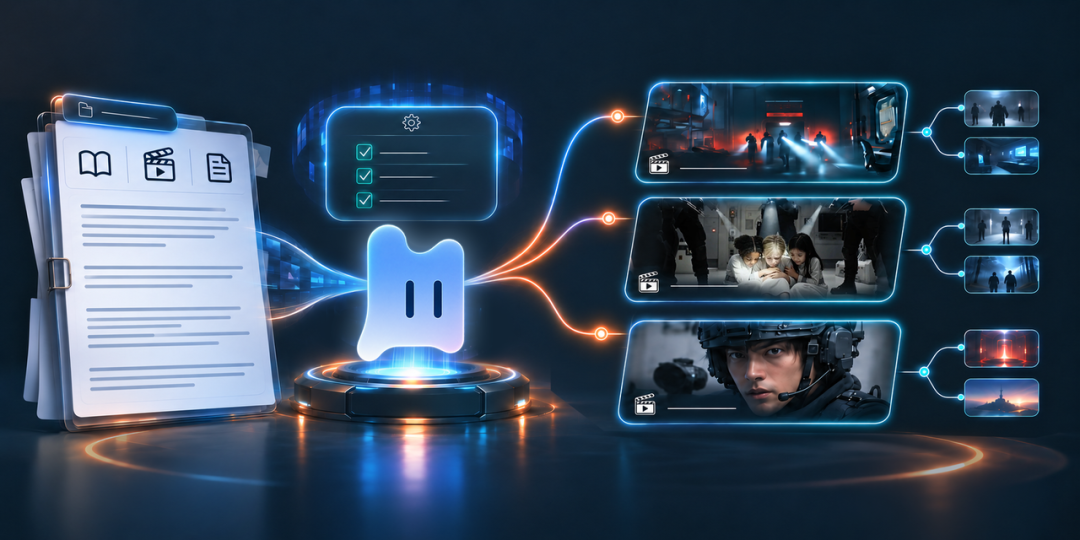
Once users hand their stories to NEX, the AI first transforms the linear story into an interactive script with multiple branches, different endings, and changes in character relationships, and then designs gameplay elements like battles, puzzles, and character development based on the interactive script, allowing player actions to push the story forward. It then generates corresponding storyboards, characters, scenes, and videos, finally integrating this content into the game system, where creators can configure paid nodes that match the narrative rhythm to complete testing, package with one click, and support multi-platform release.
Different sections are completed through the collaboration of agents in creation, branch design, art, direction, and game development. Creators can request modifications during the process to adjust the story, visuals, and gameplay.
Demonstration of branch writing agent process in real-time
Qin Kai stated that as of the end of October 2026, professional creators cooperating with them had already produced over ten games using NEX, as well as two official adaptations of IPs, covering various genres such as historical, mystery, fantasy, and romance.
The company is also experimenting with combining different genres with gameplay. For example, "Rebirth: Monarch of the Dead", adapted from a well-known overseas comic IP, employs a dark fantasy theme combining multi-linear storytelling with battle QTEs. According to the company, the game design includes 33 main scenes, 34 interactive nodes, and 102 narrative outcomes.
For Future Sequence, these works need to validate two things: whether users will continue playing to explore alternate storylines and whether creators can consistently produce works of different genres using the same tool. According to Qin Kai, in addition to "Spring Snow," five to six works have received feedback from the Douyin platform and discussions have begun regarding their official launch.
According to Qin Kai's plan, Future Sequence will initially validate market demand through works produced by official and professional creators on existing platforms like Douyin Mini Games and Steam, focusing on overseas and mobile markets.
As the products are gradually improved, the company plans to open NEX to more ordinary creators, allowing novelists, comic creators, and others to independently produce and publish interactive works while obtaining income through content payments, in-app purchases, and advertising. The long-term goal is to evolve from a creation tool into an interactive entertainment platform that integrates content production, distribution, consumption, and transaction.

From generating games to making good games
Currently, the exploration of AI games varies; some focus on generating scenes and gameplay, while others focus on adapting novels and scripts into interactive stories. Another direction is utilizing world models to generate and alter game environments in real-time during gameplay. This technology is still in the research and early application stages, facing challenges in generation costs, long-term consistency, and complex interactions.
For interactive movie games, even if visuals can be generated, they still need to balance story appeal with gameplay enjoyment. For example, while an AI can easily rewrite a novel into various plot branches, if the story quickly returns to the same main line after a player makes a choice, or merely changes a few lines of dialogue, it will not generate a true sense of participation.
To make choices meaningful, professional screenwriters and game planners need to consider in advance: Why does a character make a certain decision? How do different choices alter character relationships? How do previously established foreshadows influence subsequent plots? How do these changes encourage players to keep exploring?
The same applies to gameplay. Adding several buttons to a video does not inherently make it a fun game. Gameplay elements such as battles, puzzles, and card mechanics need to serve the story, designed according to character settings, worldviews, and plot development, rather than awkwardly inserting a mini-game into the story.
For instance, when adapting a novel into an interactive movie game, one must first clarify the script’s themes, worldviews, core control dynamics, and main story arcs, then rewrite the linear story into a branching narrative tree. The choices players make at key junctures will impact character relationships, ability values, and dominant personality traits within the game, influencing future plots. Which choices align with character personalities, and which branches are worth exploring further, need to involve professional screenwriters and planners in the design.
To this end, Future Sequence has assembled a team experienced in interactive content production, AI development, and IP operations. According to Qin Kai, the team includes individuals who have served as chief narrative editors for "Honor of Kings World," along with screenwriters and planners who have worked on "Invisible Guardian" and "Glorious World." The algorithm partner has experience in multi-modal model research at Tencent, with expertise in model retraining and generating game assets. Another partner boasts over a decade of IP operations and animation production experience. During the development of NEX, screenwriters and planners structured their professional judgments into data, allowing the algorithm team to optimize expert models and agents accordingly.
At the same time, the team is also translating the gaming experiences brought by professional physics engines like UE into AI capabilities.
When a player controls a character to punch an enemy, a well-designed game will cause the enemy to briefly stagger, coordinating the action with pauses, sound effects, visual effects, and vibrations to let players feel the impact of the punch. Traditional games can achieve this feedback through 3D models and physics engines. However, AI interactive movie games typically utilize pre-generated video clips, leading to new production challenges in avoiding stiff animations, abrupt cuts, while maintaining a sense of impact.
To accumulate these capabilities, Future Sequence is simultaneously developing NEX and creating works with it, inviting professional creators to test it. The team collects the production experiences of professional screenwriters and planners, along with records of how creators modify and correct AI-generated results, sanitizing and summarizing them into a knowledge system for further model training.
Games created using NEX "Rebirth: Monarch of the Dead" play demonstration video
Qin Kai believes that in a highly specialized field like interactive movie games, high-quality data that can address specific production issues is more important than simply increasing the volume of data. Beyond storylines and gameplay, Future Sequence is also attempting to integrate components required for publication and commercialization into NEX, providing creators the chance to present their works to audiences and earn revenue from them.

From experiencing stories to rewriting stories
"Future Sequence" embodies Qin Kai's ideal: In what seems like a predetermined fate, individuals can strive for another possibility through their choices.
The inspiration for naming the company "Future Sequence" came from an anime he admired in his student days—"Steins;Gate." In the story, destiny appears to be predetermined, with the protagonist repeatedly traversing time toward similar endings, but ultimately, through willpower and at great cost, he finds a timeline leading to his ideal conclusion.
In Qin Kai’s view, reality is not so ideal. "Limited by various conditions, it is difficult for people to fully follow their hearts in making decisions."
The charm of stories and games lies in their ability to allow people to temporarily step out of their own lives and experience another situation or fate. Interactive games provide an additional layer of experience: the ability to make choices that determine subsequent events. Qin Kai's aim, starting with interactive movie games, is to verify, if a single choice can truly change fate, would people play again for a different life?
In the past, even if an interactive movie game designed dozens of endings, players could only follow the predetermined paths laid out by the development team. With advancements in model capabilities, Qin Kai hopes to allow stories to remember what users have done, whom they have established relationships with, and what decisions they have made at critical moments, enabling these experiences to alter what follows.
Entering the same story, some may embark on adventures, some may choose to retreat, some may sacrifice themselves to help others, and some may prioritize their own protection; everyone will receive an ending uniquely theirs.
Moreover, an individual's choices might also influence another person's story.
According to Qin Kai, the team is also trying out a two-player interactive game, where player A's decisions might change the actions player B can take next. He hopes that in the future, this connection can extend to more individuals: the choices players make in their respective stories could lead to encounters at certain moments, impacting each other's experiences. The experiences of different players will intertwine, forming a constantly evolving narrative world. "Just like the 'Oasis' in 'Ready Player One'."
On this foundation, Qin Kai hopes that Future Sequence can establish an AI fully dynamic interactive entertainment platform distinct from traditional short videos and games.
NEX has already helped creators without game development backgrounds turn their stories into playable works. Next, Future Sequence plans to assist creators in distributing their works and finding audiences through the platform while exploring income models like buyouts, in-app purchases, and advertising, providing creators the opportunity to earn income from their works.
More creators bringing works of different themes and gameplay will likely attract audiences who traditionally enjoy novels, comics, or short dramas but have rarely engaged with conventional games. When creators can earn income, users are also willing to continue paying for quality content, allowing the platform to establish a stable cycle of content supply and consumption.
Today's short video platforms recommend the next piece of content to users based on viewing and liking histories. Qin Kai aims to explore whether interactive content can remember an individual's repeated choices in various contexts and the relationships established through those choices, allowing those experiences to influence whom they meet later, who trusts them, and the kinds of stories they become entangled in.
In such a world, people no longer merely observe the stories of others; instead, they step into stories, change stories, and co-create new narratives with others.
免责声明:本文章仅代表作者个人观点,不代表本平台的立场和观点。本文章仅供信息分享,不构成对任何人的任何投资建议。用户与作者之间的任何争议,与本平台无关。如网页中刊载的文章或图片涉及侵权,请提供相关的权利证明和身份证明发送邮件到[email protected],本平台相关工作人员将会进行核查。


