A discount on governance continuity, a discount on profit realization time. As the 10-year U.S. Treasury yield approaches 5%, AI assets may be transitioning from "talking growth" to "verifying realization."
What the AI bull market is starting to pay may not be the "growth tax," but the time tax. On November 12, a rather significant combination appeared in the AI industry chain: upstream core chip supplier NVIDIA suddenly changed its leadership and dropped as much as 14.35% during trading; almost simultaneously, cloud computing service provider Nebius announced a significantly better-than-expected Q3 performance, yet its stock price dropped by 16.84%.
The two companies are facing completely different issues. NVIDIA's question is "who will continue to steer," while Nebius's question is "when will it realize." But the market's answers tend to be consistent: in the past, as long as growth was fast enough, many issues could be postponed; now, governance, delivery, capital expenditure, and realization time have all started to directly enter valuations.
The macro environment behind this has also changed. The 10-year U.S. Treasury yield approaching 5% means that the opportunity cost of capital can no longer be ignored. For an AI company that requires continued investment of tens of billions or even hundreds of billions of dollars and whose income depends on future capacity release, being late by half a year is no longer just a project management delay; it may directly mean higher capital costs, longer payback periods, and lower valuations.
Therefore, what is most worth paying attention to on November 12 is not that AI suddenly became worthless, but that the market has begun to stop buying AI's long-term growth for free.
1. NVIDIA drops 14% intraday; what exactly has the market cut?
What is truly worth observing about NVIDIA this time is not just the final drop of 4.34%, but the sudden intraday drop of 14.35% and the subsequent noticeable recovery of that drop. According to the company's announcement, Jensen Huang resigned as president, CEO, and board member, effective immediately; CFO Colette Kress has been appointed as interim CEO, and former Synopsys CEO Harvey Jones has been appointed as board chairman, while the board has also begun the search for a new CEO. Following the announcement, NVIDIA opened at $151.01, hitting a low of $148.80, which represented a drop of 14.35% from the previous day's close, and then the drop quickly narrowed, eventually closing at $166.19 (the change in position over nearly 40 trading days is shown in Figure 1).
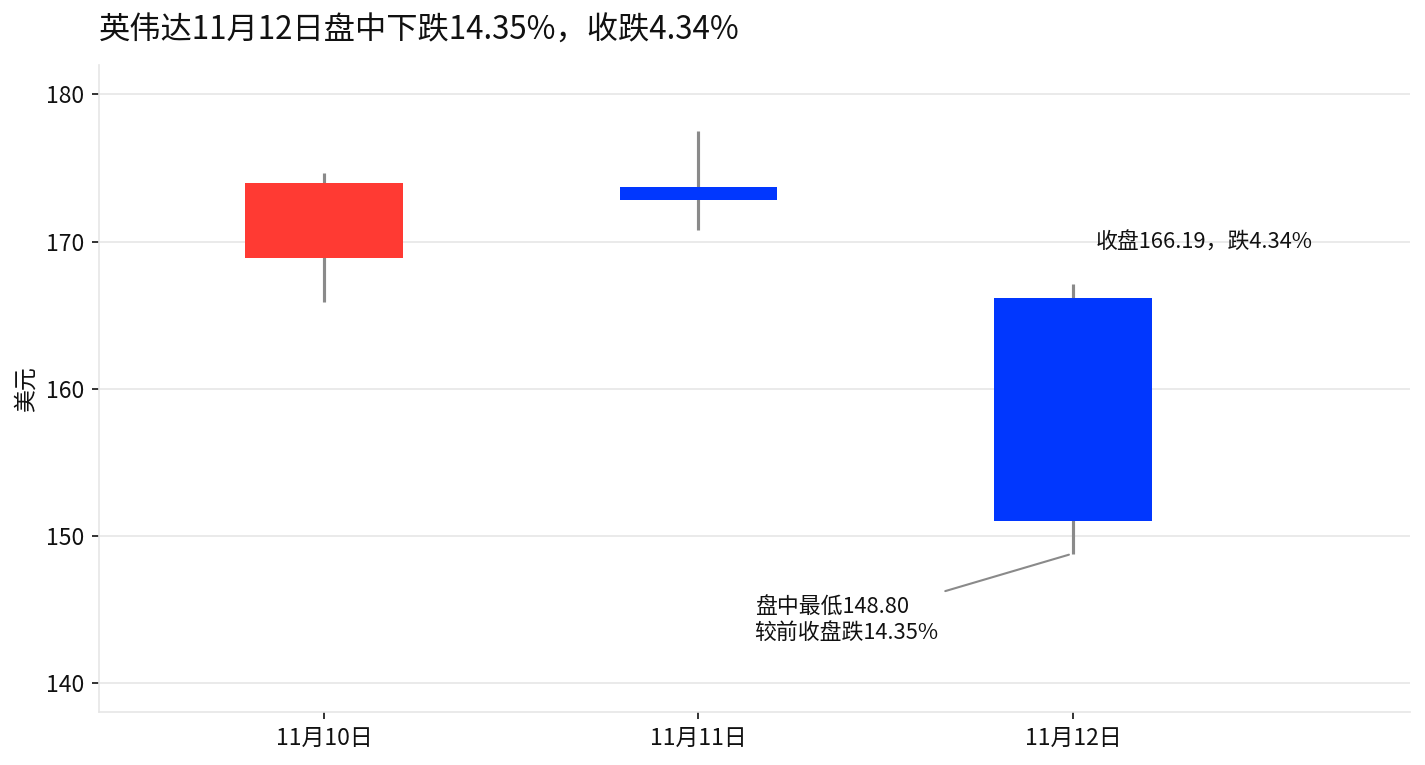
This trend itself has already provided an important signal: what the market sold off first was likely not "AI demand," but governance risk.
If investors generally believe that NVIDIA's fundamentals have fundamentally changed, such a noticeable rebound in the drop during trading would not typically occur. The price's return above $160 indicates that there is still capital that believes GPU demand, data center capital expenditure, and NVIDIA's existing ecosystem have not immediately disappeared due to the CEO's departure.
The real rapid change is in valuation. According to media reports, Baird cut NVIDIA's target price from $500 to $200, Bernstein from $400 to $200, Truist from $346 to $174, Citigroup from $285 to $225, and Goldman Sachs reduced it to $220 (the new target prices from five institutions are shown in Figure 2). The quick rearrangement of target prices indicates that the market is attempting to answer a question that has rarely been discussed separately in the past: how much of the valuation premium in NVIDIA is attributable to Jensen Huang himself?
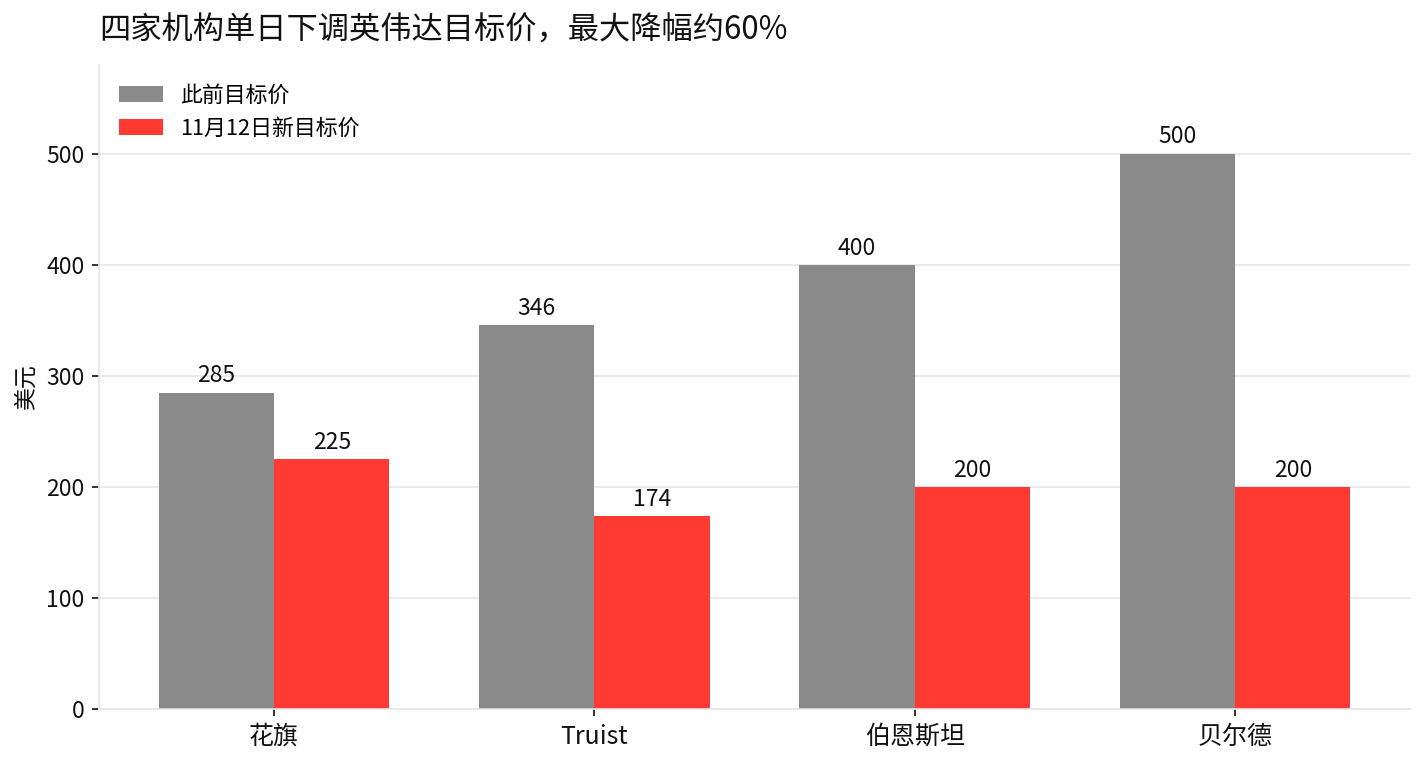
This does not mean that NVIDIA's competitive advantage will disappear with the leadership change. GPU product iterations, the CUDA ecosystem, customer relations, supply chain collaboration, and data center demand still constitute the fundamentals. What truly needs to be revalidated is whether this system can continue to maintain the speed of decision-making and execution efficiency without Jensen Huang personally at the helm.
Thus, the importance of the November 17 earnings report is no longer just "did revenue exceed expectations," but whether the management can convince the market that the leadership change will not alter the realization speed of AI computing cycles.
2. Why does Nebius's "better performance lead to greater decline"? The market has begun to charge for delays.
If NVIDIA is trading governance risk, then Nebius is trading a more direct "time risk."
Nebius reported Q3 revenue of $981 million, a year-over-year increase of 571%, exceeding the market expectation of $908 million; adjusted EBITDA reached $466 million, higher than the expected $357 million; adjusted net profit was $90.9 million, while the market previously expected a loss of about $271 million.
Looking solely at the Q3 earnings report, this is clearly not a performance that should be punished. The problem is that the market is no longer just looking at the past three months, but is recalculating the capital returns for the next 12 months.
The revenue guidance for the full year of 2026 was set at the lower end of the range of $3 billion to $3.4 billion, below the market's previous expectation of about $3.35 billion; at the same time, capital expenditure was raised from a previous $20 billion to $25 billion to about $27 billion, and expected to further reach $40 billion to $45 billion in 2027. More critically, the company's previous estimate for annual revenue exceeding $7 billion has been delayed from December 2026 to February 2027, and some third-party data centers have delayed their originally planned capacity, which was set to be operational in 2026, to the first half of 2027 due to construction and power supply delays (the guidance compared to expectations is shown in Figure 3).
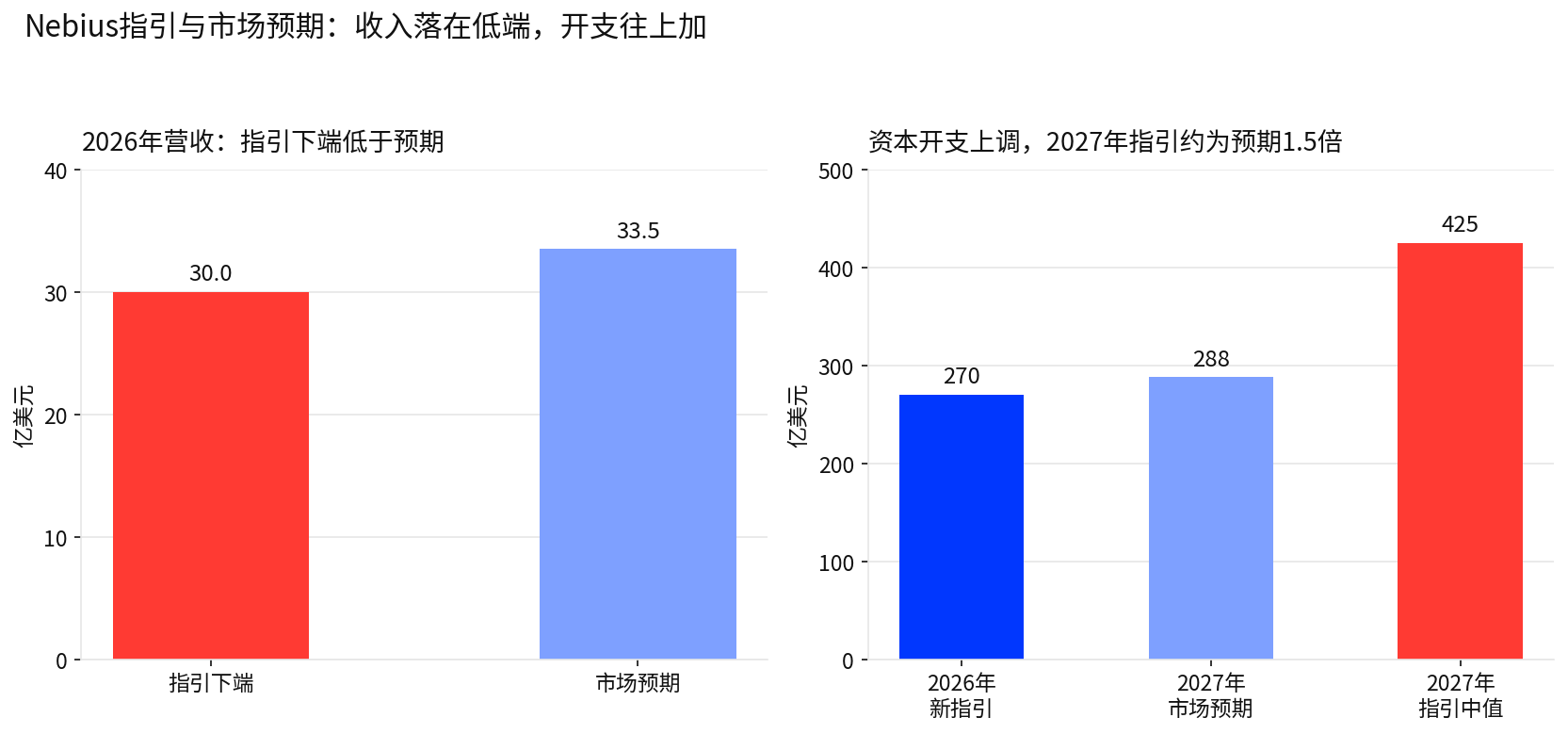
Thus, the market sees a very realistic calculation: revenue will be realized later, but capital expenditure is not only not postponed, it continues to increase. This is why Nebius's stock price did not rise despite exceeding revenue expectations.
The stronger the demand for AI computing, the greater the infrastructure investment tends to be; the greater the investment, the higher the capital occupancy; the higher the capital occupancy, the more critical the project commissioning time becomes. When the risk-free interest rate is very low, the market can be patient for revenues six months or even a year away; when the 10-year U.S. Treasury yield approaches 5%, the wait itself incurs a cost.
Therefore, Nebius is not telling the market "AI demand is poor," but rather informing the market: even if demand is very good, if revenue is delayed by half a year and capital expenditure continues to rise, shareholders may also need to bear more costs for this wait.
This is the true meaning of "time tax."
3. NVIDIA looks at "who will do it," while Nebius looks at "when will it be done": AI valuation rules are changing.
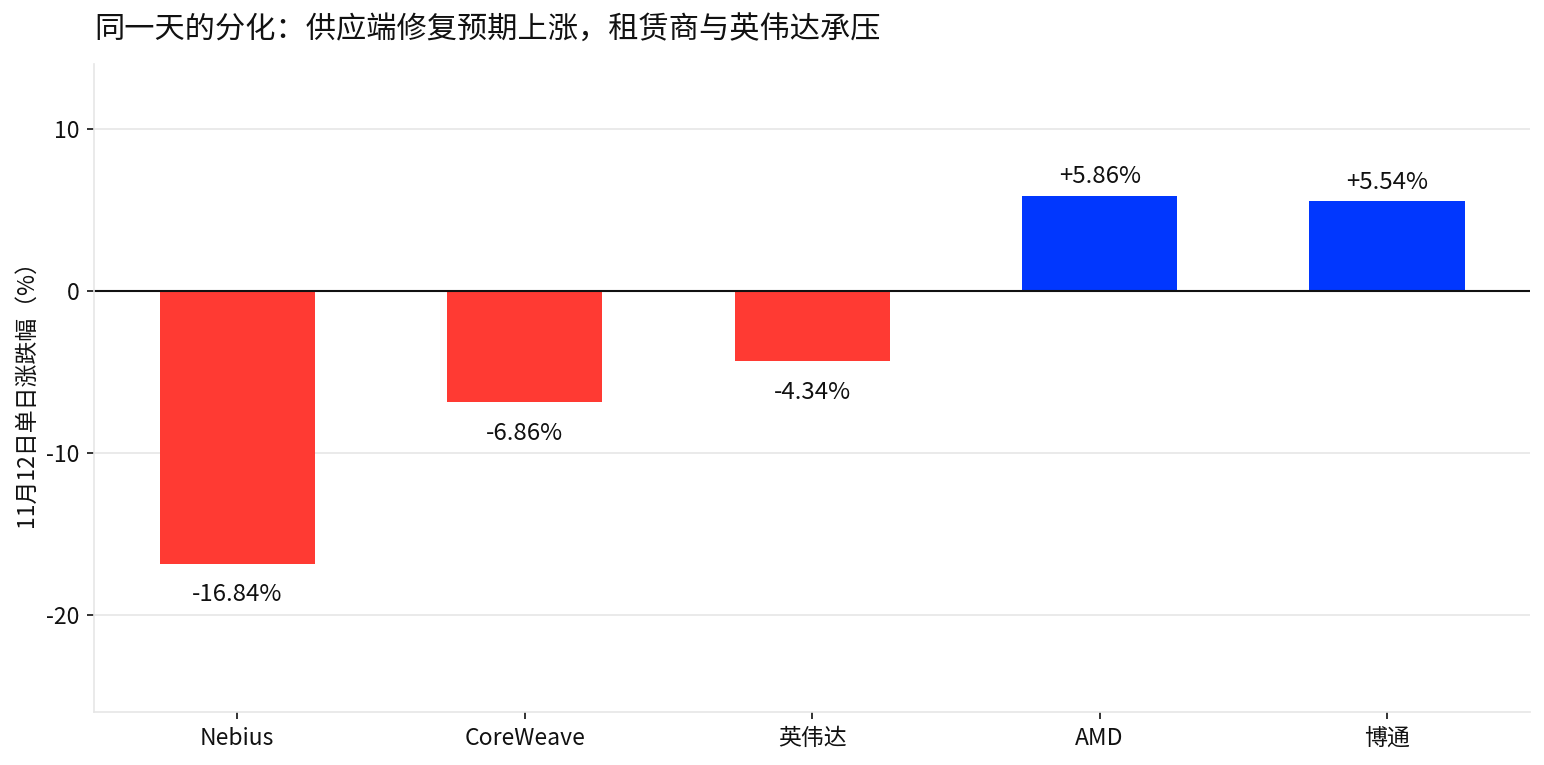
Looking at both companies together, the market on November 12 is no longer two isolated events. What is being repriced for NVIDIA is governance continuity, and what is being repriced for Nebius is realization time, as shown in the differentiation along the entire chain in Figure 4.
In the past, these two variables were easily masked by high-speed growth: as long as the market believed AI demand would continue to explode, who the CEO is could be addressed later, and a few months delay in capacity could also be understood as demand being too strong.
The market still wants to pay for growth but is no longer willing to pay the same price for all long-term growth. Investors are beginning to ask more specific questions: when will revenue appear? How much capital expenditure is needed? Are projects powered, and how much capacity has actually been operational? Can customer contracts convert into cash flow? Does management have the ability to execute at the original pace?
This is also why November 12 cannot simply be defined as "the end of the AI bull market." If AI demand really shows a structural decline, the first to be impacted should be the income and orders along the supply chain. But currently, these two cases seem to indicate something else: AI demand is still very strong, but the market is beginning to lower its tolerance for "future realization."
This has a significant impact on the upcoming stock selection logic. In the past, seeking companies with the "largest AI space" could be prioritized; now a further distinction is needed: who has already begun to make money, who is still waiting for capacity; whose capital expenditure can quickly convert into revenue, who needs to continue financing; who has stable governance and execution systems, and who relies on a key individual for core competitiveness.
4. This accounting will be transmitted along the supply chain: AMD and Broadcom benefit, but not unconditionally.
After NVIDIA's leadership change, the most direct relative trades have already appeared in the supply chain. On November 12, AMD rose by 5.86%, closing at $585.30; Broadcom rose by 5.54%, closing at $364.36, showing a stark contrast to NVIDIA. As the market reassesses NVIDIA's governance risk, it naturally shifts some capital attention to secondary supply sources.
But here it is essential to distinguish two concepts: reordering of supply shares does not equate to an increase in total AI demand. If NVIDIA's governance risk is just a short-term event and data center capital expenditure continues to grow, then AMD and Broadcom may indeed gain more relative attention; but if upcoming NVIDIA earnings reports prove that AI capital expenditure itself is slowing down, then the logic of "capital flowing from NVIDIA to AMD and Broadcom" will be challenging to sustain.
Nebius and CoreWeave represent another kind of risk. They are highly sensitive to computing demand while being more reliant on financing conditions, data center construction, and capacity deployment. Once interest rates remain high, companies with more significant capital expenditure will be more sensitive to financing costs and project delays. On November 12, CoreWeave fell by 6.86%, closing at $56.60, with Nebius experiencing a more significant decline, indicating that the market is differentiating between "beneficiaries of AI demand" and "capital-intensive implementers of AI."
In other words, what the AI industry chain needs to look at in the next stage is not just how many orders there are, but whether those orders can be converted into revenue within the promised time, and then from revenue into cash flow. This is why Nebius's response this time is more concerning than merely a performance miss.
5. Tonight's PPI is an amplifier: the higher the U.S. debt yield, the more expensive the "time tax."
The two sell-offs on November 12 did not occur in a vacuum. October's CPI has already exceeded expectations, and the market's pricing for the December interest rate decision is clearly skewed toward rate hikes. Tonight's October PPI release will further influence the market's judgment on inflation and interest rate trajectories.
If the PPI continues to exceed expectations, the market's pricing for higher and longer rates may intensify, leading high-valuation, long-duration AI assets to face greater discount pressure. Conversely, if the PPI shows a significant cooling and U.S. Treasury yields fall, some previously compressed AI valuation premiums may regain support.
Thus, when looking at AI trends now, do not just focus on how many basis points the Federal Reserve will increase next, but rather monitor the trajectory of the 10-year U.S. Treasury yield. For AI companies that need years of capital investment to realize profits, interest rates do not determine merely small decimal changes but how much future cash flows should be discounted.
This is why NVIDIA's earnings report on November 17 is in such a sensitive position: PPI initially sets the tone for the interest rate environment, and NVIDIA subsequently validates AI demand and profit realization with its earnings report. The combination of these two variables is likely to lead to a rapid change in the market's tolerance for high-valuation AI assets.
6. NVIDIA's earnings report on November 17: don't just look for "exceeding expectations," focus on these key points instead.
NVIDIA will release its Q3 report for the fiscal year 2027 after the market closes on November 17. According to media reports, the market currently expects revenue of approximately $108.8 billion and earnings per share of about $2.47.
However, following the leadership change, this earnings report can no longer be read as a regular report. The most critical aspects remain the data center business and next quarter's guidance. If revenue growth and orders continue to be strong, it indicates that the AI capital expenditure cycle has not been significantly impacted by the management change; if simultaneously gross margins remain stable, the market's concerns about "leadership change impacting fundamentals" will significantly diminish.
The new variable comes from governance. How will interim CEO Kress explain the handover arrangements? Does the board have a clear formal succession timeline? Can the market see a candidate sufficient to prove strategic continuity? The answers to these questions will determine whether the previously cut "governance premium" can return.
Ecological commitments are also worth noting. The commitments to Anthropic, stock holdings and collaborations with companies like Nebius, if they show notable adjustments, the market will further question NVIDIA's future capital allocation logic.
In terms of price, $166.19 can be regarded as an essential observation area before the earnings report, while $148.80 is the extreme event low point during intraday trading on November 12. It should not be simply interpreted as a mechanical "support level," but rather seen as two observation points reflecting the extent to which the market has priced in governance risk. If the fundamentals remain strong post-earnings and the succession plan is clear, the market may gradually recover some governance discount; if the fundamentals begin to change as well, then the previous intraday low could once again become a reference point.
The same logic applies to AMD, Broadcom, Nebius, and CoreWeave: do not rush to conclusions based on a day’s relative strength; look at whether this relativity can persist after November 17.
In conclusion: perhaps the AI bull market has not ended, but "free waiting" may have come to an end.
The two cases on November 12 very directly demonstrate the changes occurring in AI valuations. NVIDIA is telling the market that what was previously taken for granted as governance continuity now also needs to be repriced; Nebius is informing the market that even if performance has started to generate profits, as long as revenue realization time is postponed and capital expenditure continues to rise, the market will similarly demand a discount.
Thus, what is truly changing in this market cycle may not be AI demand, but rather how much the market is willing to pay for the future and how long it is willing to wait. In an environment where the 10-year U.S. Treasury yield approaches 5%, PPI is about to be released, and NVIDIA's earnings release is imminent, the upcoming judgment on AI assets can no longer simply ask "who has the biggest AI story," but must further inquire: who has already realized growth into revenue, who has converted revenue into cash flow, whose capital expenditure can yield timely returns, and who still requires the market to exercise patience.
This is also the key point to observe in the upcoming AI trends. If NVIDIA's November 17 earnings report confirms that demand remains strong, coupled with a clear succession plan and stable ecological commitments, then this adjustment is more likely a revaluation of governance premium rather than a reversal in AI industry trends. Conversely, if governance uncertainty continues to expand combined with high interest rates and lengthened capital expenditure return cycles, then the "time tax" seen in Nebius may spread from a specific company's issue to the valuation rules governing the entire AI infrastructure sector. AI can still grow, but the market is beginning to demand timely submissions.
Disclaimer:
The content of this article is for general information and market commentary purposes only, compiled based on publicly available information as of the time mentioned in the text. Relevant market data, expectations, and probabilities may change with market conditions. The views and investment strategies quoted from third-party institutions, analysts, or other individuals represent the opinions of those third parties at a specific time and do not represent the views or recommendations of BIT. This article does not constitute investment advice, investment research, invitation, solicitation, or recommendation for any security, investment product, or trading strategy, nor should it serve as the basis for any investment decision. Financial markets carry risks, and the prices of securities and market performance may be volatile; past performance and historical market trends do not guarantee future results. Investors should independently assess relevant risks based on their circumstances and seek professional advice when necessary.
免责声明:本文章仅代表作者个人观点,不代表本平台的立场和观点。本文章仅供信息分享,不构成对任何人的任何投资建议。用户与作者之间的任何争议,与本平台无关。如网页中刊载的文章或图片涉及侵权,请提供相关的权利证明和身份证明发送邮件到[email protected],本平台相关工作人员将会进行核查。


