Original author: RootData Research
Abstract
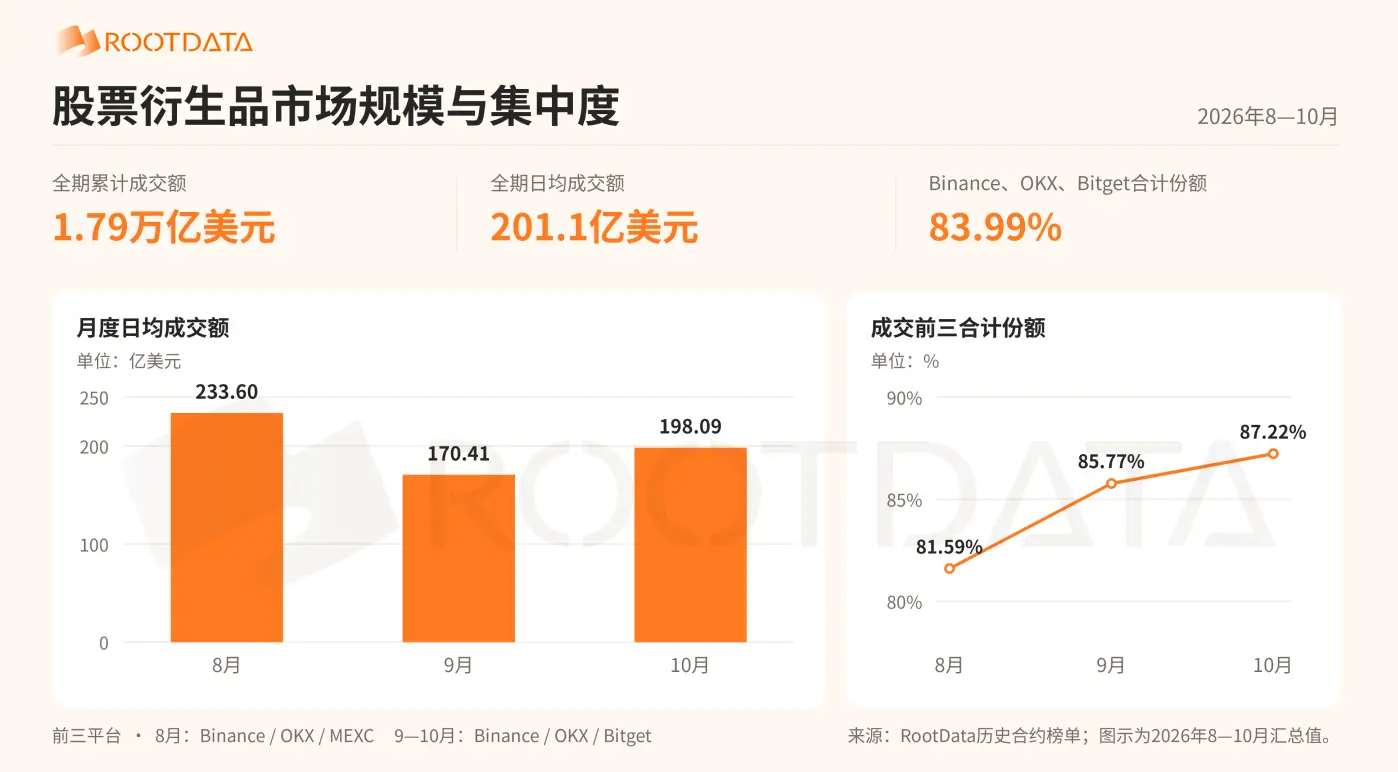
From August to October 2026, the trading volume of stock derivatives on mainstream platforms initially fell and then rose, while positions and market depth continued to expand. The average daily trading volume decreased from $23.36 billion in August to $17.04 billion in September, and rebounded to $19.81 billion in October, still not recovering to August levels.
Binance dominated the trading and position scale but did not establish an absolute advantage in transaction quality and other dimensions. The advantages of other mainstream trading platforms also varied: OKX ranked second in trading volume and price spread, while Bitget had the highest ±2% depth. Market competition has differentiated around scale, product coverage, and liquidity.
The trading channels, dividend processing, and information disclosure of tokenized stocks exhibit significant product differences. The positioning of the five issuers has its own focus: Ondo, bStocks, and xStocks lead in asset scale, while Reality has the broadest product coverage and the most diverse execution methods. Industry competition is shifting from expanding coverage to the continued conversion of holdings and trading.
Research scope and statistical methods: The exchange sample includes Binance, OKX, Bitget, Bybit, Gate, MEXC, KuCoin, and HTX. The research subject consists of stocks and ETF perpetual contracts priced or settled in stablecoins such as USDT and USDC. The tokenized issuer sample includes Ondo, xStocks, bStocks, Reality, and Robinhood Stock Tokens.
1. Market Overview and Demand Structure
In the third quarter of 2026, the global stock market adjusted repeatedly between profit growth and macro tightening. The Federal Reserve raised interest rates by 25 basis points to 3.75%–4.00% in September and kept rates unchanged in October, but there are still expectations for further rate hikes in December, making the interest rate path a core variable in the fourth quarter. On the industry side, AI storage demand and product price increases supported the market for storage targets like SNDK and MU; after October, concerns about AI capital expenditure returns intensified, leading to increased volatility in tech stocks.
Looking ahead to the fourth quarter, the U.S. midterm elections, the Anthropic IPO, and OpenAI's delayed IPO expectations until 2027 may continue to impact tech stock valuations and trading hotspots.
In this context, it is necessary to sort through the trading scale, competitive landscape, and liquidity of crypto trading platform stock derivatives and tokenized stock spot trades, assessing each platform's ability to accommodate new target and event-driven trading demands.
1. Stock Derivative Market
1.1 Trading Volume Scale and Peak
From August to October 2026, the trading volume of stock derivatives on eight mainstream platforms was approximately $1.79 trillion, averaging $20.11 billion daily. Trading was mainly concentrated on leading platforms, with Binance, OKX, and Bitget accounting for a combined trading share of 83.99%.
From a monthly trend perspective, the market trading volume shrank in September but recovered in October, with the average daily trading volume in October increasing by 16.24% month-on-month, though still lower than August levels. From the perspective of concentration trends, the combined trading share of the top three platforms in trading volume increased from 81.59% to 87.22%, indicating that trading further concentrated on the leading platforms.
1.2 Position Scale, ±2% Depth, and Peak
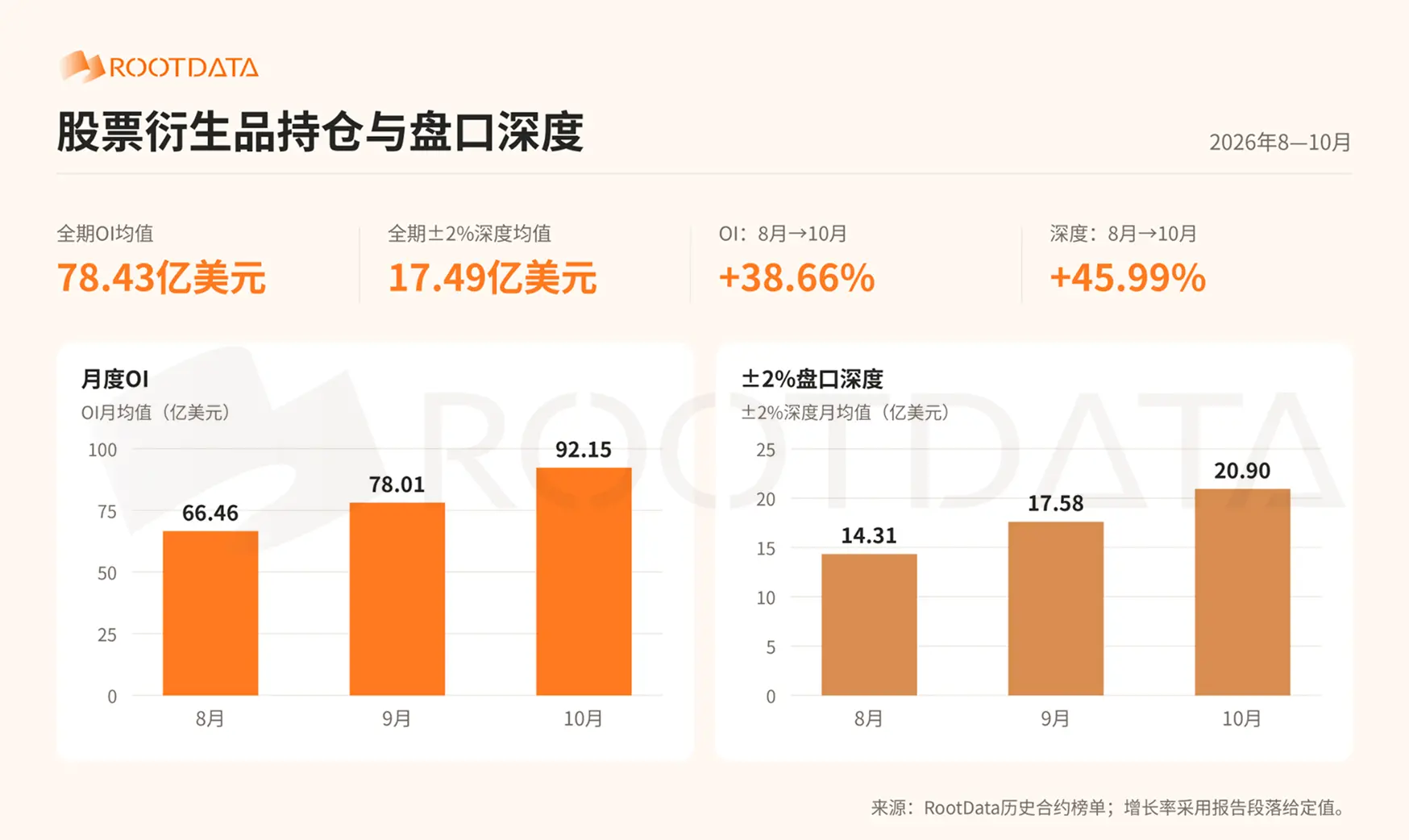
From August to October, the average daily open interest (OI) scale of eight mainstream platforms was about $7.84 billion, while the average daily scale of ±2% market depth was $1.75 billion. Compared to the initial decline and subsequent rise in trading volume, both positions and market depth saw continuous growth, with expansion being more persistent.
In October, the average daily OI reached $9.21 billion, an increase of 38.66% from August; the average daily ±2% depth reached $2.09 billion, growing 45.99%. During the trading pullback in September, the size of positions and market orders still increased, indicating that capital did not leave the market on a large scale. Instead, traders shifted more from short-term turnover to holding positions, and market making and order supply also continued to expand, suggesting that the liquidity foundation of the platforms was not affected by the contraction in trading, which may have supported the trading recovery in October.
1.3 Popular Stocks and ETF Contracts
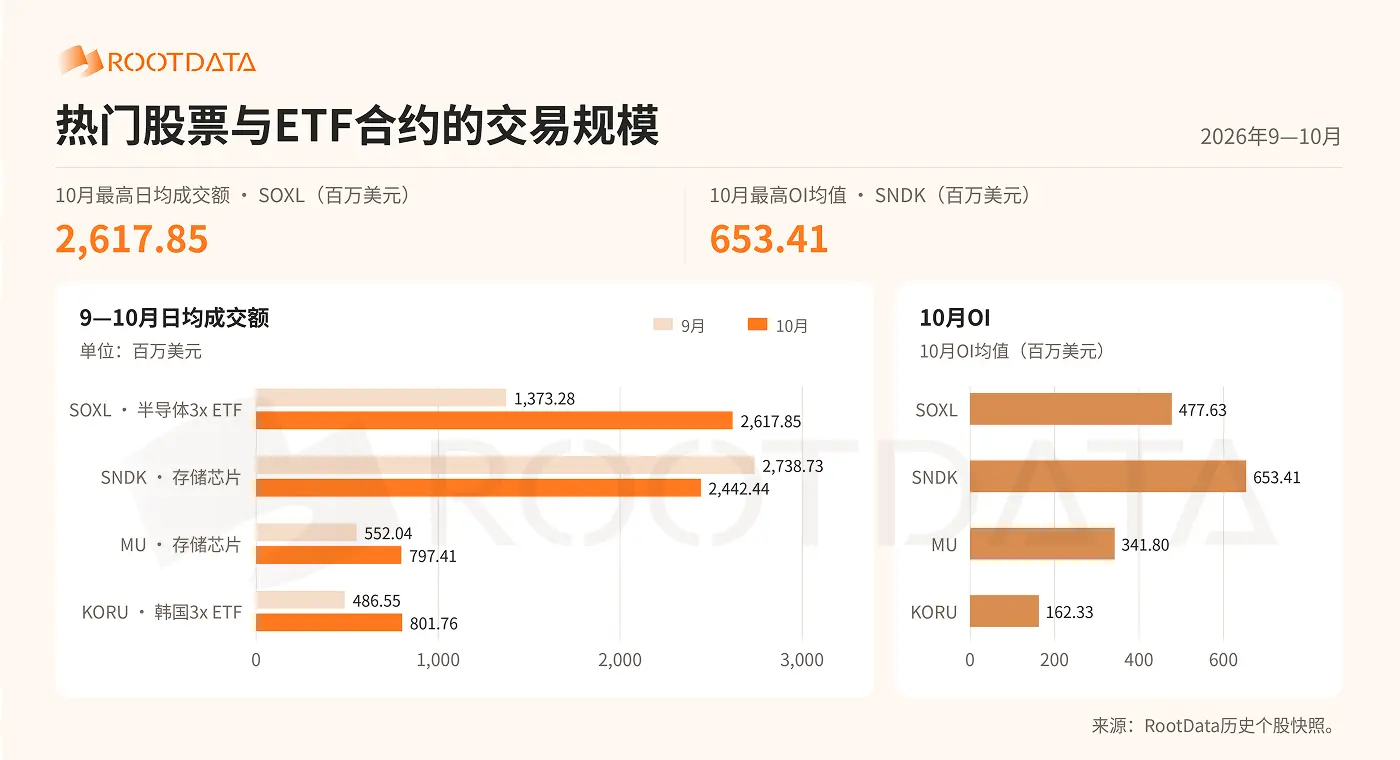
From September to October, trading in individual stocks was mainly concentrated in semiconductors, storage, and leveraged ETFs. SOXL and SNDK had average daily trading volumes of approximately $2.62 billion and $2.44 billion on the eight sample platforms, ranking among the most popular stock assets.
2. Tokenized Stock Spot Market
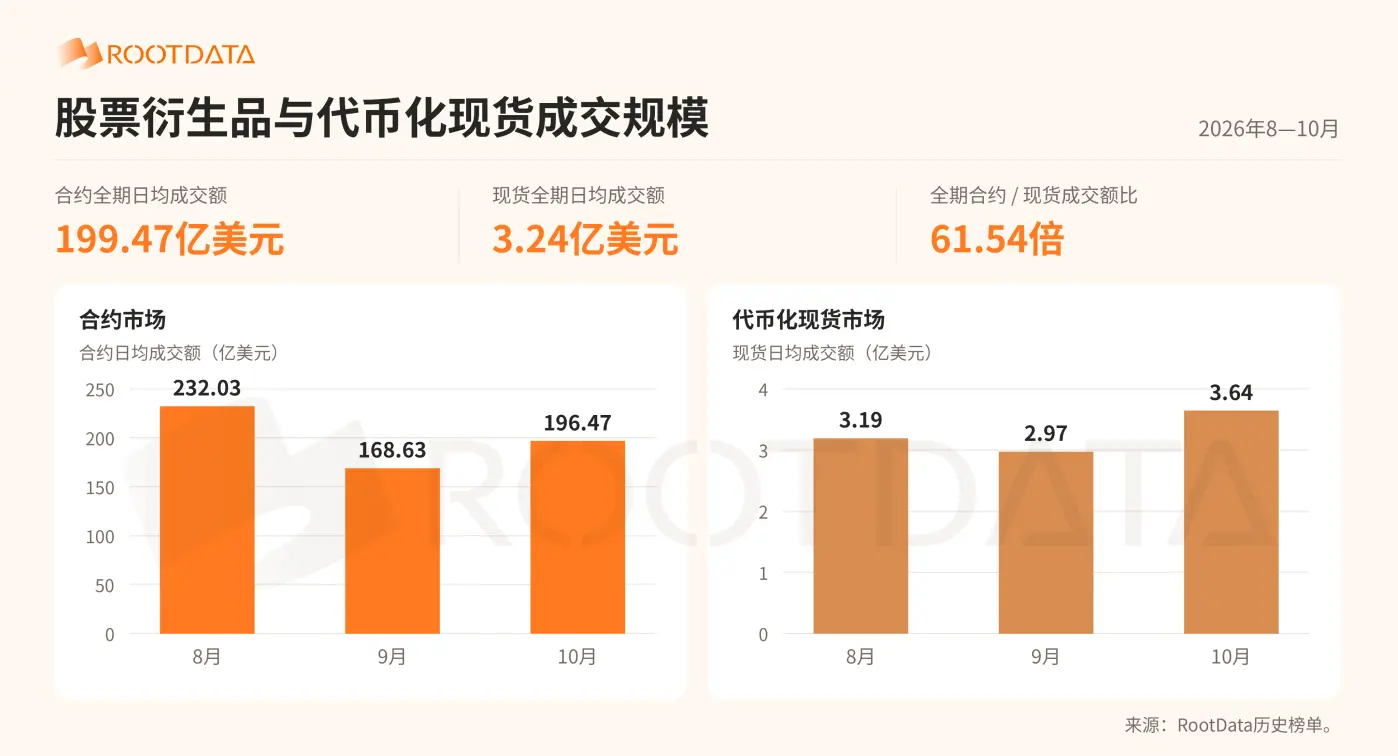 From August to October, the five mainstream tokenized stock issuance platforms had an average daily trading volume of approximately $0.32 billion for spot trades, while the stock derivatives on the same platform had an average daily trading volume of about $19.95 billion, approximately 61.5 times that of the spot trades. Stock derivatives remain the main trading market.
Moreover, the concentration in contract trading was higher. The top three platforms for contract trading, Binance, OKX, and Bitget, together accounted for 83.99%; the top three for spot trading, Binance, OKX, and Gate, collectively accounted for 78.25%, with trading distribution being relatively dispersed.
However, in October, the average daily spot trading volume reached $0.36 billion, with a month-on-month growth of 22.72%, recovering faster than the contract market, narrowing the gap in trading scale between contracts and spots.
2. Exchange Competitive Landscape
1. Stock Derivatives
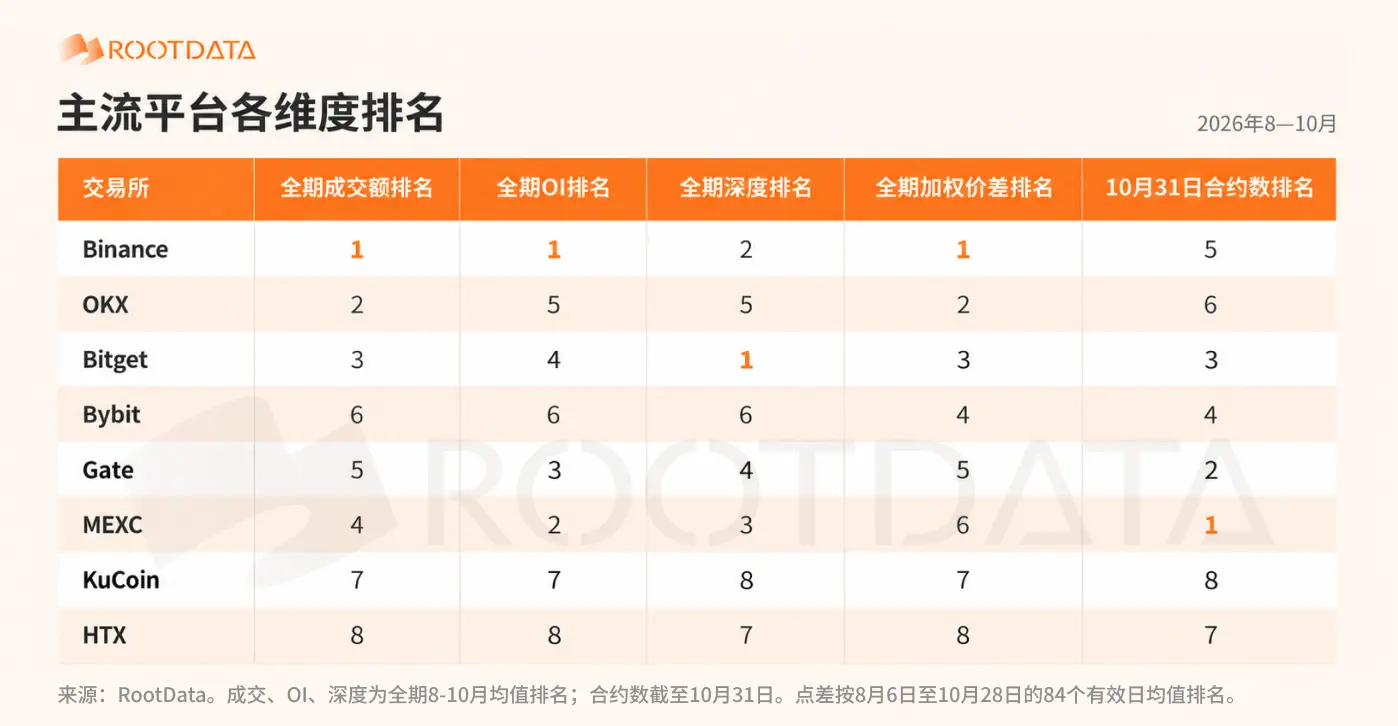
From August to October, the leading positions of mainstream platforms in different dimensions varied. Binance held the top average daily trading volume and OI; Bitget ranked first in ±2% depth average; OKX remained second in both trading volume and weighted price spread. MEXC ranked second in OI scale, with the most stock derivative quantities.
Trading, positions, product coverage, and trading quality each show different competitive landscapes. The following analysis will combine overall rankings and monthly changes to analyze the scale, growth, and liquidity performance of each platform.
1.1 Trading Scale
Trading Volume and Market Share
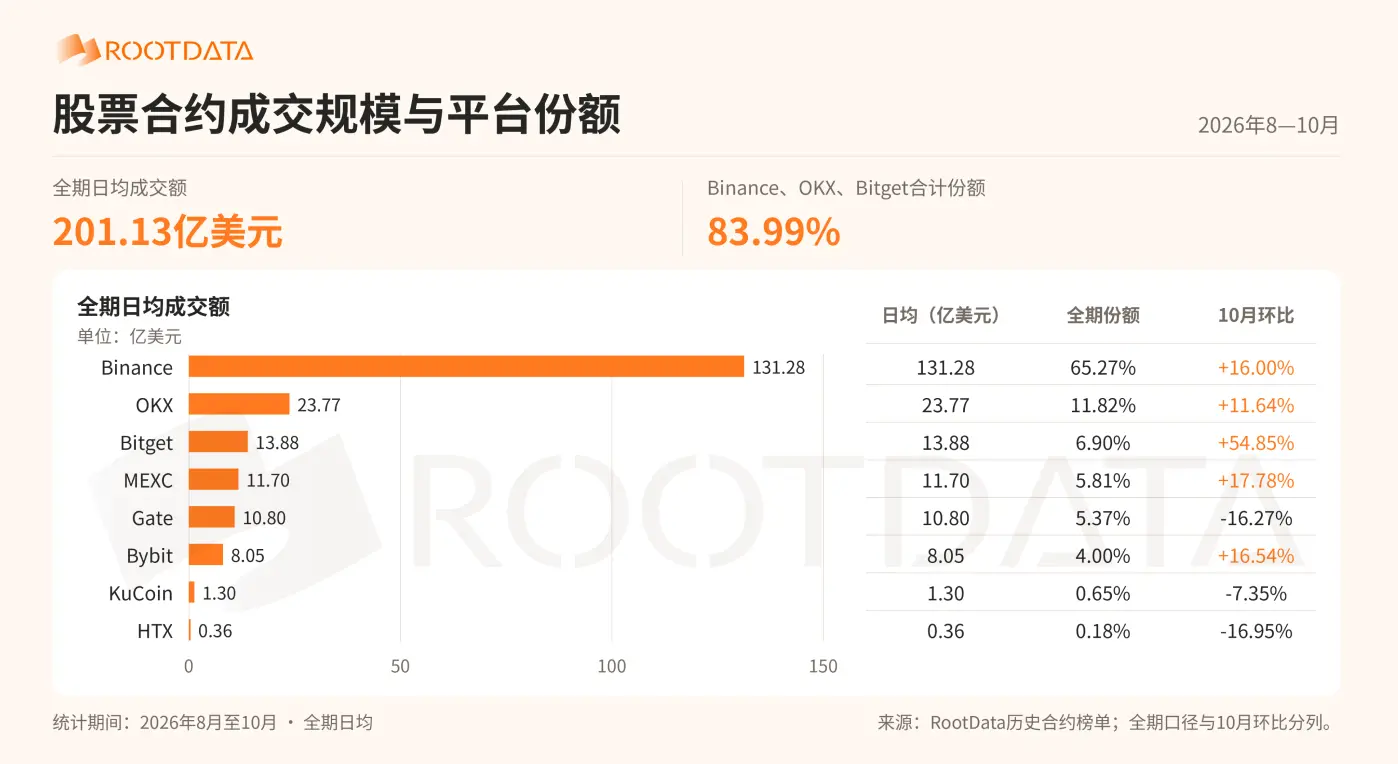
The trading scale exhibits clear concentration among the top players. From August to October, Binance's average daily trading volume was $13.13 billion, with a share of 65.27%; OKX and Bitget ranked second and third with $2.38 billion and $1.39 billion respectively. MEXC, Gate, and Bybit ranked fourth to sixth, while KuCoin and HTX had a combined share of less than 1%.
The recovery pace varied among platforms in October. Bitget ranked first in month-on-month growth of trading volume, with an increase of 54.85%, and MEXC and Bybit also showed signs of recovery. Binance maintained the largest trading volume and further increased its share.
Positions Size and Share
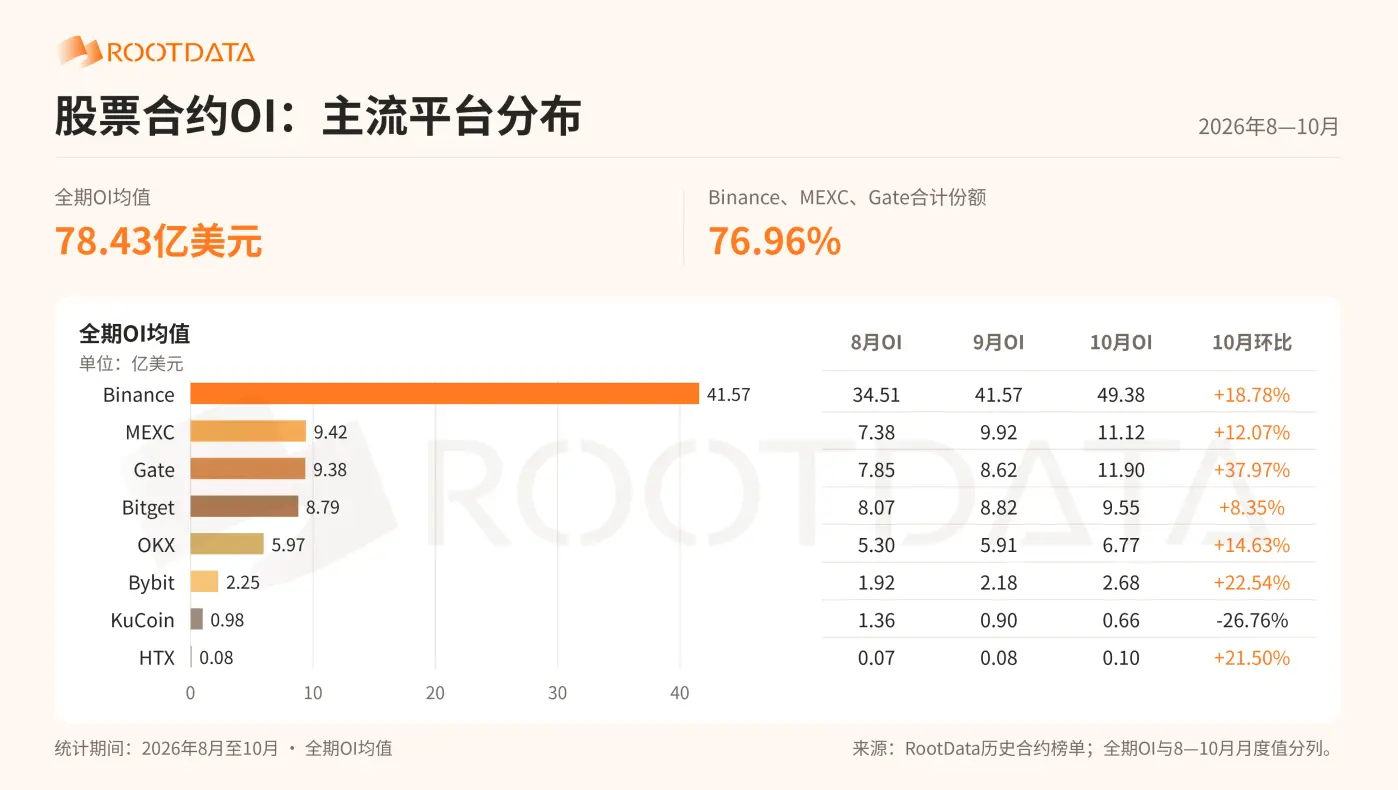
The position data of stock derivatives is dominated by Binance. From August to October, Binance's average OI was $4.16 billion, accounting for over half of the total. Bitget, Gate, and MEXC’s OI shares were relatively close, all between 11%-12%; OKX was at 7.61%, in the middle range; while the OI shares of Bybit, KuCoin, and HTX were relatively low, in the 0.1%-3% range.
1.2 Trading Quality
Market Depth
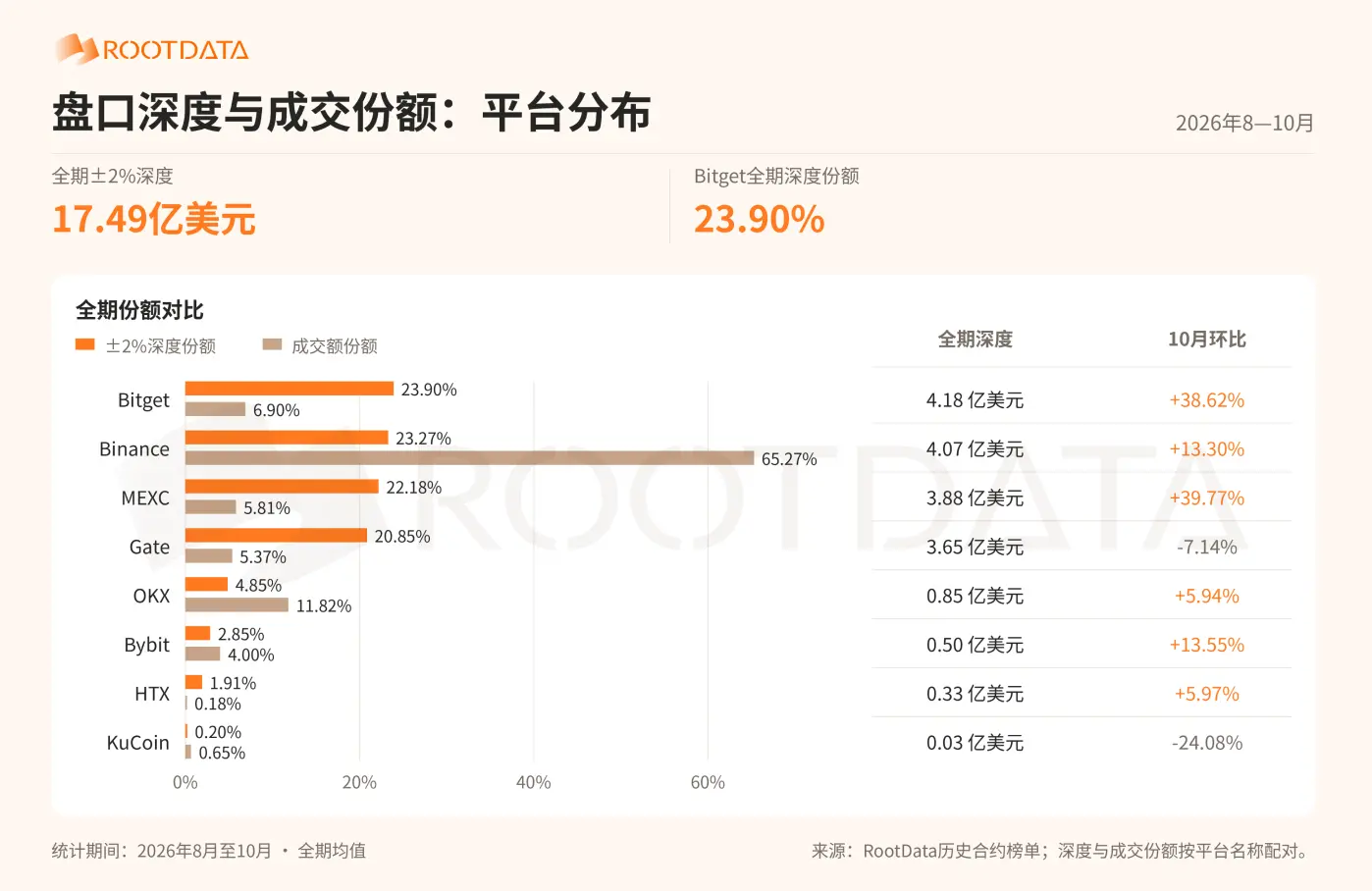
From August to October, despite having lower trading volume and OI scale than Binance, Bitget's ±2% depth average reached $41.8 million, higher than Binance's $40.7 million, ranking first among the eight platforms. Additionally, Bitget’s depth share was 23.90%, showing larger visible order sizes in the ±2% range, indicating strong competitiveness in market liquidity supply.
Weighted Price Spread
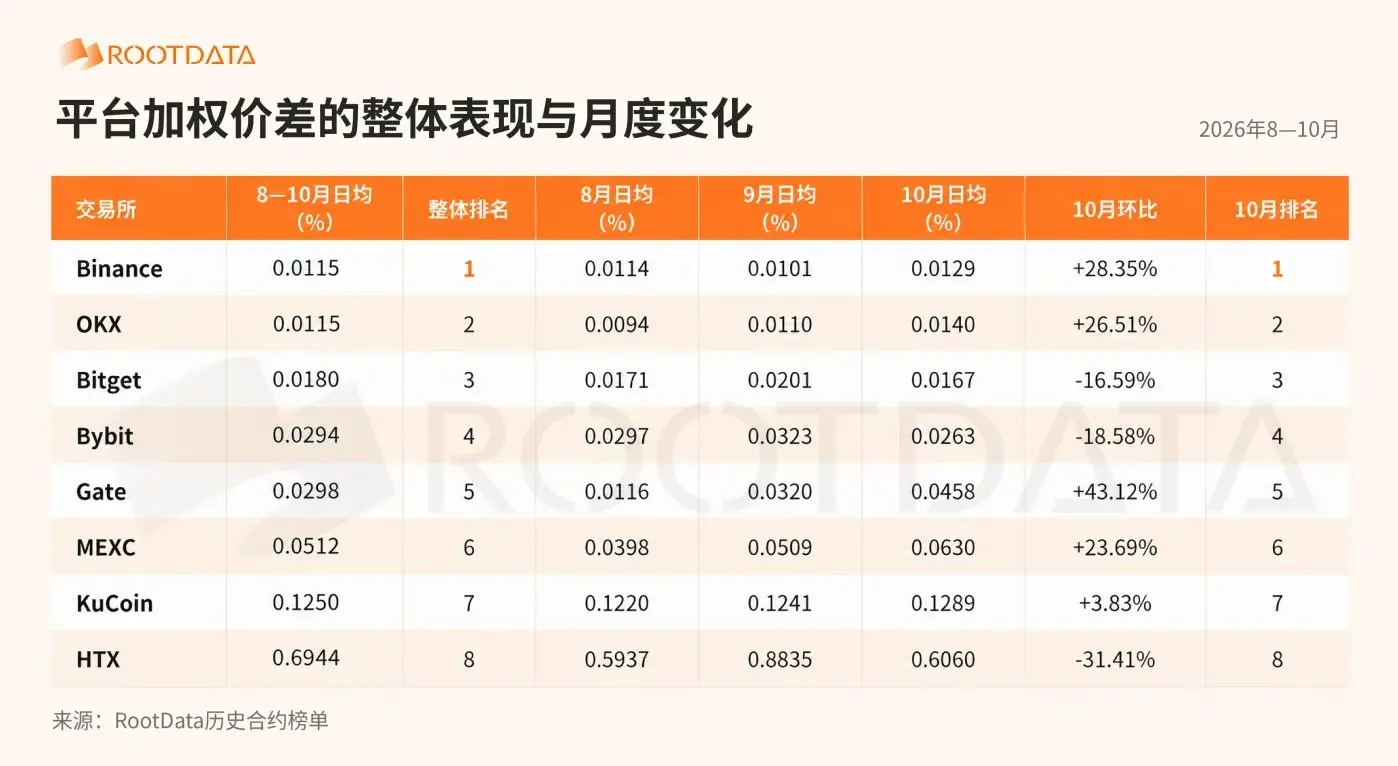
Binance and OKX maintained an edge in price spread. From August to October, both had an average daily weighted price spread of 0.0115%, with Bitget ranked third at 0.018%, followed by Bybit in fourth.
In October, the spreads of Bitget and Bybit narrowed by 16.59% and 18.58% respectively, reflecting some improvement in platform trading costs. Although Binance and OKX's spreads widened compared to September, they still maintained the smallest spreads. HTX experienced the largest narrowing but still had a significantly higher absolute spread than other platforms.
2. Tokenized Stock Spot
In the tokenized stock products, AUM (Assets Under Management) reflects the scale of issued assets, and product quantity reflects coverage scope. This section compares the product information of Ondo, bStocks, xStocks, Reality, and Robinhood Stocks, focusing on the coverage, asset scale, trading mechanisms, and handling actions of the five product lines.
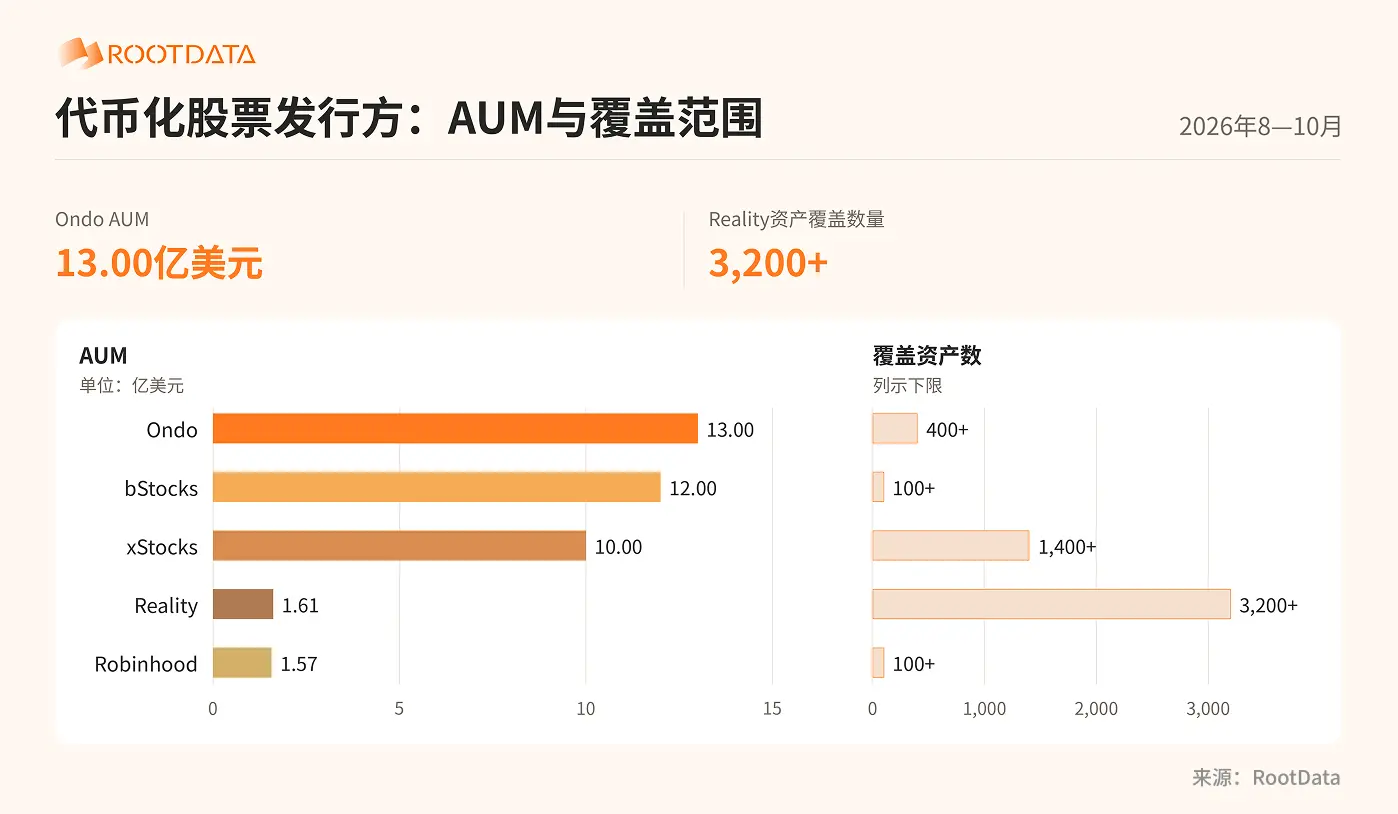
The five products have different focuses in asset scale and coverage. According to the listed data, Ondo, bStocks, and xStocks have AUMs of $1.3 billion, $1.2 billion, and $1 billion respectively, leading in total funds; Reality and Robinhood follow closely with AUMs of $161 million and $157 million. Notably, Reality has a broader coverage, with asset coverage exceeding 3,200 items, significantly higher than the other four; Robinhood mainly relies on its user base for distribution.
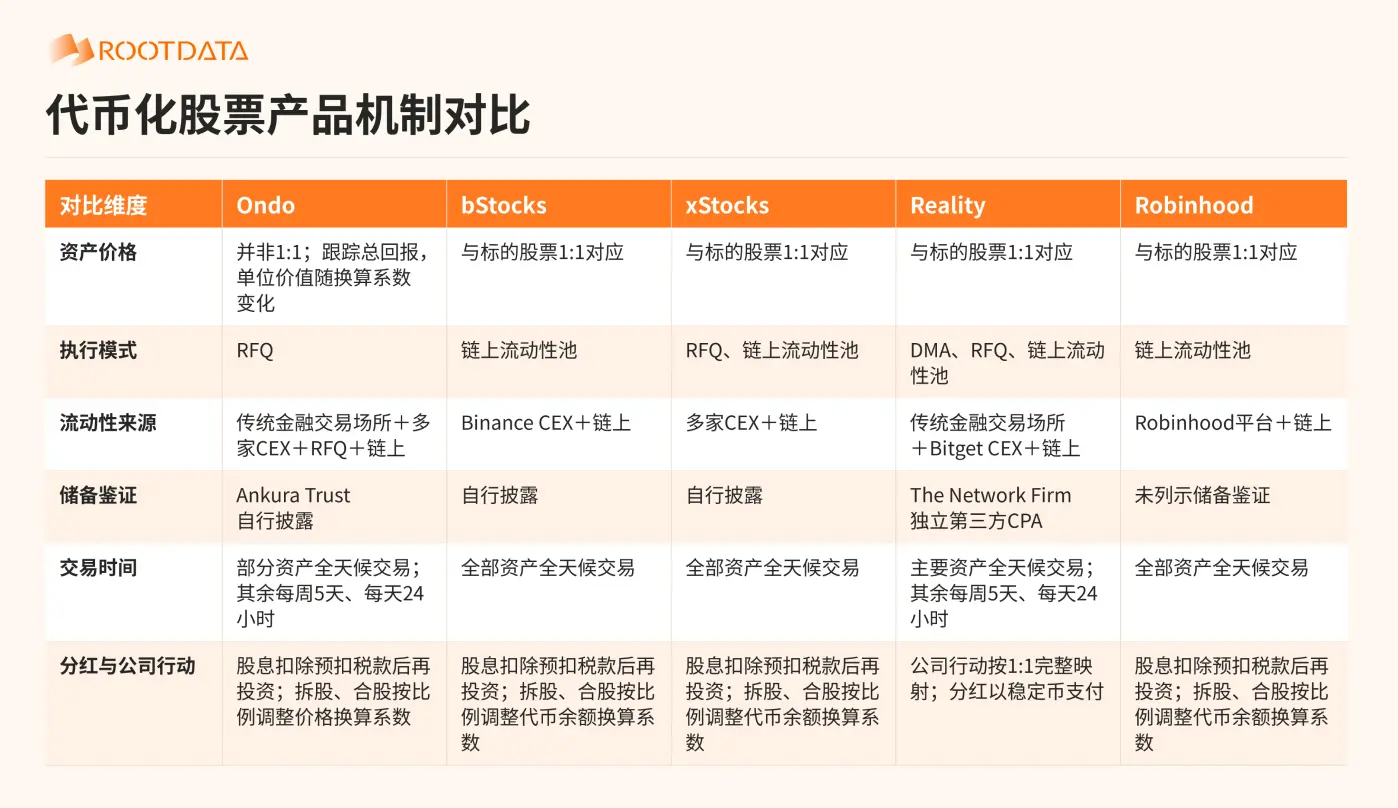
Trading channels are also an important distinction. Reality provides three execution methods: DMA (Direct Market Access, where orders are directly matched in traditional financial trading venues), RFQ (Request for Quote, where traders obtain quotes from market makers before executing trades), and an on-chain liquidity pool, with liquidity sources covering traditional financial trading venues, Bitget CEX, and on-chain; Ondo and xStocks distribute through multiple CEX and on-chain channels, while bStocks and Robinhood rely on Binance, Robinhood platforms, and on-chain channels. The liquidity sources of the five range from "traditional trading venues + CEX + on-chain" to single platforms, directly impacting the accessible funding range.
Regarding dividend processing, the five create two holding experiences: "cash dividends" and "automatic reinvestment": Reality directly pays dividends to holders in stablecoins, allowing investors to freely manage cash flow; the other four automatically reinvest post-tax dividends, eliminating manual operations but prohibiting direct cash distribution, making the former more friendly to investors needing cash distribution.
In terms of information disclosure, Reality lists reserves verified by an independent third-party CPA, with reserve transparency validated externally; Ondo, xStocks, and bStocks mainly rely on self-disclosure, while Robinhood does not list reserve verification arrangements.
On trading time, all assets of xStocks, bStocks, and Robinhood support round-the-clock trading; Reality and Ondo's major assets support 7×24 hours trading, while other assets support five days a week, 24 hours each day, with trading periods needing to be distinguished based on specific targets.
In summary, none of the five products leads across all dimensions; differences essentially stem from varied product routes: Ondo, bStocks, and xStocks focus on asset scale, leveraging multiple CEX or channels like Binance to deepen their holdings; Reality chose a different path, setting itself apart through coverage breadth and mechanism design with over 3,200 asset coverage, operating DMA and RFQ concurrently, paying dividends in stablecoin cash, and providing independent third-party CPA verification. For Reality, it has initially accumulated share through Bitget's exchange channel while also offering a trading experience more aligned with real U.S. stocks, establishing its own recognition; however, whether the breadth of its products can ultimately translate into sustained trading and positions requires further data verification.
3. Q4 Outlook and Competitive Evolution
The U.S. midterm elections are an important observation point for subsequent policy expectations. More importantly, it is worth tracking how post-election taxation, trade, and technology regulatory arrangements progress, and whether companies adjust their investment and profit guidance accordingly. For crypto stock platforms, the ability to continue quoting and maintain reasonable spreads during events will be more distinguishing than liquidity rankings during calm periods.
The stock derivatives market has formed different competitive advantages. Binance leads in trading and position scale, while OKX ranks second in both trading volume and price spread. Bitget ranks first in market depth, showing relative balance across most indicators compared to this comparison.
Platforms that rapidly expand their products also face various trading quality challenges. MEXC has the most contracts and ranks second in OI, but ranks sixth in price spread; Gate ranks second and third in contract quantity and OI but saw trading volume decline in October. Bybit experienced the highest growth in contract numbers during this period, but still ranks sixth in trading volume, OI, and depth. KuCoin and HTX currently have relatively small trading shares and larger spreads, with subsequent attention on the changes in their product coverage and trading activity.
In the next phase, the focus of competition may shift from the number of new products to the continued trading of new targets, as well as quoting capabilities during market volatility. MEXC, Gate, and Bybit need to observe whether product expansion can drive trading and position growth; Bitget must check whether depth advantages can translate to higher trading shares; Binance and OKX should focus on maintaining scale and quoting advantages during hot stocks and non-U.S. stock trading periods. Future monitoring should emphasize transactions of new targets, OI retention, and changes in depth and spreads during events.
Data Description and Reference Materials
Data covers from August 1, 2026, to October 31, 2026, sourced from RootData contracts, spot lists, and historical snapshots. Monthly averages and overall averages are calculated as sums of each platform's values for valid days divided by the effective number of days, with missing dates not filled in with zeros; market and individual stock cross-platform averages are sums of platform averages. The trading volume takes a 24-hour rolling value daily, with October being the in-month average up to the 31st; rounding may cause slight discrepancies.
[ S1 ] Ondo Stocks Product Operations and Reserve Verification Description
[ S2 ] xStocks Official FAQs and Company Actions Description
[ S3 ] Binance bStocks Official FAQs
[ S4 ] Bitget rToken FAQ and Trading Time and Company Actions Description
[ S5 ] Bitget Reality Product and Development Documentation
[ S6 ] Robinhood Chain Stock Tokens Documentation and Classic Product Description
[ S6 a ] Robinhood Classic Stock Tokens Product Description
[ S7 ] FEC 2026 U.S. Federal Election Dates
This report is for research reference only and does not constitute investment advice.
免责声明:本文章仅代表作者个人观点,不代表本平台的立场和观点。本文章仅供信息分享,不构成对任何人的任何投资建议。用户与作者之间的任何争议,与本平台无关。如网页中刊载的文章或图片涉及侵权,请提供相关的权利证明和身份证明发送邮件到[email protected],本平台相关工作人员将会进行核查。


