Original | Odaily Planet Daily (@OdailyChina)
Author|Azuma (@azuma_eth)

The soul of Nvidia, co-founder Jensen Huang, who has been at the helm for 33 years, has abruptly exited in a way that neither Silicon Valley nor Wall Street expected.
Due to the recent fallout from multiple extramarital scandals and potential national security compliance investigations, Nvidia officially announced on Thursday (November 12) that Jensen Huang has resigned from his positions as president, CEO, and board member, effective immediately. To stabilize the situation, Nvidia's board swiftly appointed Chief Financial Officer Colette Kress, who has worked at the company for 13 years, as interim CEO (while retaining her CFO position, as Kress lacks an engineering background and is generally viewed as a transitional option), and engaged a top external recruitment firm to begin the formal search for her successor.
Who will finally take over the "leather jacket" that symbolizes global AI computing dominance? Undoubtedly, it is one of the hottest topics in the market right now.
U.S. President Trump publicly called this morning on social media to appoint Apple’s former CEO and current executive chairman Tim Cook to lead; meanwhile, financial media like Bloomberg are actively compiling a list of various internal executives, chip industry peers, and cloud giants as candidates; on the prediction market Polymarket, the number of potential successors for Huang has already risen to 24.
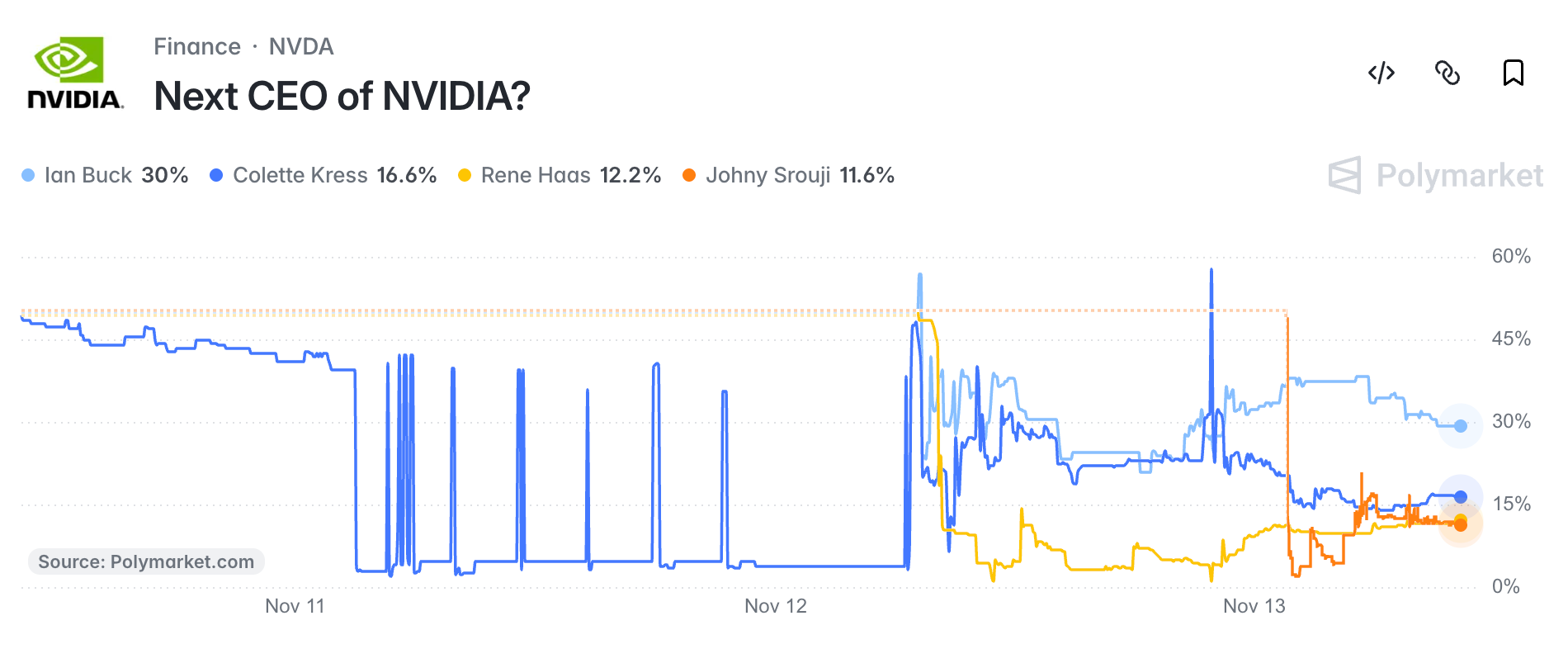
This article will use the probabilities from the prediction market as a benchmark to review the top ten most likely candidates to succeed Jensen Huang, and analyze the potential pros and cons of choosing internal promotions versus external hires.
Overview of Ten Potential Candidates
Based on industry analyses from various media and the latest odds data from the prediction market, Nvidia's selection range is divided into three main camps: internal core veterans, external semiconductor moguls, and politically favored "legendary wild cards."
Internal Promotion Channels: The Preferred Choice for Stability
Due to Huang’s long-standing flat management style without a deputy, Nvidia has formed a multi-sector structure that includes software, finance, networks, sales, and cutting-edge research, with leaders from these different sectors seen as popular candidates.
- Ian Buck — Vice President of Nvidia's Large Scale and High Performance Computing

Polymarket Winning Probability (as of November 13, 10:20 AM Beijing time, same below): 30%, currently the top favorite.
Core Advantage: Widely recognized in the industry as the "Father of CUDA." He has been with Nvidia for over 20 years, leading the software revolution that transformed GPUs from graphic cards into general-purpose parallel computing platforms, and he has been a core driver of Nvidia's data center business from zero to hundreds of billions in scale.
Successor Logic: Nvidia’s true moat is not just chips but the deeply integrated CUDA ecosystem with both hardware and software. Buck is intimately familiar with the company's technology roadmap (from Blackwell to the subsequent Rubin architecture), making his succession the best way to reassure the internal R&D team's morale and core cloud vendor clients.
- Colette Kress — Interim CEO and Chief Financial Officer of Nvidia

Polymarket Winning Probability: 17%, currently ranked second
Core Advantage: Recruited personally by Huang in 2013 while he sketched AI blueprints on a whiteboard, Kress has nearly 25 years of financial and operational experience from Microsoft (previous CFO of the Server and Tools division), Cisco, and Texas Instruments. During her tenure, Nvidia achieved over 50 times annual revenue growth, making her the most familiar and trusted "financial amplifier" of Nvidia on Wall Street.
Successor Logic: In the sensitive period where the founder's personal scandal has triggered a corporate governance crisis, and facing a staggering $164.5 billion financial commitment to data centers and the geopolitical chip export regulatory battles between the U.S. and China, Kress possesses extremely high credibility in capital markets, making her the safest choice for a smooth transition.
- Michael Kagan — Chief Technology Officer (CTO) of Nvidia

Polymarket Winning Probability: 4%
Core Advantage: A top Israeli computer architect who previously worked for Intel for 16 years (having led the Pentium MMX architecture), Kagan co-founded the high-speed networking giant Mellanox in 1999 and served as CTO for over 20 years. After Nvidia acquired Mellanox for $7 billion in 2020, Kagan became Nvidia's CTO, overseeing one of Nvidia's largest R&D bases (the Israeli R&D center) outside the U.S.
Successor Logic: The bottleneck for a million-card AI cluster has shifted from "single-card performance" to "high-speed interconnect" (InfiniBand and NVLink). Kagan is the chief architect who defines a modern data center as "a giant computer" (AI factory), making his succession highly aligned with Nvidia's technical mainline transformation into a full-stack system provider.
- Jay Puri — Former Executive Vice President of Global Business Operations at Nvidia, currently a senior advisor

Polymarket Winning Probability: 3%
Core Advantage: An internal "evergreen" figure and head of business monetization at Nvidia. He holds a master's degree in electrical engineering from Caltech and an MBA from Harvard Business School. After 22 years at Sun Microsystems, he joined Nvidia in 2005, overseeing global sales, major customer relations, and regional markets for 21 years.
Successor Logic: He is one of the few executives at Nvidia with a deep engineering background and global business expansion skills, directly interfacing with major sovereign AI buyers and super-scaled cloud vendors. However, Puri has recently stepped back from active management and transitioned to a senior advisory role this autumn, reducing the likelihood of directly appointing him as CEO.
- Bill Dally — Chief Scientist and Senior Vice President of Research at Nvidia

Polymarket Winning Probability: 2%
Core Advantage: A heavyweight figure in the field of computer architecture and former head of the Computer Science Department at Stanford University. Since joining Nvidia in 2009, he has built Nvidia Research, leading developments in Tensor Core, NVLink high-speed interconnect, and low-precision inference, nearly all of which established today's AI dominance.
Successor Logic: As the company's "technical brain" and a member of the President's Council of Advisors on Science and Technology (PCAST), Dally holds an extremely high reputation in academia, politics, and engineering, serving as a spiritual totem for maintaining Nvidia's technological edge over the next decade.
External Hires: Top Technical Giants in the Semiconductor World
If the board decides to seek external help, the prediction market heavily favors three chip giants with an understanding of hardware, architecture, and the ability to handle TSMC’s production capacity.
- Rene Haas — CEO of Arm

Polymarket Winning Probability: 12%, tied for first among external candidates
Core Advantage: A combination of experience as a public company CEO and "former Nvidia executive" heritage. He served as Vice President and General Manager of Nvidia's Computing Products Business from 2006 to 2013 for seven years; after taking over Arm, he successfully led the company through its IPO and transformation toward data centers and AI computing foundations.
Successor Logic: He understands Nvidia's unique internal culture and holds ecological resources related to global mobile and server CPU architecture (Nvidia's Grace CPU is based on the Arm architecture), making him one of the rare "internally and externally qualified" candidates.
- Johny Srouji — Senior Vice President and Chief Hardware Technologist at Apple

Polymarket Winning Probability: 12%, tied for first among external candidates
Core Advantage: The creator of Apple's custom chip empire (Apple Silicon, covering A-series and M-series chips), who possesses unparalleled execution power in advanced process architecture design, hardware-software collaboration, and managing TSMC's crucial production capacity.
Successor Logic: Nvidia is at an "annual iteration" extreme R&D pace and heavily relies on TSMC's advanced packaging and wafer production capabilities. Srouji's engineering reputation and supply chain control align perfectly with Nvidia's hardware foundation needs.
- Lisa Su — Chair and CEO of AMD

Polymarket Winning Probability: 4%
Core Advantage: A PhD in electrical engineering from MIT, she is recognized as the "Iron Lady" in the semiconductor industry. After taking over AMD when it was on the brink of collapse, she devastated Intel in the data center market with the Zen architecture CPU and launched the MI series AI acceleration cards, currently the only competitor able to challenge Nvidia head-to-head in AI computing.
Successor Logic: In terms of technical depth, supply chain appeal, and business acumen, Su is nearly the only chip leader globally who can stand shoulder to shoulder with Jensen Huang (and they also share a distant cousin connection), but as the commander of a top adversary, this option reflects more of the market's speculative willingness with great practical resistance.
Politically Favored "Legendary Wild Cards": Former Tech Titans
Huang's resignation involves not only personal morality but also scrutiny from Congress and the FBI regarding potential national security risks. Thus, two Silicon Valley patriarchs with top political and business acumen have also entered the top ten in odds.
- Tim Cook — Former CEO and current Executive Chairman of Apple

Polymarket Winning Probability: 5%
Core Advantage: Trump's recommendation — after Huang's resignation, President Trump publicly named on social media: "Since Nvidia CEO Jensen Huang, who has done an excellent job, has resigned, there is only one person who can take his place, and that is Apple's Tim Cook. Replacing a legend with another legend."
Successor Logic: Cook has proven at Apple how he can leverage exceptional global supply chain control, strong financial discipline, and lobbying abilities amidst great powers to push a tech company to a peak market value of several trillion dollars after the departure of the legendary founder (Steve Jobs).
- Eric Schmidt — Former CEO and Executive Chairman of Google

Polymarket Winning Probability: 2%
Core Advantage: Silicon Valley’s most renowned "Adult Supervision." He took over as CEO of Google in 2001 for ten years, assisting the two young founders in turning Google from a startup into a global internet giant; post-retirement, he has remained active in Washington on defense and AI policy matters (having served as chair of the U.S. National AI Safety Commission) and has heavily invested in the AI sector.
Successor Logic: Some Wall Street analysts have pointed out that Nvidia's biggest pain point is that the 60 direct reports left by Huang lack the prestige to navigate the political storms of Wall Street and Washington. Schmidt understands the ultra-scale AI strategy and has deep connections in the Pentagon and the White House, making him an excellent transitional commander to help Nvidia weather the national security investigation storm.
Internal Promotion vs. External Hires: The Board's Cost-Benefit Analysis
Nvidia is not a company that employs a conventional professional managerial system. Over the past 33 years, Huang has created a very unique organizational structure—highly flat management, engineering agility defined by "light speed," and a heavy integration of hardware and software. This has made the direction for choosing a successor a complex game.
If the choice is "internal promotion" (like Buck, Kress, or Kagan), the biggest advantages are "stability" and "speed."
On one hand, there is a seamless connection of technology roadmaps with customer expectations. Nvidia is currently at a critical junction with the capacity ramping of the Blackwell architecture and intensive R&D on the Rubin architecture; core internal veterans will not need to spend months reunderstanding the complex CUDA software stack and NVLink network architecture. At the same time, major cloud vendors like Microsoft, Google, and Meta have long directly engaged with Buck, Puri, and Kress on product roadmaps and multi-billion dollar orders, allowing an internal successor to minimize the waiting mood and transitional friction costs of large clients.
On the other hand, it protects Nvidia's unique engineering culture. External executives often adapt to the hierarchical and bureaucratic management processes of traditional tech giants; forcing them into Nvidia could easily undermine the flat agile decision-making the company prides itself on, while internal veterans naturally adapt to this high-intensity, engineering-oriented operating model, thus maximizing the stabilization of the morale of the R&D troops.
However, the shortcomings of internal promotions are also evident. First is the lack of experience managing in a public company as "the top leader,” whether it's Buck or Kagan leaning towards technology and business or Kress leaning towards finance, none have previously independently managed a multinational tech empire with a market cap of nearly $40 trillion, lacking direct experience in tackling complex geopolitical games, congressional national security reviews, and global antitrust regulation; secondly, there are difficulties in balancing internal factions' power structures, in the past, Huang could manage 60 executives single-handedly with his absolute authority as a co-founder, now promoting someone from among equally ranked senior vice presidents could disrupt the delicate internal power balance.
Moreover, faced with the encirclement of cloud vendors' self-developed chips (ASICs), internal maintainers often fall into path dependency and lack the courage to transcend the existing framework for a disruptive business model.
On the contrary, if "external hires" (including peers in the industry or heads of other major corporations) are chosen, the board values “breaking the deadlock” and “reshaping.”
The core advantage lies first in mature governance skills and crisis public relations capabilities of established giants. External leaders like Haas, Cook, and Schmidt have already proven their dominance in independently steering large enterprises in the capital markets; since Nvidia's change in leadership stems from the founder's personal scandal and potential national security compliance crisis, bringing in a highly reputable external CEO with a strong record can not only calm nervous Wall Street institutional investors but also convey a strong signal to the outside that “company governance is completely turning a page, no longer relying on a single founder's halo.”
Simultaneously, cross-border gene might help Nvidia fill its shortcomings. If Apple executives (Srouji or Cook) are brought in, they can take chip design and TSMC supply chain control to the limit; if political business patriarchs (Schmidt) or cloud giant executives are brought in, they can quickly repair relationships in Washington or accelerate the transition to a full-stack cloud service provider.
However, external hiring is also a gamble with a high price.
The biggest hidden danger lies in the strong "cultural rejection response" and the loss of core talent. Nvidia's core engineering team has an almost religious sense of identity with the company; if the new leader attempts to implement bold organizational restructuring or introduce cumbersome KPI assessments, it could easily trigger an exodus of core vice presidents and top chip architects. Even more fatal is the long strategic acclimatization period—in the fiercely competitive AI computational arms race, any six-month to one-year strategic hiatus due to the new leader getting familiar with the business could provide an excellent window for AMD and the cloud vendors' self-developed ASIC camp to breathe and counterattack.Realistic Difficulties in Poaching Peers
Although prediction markets have given odds of 12% to Haas, 12% to Srouji, 5% to Cook, and 4% to Su, in practical business operations, directly poaching executives from competitors or core ecosystem partners faces three nearly insurmountable real barriers.
The first barrier is litigation over trade secrets and the long "garden leave" period. Although California's laws where Nvidia's headquarters is located generally do not support non-compete agreements, the U.S. federal and state laws surrounding the Protection of Trade Secrets Act (DTSA/UTSA) still carry significant weight.
For example, if Su or Srouji are poached, they carry AMD’s or Apple's chip architecture plans, TSMC’s advanced process capacity locking agreements, and core customer pricing strategies for the next 3 to 5 years in their minds. Once they join a direct competitor like Nvidia, the original company will inevitably file a lawsuit in court, invoking the “inevitable disclosure principle” — claiming they cannot perform their duties at Nvidia without using the original company’s core trade secrets, thus applying for a court to issue a temporary injunction mandating a paid "garden leave" of 1 to 2 years. In the rapidly changing AI era, Nvidia can never afford to wait for a new leader to remain idle for more than a year before officially taking office.
The second barrier comes from the ironclad scrutiny of global antitrust agencies. Nvidia currently occupies more than 80% of the global market share for AI acceleration chips in data centers and has long been under the antitrust microscope of the U.S. Department of Justice (DOJ), the Federal Trade Commission (FTC), and the European Commission.
If the board attempts to poach Su from AMD, considering AMD is Nvidia's only substantial counterbalance in the GPU realm, the transition of its highest commander to Nvidia, while not a corporate merger, could easily be categorized by regulators as “maliciously undermining market competitive vitality” or talent monopoly, leading to intensified antitrust investigations and administrative interventions.
And if the attempt is made to poach Haas from Arm, historical resistance is similarly daunting. From 2020 to 2022, Nvidia attempted to acquire Arm for $40 billion but ultimately failed under the united attack of multiple regulatory agencies, including Qualcomm and Microsoft, precisely due to the regulators’ demands to ensure Arm's "absolute neutrality." If now the current CEO of Arm directly switches to lead Nvidia, chip giants like Apple, Qualcomm, and Broadcom that also rely on Arm's instruction set would certainly pressure global regulatory bodies again, accusing both companies of potential ecological favoritism and利益输送.
The third barrier is the exorbitant "golden handcuffs" and the lengthy negotiation process. Whether it is Su, Haas, or Srouji from Apple, they all hold unvested restricted stock units (RSUs) and long-term performance stock units (PSUs) worth hundreds of millions from their original companies.
For Nvidia to forcibly poach them, it would not only need the board to approve a historically high "buyout compensation package" — which could easily provoke shareholder disputes given the company has just experienced a scandal and significant market value evaporation; it would also have to face various defensive retention and legal negotiations from the original company’s board, leading to an indefinite extension of the entire negotiation and transfer cycle.
No matter who it is, they must redefine Nvidia without Jensen Huang
From the distribution of odds on Polymarket, it is clear that real-money traders have a clear understanding of the legal and antitrust obstacles to external poaching—among the ten candidates, internal executives from Nvidia hold half of the positions, with the combined winning probability of Buck (30%) and Kress (17%) nearing 50%.
After Huang's sudden withdrawal from the power center, Nvidia has essentially entered a subtle "dual-core transition period" — externally, interim CEO Kress will preside over next week's Q3 earnings call to reassure nervous Wall Street institutions and regulatory agencies; internally, they heavily rely on veterans like Buck and Kagan to stabilize R&D and cloud vendor deliveries.
Regardless of whether a particular internal high-level executive succeeds or if an external magnate parachutes in, the new leader must answer one ultimate question — when that iconic leather jacket is not present, will Nvidia's nearly $40 trillion empire operate on individual heroism or has it already become a smoothly functioning precision machine?
免责声明:本文章仅代表作者个人观点,不代表本平台的立场和观点。本文章仅供信息分享,不构成对任何人的任何投资建议。用户与作者之间的任何争议,与本平台无关。如网页中刊载的文章或图片涉及侵权,请提供相关的权利证明和身份证明发送邮件到[email protected],本平台相关工作人员将会进行核查。


