The founder of Nvidia has stepped down, and leaders in technology and the crypto circles are outraged.
Written by: Jose
Translated by: Luffy, Foresight News
Nvidia co-founder Jensen Huang has resigned as CEO after 33 years in charge, and some of the most vocal figures in the cryptocurrency and artificial intelligence fields believe the company has just made a monumental mistake.
Last night, Nvidia announced that Jensen Huang had resigned from his positions as president, CEO, and board member, and appointed Colette Kress, who has long served as the CFO, as interim CEO. Prior reports indicated that Huang was involved in two extramarital affairs, one allegedly with a businesswoman connected to China; there were also reports of an affair with a Nvidia employee.
In a letter to the company released last Sunday, Huang admitted to infidelity. Nvidia's board statement indicated there is no reason to believe that company secrets or national security have been compromised and that an independent investigation is ongoing. The allegations regarding foreign intelligence have not been confirmed, nor has it been shown that Huang knowingly provided information to foreign governments.
But even without any leaks, the controversy was enough for the board to decide to part ways with him.
The market did not welcome this leadership change. Upon the US stock market opening yesterday, Nvidia's stock price dropped as much as 14%; in just one minute, the market capitalization evaporated by over $500 billion. This company, once the highest in the world by market value, has now dropped to third place.
Before the scandal broke, Nvidia was already under pressure, and Huang's departure poses a unique question for this company, which has tightly built itself around its founder: who can replace him?
Big players in the crypto field call it a mistake
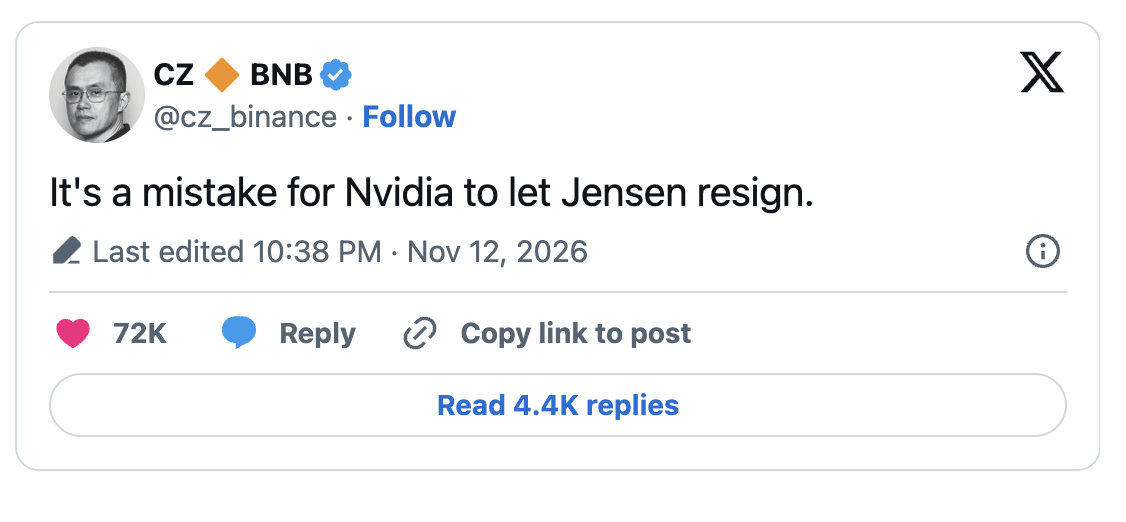
Binance co-founder Changpeng Zhao stated, "Nvidia's decision to have Jensen Huang resign is a mistake." Bitcoin entrepreneur and former Kraken executive Dan Held also spoke out, writing, "He shouldn't have resigned," and argued that Huang's personal issues should be weighed against the company he built.
Erik Voorhees, founder of the privacy-oriented AI platform Venice, expressed even stronger language. "To stop the entire coup against Jensen Huang, just ask one question." He wrote, "What evidence is there that Alice Huang is actually a Chinese spy? The answer is unsurprisingly: none at all."
According to reports, US intelligence officials assessed Alice Huang to be a Chinese intelligence agent, but Nvidia stated there is no reason to believe that any confidential information has been leaked, and the Singapore authorities also stated that there is insufficient evidence to prove she committed a crime. As of today, no law enforcement agency has produced definitive evidence against Alice Huang.
Bitcoin investor and commentator Anthony Pompliano pulled the discussion back to the technology itself. "Don't get carried away by the headlines." He wrote, "Open-source AI is crucial for the freedom of billions of people in the future."
Surrounding all this is likely the most discussed conspiracy theory in the open-source AI community: this removal is aimed at stifling open-source development, with the logic speculated being that Nvidia is one of the primary supporters of the open-source movement, while closed-source companies view open-source as a threat.
For Voorhees, this controversy also raises a practical question. "Is there now a decentralized Hugging Face?" He asked, referring to one of the commitments Huang had publicly made. In other words, faced with potential platform bottlenecks, the solution offered by cryptocurrency is to no longer trust a single platform.
For a founder who built Venice AI on "privately accessible open models," this concern is not just a slogan. Voorhees previously stated that the antidote to AI being over-controlled is "open-source decentralization."
Will Jensen Huang's departure hurt open-source AI?
Some developers see a deeper threat stemming from Huang's departure: losing a strong corporate advocate for "downloadable AI models"—these models' foundational parameters can run outside the companies that built them.
The concern is that without Huang, Nvidia may be less willing to confront those companies that lock state-of-the-art models in proprietary services.
Open-source AI advocate and hardware entrepreneur Jun Song stated that OpenAI and Anthropic had spent millions lobbying Congress to limit open weights. He mentioned a movement called "Pace the Frontier" and argued that Huang's response was to form the Open Secure AI Alliance, concluding with, "And today, we lost him."
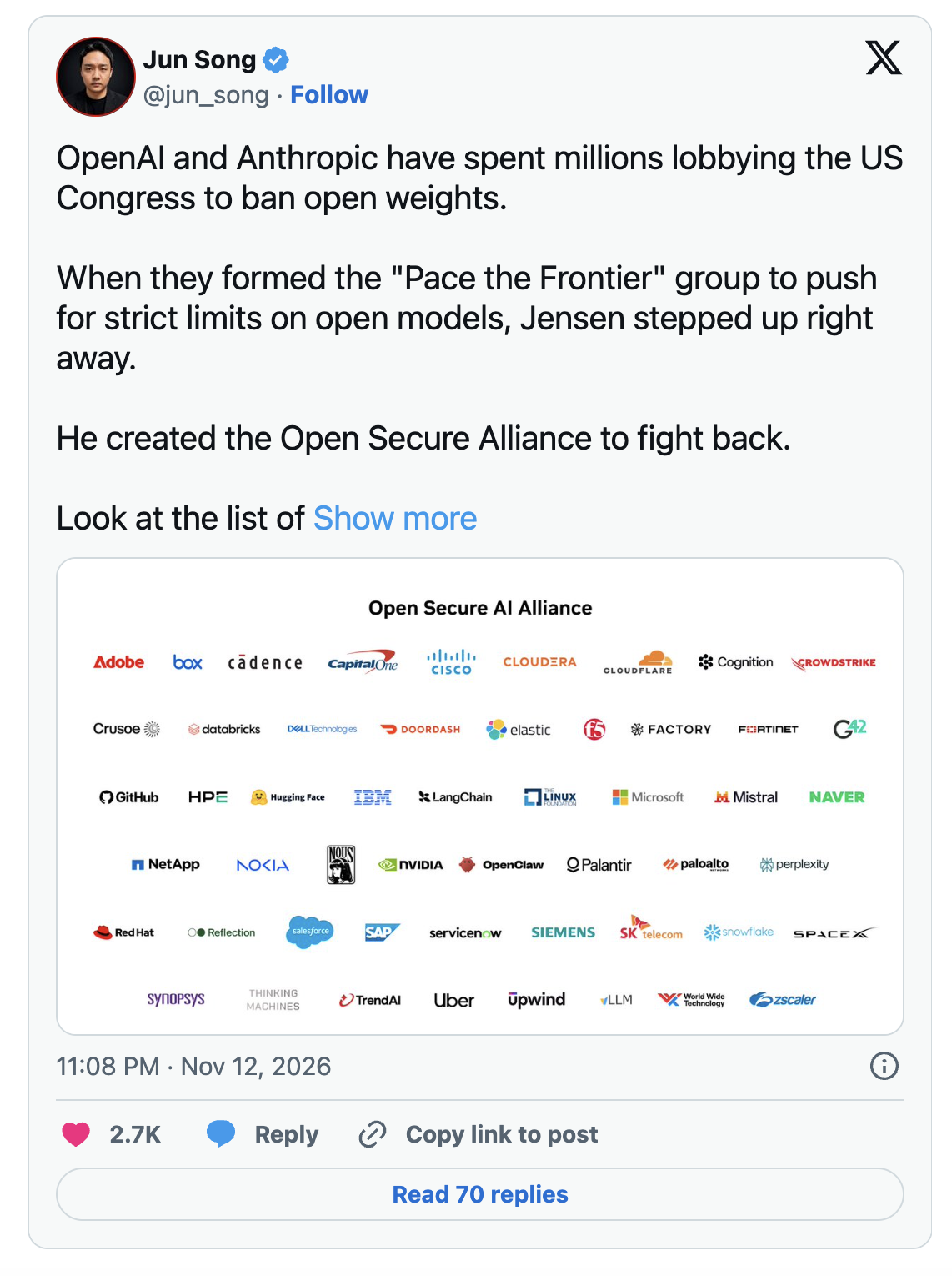
In July, Nvidia, along with Microsoft, IBM, Hugging Face, and dozens of other organizations, initiated the Open Secure AI Alliance, dedicated to open-source AI security tools and standards. Nvidia also supported an open letter against broad restrictions.
Of course, the more macro conspiracy theory claims require much more evidence. The "Pace the Frontier" initiative arose from statements by employees of several AI companies, aiming to find tools to slow down dangerous frontier R&D, not as evidence of some corporate coalition seeking to shut down all open weight models or to oust Huang.
OpenAI subsequently signed that letter supporting open weights, and Anthropic CEO Dario Amodei stated that his company never advocated such a ban.
Posts on social media have shown how much anxiety this debate has generated. One commenter told Song that they are now "relying on Huawei and DeepSeek for the survival of the open-source software community." Huawei and DeepSeek are two Chinese companies known for their open-source efforts.
Behind this issue is a considerable commercial backdrop: Nvidia announced plans to acquire the open-source AI model repository Hugging Face for approximately $12.9 billion, a deal that requires regulatory approval and is expected to be completed in the first half of 2027.
This arrangement could unite "the hardware for building AI" with "the largest hub for distributing open models" under one company; arguably, the most powerful company on Earth.
For developers and shareholders, it is a "sad day"
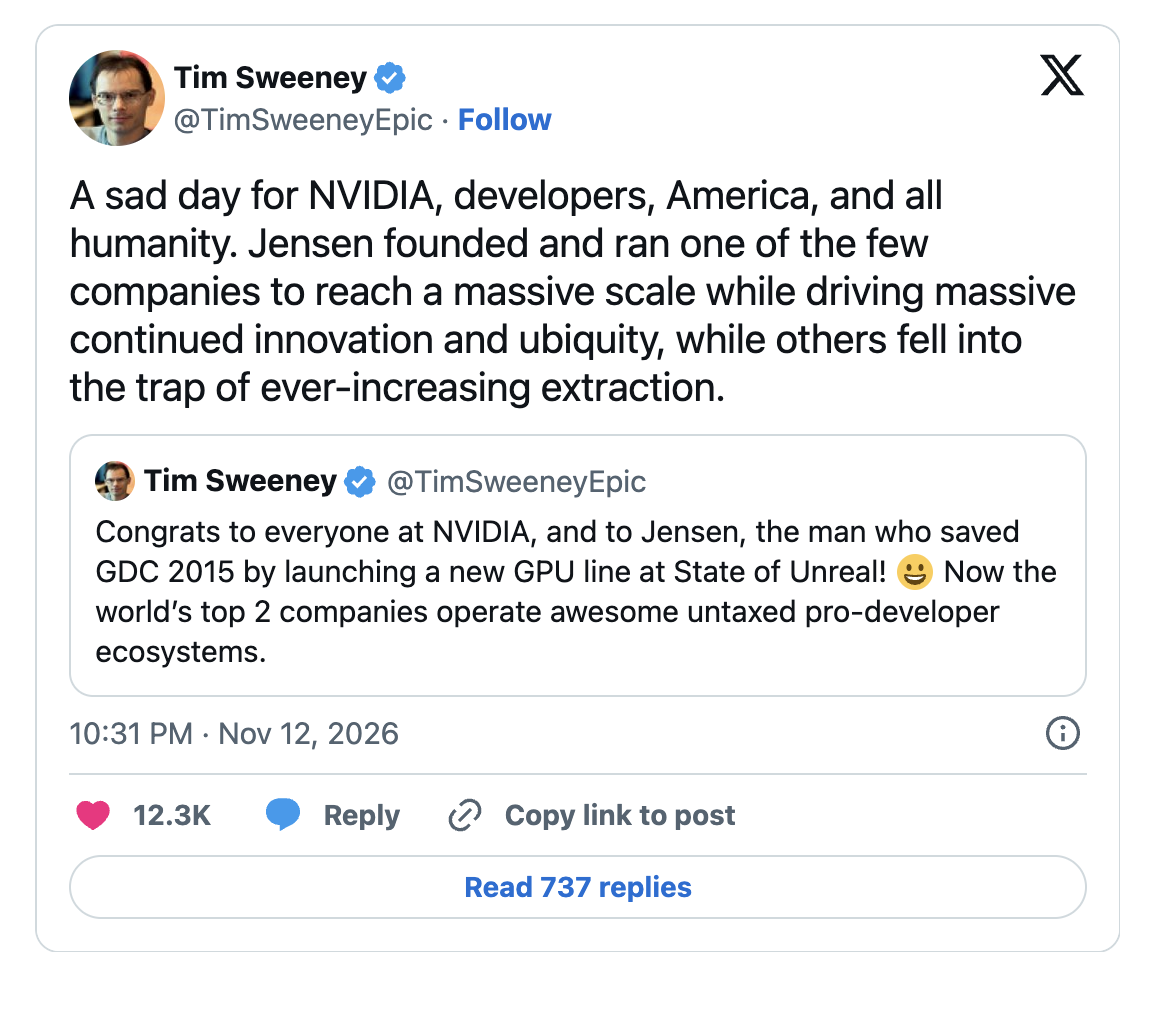
Tim Sweeney, founder and CEO of Epic Games, is one of the most vocal tech executives condemning this departure. "This is a sad day for Nvidia, for developers, for America, for all of humanity." He wrote, praising Huang for allowing innovation to continue while Nvidia grew into a behemoth.
Aravind Srinivas, co-founder and CEO of Perplexity AI, expressed a more personal sentiment. "Thank you, Jensen Huang, for 33 years of leadership." He wrote, viewing Huang's generosity towards other founders (including himself) as one of the forces shaping the future of AI in America.
Peter Steinberger, author of the open-source OpenClaw agent and now employed at OpenAI, believes this decision seems hasty. "If the goal of that spy was to throw one of America's most successful companies into turmoil, they succeeded." He wrote, "Ousting Jensen Huang appears very rushed."
The financial commentary account The Kobeissi Letter insisted that any decisions should consult shareholders, arguing that there were no obvious alternatives and citing research on "the costs of ousting a successful CEO." Following the announcement, the account described this resignation as "the most costly mistake in the AI revolution."
Former DWS executive and corporate governance critic Desiree Fixler discussed the board's fiduciary duty, stating that the board should protect shareholders, rather than indulge in what she called a media frenzy.
Overall, most reactions have been supportive, separating personal issues from business. The line of corporate espionage clearly did not persuade the enthusiastic supporters in the tech circle.
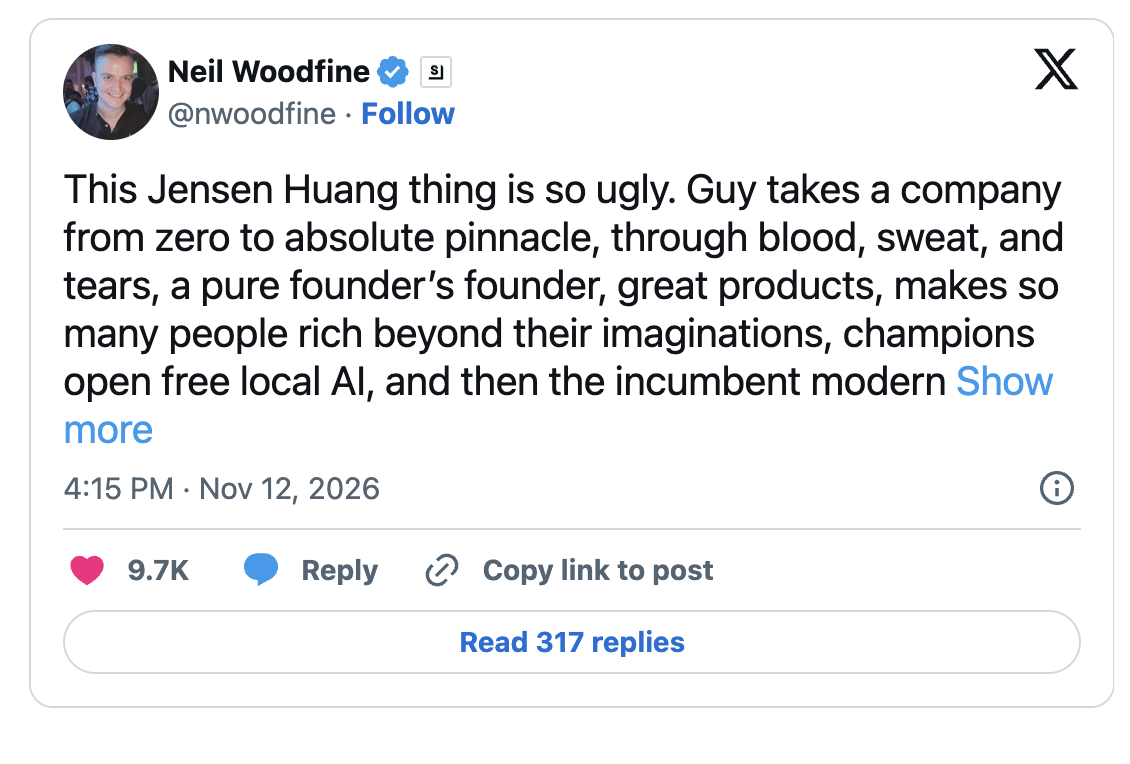
Bitcoin and privacy advocate Neil Woodfine described Huang as a founder who brought Nvidia to greatness and defended freedom and localized AI, only to be replaced by a management team that believes they can do better.
Not everyone believes security issues can be sidelined. North Dakota Republican Senator Kevin Cramer has previously warned about ransomware risks, stating that internal investigations were insufficient. Concerns from Washington are largely consistent: is there a possibility that a leader of a company at the core of US AI infrastructure could be pressured or blackmailed?
Meanwhile, Trump has consistently expressed support for Huang. "He clearly feels very hurt." He said to the media, "I think he'll be okay."
Speculation about Huang's next job has spread as quickly as the criticisms of his previous role. One X user urged Musk to hire Huang, to which Musk replied, "That would be an honor."
Nvidia stated that the board is searching for a formal CEO candidate both inside and outside the company, during which period Kress will preside over the business. Its next scheduled financial report date is November 17, which will be the first important financial update for investors following Huang's departure.
免责声明:本文章仅代表作者个人观点,不代表本平台的立场和观点。本文章仅供信息分享,不构成对任何人的任何投资建议。用户与作者之间的任何争议,与本平台无关。如网页中刊载的文章或图片涉及侵权,请提供相关的权利证明和身份证明发送邮件到[email protected],本平台相关工作人员将会进行核查。


