Investment Logic
On Sunday evening, Jensen Huang, co-founder and CEO of NVIDIA Corporation (NVDA), sent an email to company employees disclosing an extramarital affair with a person reportedly linked to foreign intelligence.
Initially a personal disclosure surrounding the Nvidia CEO's "honey trap" scandal, it has quickly evolved into a complex, multi-faceted crisis involving corporate governance and geopolitical issues. Federal investigations, congressional subpoenas, shareholder lawsuits, and declining stock valuations are all weighing on Nvidia's stock price, as the market rapidly incorporates the various vulnerabilities this scandal may bring.
In the analysis below, I will update my view on Nvidia’s rapidly evolving situation while explaining to investors how I am avoiding the unnecessary negative attention surrounding Nvidia by investing in three AI stocks, while still maintaining exposure to the broader AI ecosystem.
Update on Nvidia's Investment Logic Post-Scandal
Earlier this week, I published an analysis article explaining three possible courses of action the Nvidia board might take to manage the current scandal's impact.
In that analysis, I mentioned that the CEO's personal disclosure would trigger "a governance crisis for the world's most critical AI company." My prior analysis was based on the board needing to achieve several potential objectives, including but not limited to stabilizing the executive team, conducting a “PR brand overhaul,” and providing assurances to employees, customers, suppliers, investors, and other key stakeholders that the Nvidia CEO's actions do not jeopardize national security.
Based on the analysis from earlier this week, I have redrawn the investor-facing scenario diagram to help everyone better visualize the prior situational analysis.
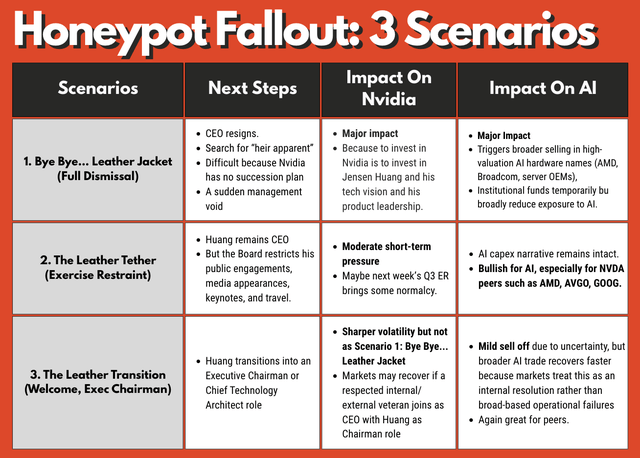
[Original image position: Figure A: Scenario analysis of possible actions by the board after the revelation of Jensen Huang's extramarital affair (author)]
In my view, the most likely course of action the board will take is scenario #2, “The Leather Tether”: allowing the CEO to remain in his position but more strictly limiting his public speaking, activities, and travel—especially trips to geopolitically sensitive areas—while reshaping Nvidia's brand image to convey messages of trustworthiness, optimism, and safety.
However, the board's work has become more complex over the past 48 hours.
First, Nvidia has already faced a shareholder lawsuit regarding prior comments related to the person reported to be a foreign intelligence agent. Second, formal congressional subpoenas and bipartisan hearings appear to be moving ahead significantly. Third, President Trump has confirmed that the FBI has begun investigating this scandal.
For Nvidia, the board, and the shareholders, these are a series of heavy and critical new developments, especially as the company's AI ecosystem status is at a crucial phase, with the third-quarter earnings report due next week. For Nvidia, I still believe that its stock price can ultimately overcome these tensions, uncertainties, and regulatory pressures. I agree with many sell-side analysts that Nvidia should be able to recover.
But at present, the company is indeed facing excessive noise, unprecedented criticism, and a significant amount of unwanted attention. The vast majority of the criticism seems to be focused on the CEO and the company, creating a series of regrettable events for Nvidia's shareholders. In the short term, Nvidia's stock price may experience some restraint, depending on how legal and regulatory actions evolve from here.
However, as I mentioned in the scenario analysis, I still believe that the broader AI trading logic remains intact. From a higher perspective, the market has begun to gradually move beyond this "honey trap" scandal, reflecting my assessment in scenario #2 “TheLeather Tether.
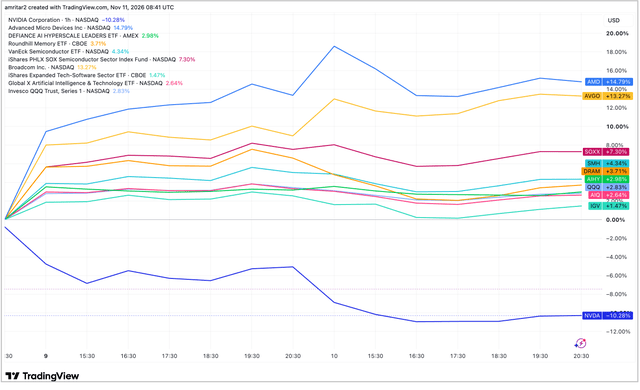
[Original image position: Figure B: The performance of major AI beneficiary stocks within 48 hours after the Nvidia "honey trap" scandal broke (TradingView)]
As shown in the above graph, the market is refocusing on the broader AI trade and beginning to distinguish the true core winners. This also gives investors the opportunity to realign their portfolios, participating in AI opportunities while avoiding the noise surrounding Nvidia's stock price.
I do not own Nvidia stock and have started to concentrate my investment funds on the following three main AI beneficiaries.
Here are the three companies I believe are most likely to benefit next. Coincidentally, according to the Seeking Alpha Quant Rating system, all three stocks currently hold a "Strong Buy" rating.
#1: Advanced Micro Devices (AMD)
The market has essentially cast its vote with real money, and AMD appears to have become the most obvious and strongest AI beneficiary following the image crisis Nvidia faced due to Jensen Huang's scandal.
A simple look at the performance of the two largest semiconductor ETFs—SMH and SOXX—illustrates how strongly AMD's stock price has risen in the past 48 hours, as shown in the chart C below.
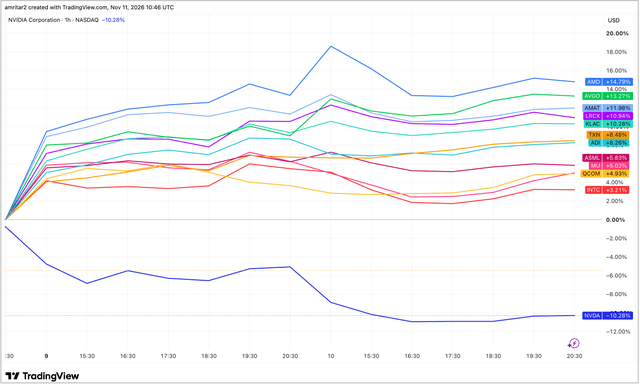
[Original image position: Figure C: Performance of major semiconductor stocks within 48 hours of Jensen Huang revealing his extramarital affair with a reported foreign intelligence agent (TradingView)]
From a market perspective, Broadcom Inc. (AVGO) is also an important beneficiary. However, I prefer AMD more because it not only has strong momentum in its GPU business—the M series Instinct accelerators—but its EPYC server CPU business is also rapidly developing.
Industry reports show that server CPUs and other key AI infrastructure components are still under tight or even extremely tight supply, with CPU delivery times exceeding 25-30 weeks. Server CPUs remain one of the critical bottlenecks, making AMD's strong position in this market even more remarkable. One of AMD's main CPU competitors, Intel Corporation (INTC), saw its stock price plummet last month due to revealed executive issues and missteps in raw material procurement. Now, compounded by the image and compliance nightmare Nvidia faces from the Huang scandal, AMD is in one of its historically advantageous positions.
Additionally, AMD recently announced a partnership with Google Cloud, a subsidiary of Alphabet Inc. (GOOG, GOOGL), further enhancing its attractiveness compared to peers.
In terms of valuation, I believe AMD is also very appealing at present. The market anticipates the company’s CY2027 EPS will grow by 119%, up from 93% this year; meanwhile, CY2027 revenue is expected to grow by 84%, also higher than 51% this year. Based on these median expectations, AMD is currently trading at about 29 times CY2027 earnings and about 9 times next year’s sales, which I find very attractive.
AMD is one of my largest core positions in the fund, and it also holds a "Strong Buy" rating on Seeking Alpha.
#2: Amazon.com (AMZN)
Amazon is one of my favorite hyperscaler stocks to include in my portfolio, currently also the largest holding in my fund.
In my view, Amazon remains one of the most powerful hyperscalers, and how it translates AI investments into revenues and returns has now become unprecedentedly clear. During the third-quarter conference call, Amazon's management specifically took considerable time to explain to analysts that the company expects "significantly increased spending" in CapEx for CY2027.
Additionally, management revealed that the company plans to "start selling chips commercially" in CY2027, indicating that Amazon will begin commercializing its self-developed chips, including Trainium and Graviton, thus creating a new direct revenue source. This is expected to allow free cash flow to materialize sooner and offset significant capital expenditures. This is the clearest explanation Amazon has provided regarding the CapEx return path in recent months, suggesting that AWS's annual growth rate may accelerate to over 40% over the next two years, up from the 39.3% already reached in CY2026’s third quarter. For me, this basically means that the current AWS quarterly growth rate of about 39%-40% may just be a bottom level with further acceleration potential in the future.
I believe Amazon’s decision to start selling self-developed chips at this time is perfectly timed, as Nvidia is currently in a complex phase where it needs to repair its brand image and market trust.
The market's median expectation for Amazon's forward revenue growth for CY2027 is 15.8%, slightly accelerating from 15.6% this year. The current stock is valued at only about 3.3 times next year's sales, which I still find very attractive.
Currently, Amazon is my largest holding in the entire portfolio, and it also holds a "Strong Buy" rating on Seeking Alpha.
#3: Micron Technology (MU)
From June to July this year, I significantly reduced my Micron position because at that time the stock price appeared to be fully priced, and I only kept a small core position. My investment logic was very simple: Micron's stock price was rising faster than the actual increases in the spot prices of the memory products it produces and sells.
Last month, after noticing a positive divergence beginning to appear between spot memory prices and Micron's stock price, I changed my view to "wait and see." Now, since I published that article in October, Micron’s stock price has dropped 27%, so I have begun to accumulate Micron again amid the panic selling driven by intense volatility over the past two weeks.
This recent wave of volatility has been driven by two catalytic factors.
First, the midterm elections have brought overwhelming political authorization, indicating that the U.S. Congress will face a shift in the political landscape in the coming months. Second, as mentioned before, Nvidia and its co-founder have been embroiled in the current scandal. Initially, the market viewed both of these events as significant headwinds for the AI industry.
However, spot memory prices remain very strong, with the spot price for a DDR5 16GB (2GBx8) 4800/5600 module still stable above $60.
Readers familiar with my articles know that I do not evaluate Micron using traditional valuation multiples; instead, I strictly focus on Micron's stock price relative to DRAM spot prices. Based on the current price difference between the two, I believe Micron has become very attractive. Therefore, I am re-establishing exposure and actively buying back Micron stock.
It is worth noting that Micron also holds a "Strong Buy" rating on Seeking Alpha at this time.
Risks and Other Factors to Consider
The most critical risk investors need to focus on right now is whether the macro environment for AI infrastructure development can continue to support all the AI beneficiary companies mentioned in this article. Another ongoing risk to monitor is the congressional subpoenas, subpoenas, and various investigations arising from Nvidia's "honey trap" scandal.
If this event can ultimately be contained within Nvidia, then the broader AI trade should be able to open the next round of increases. However, if these investigations expand to the entire AI ecosystem, then all AI beneficiary stocks may face a round of correction.
Core Conclusion
The "honey trap" scandal brewing at Nvidia's top management is pulling investors in different directions.
I anticipate that as the company’s board collaborates with various stakeholders to repair Nvidia's brand image and reassure the GPU giant's employees, customers, suppliers, and investors, the entire event will ultimately be resolved over time.
Importantly, the broader AI investment logic currently appears unaffected. I have begun to take advantage of each pullback to further withdraw funds from these noise-driven issues in my portfolio and divert them toward those companies I believe are most likely to benefit from the next wave of AI upward momentum.
免责声明:本文章仅代表作者个人观点,不代表本平台的立场和观点。本文章仅供信息分享,不构成对任何人的任何投资建议。用户与作者之间的任何争议,与本平台无关。如网页中刊载的文章或图片涉及侵权,请提供相关的权利证明和身份证明发送邮件到[email protected],本平台相关工作人员将会进行核查。


