Original Author: Joanne
Original Editor: Su Yang
Original Source: Tencent Technology
After the announcement of Jensen Huang's departure, Nvidia's stock price fluctuated sharply, but the market did not experience panic selling for the time being.
On November 12, Nvidia announced that Jensen Huang resigned from his positions as CEO and director, with CFO Colette Kress becoming interim CEO. Following the announcement, Nvidia's stock price briefly dropped by about 14% during intraday trading, before closing down approximately 4%.
In contrast, the S&P 500 Index and the Nasdaq Composite Index fell by 0.35% and 0.39%, respectively, while the Dow Jones Industrial Average fell by 0.36%. On that day, the Nasdaq 100 Index closed down 0.30%, at 28,289.19 points.
The impact of Huang's departure raised concerns among investors about whether the effects would spread to the AI supply chain in the US stock market. Over the past few years, Nvidia has sold GPUs to customers and has helped some clients expand purchases and build data centers through equity investments, credit support, and computing power collaborations. The financing capabilities of clients, Nvidia's chip orders, and the expansion of AI infrastructure are closely interconnected. Whether the new management will adjust these arrangements will determine whether the impacts will further extend throughout the entire supply chain.
Separating Huang's Exit from AI Trading Pricing
On November 12, Nvidia closed down 4.3%, while AMD and Broadcom both rose nearly 6%. The rise of competitors indicates that at least some investors are still seeking opportunities brought by AI chip demand and are re-evaluating the potential market share different suppliers may gain.
On the other hand, AI infrastructure companies faced greater pressure. CoreWeave fell 6.9%, Nebius dropped 16.8%, and data center-related companies IREN and Applied Digital declined by 6.5% and 5.4%, respectively. However, Nebius also released its quarterly performance and outlook that day, and the performance of these companies was influenced by their respective business conditions, financing expectations, and market environment.
These enterprises are connected to Nvidia not just through chip purchases. Some companies have accepted Nvidia’s investments or other commercial support, and their expansion relies on continuous external funding. Therefore, the market needs to assess not only whether GPU demand remains strong, but also if the financing and capital support arrangements for clients can continue after the management change at Nvidia.
This pressure ultimately transmitted to the broader market. On that day, all three major US stock indexes fell by about 0.4%, while the Philadelphia Semiconductor Index dropped by 0.5%; the energy sector rose by 1.5%, partially offsetting the drag from technology stocks.
From the day's market performance, it appears the market has not completely given up on AI trading, but is differentiating between different risks: which companies might gain competitive opportunities, which companies rely more on the financing environment, and which companies' growth is closely tied to Nvidia's support.
The New Nvidia
In recent years, building AI data centers requires the purchase of a large number of GPUs, but GPU prices are high, and substantial investments are also needed for power, land, hosting, and network facilities. For companies like CoreWeave, Lambda, and Nscale that specialize in leasing AI computing power, the ability to secure adequate financing directly determines how many chips they can procure and how large their data centers can become.
Nvidia has gradually formed a unique role in the industry: it is both an AI chip supplier and an investor and financing supporter for some clients.
Nvidia provides these companies with equity investments, credit guarantees, or other financing support to help them obtain funds; those companies then use the financing to purchase Nvidia's GPUs and lease computing power to model companies like OpenAI and Anthropic.
Ultimately, the financial support translates into chip demand.
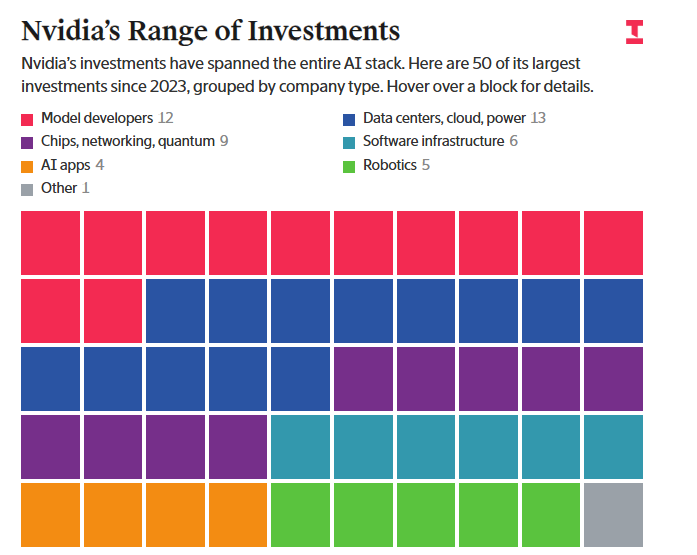
Nvidia's investments cover the entire AI stack: classified by company type, showing its 50 largest investments since 2023
This is also the source of the market's so-called "circular financing" concerns: on one hand, Nvidia sells chips to customers, while on the other, it helps customers obtain the necessary funds to purchase these chips. The faster clients expand, the more orders Nvidia receives; but if clients are unable to generate enough income to repay debts, the financing risks could then backfire onto Nvidia.
Nvidia's latest disclosures show financial commitments totaling $164.5 billion, including guarantees for data center leases, capacity purchase commitments, and more; additionally, the company has made direct equity investments in AI cloud service providers.
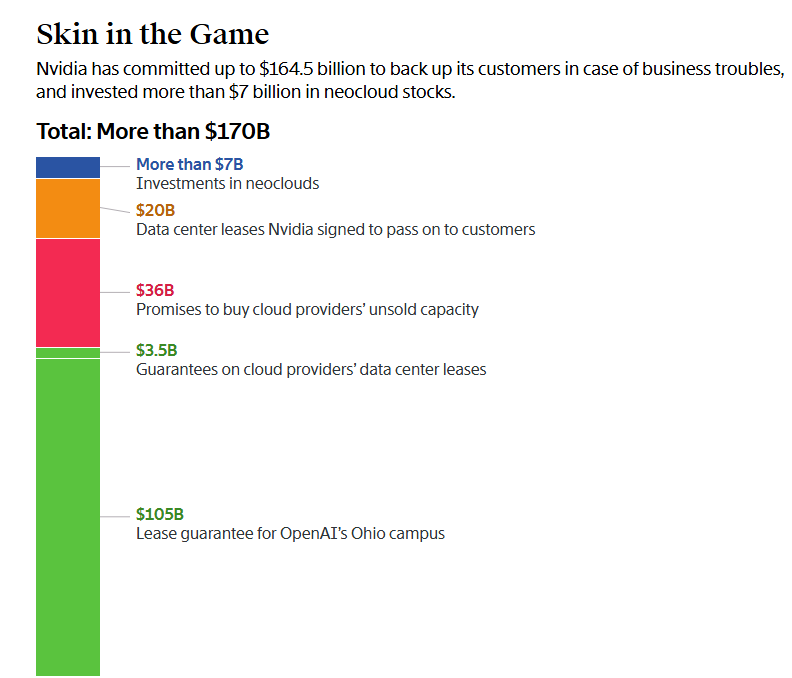
Nvidia has committed up to $164.5 billion to cushion its customers' business difficulties
This model is important because Nvidia's major clients are changing.
Microsoft, Amazon, and Google have their own cloud businesses and substantial cash flows, and are also developing their own chips, thus able to support computing power expansions through their own balance sheets. In contrast, many emerging cloud service providers do not have equivalent cash flows and must rely on external financing to purchase GPUs.
Nvidia's earnings reports show that the proportion of non-hyperscale cloud vendors and large enterprise customers in its data center revenues has significantly increased. For example, in the July quarter disclosed by the company, this type of client contributed about $40 billion in data center revenue, accounting for about 45%, a substantial increase from the same period last year. They have become an important part of Nvidia's growth.
Therefore, the risk posed by Huang's departure is not that clients will stop purchasing GPUs tomorrow, but whether Nvidia is still willing to assume the financing and business risks of the past.
The Uncertainty of Continuing “Blood Transfusion”
Nvidia's financial support for the AI industry has penetrated several projects. However, these deals are at different stages, and not all investment intentions should be viewed as commitments that have been finalized.
The most关注 is OpenAI.
Nvidia previously committed to providing OpenAI with at least $30 billion in financial support, involving up to $105 billion in lease credit support for a data center project in Ohio. Nvidia also plans to participate in Anthropic's IPO, with an intended investment of about $10 billion, and has discussed providing credit guarantees for the data center leased by Anthropic.
For Nvidia, these deals are not only financial investments but also crucial ways to ensure that large model companies continue to obtain computing power and keep purchasing GPUs.
However, model companies like OpenAI and Anthropic do not entirely share the same financing logic as emerging cloud service providers. They have greater computing power demands and more potential sources of funding. Even if Nvidia tightens support for smaller cloud providers, it does not mean it will immediately withdraw from cooperation with large model companies.
CoreWeave represents a different situation.
This company is one of the AI cloud service providers strongly supported by Nvidia, and there is not only a chip purchasing relationship; Nvidia has also invested in CoreWeave multiple times and provided credit support for its leasing of Nvidia chips.
CoreWeave's business model involves first securing financing to build data centers and purchase GPUs, before leasing computing power to AI enterprises. As long as client demand continues to grow, this model can roll out expansively; but if the financing environment deteriorates or the leasing prices for computing power drop, the debt pressure will quickly become apparent.
After Huang's departure, the concern in the market is whether Nvidia will still step in when CoreWeave encounters financing difficulties. Even if Nvidia does not immediately withdraw its existing support, future approvals for new guarantees may become more cautious.
The situation of Firmus illustrates the point further. This Australian AI cloud service provider previously planned an IPO but withdrew its listing plan due to investors' doubts about its valuation and business prospects, and has since sought at least $2 billion in private financing. Nvidia has previously participated in multiple rounds of financing for Firmus and provided credit support for its server purchases. Related arrangements also involved Nvidia providing support in exchange for a share of cloud revenue.
The significance of these deals lies in the fact that Nvidia is providing not just funds, but is also helping clients overcome financing hurdles, allowing GPU procurement and data center construction, which would have been difficult independently, to continue. However, Firmus' IPO setback also exposes a reality: even with Nvidia's endorsement, the capital markets may not be willing to unconditionally back all AI infrastructure companies.
These cases need to distinguish between two things: signed investments and guarantees will not automatically become void due to the CEO's departure; ongoing negotiations concerning investments, credit support, and cooperation projects are more likely to be influenced by the decision-making style of the new management.
Kress, who has long been responsible for Nvidia's financial work, is very familiar with the company's cash flows, risk exposures, and capital allocations. After taking on the role of interim CEO, the most noteworthy observation is not whether investment will be immediately halted, but whether Nvidia will reset its investment thresholds: which clients are worth continuing to support, which projects require more collateral and return assurances, and which risks are no longer borne by Nvidia.
The “Severance Fee” That Has Yet to Appear
The impact of the Nvidia departure event on US stocks cannot be viewed solely in terms of how much Nvidia's market value has evaporated.
Nvidia previously accounted for over 6% of the S&P 500 Index weight, being one of the important companies driving the rise of US stocks over the past few years. Its stock price fluctuations directly affect index performance, but the slight declines in the S&P and Nasdaq on November 12 also indicate that the broader market does not entirely rely on Nvidia alone. Competitors like AMD and Broadcom rose, and stocks from other sectors strengthened, partially offsetting Nvidia's drag.
If Nvidia tightens credit support, the first to be affected might be emerging cloud service providers and data center operators—the increase in financing costs will lead them to delay GPU procurements, slow down data center constructions, or even renegotiate computing power leasing contracts. The impact may then extend to chip suppliers, server manufacturers, storage companies, and data center power equipment companies.
This also explains why there was a clear market divergence on November 12: companies closely tied to Nvidia's financial support, such as CoreWeave and Nebius, faced pressure, while AMD and Broadcom rose due to potential market share shifts.
Investors are not abandoning their optimism about AI but are instead reassessing who can gain revenue from the next phase of computing power investments and who must rely on external funding to maintain their expansion.
Another layer of impact derives from valuations.
In the past, the valuations of AI infrastructure companies were largely based on expectations of sustained growth in future computing power demand. As long as financing channels are open, companies can construct data centers and purchase GPUs in advance, then repay debts with future computing power leasing revenues. However, when capital markets begin to demand higher risk compensation, project return cycles, the quality of client contracts, and debt repayment capabilities will be re-examined.
This is not directed solely at Nvidia. On November 12, the yield on US 10-year Treasury bonds rose to about 5.07%, and oil prices also increased amid geopolitical risks. High interest rates raise the financing costs for data center projects and suppress the valuations of technology companies with a high proportion of future cash flows. The changes in Nvidia's management, coupled with macro interest rate pressures, may put greater strain on the valuations of AI infrastructure companies.
However, Nvidia's own performance remains a critical variable. The company is set to announce its third-quarter earnings report on November 17. The market needs to confirm not only whether GPU orders continue to grow, but also from which clients those orders are coming, whether clients have the ability to make continuous payments, and whether Nvidia needs to continue driving these orders through investments and credit guarantees.
If the earnings report shows that demand from major cloud vendors and enterprise customers is strong enough, Nvidia will have an opportunity to prove that the company's growth does not entirely depend on the investment network driven by Jensen Huang. Conversely, if new orders are still highly reliant on cloud service providers with weaker financing capabilities, then investors will pay closer attention to these clients' debt and Nvidia's guarantee responsibilities.
免责声明:本文章仅代表作者个人观点,不代表本平台的立场和观点。本文章仅供信息分享,不构成对任何人的任何投资建议。用户与作者之间的任何争议,与本平台无关。如网页中刊载的文章或图片涉及侵权,请提供相关的权利证明和身份证明发送邮件到[email protected],本平台相关工作人员将会进行核查。


