In the second half of 2026, global tech giants are starting a new competition for AI entry points.
From Grok Bot, Muse, OpenAI Dots, to Anthropic Duet in Silicon Valley, as well as startup Instinct, AI products in the form of Personal Assistants are emerging one after another.
After the explosion of AI on the enterprise side, the personal consumer side presents a larger market, which is the next battlefield that all giants are eager to enter. In China, the battle for PA-type products has also begun, but the Chinese market and Silicon Valley's ecosystem will be quite different.
China has the giants' Super app ecosystem, which means that agents within the ecosystem can more easily integrate payments, office tasks, travel, and other aspects. However, in the more competitive mainland market for AI products, how to commercialize such products is also a significant challenge.
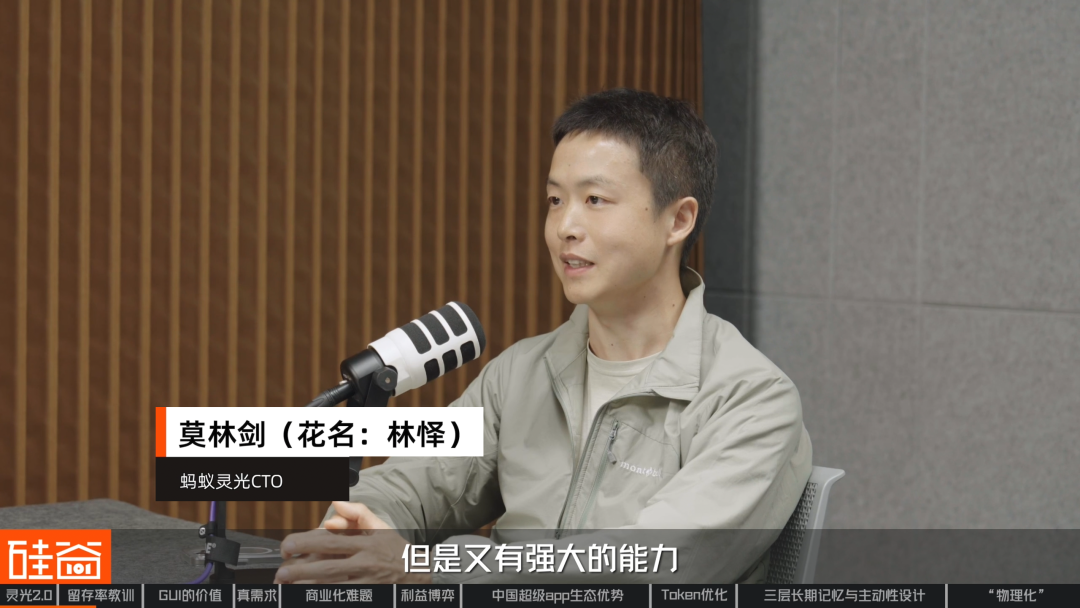
We chatted with Lin Yi, CTO of Ant Group, who just released Lingguang 2.0. He shared his thoughts on the evolution of Agent products.
A year ago, Lingguang 1.0 focused on generating simple applications with a single sentence, allowing ordinary people without programming skills to create their own tools. This was a very imaginative direction. However, after going online, the team gradually discovered that while users could create an application, it didn't necessarily mean that the application actually solved a problem; creation itself might not be a high-frequency demand.

So, by the time of 2.0, Lingguang attempted to shift the product focus from helping users create tools to helping users actually achieve their goals. Not just answering a question once, but being able to remember your needs, continuously track tasks, actively remind you at appropriate times, and even do tasks for you with authorization.
At the same time, this battle for personal AI assistants has brought many issues worth discussing. Are users really willing to pay for an AI personal assistant? If AI can complete shopping for us, what happens to platforms that originally relied on traffic and advertisements? As AI gains access to more and more personal information, how can we build trust and ensure it won't make mistakes?
In this article, we discuss the product upgrades, technological advancements, and the balancing of business interests behind the battle for personal AI assistants, and how high-frequency, high-value AI products that can be used by ordinary people can find their way to us.
This article is a video transcription, and we welcome everyone to watch the following video

Chen Qian: Lin Yi, welcome to "Silicon Valley 101." I know you just released Lingguang 2.0, and it's been a year since Lingguang 1.0 was launched. Why did you choose this moment to release 2.0?

Lin Yi: We've been preparing 2.0 for a long time. Perhaps the most memorable aspect of 1.0 was creating flash applications, but we've always been thinking about how to help users better get things done. Whether through Q&A or applications, they often only solve certain aspects of a problem, and tasks like travel span across different time periods.
We started brainstorming related work around June or July of this year, and releasing at this point felt like a natural outcome for us. Additionally, many similar products have appeared in the industry.
Chen Qian: So, Lingguang 2.0's audience is still relatively consumer-oriented, hoping to help the public get things done and solve problems. Does this align somewhat with Muse?
Lin Yi: We didn't start this after seeing Muse; to be frank, that was too late. We began this work quite early, and it certainly targets individual consumers. We genuinely hope this is a product that ordinary people can use.
I can share my personal experience; I've been using tools like Codex to manage my life and handle work tasks for a long time. For example, if my child makes mistakes on a math exercise, I would take a picture of the mistakes, let it analyze where they went wrong, and then generate a new question specifically targeted at those errors. If my child makes a mistake again, we continue this process, somewhat like manually conducting reinforcement learning. However, this process is still complex for the average person; my wife can’t manage it either, and it's even harder to imagine my mother or other elderly people using it.
Chen Qian: Is it not possible to just use a sentence in natural language to complete it?
Lin Yi: One sentence won't cut it; you need to understand the underlying logic.
Chen Qian: Because it was originally intended for developers.
Lin Yi: Right, but I believe similar capabilities can be generalized. For instance, take my mother as an example; she has high blood pressure and needs to manage it. Currently, she records her blood pressure in a small notebook every day.
However, recording is just the first step. More importantly, it’s about analyzing trends and possibly providing advice: if blood pressure is high, what should she do? These tasks are suitable for management by Codex or similar agents, but she can't use them at all.
We see such powerful capabilities that my mother cannot access. Does she need these capabilities? Definitely. We hope to turn these powerful capabilities into products that ordinary people can use.
Chen Qian: Does this also draw inspiration from the "Little Lobster" OpenClaw from earlier this year and the later rise of Hermes? At the time, ordinary people couldn’t manage either; many were anxious. Even if they installed "Little Lobster," they didn’t know how to use it.
Lin Yi: Yes, it’s more of an inspiration. This type of interaction is very informative for us, but our main line hasn't changed; we still want to help users better accomplish a task.
We hope to move from searching for information and creating applications towards interactions directly based around user goals. Once users clarify their goals and constraints, we proactively help them achieve them during the process. This is a natural result of the product's upgrade, and we have absorbed insights from these products along the way.
Chen Qian: To create a universally usable agent product, what technologies have advanced over the past year that have enabled today's agent capabilities?
Lin Yi:Technologically, definitely model capabilities. Last year, everyone might have been focused on programming and mathematical reasoning, but there has been significant progress in long-duration task execution abilities; this is one of the conditions.
The second is the harness (agent execution framework). It doesn’t necessarily contain extremely advanced technology, but it is crucial for the agent's implementation.
Models have their limitations; even with increasingly powerful capabilities, some problems remain unsolvable. For example, it is still a probabilistic model that cannot guarantee 100% accuracy. Many things, including new developments, must be supported by engineering means. Because model training takes at least months for cycles, new things also need to be supplemented through external memory and other mechanisms.
Furthermore, the development of ecosystems, MCP (Model Context Protocol), etc., are also driving advancements in this area. Cost is equally critical; otherwise, it cannot support the completion of so many things.

Chen Qian: These are all very important; we will expand on them later. First, let's review the birth of Lingguang 1.0: from the development of 1.0 to 2.0, what experiences did you gain from market feedback?
Lin Yi: Our product is not about adding features to existing businesses; rather, we hope to work closely with the cutting edge of technology. For instance, judging where technology might develop six months to a year from now, we build products around these capabilities.
When we started this job last year, one significant trend was the advancements in programming capabilities. Can they help us achieve our goal of “helping people get things done”? A very natural direction is to help people write programs and make applications. Generating applications with one sentence makes it simple enough for ordinary people to use.
Chen Qian: I have a challenging question. We saw data indicating that after Lingguang 1.0 was launched, the three-day retention rate was just over 20%, which is less than chatbot (chat bot). What reflections did this bring to you, and how did it influence the design of 2.0?

Lin Yi: On one hand, we should look at these numbers; on the other, we need to examine the essence: are truly useful, repeatedly used applications growing?
To be frank, creating flash applications is not a high-frequency demand; many people prefer to use applications directly. This is also why we later developed Lingguang Circle; not everyone has so many ideas and wants to create applications on their own. A significant reflection is that we should focus on how much value the product ultimately brings to users. Creating an application doesn’t mean it generates value; using it to solve user problems is what constitutes value.
By 2.0, we will continue this value judgment process; we won’t just look at numbers or how many people create, because there are too many other disturbing factors in between. The core still is whether it helps users truly accomplish tasks and provide incremental value.
Chen Qian: I see that Muse’s current retention rate might also be just over 20%. Is this number higher or lower than you expected?

Lin Yi: If it were me, I’d want to see whether those who have created goals and deeply use the product have sustained growth and retention.
Overall data can be affected by other factors, which is somewhat similar to our flash applications. A product that explodes in popularity will inevitably attract a large number of users. Ideally, if everyone who comes stays, that would be great, but in reality, there are many disturbances.
So I care more about whether this subset of users, with three to five sincere goals, is experiencing continued growth and retention. After we went live, we may also look at our situation from this perspective.
Chen Qian: I noticed it recently had exceeded 10 million users, growing quickly, but the speed of new user acquisition is declining. Is this inevitable?
Lin Yi: Such a situation may arise, and it might also be related to the evolution of capabilities. For us, one common aspect is that it should ultimately return to the core of user value.
ChenQian: Lingguang 1.0 launched a flash application incentive plan worth 10 million yuan. Do you think it was worth it? If so, will 2.0 launch a corresponding plan? If not, what lessons have been learned?
Lin Yi: For 1.0, the incentives certainly had value in habit formation, allowing more people to learn about it and create their first application, which had clear market education implications.
Secondly, the incentives we provided covered not only creation itself but also improving the product. So at that time, the plan was strongly tied with Lingguang Circle, closely integrated. Creating something is the first step; we hoped everyone would create good products, share them, gain recognition, and let more people continue to iterate based on those results.
However, truly creating fine products still has a high threshold, and comprehensive capabilities still have room for improvement. It is already good to have people able to create simple applications that casually address surrounding problems.
Chen Qian: Do you think general agents still need market education? For example, Meta is also using incentives, providing free token limits to both parties via invitation codes to achieve social fission. But ChatGPT did not adopt this promotional approach. Why did the chatbot not need it back then, but agents do now? Is it due to insufficient market education, or are the capabilities still not sufficient for many people to use spontaneously?
Lin Yi: I think there may be multiple factors. Meta certainly considers market competition, and the timing differs from that of ChatGPT, which was unique at the time.
Chen Qian: There was no competition back then.
Lin Yi: Right, the situation was different. Meta faces fierce competition, and marketing through fission is not surprising; this is related to the market environment.
On the other hand, users have already developed a habit of using chatbots. Using personal agents requires users to articulate their goals, not just pose a question. Instead of asking, “What’s the weather like in southern Xinjiang?” they would say, “I want to travel to southern Xinjiang, help me arrange it.” This habit needs to be cultivated, letting users know that this is how they can use it. While a shift is needed, I think the latter approach is more human-centric, as users only need to state their intentions.

Chen Qian: Changing user habits is not easy. In the Internet and mobile Internet eras, people are used to opening applications and completing tasks through clicks. Now, it is about using natural language to tell a personal assistant what to do, and letting it complete the task automatically. Will this shift in interaction paradigms bring about a tenfold increase in efficiency or convenience?
Lin Yi: I don't think it will replace the existing modes; the two should integrate better instead.
Chen Qian: You believe the original paradigm won’t disappear?
Lin Yi: No, and both will improve. For instance, GUI (graphical user interface) type operations have inherent advantages. On one hand, many people have already been educated in them. On the other hand, they encapsulate the operational steps. For example, with a complex task, the first step is to select a destination, and the second step is to select other criteria; users can easily understand it, and the interface encapsulates the best processes inside.
If it is purely a dialogue, ideally, users can express all information in one sentence, but such freedom might confuse users on what next to say. So, I think GUI is a great encapsulation, because for repetitive processes, clicking might be more convenient than speaking; a quick click achieves the task.
Thus, I don't believe it will disappear; the two will certainly integrate better. We have also explored this aspect, using a combination of GUI and dialogue in 1.0, hoping to interact with users in the best way, presenting results with the highest information efficiency. Sometimes, a picture is worth a thousand words; sometimes, an interactive animation can be more useful than a lot of text. 2.0 is the same.
Chen Qian: Natural language is not necessarily the most efficient way to communicate, and many things cannot be expressed in words.
Lin Yi: Right, for example, if you ask me to describe what this space looks like, how do I say it in one sentence?
Chen Qian: I might need to write an 800-word article.
Lin Yi: A photo might actually be the best. So, there will definitely be multiple input methods, including multimodal and unstructured inputs, while outputs should be structured.

ChenQian: What brings the most value to general agents? Taking Lingguang 2.0 as an example, what scenes do you see users finding most valuable?
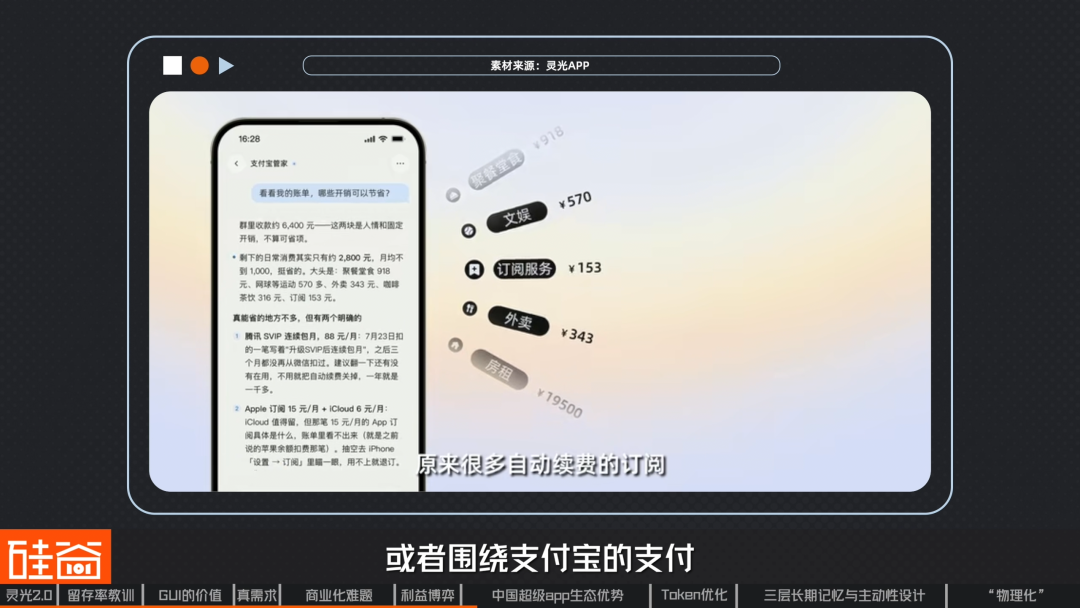
Lin Yi: We have integrated some capabilities from the Alipay ecosystem. A friend asked it to analyze a bill to see where he was spending unnecessarily and how he could save money. It turned out he had refunded five times the amount he had spent. For instance, he bought six pieces of clothing, returned five, and kept one. It concluded he was an impulsive buyer, and he said it really hit home for him.
I also analyzed my own bill, and its suggestion was that my telecom plan was too luxurious. I took a look, realized I actually didn’t need such a high limit, and downgraded it; so, I saved some money. Although these examples are small, I find them valuable.
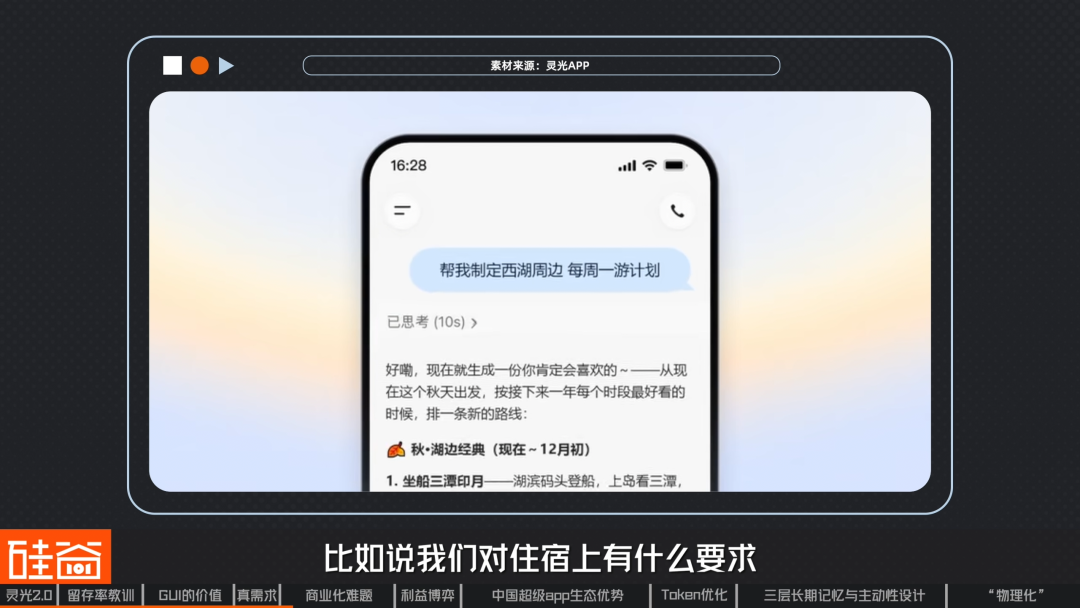
Also, during my summer vacation trip to Xinjiang with my family, the planning experience was fantastic. I told it my goals, itinerary, and constraints, such as accommodation requirements, and it kept track for us throughout the whole journey. The key is that it doesn't just give you a travel plan before departure; it improves the experience during the trip. It would suggest adjustments based on changes in circumstances. For example, scenic views in southern Xinjiang are very weather dependent; if the weather is poor, you won't see the views, and it would help you adjust your itinerary accordingly.
Chen Qian: It gives new suggestions based on daily changes.
Lin Yi: Yes. For instance, if I get sick from eating something bad and feel uncomfortable, it will recommend adjusting the itinerary again. Throughout the trip, it updates the overall arrangements based on the conditions we care about and external changes. It doesn’t simply push unaccomplished tasks from yesterday to tomorrow; instead, it re-plans based on the overall goals of the trip, which is very hassle-free.
Chen Qian: Very interesting. I noticed that in Silicon Valley, some popular scenarios of Muse also help everyone save money.
Lin Yi: I see many are related to shopping.
Chen Qian: Yes. I also want to share two examples: one is helping people sell items on Facebook's second-hand marketplace, Marketplace. The other is having Muse find small refunds or checks in the email that needed to be claimed. Users can easily overlook emails, but it can help locate them, making people feel they have indeed saved a lot of money.
Lin Yi: These tasks can be done by people if they are willing to take the time, like going through bills one by one. But often, they either forget or find it cumbersome. A personal assistant can do it for you.
Chen Qian: What do you think agents can actually do, and what are their high-value scenarios? Is it more valuable for agents to help you save money and time or to help you spend money and time?
Lin Yi: I think both are not contradictory; both can be done well and both are valuable.
For example, productivity and office software, like the commonly used Office trio for white-collar workers, creating PPTs, Excel sheets, and Word documents, are among the first scenarios to emerge. Products like Claude Code and WorkBuddy also focus on office tasks, later expanding into personal life scenarios.
These two scenarios are not contradictory and can be executed well, but they involve cost and cost-effectiveness. Currently, reasoning costs are still quite high, making the office scenarios relatively easier to recoup costs.
Chen Qian: For enterprise users, the commercial value might be higher.
Lin Yi: However, the pure office scenario market is certainly smaller than the personal life scenario. The underlying technology is advancing, and costs are declining, which is one of the prerequisites for product feasibility. Saving time has a very clear value; using the saved time for better living isn't that great?
Chen Qian: What scenarios are likely to be high-frequency for agents? Only with truly high-frequency and reproducible use will there be greater value and user stickiness.
Lin Yi: Offices are definitely high-frequency, and there are quite a few in life as well. We might be mentally preoccupied with certain things every day, like with children; when they are small, they need vaccinations, when they grow up, you need to manage their learning.
Chen Qian: Checking wrong problems.
Lin Yi: Right. Also, managing finances, how to save money, earn money, and travel—all these scenarios are abundant.
Moreover, many things cannot be solved in a single dialogue; there are underlying goals involved. When I ask you to help with my child’s homework, it's so he learns better. Achieving that goal entails many things to accomplish.
Chen Qian: Will it become each person's personal secretary and simplify work?
Lin Yi: I have that feeling. After some interaction, the more it understands me, the more it can handle those tedious tasks for me. But for matters that truly require my decisions, it should inform me. When it doesn't need to bother me, it should proactively complete tasks; that boundary must be established.
Chen Qian: Will users pay for such a personal secretary?
Lin Yi: It depends on the incremental value it creates. For example, if it can really help my child improve by 10 points, why wouldn't I pay? I've already spent so much on education. So it ultimately depends on what it creates; I believe the demand for payment definitely exists.
Chen Qian: There’s a business judgment about whether the product has addressed a “pain point” or a “tickling point” for users. A tickling point is optional; it's nice to have but users will compare prices and free competitors. A pain point means people are genuinely willing to pay. Currently, does the agent help enhance efficiency and handle daily tasks fall into a pain point or a tickling point?
Lin Yi: This is related to capability progress and specific scenarios. The education aspect I mentioned is absolutely a pain point, but it still depends on how much incremental value we can provide. It's not that just having it will solve all problems; that's definitely not feasible. But it can significantly improve the efficiency of certain steps compared to ineffective practices.
Some scenarios could also be classified as tickling points. For instance, we often use it to summarize DingTalk messages; originally, you used to scroll through each group, but now it automatically summarizes them for you each day, which greatly increases efficiency. You might say it's not absolutely necessary, but it truly frees up time for me to do other things.

Chen Qian: Regarding commercialization, recent discussions in Silicon Valley have been quite lively. Instinct has stated it will not charge users and is currently burning venture capital money. In the future, it’s uncertain whether it will use advertisements or take a certain percentage of commissions based on the money saved for users.
Large companies may have another set of logic. For instance, Muse may not necessarily need to directly make money for Meta; it could eventually improve its advertising system, generating revenue through enhanced ad efficiency. Grok Bot might charge enterprise users by tokens or other methods.
Do you think China's business and product competition, as well as user payment habits, will differ from the international market?
Lin Yi: To be frank, it's hard to judge, but many underlying logics should be similar; it’s just a matter of whether to charge individual consumers or enterprises.
Currently, no one has reached the stage of very successful commercialization for personal AI agents; the enterprise market already has many successful cases, but the personal market may not have.
In terms of charging models, I personally lean towards membership fees and the commission model mentioned earlier. As for whether advertising models are compatible with personal agents, I think there could be difficulties. PAs are different from chatbots or other tools; tools still lean towards platform and traffic logic, while personal agents feel like close partners. If commercial interests intermingle with your interactions with it, I think it would be challenging.
Chen Qian: If it broadcasts two advertisements to you first thing in the morning, the experience could be completely ruined.
Lin Yi: A personal AI assistant must gain the user’s trust; intertwining commercial interests would make this difficult. There may be innovations, but I think it’s quite hard.
Chen Qian: So how will it be commercialized? Can it not be commercialized?
Lin Yi: That's not the point. I’m talking about advertising models. Membership fees and commissions can be tried; we might explore that at the right time, but we don’t need to do it right away.
The core remains whether it has generated incremental value. First, grow the pie; how to slice it up is a second step. If it truly addresses pain points and improves user life, creating added benefits, it will certainly earn its rightful share.
Chen Qian: The reason I ask this question is that I’ve recently seen some investors believe that PA is not a small player’s game but a big player’s game in China.
Product competition domestically is very fierce; big companies have resources, and they can generally achieve better interactions across the board, so small players have fewer opportunities and find it hard to achieve commercialization from the start.
Lin Yi: Yes. Right now might not be the best stage to implement commercialization immediately. It should be considered, but there’s no need to push aggressively.
Entrepreneurs also face a challenge related to the boundary of PA’s capabilities. The models now have strong action and long-term planning capabilities; the key is the environment you provide them. In a virtual world or a controlled environment, they can only do those tasks. If only provided with a virtual machine, their capabilities are confined within that virtual world. However, if connected to real services and the real world, they can do much more. It’s not that the model capabilities are lacking; rather, it's the environment that limits them. The ecological capabilities accumulated by large platforms in the past will greatly help in this area.
Chen Qian: This is also the key point I want to ask next: the ability boundaries and access permissions of agents. When designing Lingguang 2.0, will you refer to Ant or Alibaba’s overall ecosystem before deciding the product form or star cases?
Lin Yi: We will definitely consider this. The previous bill example indeed relies on the Alipay ecosystem to function.
While each company’s products may have similarities in broad concepts, the core values they provide to customers developed from relying on their own ecosystems can differ. For instance, around bills and payments, many services related to saving money can be derived.
Chen Qian: What advantages does Ant and Alibaba's ecosystem bring to Lingguang? Delivery is a very frequent occurrence, and travel is too.
Lin Yi: Right, the second issue is what position and attitude service providers hold in this transition. If they have their own platform and can leverage their abilities, the same issues do not arise.
Chen Qian: For instance, we see Amazon blocking Muse's access. What do you think the motivations and conflicts are? What conflicts exist among Amazon as the platform provider, users, and agent providers like Meta?
Lin Yi: The primary reason probably lies in commercial interests; Amazon’s business model relies heavily on traffic and advertisements.
According to the logic of personal AI assistants, users might not need to access the platform to complete transactions directly, which would definitely threaten this part of the value and thus instigate interest conflicts.
Chen Qian: Is there no such conflict between Lingguang and Alibaba, for example, Taobao?
Lin Yi: It's not that either. It won’t directly replace the platform; for a long time, users will retain both habits. I don’t believe the future will see complete agent-centric access without visiting platforms. However, in a large ecosystem, collaboration is considerably more convenient than going outside, especially within Ant.
Chen Qian: Is there a way to align the interests of the three parties?
Lin Yi: I think the interest game will persist for a long time, but the key still lies in whether this approach creates increments. If there are no increments, it becomes a zero-sum game; if there are increments, then there is new space for interest coordination.
For example, buying coffee is essential for some, but not for me. I wouldn’t typically go buy it while driving, but if I want to drink it and can just say one sentence, then the scene exists. This is not only a capability issue but relates to payment, trust, and a series of other matters that the industry should explore together.

Chen Qian: How is the interface design for Lingguang 2.0? What can be accessed now?
Lin Yi: It connects to borrowed bills, and there are many externally open services like emails, DingTalk, and Feishu. Interfaces come in various forms; merchants open MCP (Model Context Protocol) and connect according to that protocol, while some use A2A (Agent-to-Agent Communication Protocol).
Chen Qian: At what stage are these two protocols developed now?
Lin Yi: The protocols themselves probably aren’t bottlenecks; they have already become some standard practices. Stateless queries or relatively simple queries can use interfaces. But some queries come with business logic; for example, connecting to internal credit services. If I just ask, “What is my Huabei bill?”, I can use a single sentence and one interface. However, if users ask, “Why is my limit so low?” or “How can I increase my limit?”, these have underlying business logic, which is best answered by the credit service agent because external parties may not accurately grasp the full context; this is where using A2A might be more suitable.
Chen Qian: So, MCP and A2A are not categorically better than one another, but depend on the situation. If the counterpart doesn’t grant permission, is Browser Use the only solution?
Lin Yi: Browser Use won’t necessarily solve the problem; it depends on why permission hasn’t been granted. For example, if Amazon explicitly doesn’t allow you to enter, forcing your way through Browser Use becomes antagonistic and won’t yield good results.
There’s a scenario where the counterpart is willing to open up but is limited by conditions. Small merchants might lack technical capabilities or may not have the additional costs to develop interfaces; in this case, Browser Use could be a good method since they are already open to it. But if they just refuse, then it’s not purely a technical issue. While Browser Use certainly carries technical difficulties, the larger problem could extend beyond just technology.
Chen Qian: If this conflict cannot be coordinated between both parties, will it become a bottleneck for agent development?
Lin Yi: It will.
Chen Qian: So the bottleneck is not just technical in nature; all parties also need to coordinate their interests first.
Lin Yi: Yes, many complex issues are not purely technical.
Chen Qian: What industry trends do you see? Are people increasingly aligned and beginning to cooperate, or are we still in a confrontational phase?
Lin Yi: It’s complicated; generally, everyone is trying, and it's hard to say how the future will unfold. Taking Amazon as an example, different parties have different attitudes and interests.
However, I believe some things will inevitably occur; users won’t leap to only interacting with agents in the future, but agents will definitely become a default option.
Chen Qian: Once users find it useful, it will be hard to go back. We had a colleague who was selling furniture two months ago, and he used to take pictures, upload, and describe them on Facebook's Marketplace, but now Muse can directly assist him in selling, reducing the time and effort involved significantly. Once you get used to this method, you won't think about managing it yourself.
Lin Yi: Yes, there’s a clear trend towards this habit change. Yet, in this trend, different merchants and brands will have different attitudes.
Merchants with higher profit margins may be more willing to embrace it; for instance, some brands have hefty profit, and they’re not necessarily afraid of price comparisons. They might be more concerned that agents will make uncontrolled remarks, which could affect brand image. Instead of letting others speak for me, I would prefer to take the initiative to connect.
On the flip side, agents inherently compare prices, and the pricing system could be very complex with different channel pricing. Some merchants may be very concerned, especially those with thin margins.
Chen Qian: It may strip away a portion of the arbitrage space for intermediaries.
Lin Yi: Exactly, so small merchants may find it more challenging. But they also can’t afford not to embrace it; otherwise, after traffic shifts, users might not see them at all, making these issues quite difficult to resolve.
Chen Qian: You just mentioned conflicts of interest for large platforms, like Amazon refusing Muse access, due to its original business model and advertisement income. Advertisers pay for ranking; once agents enter, that may be overturned?
Lin Yi: Yes, exactly.
Chen Qian: The only way might be for it to change its business model.
Lin Yi: I believe they will eventually try to do similar things. The ecosystem in the U.S. has many standardized parts and is overall more open.
Domestically, there are basically super ecosystems that form closed loops from payment to shopping, and there are several such closed loops. Amazon could be seen as a typical representative abroad, while other parts are relatively scattered and more open.
Chen Qian: Could agents land sooner in China because these ecosystems already exist in super apps?
Lin Yi: With sufficient scenarios and space, I think it’s possible.

Chen Qian: Let’s discuss security. AI can always hallucinate; agents might make mistakes and perform unexpected actions. How have you designed for security?
Lin Yi: I think this is a matter of life and death that could even impact the entire industry's development. As mentioned earlier, PAs will become one of users' default habits, but certain conditions might alter this trend. For example, if a large-scale malevolent incident truly occurs and users lose trust, that would definitely roll things back. Thus, this is of utmost importance; we've conducted a series of efforts, and it's a continuous task.
On one hand, Ant Group has substantial experience in security. For instance, we collaborate with the internal security team on the APASS platform to implement some security protections, isolating user accounts and passwords from the agent.
On the other hand, to address potential mistakes, commands and actions should be stratified where different levels trigger different permissions. For example, regarding payments, the simplest current method is that all actions require user confirmation. We are also exploring other methods; the Ant Group is working on “AI Payment”: under certain limits, scenarios, and conditions, it can automatically pay for users, which requires systematic cooperation.
At present, we still tend toward information inquiries; we haven't executed risky actions like payments on a large scale. We must be particularly cautious in this regard until the infrastructure is perfected.
Chen Qian: Currently, the final decision still lies with humans; for instance, whether to make a payment still requires a human decision. Under what conditions could machines start making payments? Could some small payments be automated?
Lin Yi: The “AI Payment” I referred to earlier might be the very key infrastructure. Clarifying what conditions and scenarios can trigger automated payments is the issue the infrastructure needs to solve.
Chen Qian: Alipay should have plenty of experience.
Lin Yi: There has been considerable accumulation. However, to do it on a large scale, we still need to be especially cautious. At the same time, we are confident because Ant Group has accumulated experience in this area.

Chen Qian: Earlier, you mentioned that technical optimizations over the past year have lowered token consumption costs, which is also an important advancement. What specific technologies have improved token usage efficiency?
Lin Yi: The biggest driver has certainly been advancements in model technology. Some key rankings now show that a 100B model might score higher than a previous 1T model. This is a significant improvement and continues to progress. The model can execute tasks, while also enjoying substantial reductions in consumption; I believe this is the biggest driver.
Moreover, changes in product form, such as in PAs like Muse and Lingguang, involve many tasks being executed in the background. Background tasks can be scheduled, which means they don’t have to be crammed during peak times, allowing for smoother execution at more appropriate times, thereby using hardware inference resources more efficiently. These changes can potentially lower costs.
ChenQian: Are the models invoked all large models? Or can smaller models also complete some tasks?
Lin Yi: Many tasks can be performed by smaller models; not everything needs to use the largest model.
Chen Qian: So at the core, there are large models and small models which are utilized according to task scheduling differences?
Lin Yi: Yes, theoretically, it can be structured this way. But we still have much room for optimization in that respect; we haven't reached a very good state yet.
Chen Qian: Is the primary optimization space ahead mainly in scheduling?
Lin Yi: I believe the main focus is still on models, and scheduling can be optimized simultaneously. Models will continue to advance; we have already seen significant progress on BaiLing. For example, on public rankings like AA, similarly sized models have been able to improve rapidly within a few months.

Chen Qian: Model progress is indeed very rapid. With the introduction of RSI (Recursive Self-Improvement) in the future, it may accelerate even more. What scenes that AI currently cannot achieve do you anticipate becoming feasible in the next six months to a year as models improve?
Lin Yi: There’s one thing I am particularly looking forward to, but it’s still relatively difficult: having the PA (Personal Assistant) improve with use.
Chen Qian: Getting to know you better?
Lin Yi: It should not only understand you, but also become better.
Chen Qian: How do you define “better”?
Lin Yi: “Understanding you” is more reflected in memory, meaning understanding you better through context.
However, “better” is not only reflected in memory but may also reflect improvements in execution paths. For instance, when helping you buy a flight ticket, knowing your preferences means it understands you better. But there is also space for optimizing search paths and execution paths. Suppose it checks ten platforms or ten airlines—can it save the best experiences among those and execute more efficiently the next time? This relates to both cost and efficiency, but also affects effectiveness.
Complex long-term tasks cannot guarantee success on every attempt; sometimes searches will fail, and other times there will be timeouts. After accumulating experience, the success rate may improve. Similar concepts have been around for quite some time, and Hermes has a method for automatically summarizing skills. However, it cannot be implemented indiscriminately due to potential side effects.
Chen Qian: What side effects?
Lin Yi: For example, over-summarization.
Chen Qian: What does over-summarization mean?
Lin Yi: For instance, if I state, “I won't eat spicy food today,” it might mistakenly summarize it as, “This person never eats spicy food.” That boundary is hard to grasp.
Chen Qian: Incorrectly categorizing you and failing to recognize your intent.
Lin Yi: Exactly. Just because an execution path was successful once, does it mean it will always be the best? That's not guaranteed.
Chen Qian: Plus, my preferences may change; I might not want spicy today but want it tomorrow.
Lin Yi: Right; preferences are one aspect, while execution capabilities are another.
It’s not to say we can't do this at all right now. In the matter of “understanding you,” memory can play a substantial role. But automatically optimizing the user's execution trajectory and embedding that optimization into systemic capabilities, letting it get better with use, faces many conditions to handle.
This closed loop not only involves memory but also skills and models. What experiences should the model absorb, and which should it not? Many things might conceptually work, but achieving sustained improvement in real-world operation remains challenging, with a lot of noise.
Chen Qian: Do you think this will gradually be realized in the next few months?
Lin Yi: We hope so, but it may not be immediately solvable in the next few months. I believe it will continuously progress, allowing users to feel that it’s getting better with use.
Chen Qian: Has the issue of long-term memory and long context been resolved yet?
Lin Yi: I certainly cannot say it’s solved. The previous example also isn't easy. I believe memory can generally be classified into three categories.
First category: long-term preferences, which are relatively stable. For instance, a preference for staying at a certain brand of hotel or long-term habits.
Second category: facts, which are real occurrences. For example, during travel, if you visited three places today and didn't visit the fourth, that is factual.
Third category: temporary items. For example, “No spicy food today.”
These three categories need to be distinguished. When should a temporary item transition to become a long-term preference? These all require separate handling.
PAs (Personal Assistants) have certain advantages over chatbots in this respect, and some information can be used better for memory processing. For Lingguang, it will keep managing a certain task, allowing for much interaction and processes, which can solidify factual memories, namely what has truly occurred.
In chatbots, when I check a certain brand of car, that doesn't indicate I necessarily want to buy it; I might just be finding out about it. But if I set a goal: “I want to save money to buy a specific car,” that is a fact explicitly stated by the user, also helping to understand related queries later.
Placing temporary, one-time conversations into a sustained thread will contribute to memory processing. It can extract long-term preferences from real occurrences or adjust responses to users accordingly, providing a basis that’s more reliable than one-time conversations.

Chen Qian: This involves another level: the proactivity and passivity of AI. Chatbots respond passively, while PAs (Personal Assistants) can be proactive and even nudge you.
Lin Yi: Yes, there's a degree that needs to be managed.
Chen Qian: It might remind you what needs to be accomplished today and tomorrow to reach long-term goals. It can be a bit more assertive, but how should this scale be designed?
Lin Yi: That’s a great question, and we are exploring it. I think information can be divided into three layers.
First category: things directly related to action goals and on the main path. For example, during travel, “If you don't get up now, you’ll miss the sunrise.” A reminder here is necessary; otherwise, missing it would constitute negligence on its part. This type of thing must be done well.
Second category: information that may alter user actions with a certain or high probability. I believe such information should also be delivered to users appropriately. For instance, if it knows you love coffee, and there’s a highly rated coffee shop nearby that you've previously shown willingness to change your plans for, even though it’s not on the main line, that information should definitely be shared.
Third category: introductions to destinations. This type of information is akin to a secretary placing a document beside you; you can look at it if you wish, but it should not push reminders actively.

Therefore, information needs to be stratified, and the interaction methods may vary. The first category should be strongly reminding; the second might be reminded within dialogues or presented in dedicated spots. The third can be positioned separately for user reference, but at least should not push reminders proactively. Currently, Lingguang tends to be more conservative and doesn’t interfere with users as much.
Chen Qian: In the future, could different modes be offered? For instance, I might want a proactive assistant to remind me not to be lazy and to get more things done every day.
Lin Yi: Yes, there’s also a personalized aspect here.
Chen Qian: Could there be different personalities or characteristics for PAs (Personal Assistants)?
Lin Yi: Yes, and the user's personality will influence how information is stratified. For the same good coffee shop, if you love coffee, it might be classified into the second category for you, but not for me. It depends on how significant an influence this information has on you.
Chen Qian: This also pertains to the incremental value you mentioned at the beginning. If I don't know this shop exists, I won’t make a purchase. If I find out about it and want to try it, then that’s the added value.
Some things fall under “I don’t know that I don’t know.” If the PA (Personal Assistant) informs me of something's existence, facilitating consideration, it then provides increments in cognition, information, and choice, which may ultimately lead to consumption increments.
Lin Yi: Right, that’s potentially the case. We are now mainly focused on the first category and are trying to explore the second category.
Chen Qian: I believe it’s very valuable. I’ve used an application a friend created where its agent connects new acquaintances with my existing network.
For instance, if I need to meet someone, it would inform me about the other's background and how to introduce myself, and also what we’ve chatted about so far, and where I’ve been recently. One time when I was in Beijing, it actively told me that a certain person might also be in Beijing and suggested I meet. Or it knows I'm heading to the airport shortly and there’s two hours of free time in between, so it suggests utilizing that time to meet someone. This is very helpful for my network and social connections.
Lin Yi: Yes, that can bring a wonderful element of surprise. The second category mentioned earlier is certainly something we should implement.
Chen Qian: So, are the truly valuable opportunities in the future likely found within the second category?
Lin Yi: I believe both the second and third categories hold value, but we need to assess: after users know this information, how likely is it to change their actions?
If the probability of change is low, it might belong to the third category: it's good to know, but it's no concern if you don’t. The second category has much higher chances of impacting actions, so that’s the increments and surprise you mentioned.
Chen Qian: What prerequisites must be in place to do well in the second category?
Lin Yi:First, you must understand the user, as the same information might change one person’s actions but not another's. Whether called memory or “understanding this person,” that’s all a prerequisite.
Secondly, there needs to be sufficient information. First, I have to know there’s a coffee shop there and that it has good reviews. Once this is established, many technical means can be applied.
Chen Qian: Are most agents currently still stuck in the first category?
Lin Yi: I think we can’t say that. The first category is certainly a must for most agents; without it, it's hard to call them agents. However, strategies can differ significantly across products; some can be very proactive and even come off as nagging.
ChenQian: Being pushed too much may even lead them to order me to meet someone.
Lin Yi: True, it may inadvertently categorize some third-category information as first or second category. Different products offer varied choices; at present, we may be too conservative overall and should actively explore incremental value instead.
Chen Qian: Is Lingguang primarily doing the first category now, with plans to develop towards the second category in the future?
Lin Yi: Yes, currently it's focused on the first category with a bit of the second category; we hope to explore more.
Chen Qian: Are there any interesting real cases from the internal testing of Lingguang 2.0?
Lin Yi: I now have a deep reliance on it, and I indeed entrust some life tasks to it.
Chen Qian: Deep reliance means you open it a lot daily?
Lin Yi: Exactly; the duration of use is quite high. Taking the example of my trip to Xinjiang, I might spend one to two hours on it.
If I weren't deliberately testing it, I would typically only interact a few times a day, or a dozen at most; it wouldn’t take that long. But viewing it as a PA (Personal Assistant) rather than merely an information retrieval tool leads me to have many thoughts to share with it. For instance, if I'm feeling unwell or there’s a change in my itinerary, it assists in re-planning. More importantly, the better it understands me, the better help it can provide.
Thus, at the end of each day, my child is also very willing to tell it what they liked or disliked today, often writing a travel diary for it. Such information can help with the next trip planning, and let it understand us better. Recognizing value is what encourages time investment. If interactions are more engaging, children are more likely to partake, which naturally increases usage time.
Also concerning exercise, since I like running—if I plan to run a half marathon—one aspect is that it can set up a training module, scheduling how many kilometers to run today and what strength training to do tomorrow. The other aspect is the connector. It can be linked to my Garmin watch, body fat scale, and strength training applications. This data can be transmitted regularly, so I don’t have to inform it of how long I ran today; it can summarize that and plan the next day efficiently, which is quite hassle-free.
Sometimes, when I open it, I might report feeling too tired and unable to run. There are also times I check for the day's arrangements, which previously required me to actively check “what should I do today”; now it proactively pushes it to me, so I can simply run according to the schedule.
Entrusting the things you truly care about to it and using it as a PA (Personal Assistant) signifies deep usage. It can still make mistakes, but when I point out where it erred, it will adjust. Using it this way, I feel there's a high stickiness.
Chen Qian: It understands you more as time goes on.
Lin Yi: Correct, and the value will also increase. However, we must also address how to enable users to use it better. It's not as straightforward as querying a question for an answer; it requires a process.
Chen Qian: Will the final form of PA (Personal Assistant) feature an always-on presence? I feel this is needed for better understanding, but the technical challenges are significant.
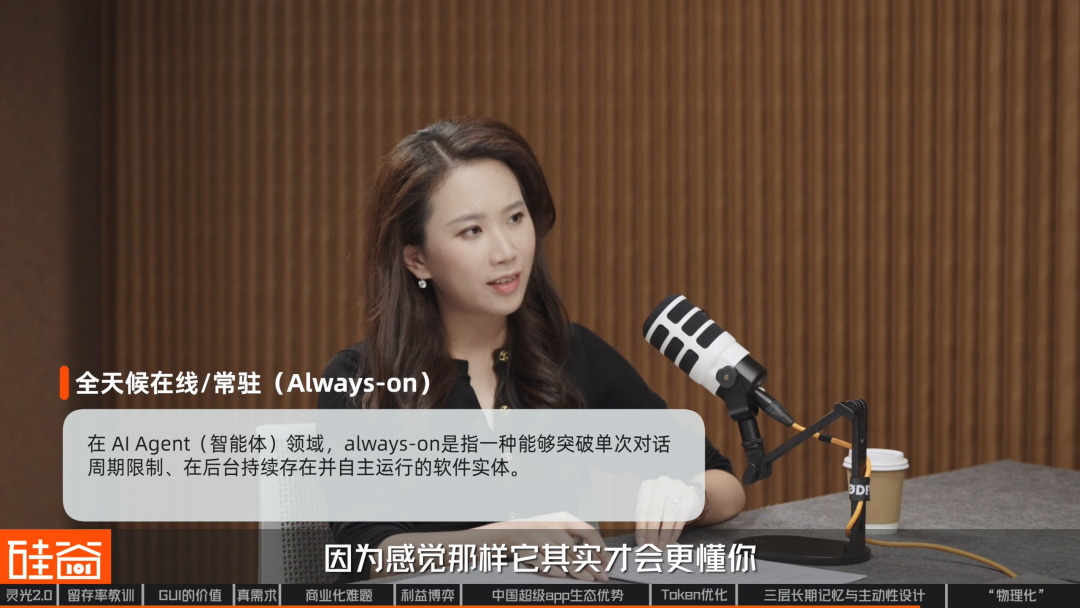
Lin Yi: It doesn't necessarily need to be always-on in the literal sense. For example, if we genuinely had an assistant, they wouldn’t need to follow you 24/7.
Chen Qian: But a good assistant being on standby 24/7 would be fantastic.
Lin Yi: I believe it just needs to be present when it's most required. For example, during workouts, the most crucial points during the day are certain moments: informing you of training plans, analyzing results, and giving suggestions for the next day. If there are issues, it should also be able to explain things clearly. If these are achieved, it serves adequately in those areas.
Going further, it can also do more second-category tasks, like providing better training suggestions. The user feeling that it is always on does not mean the backend must always operate. It can wake up at appropriate times to get things done well.
Chen Qian: What technological milestones are required to achieve true always-on capability?
Lin Yi: It still holds that the user perception of always-on presence and the technical realization of it are two different matters. Keeping the PA (Personal Assistant) running continuously for 24 hours is less of a technical issue and more about costs and what incremental value it really provides.
Chen Qian: It circles back to balancing costs and incremental value.
Lin Yi: Yes. Many times it is merely running in vain; without increments, the value isn't substantial.

Chen Qian: Are you optimistic about agent mobile phones? If it’s just an app, users still have to open their phones and the app to use it. End-side hardware can better accompany users and receive information, forming an always-on PA (Personal Assistant). Could this be the ultimate form?
Lin Yi: I believe it will evolve in this direction. For example, while driving, there will be needs to ask a few questions and chat. However, opening the phone and then launching the application isn't the most optimal choice.
If we had hardware entry points like car infotainment systems or glasses, PAs could be omnipresent. I think this is a trend because the demand exists. I sometimes desire to pull out my phone while driving to ask some questions, but that's a bit dangerous.
Chen Qian: I get that feeling too. Since I drive a Tesla, when using FSD, I sometimes want to do things on my phone, but if I take my eyes off the road, the in-car cameras will determine it’s a violation.
Lin Yi: Thus, while the demand exists, it still hasn’t been effectively met. I believe it will definitely be fulfilled through headphones, car infotainment systems, and other means.
Chen Qian: Let's imagine, what might Lingguang 3.0 look like?
Lin Yi: I dare not predict the specifics of 3.0, but a few directions are clear and will continue to advance.
One is the omnipresent PA (Personal Assistant) that can be accessed at any time in the most convenient ways, engaging in the most natural interactions. Currently, many are still voice and text-based, but we can explore real-time multimodal interactions and more.
Second, it needs to connect to a broader physical world. Now the connection is still primarily virtual plus some services, but that range will certainly continue to expand.
Additionally, this interface layer must enable PAs to complete tasks reliably. The core evaluation of a PA is its ability to truly complete the tasks assigned by users, which is the bottom line requirement.
Chen Qian: What do you mean by connecting to the physical world specifically?
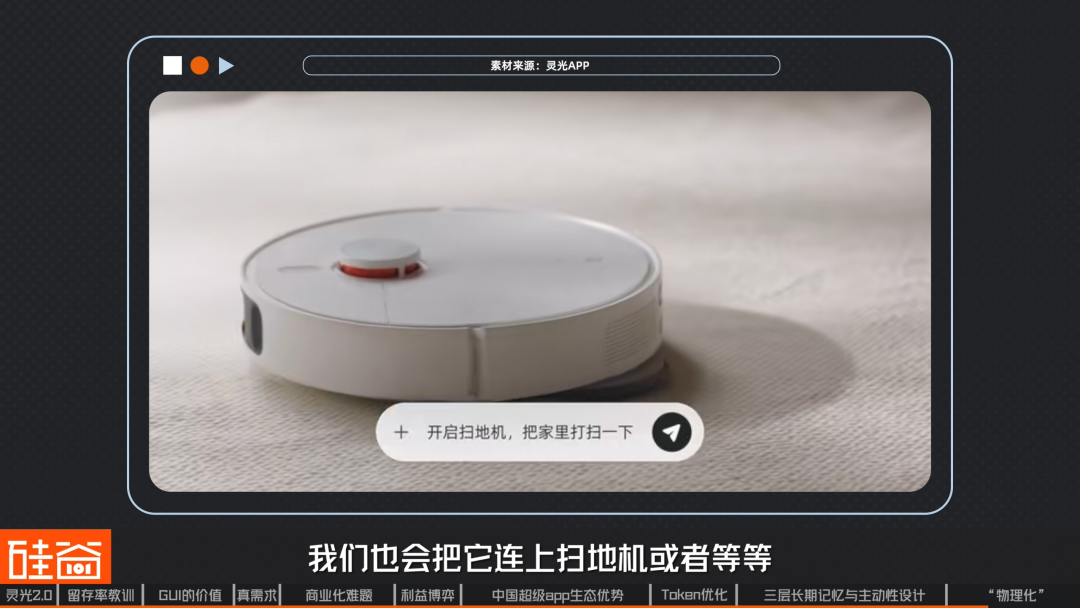
Lin Yi: This could include interfaces, such as connecting smart home devices, vacuum robots, etc. Many home devices already provide such interfaces, making connections a natural occurrence, and the conditions are there now.
Chen Qian: I find this very necessary. For instance, a Tesla can set the in-car temperature in advance. In the U.S., it might be over 30 degrees outside while it could be over 40 degrees inside the car, but I often forget to turn on the air conditioning early. If the agent knows I’m about to return to the car in about three minutes, it can link up with the Tesla app and automatically adjust the temperature. This is a feature I would be willing to pay for.
Lin Yi: The benefit is that it can tap into more extensive information. The Tesla app can also allow you to pre-cool the car.
Chen Qian: However, that’s not proactive since it doesn’t know when I’ll return.
Lin Yi: Exactly; that's key. The PA can access broader information. For instance, if I drop my child off at a tutoring class for an hour and a half, I wouldn’t know if you’re there or not, which is common domestically.
Chen Qian: My child is currently a year and a half old, so we haven't started classes yet, but we might in the future.
Lin Yi: It knows that the tutoring class duration is one and a half hours, and it can also manage when I enter the parking lot. At least, in China, information about senseless smart parking gets pushed to Alipay.
If it is aware of when to park, the duration of classes, and that the outside temperature exceeds 30 degrees, it may connect and open the air conditioning ahead of time without me needing to say anything. If it’s cool outside that day, it wouldn’t need to be opened. How long in advance this occurs would also depend on the arrival time. All these are theoretically feasible and I think we aren't far from realizing them.

Chen Qian: Lastly, I have two personal questions. I’ve spoken with many entrepreneurs developing agents, and they are all excited, believing they are creating products that make human life more convenient and efficient. Do you feel the same way? What moments make you feel that you’re working on an exciting product?
Lin Yi: I do feel that strongly. Some of the examples mentioned earlier are great; for instance, using it to manage correction for my child’s mistakes has indeed improved their math scores.
Chen Qian: Really? What did the score improve from and to?
Lin Yi: From the 80s to 90s.
Chen Qian: That's quite impressive.
Lin Yi: Yes, it’s really good, and the key is that it saves time. While it could be done by drilling through exercises, this has specifically targeted help for you. This was the first instance that gave me an intuitive sense of its value.
Another instance occurred during travel; my child spontaneously mentioned, “I haven’t updated it with the travel diary for tonight yet,” which I found valuable.
Another moment was when my child wanted to buy a gift for my wife and asked it for suggestions. It knew we were going to Japan for National Day, and it initially provided some common suggestions, then later said, “Since you’re going to Japan for National Day, why not pick something on-site for mom?”
At that moment, I felt this product was different from before. It didn’t give a generic response; it genuinely understood our itinerary and suggested I get something in Japan for my mom.
Chen Qian: Very personalized.
Lin Yi: These moments make me feel it's useful, and I genuinely wish my mother could use it too. If one day she tells me it’s very helpful to her, I would feel a greater sense of accomplishment.
Chen Qian: I believe elderly people will greatly need such products. Previously, in conversations with another interviewee, he expressed concerns about global aging. Children are all busy working and face significant pressure in their lives. Many elderly individuals require companionship and greater assistance in medical care, dealing with loneliness, and everyday social interactions, which are still insufficient.
If there were a product that could genuinely help the elderly order takeout, track their health metrics, or offer small daily suggestions, I believe it would be very meaningful.
Lin Yi: Yes. I hope to help ordinary people live better by delegating trivial matters to Lingguang, giving everyone more time to live.
Chen Qian: I also hope our agent products continue to improve and assist more people. Thank you very much for your time.
Lin Yi: Thank you.
This concludes our conversation with Lin Yi. After this episode, we will find that a very obvious trend right now is that AI is becoming increasingly “proactive” and “capable of executing tasks.” However, for personal AI assistants to truly enter our lives, there are several thresholds that still need to be addressed:
The first is technical and trust issues.
The second is ecosystem and interest distribution issues.
The third is commercialization.
Behind these key issues is, in fact, the unification of technical and commercialization logic: the ultimate competition for personal AI assistants may not be about who has the strongest model but rather about who can gain user trust, access enough real services, and continuously create measurable value.
However, these three hurdles need companies and products to be worked through and resolved one by one. But we believe that once resolved, AI assistants will start to integrate very naturally into our lives, genuinely returning time to people.

Note: Some images are sourced from the internet.
[This episode does not constitute any investment advice]
免责声明:本文章仅代表作者个人观点,不代表本平台的立场和观点。本文章仅供信息分享,不构成对任何人的任何投资建议。用户与作者之间的任何争议,与本平台无关。如网页中刊载的文章或图片涉及侵权,请提供相关的权利证明和身份证明发送邮件到[email protected],本平台相关工作人员将会进行核查。